
For an Extra $130 Bucks….
Update
On Canada’s Military Financial Crisis
A
VIEW FROM THE BOTTOM UP
Insufficient
Funding for Operations, Maintenance
and Infrastructure
| The Operations
and Maintenance budget of the Canadian Forces is manifestly inadequate.
Flying hours, at sea days, inventory of spare parts, live firing
exercises etc. have all been pared to the bone to save money. The impact of
this lack of adequate Operations and Maintenance funds quickly became
evident at nearly every base and unit visited. On a number of occasions
during its fact-finding visits, the Committee was told that the
infrastructure of military bases (and the bases of the Army in particular)
was inadequate, either because of dilapidated facilities or non-existent
facilities. Lack of funds to re-habilitate, maintain and to build
infrastructure at military bases is another fallout from the lack of funds
budgeted for operations and maintenance. While not restricted to Army bases,
the issue of infrastructure was raised much more insistently at Army bases
that at Navy or Air Force bases. |
The Committee heard testimony on
lack of funds for operations and maintenance at the following bases in
particular:
At the Headquarters of Maritime
Forces Pacific (MARPAC), the Committee was given a number of examples of the
impact of the reduced budgets. For example, the surveillance role of MARPAC
has been reduced because its most effective tools, the Aurora aircraft
overflights, have been cut back to 2-3 patrols a week. The units of other NATO
countries average 125 days at sea, but Canada’s navy on average only budgets
enough fuel for 60 sea days a year. Inadequate budgets and lack of personnel
mean that only 60% of the fleet can be kept at the highest level of readiness.
443 Squadron has only six Sea King helicopters to support Maritime Forces
Pacific. Of these, one is unavailable. At Maritime Forces Pacific (MARPAC)
officers and men complained that newcomers found family housing very
expensive, both on and off base.
At 1 Canadian Air Division,
Canadian Region NORAD Headquarters, cutbacks in funding have reduced every
kind of training – individual, group, national and international. As a
result, the general level of readiness has declined, with only a small number
of pilots at the highest level of readiness (i.e. combat ready in both
air-to-ground and air-to-air roles).
Training for a number of types of
missions has been discontinued. CF-18 pilots no longer practice low-level
flying as one way of complying with the reduction in annual flying hours to
180 from 210. In the early 1990s, the norm for CF18 pilots was 240 hours per
year.
Similarly, flying hours for Aurora
pilots have been reduced. Use of simulators, and the elimination of
anti-submarine training, are the rationales given for the reduction in flying
hours of the pilots and crew of Aurora patrol aircraft.
The Committee was told that the
combination of reduced equipment and fewer personnel had led to tension about
the tempo of operations and the quality of life at Maritime Forces Atlantic.
At the time of our visit, however, a shortage of technicians was an even more
visible grievance than the overall shortage of money. At an informal meeting
with members of the Committee, service personnel complained about the length
of time it took to get needed equipment.
The Committee also heard from both
officers and enlisted personnel that the military housing in Halifax is
substandard. The Permanent Married Quarters (PMQs) were built in the 1950s to
the standards of the 1940s. As a result, about 70 per cent of the officers and
enlisted personnel either owned or rented in Halifax. There was not much
demand for the smaller military apartments because of local market conditions,
and many were consequently unoccupied. In general the other ranks the
Committee spoke to believed that the military units were not worth the rent
charged – frequently more than the cost of buying a local house.
There was agreement, however, that there was still the need to make
larger 3 and4 bedroom apartments available.
Colonel
MacLeod, Commander 3 Area Support Group, told the Committee that there
was a shortage of single rooms, even in the winter, and 200 staff had to live
two or three to a room. In the summer the situation was much worse and both
staff and students had to live in tents. The base infrastructure was
deteriorating and some buildings were actually dangerous. There was no money
available to carry out the $100 million of renovations base training areas
needed.
Another
serious problem was the shortage of spare parts and ammunition for new
equipment. In particular, it was extremely difficult to provide
“sustainment” logistical support of parts and ammunition for overseas
deployments. Lack of spare parts and ammunition leads to lack of adequate
training, which not only leads to substandard performance on the battlefield
and in other emergencies, but also leads to qualified people giving up and
leaving Canada’s armed forces.
Major
Hall, Deputy Commandant of the
School of Communications and Electronics, told the Committee that the School
trains CF personnel on how to set up, operate and maintain radio, telephone
and computer communications in Canada and abroad.
The
Committee learned that as a result of the halt in recruitment as the Forces
downsized in the 1990s, the School lost one of its major buildings. Now, with
the ramp up in recruiting and the requirement to increase training output, it
is desperately short of space, dealt with in the next section of the report.
This lack of space has had a negative impact on the morale of staff and
students alike.
Current
capacity in the Performance-Oriented Electronics Training program is 180
positions. Although it is planned to increase the number of seats to 384,
there is demand for 550-600
spaces.
It
is difficult to overemphasize the debilitating effect of insufficient training
capacity, and the Committee got an earful about what the effects have been.
Reduced training meant no low-level technicians for a number of years, which
means insufficient numbers of low-level technicians gaining the experience
necessary to become supervisors. The average age of technicians rises, and
when they become discouraged about lack of capacity to do their jobs and get
out, there is no one to replace them. There is simply too much work for too
few people.
Following
the briefing the Committee visited classrooms and spoke with instructors and students before
having lunch with some of the students. The loss of a building in the 1990s
has forced the school to jam its parade square with about 20 temporary,
portable structures. An additional 12 double trailers are on order and will be
located at another site. A garage has been converted into classrooms, but it
leaks and is referred to as the “swimming pool”.
Although potable, its water supply is an unsightly brown colour.
Funds are so short that old, unused buildings cannot be torn down.
Students share accommodation – four to a 16 by
16 foot room.
2 Electronic
Warfare Squadron, Kingston
At
a stand-up lunch with enlisted personnel of the Squadron, the members of the
Committee learned a great deal about the ineffectiveness of forces equipment
and the frustrations that ineffectiveness engenders.
The
Intelligence Gathering System, for instance, has never worked to its promised
capacity. The firm that originally supplied it went out of business, and never
actually put the equipment into production.
With no spare parts, a second unit is being cannibalized to keep three
in operation. The electronics
often malfunction after cross-country movement. Many of the system’s coding
and coding functions have been obsolescent.
Many
of the system’s coding and decoding functions have become obsolete. Modern
digital systems – the kind used by American troops – “frequency-hop”
as an added measure of security. The soldiers pointed out, however, that even
if they got modern equipment, the Canadian Radio-Television and
Telecommunications Commission restricts the military to assigned bandwidths.
Without frequency-hopping, it is more difficult to develop code-breaking
skills, to make Canadian communications secure, and to coordinate operations
with allies.
Personnel
told members of the Committee that they could make the Intelligence Gathering
System work if they were allowed to bypass the procurement system and buy
off-the-shelf parts, some of which were readily available at the local Radio
Shack. They also told us that off-the-shelf parts would also have the
advantage of being relatively inexpensive and easily replaced.
At
Canadian Forces Recruiting Group Headquarters, members of the Committee had an
informal lunch with junior non-commissioned members. While the latter would
clearly appreciate higher levels of pay and /or signing bonuses on
re-enlistment, their major complaints concerned the difficulty of getting on
training courses, plus their lack of opportunity to do enough of the things
they had joined the Forces to do – take part in live field exercises, fire
weapons, etc. This, in tandem
with the unrealistic tempo of operations, was causing a good number to decide
against re-enlisting when their time was up. The attitude toward bonuses was
ambivalent – the feeling was that their appeal was primarily to those who
intended to re-enlist anyway.
At
2 Canadian Mechanized Brigade Group the officers told the Committee that, if
the Brigade had more money, improvements to the base infrastructure would be a
priority. For example, the
Battalions have been ordered not to keep their Light Armored Vehicles
outdoors, but there are no funds available to build indoor storage. Nor is
there a proper building to house the computers needed for training.
At
8 Wing the Committee learned that the fleet of Hercules transports is aging
faster than the Senate. Most were acquired between 1964-1967. Planning must be
based on the assumption that, at any given time, about one out of four will
not be available because they need maintenance and repair. There are five
different models with two different engines to service and repair. According
to technicians, a lack of spare parts keeps planes on the ground
unnecessarily. In their opinion, two days should be the maximum time it takes
to get a spare part, but that is certainly not the case now.
At
the informal lunch with Squadron staff, members of the Committee continued to
explore the reasons why highly trained personnel were not re-enlisting.
Responses: pilots cannot fly and airlift missions must be turned down because
aircraft are not available. Mechanics and technicians have to wait for spare
parts or do not have the equipment necessary to carry out maintenance quickly.
Their frustration is compounded because they say the parts or equipment they
need frequently could be purchased locally.
2
Canadian Mechanized Brigade Group officers told the Committee that if the
brigade had a bigger budget, their priority would be field exercises and on
ammunition for live fire training, both of which have been severely
restricted. In their opinion, lack of resources (the capacity to fire live
ammunition, missiles, etc.) and the feeling that personnel are not being as
challenged in the Army as they had expected, are major reasons why many
trained soldiers fail to sign up for a second 3-year term.
The other ranks with whom the members of the Committee lunched raised
many of the same issues. Many soldiers believe that they are no longer allowed
to practice their profession to the limits of their ability – whether as
infantry (lack of exercises, live ammunition, ), armoured corps/artillery
(obsolescent equipment, lack of opportunity to exercise, practice gunnery,.),
or mechanics/technicians (lack of spare parts, insufficient training, .).
Members of the artillery, armoured corps, and air defence expressed
uncertainty about the future of their trades in the Canadian forces.
The
Black Watch, like the other militia units, is starved for equipment as well as
operational and training funds. The very success of the current recruiting
drive could make the situation worse because the proposed increase in the
strength of the militia has not been funded, nor have funds been allocated for
the equipment and stores necessary to train the new recruits.
The
Black Watch was short of just about every kind of equipment and much of what
they had was obsolescent, if not obsolete. Members of the Committee heard
comments about the lack of modern personal kit for male and female recruits
and about the lack of training equipment and training aids to make the
theoretical part of recruit training and introductory trades training
interesting.
The
“hands on” or practical parts of courses cannot usually be given at the
armoury. The soldiers and their instructors must go to a militia training base
to get experience on small arms ranges, to practice section tactics, etc. A
shortage of live ammunition compromises the value of the training.
III. The Capital Equipment
Crisis:
Canada’s
Antique Road Show
It is no secret that the big
difference between the U.S. military and the military forces of the rest of
the world is the stratospheric leap the Americans have made in the
sophistication of their equipment. A country the size of Canada cannot expect
to keep up with the technological advances of the world’s one remaining
superpower, nor can it afford to allow a huge gap to develop between its own
capital equipment and the advanced equipment of its allies. That gap exists,
and it is growing not only with many of Canada’s allies, but with its
potential enemies as well. Canada cannot afford a state-of-the-art military,
but it can afford a sophisticated and effective military with some
state-of-the-art equipment.
Capital equipment deficiencies were brought to our attention at several
bases:
At CFB Esquimalt and CFB Halifax
the Committee concluded that at least two capital programs must go ahead
without delay if Canada wants to continue deploying the Navy on foreign
missions. The first is the Maritime Helicopter Project to replace the Sea King
helicopters. The second is the Afloat Logistics Sealift to replace the
Protecteur class replenishment ships.
Outside the patrol range of Aurora
aircraft, the Sea King helicopter acts as the eyes and ears of the fleet. The
Sea King is now obsolescent and only an exceptional but time-consuming and
expensive maintenance and repair program keeps it airworthy.
The Commanding Officer of 12 Wing
CFB Shearwater assured the Committee in the strongest possible terms that the
Sea King was and could be kept safe to fly. Nevertheless, the helicopter has
become increasingly unreliable and spends half of its time out-of-service due
to breakdown, repair and maintenance.
Without reliable helicopters, the
Pacific and Atlantic fleets are increasingly at risk in zones of active
operations. Unquestionably, the
Maritime Helicopter Project is the most urgent capital equipment project.
Almost nine years after cancellation of the order for EH 101
helicopters to replace the Sea Kings, the government has still failed to let
the necessary contracts.
Ground crew in Shearwater told us
that the continuing “starting and stopping” of the Maritime Helicopter
Project was killing motivation in the unit. One day, crew would hear that the
MHP would be operational by 2005, only to hear a day later that the project
would be delayed for still another two years. These people take pride in the
role they play, but they are clearly succumbing to frustration over the lack
of a definite schedule for the MHP.
We were repeatedly reminded of the
Navy’s lack of “roll-on, roll-off” sealift capability to move
heavy equipment and support
deployed task groups.. The Navy
only has two tired support ships – “oilers” – with limited capacity,
making it extremely difficult to move troops and equipment in and out of
emergency situations.” The Navy presented the government with a plan to develop a
roll-on, roll-off capacity in 2001, but there has been no word as to whether
the plan will be approved.
Canadian Air
Division – Winnipeg
We were told that the Canadian
Forces’ airlift capacity is also in need of review to determine whether it
is currently adequate and likely to be adequate into the future.
Units of the Regular Army have been
withdrawn from coastal provinces and concentrated in CFB Edmonton (Alberta),
CFB Petawawa (Ontario), and CFB Valcartier (Quebec). There is a new premium on
moving Army units by air in the event of an emergency – particularly an
emergency that substantially disrupts road and rail communications between
inland bases and coastal communities.
A Disaster Assistance Response Team
(DART) is based on the Joint Operations Group, CFB Kingston. Its equipment is
stored at CFB Trenton and 2 Canadian Mechanized Brigade Group of CFB Petawawa
is required to be ready within 12 hours to deploy a Company headquarters and
four platoons – about 200 personnel – to a disaster site anywhere in
Canada or the world.
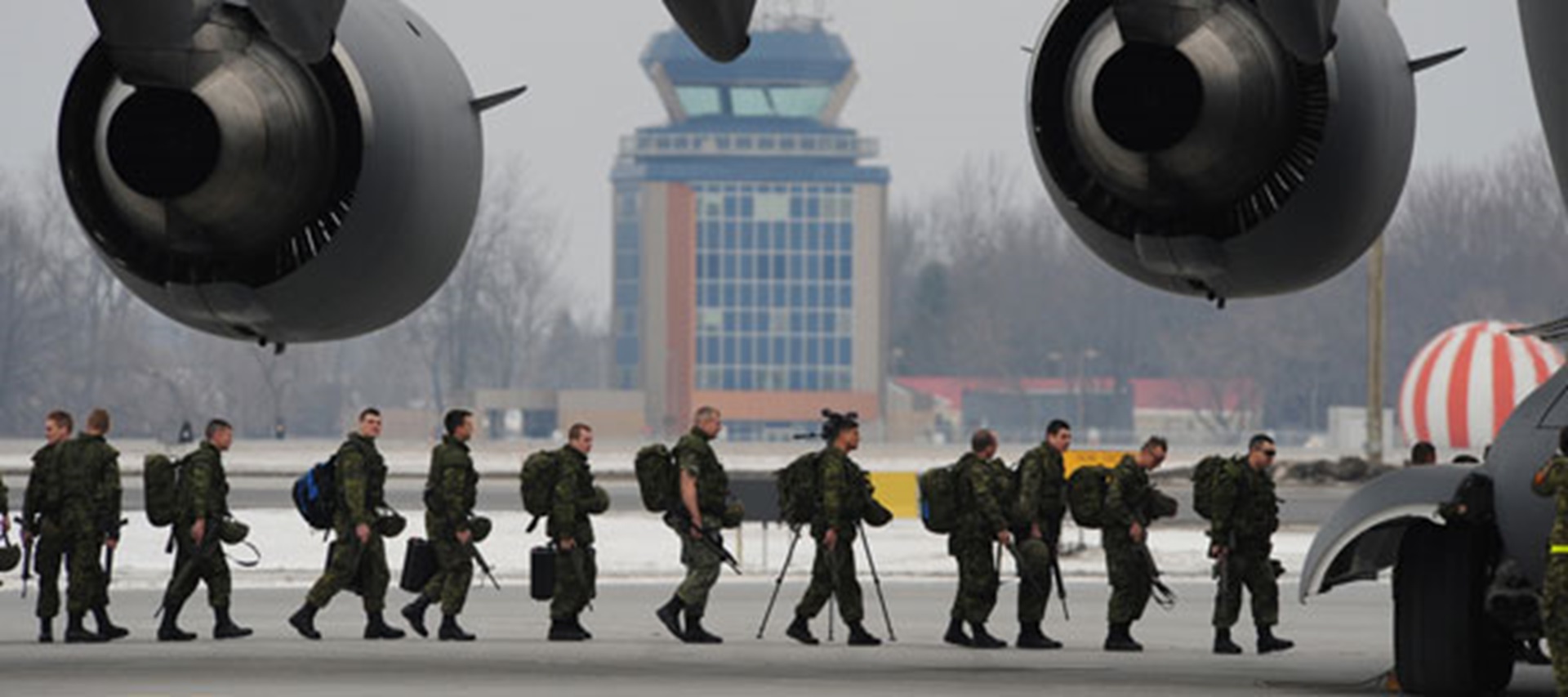
The Committee was surprised to
learn that it took about 26 flights of Hercules military cargo planes to move
the DART equipment and personnel, an airlift requirement that could be met by
about 4 flights of an Antonov class transport aircraft, which Canada is forced
to rent when troop-moving emergencies arise. It was just as surprised to learn
that only between one half and three-quarters of Canada’s fleet of Hercules
aircraft are serviceable on any given day. As a result, in the event of an
emergency, days rather than hours would elapse before the DART could be fully
operational on either coast.
While Canada’s military has
committed funds to upgrade the CF18, the timeframe to complete the project has
been spread out over several years. There is only enough money to upgrade 80
of the 119 CF18s in inventory.
The Aurora upgrade program has been
approved, but like the CF18 program, it will take several years to complete.
Furthermore, there is not enough money to upgrade all of the Auroras.
The troops at Trenton told us that
recent upgrades to Hercules aircraft have at least produced a “common
cockpit configuration” of the various models that Canada uses. However,
these early-model Hercules aircraft are fast becoming tired and antiquated.
There was a feeling that forcing the Canadian military to rent strategic lift
for use in moving troops and equipment diminished the country’s military
credibility.
It was recommended that there be a
complete review of all transport capabilities to fit missions with appropriate
aircraft. It was noted, for example, that using Hercules aircraft for search
and rescue was extremely hard on the aircraft due to the type of flying
required by SAR. A number of “purpose-designed” SAR aircraft with lower
operating costs are available on the market. Purchasing them would reduce the
overall operations and maintenance costs of the SAR operation. While everyone
enjoyed flying the Airbuses purchased from Canadian Airlines, there was
considerable dismay at the money wasted converting civilian aircraft costing
less than $60 million apiece into military aircraft for something in the
neighbourhood of $200 million.
There was a general sense that
while new Armoured Personnel Carriers (APCs) had been purchased, the number is
woefully short of fulfilling needs, forcing the army to upgrade some of its
M113s. Half-measures seemed to be the order of the day: for instance, new
wheeled equipment was supposed to be housed under cover, but the project
purchasing this equipment did not provide funds to build garages.
2 Electronic Warfare Squadron, CFB
Kingston
Electronic Warfare troops told us
that their equipment had never even made it past the experimental stage before
the company that built it went bankrupt. So they were working with
“electronic test models” that were not only difficult to get spare parts
for, but that were incompatible with the equipment of Canada’s allies.
The 1994 White Paper on
Defence:
Promises Not Kept
Our report would not be complete
without pointing out that the state of disrepair in which the Canadian military finds itself today would not have evolved over the past decade if the
Government of Canada had followed the recommendations of the 1994 White Paper
on Defence. The Canadian Forces’ personnel, equipment and capabilities fall
far short of what was called for in the White Paper, which set forth an
intelligent plan, certainly not an extravagant plan.
The White Paper, ostensibly a
blueprint for government strategy, promised that Canada’s armed forces
|
“ . . . will
remain prepared to deploy on UN operations, contingency forces of up to a
maritime task group, a brigade group plus an infantry battalion group, a
wing of fighter aircraft, and a squadron of tactical transport aircraft.
Were these forces to be deployed simultaneously, this could
conceivably involve as many as 10,000 personnel.
Within this upper limit, Canada will increase its commitment of
stand-by forces to the UN of two ships, one battle group, one infantry
battalion group, one squadron of fighter aircraft, a flight of tactical
transport aircraft, a communications element and a headquarters element.
If deployed, simultaneously, this would represent a commitment of
4000 personnel.” |
That represented a commitment to
the Canadian people that their defence forces would be capable of deploying
and sustaining approximately 4,000 personnel deployed on UN missions overseas
on a continuing basis. That never happened. Canada has never maintained 4,000
personnel overseas in the intervening years, because the personnel and
resources were never developed to meet that commitment. Twice – in Bosnia
and Afghanistan – Canada set out on ambitious field efforts, only to be
forced to withdraw because of lack of capacity to sustain those efforts.
The White Paper stated that the
Canadian forces “will be able to deploy, or redeploy from other
multilateral operations, a joint task force headquarters and, as single units
or in combination, one or more of the following elements:
·
a naval task group comprised of up to four combatants (destroyers,
frigates or submarines) and a support ship with appropriate maritime air
support [Afghanistan
demonstrated that Canada cannot sustain this commitment for more than one
rotation of troops].
·
three separate battle groups, or a brigade group (comprised of three
infantry battalions, an armored regiment, and an artillery regiment, with
appropriate combat support and combat service support) [Canada
has never been able to sustain this type of commitment.
Bosnia and Afghanistan demonstrated clearly that Canada’s military
can hardly manage to support half of this commitment].
·
a wing of fighter aircraft with appropriate support [The last time Canada sent an augmented squadron of
aircraft (28) was during the Gulf War in 1990/91. Capacity subsequently
dwindled to the point that the Canadian military was hard pressed to sustain a
small squadron of aircraft (8-10 planes) during the Kosovo bombing campaign. A
wing of aircraft is at least 36 aircraft, with appropriate aircrew and
support].
·
one squadron of tactical transport aircraft [Canada has never
deployed a squadron of tactical transport since the Gulf War – our present
commitment to Afghanistan is two aircraft and support].
·
single elements or the vanguard component of this force – within three
weeks – and be able to sustain them indefinitely in a low-threat environment
and, within three months, the remaining elements of the full contingency force
[until the CF
possesses its own integral strategic air and sea transport, it will never be
able to deploy within the required time, nor does the Canadian military
possess the resources to have any hope of sustaining such a Vanguard force for
more than six months].
The White Paper said Canada’s military would also:
·
earmark an infantry battalion group as either a standby force for the UN
or to serve with NATO’s Immediate Reaction Force [at
least Canada’s current military has sufficient resources to earmark
an infantry battalion – deploying one under current conditions of over
commitment and underfunding would
be another matter] .
·
have
plans ready to institute other measures to increase the capabilities of the
Canadian forces to sustain existing commitments or to respond to a major
crisis [there is a
major crisis at hand, but no apparent measures to meet it].
A Nation Diminished
Canada did a commendable job during
the 20th century in two particular areas – helping defend the world against
chaos and tyranny while defending the security and culture of its people, and
establishing a national presence on the world stage. To a large extent the two
went hand in hand. Canada’s military performance over the century
significantly increased our country’s stature in the eyes of the world.
It is ironic that while Canada’s
population is growing and its economy is robust, the country’s stature is
being diminished by a refusal to pull our weight militarily in an increasingly
unpredictable world. With loss of stature comes loss of influence in world
affairs.
The first role of any government is
to protect its people. Canadians are not being adequately protected – the
refusal to properly fund a reasonable degree of military security amounts to
nothing more than rolling the dice. Like homeowners who don’t insure their
property, the gamble is that nothing bad will happen and that skimping on
insurance will pay off in other ways.
The Government of Canada is
privileged to preside over a nation of many treasures, however, it is skimping
on their protection. It is also skimping on its obligations to its allies.
Our friends are watching. Our
friends are not impressed. Neither should the citizens of Canada be impressed.
There is an old saying: Every country has an army – its own, or
someone else’s.