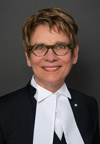
Speech from the Throne
Motion for Address in Reply--Debate Continued
November 26, 2024
Honourable senators, this item stands adjourned in the name of the Honourable Senator Plett, and after my intervention today I ask for leave that it remain adjourned in his name.
Is leave granted, honourable senators?
So ordered.
Honourable senators, I am honoured to stand for the first time to speak to you. Because I’m 70 and the mandatory retirement rule could not be clearer, I will be in this Senate Chamber for a maximum of four more years and nine months. By the standards of this institution, that’s not much time to achieve one’s goals, and, therefore, it would be unrealistic for me to offer you a long list. Key among the ones I have are the advancement and protection of democracy and human rights in Canada and around the world. The truth is I didn’t pick those goals; they picked me.
The story starts 102 years ago in a tiny Hungarian village sandwiched between Ukraine and Romania, where my father, Miklosz Mike Adler, was born to two Orthodox Jewish parents who owned the village general store. They sold food, clothing, a lot of soda water. The Adler family’s relationship with its customers could not have been better. There was a barter system in those early days of the 20th century. Farmers brought their crops to the store, and it was the job of my dad and his brothers to take those crops to a town where they could sell them for hard currency. It was not an easy life. Roads to the town were in a flood zone. At times, the dirt roads got so muddy there were many days when only an ox could pull the Adler wagon. While it would sometimes take hours, when those roads got muddy, it took several days to get the goods to market.
While that life was burdensome, it was a beautiful life, indeed, considering the black glove of brutality that was lurking just around the corner. Before my dad turned 17, Adolf Hitler turned his eyes on all of Europe, putting a target on the back and a yellow star on the chest of every single Jew. They would not be permitted to own general stores. Their businesses were to be looted, synagogues destroyed, lives extinguished. My father’s parents, brothers, sisters, nephews, cousins, nieces had their lives ended in the ovens of Auschwitz.
I need to give you some cold, hard facts about the Hungarian Holocaust. More than 840,000 Jews were living in Hungary before the Holocaust. Only one out of five survived; four out of five were exterminated by the enemies of democracy and human rights.
My dad survived the Holocaust because of the generosity of a righteous Gentile, a friend of my father’s who would not allow him to show up at the train station for deportation to Auschwitz. He threw my dad in his wagon and headed for the Romanian border, crossed that border and told one of the farmers that my dad was a good man, a hard-working man who would work in the field all day and sleep in the barn at night.
And he did that for three months until Russian soldiers marched through Romania on their road to take Europe away from Hitler. They knocked on the door of the barn where Miklosz Adler was hiding. My father was arrested by the Russian Communists, taken to the Siberian gulag, where he was kept for three years under conditions that I cannot describe. I honestly don’t know how he managed to survive. The odds against my father were high, and he beat them. And while his mind was damaged, his heart was intact. My father survived.
My mother, Rosza — Rose — was born 90 years ago in another Hungarian village. She was born to a family of one — no siblings — and her mom was a young widow. Her husband, my mother’s dad, died while baby Rosza was still in the womb. That made my maternal grandmother a single mom without any way to raise her child in the village. She took her baby daughter to the big city of Budapest.
Another cold, hard fact of the Holocaust in Hungary is this: Had my mother’s father not died in his twenties, had my grandmother remained in that village, she and her husband and her daughter, my mom, would have shared a chimney in Auschwitz. You see, every single Jew in that village was deported and murdered. My family’s history is my compass when I support, in this Senate chamber, an order of reference addressing the intergenerational effects of deportation.
I’ve never been to Auschwitz, but Auschwitz has always been in me. The nightmares that haunt so many sleeps also stalk so many days. The legacy of history apparently does not care whether the eyes are open or shut. Periods of celebration are always followed by periods of solitude in silence. It is the same survivor’s guilt that haunted my mom and dad. It is part of a phenomenon known as intergenerational trauma.
The same trauma is suffered by so many people in this great country who are descendants of the First Peoples, the First Nations of this country. I will never know enough about their stories, but I will always feel their pain. And because empathy is not unavailable to me, I need to apologize now, without qualification, for the unnecessary pain caused by my words, for which I take responsibility in this hallowed chamber.
This has to do with remarks I made during a radio broadcast 25 years ago. They garnered no media attention at the time because at the time there was nothing about my remarks that appeared newsworthy or controversial. But some of those words, which were republished at the time of my appointment three months ago, simply do not fit with the times we are living in. I would never use those words today, and I won’t repeat them here. Three months ago, when they were exhumed from history, they looked ugly and obscene to my eyes and, without any doubt, to the eyes of Indigenous people.
It doesn’t matter that my motivation was love for my listeners, including some of my most loyal listeners, Indigenous people. It doesn’t matter that I was trying to be helpful when I was being critical of some First Nations’ leadership. I permitted myself to use language that in the light of this day is excessive and offensive and hurtful.
Those words are on the record, and there is nothing I can do to remove them. The only thing I can do for the record now for Indigenous Manitobans, for Indigenous Canadians and for this Canadian Senate is to add three more words to the record: I am sorry.
While I take the opportunity here to apologize for some language used 25 years ago, I want you to know that I take a great deal of pride in a half-century of media work, which has always had my heart in it all the way and has always been a great, big thank-you card to Canada.
My broadcasting career gave me the privilege for several decades to get to know Canadians from coast to coast to coast, to talk to them about the things that mattered to them — most especially Manitobans, whom I am so proud to represent. I have hosted many years of national radio and TV shows reaching a very diverse group of Canadians, and this experience has given me a unique perspective on this country, which is not just theoretical, and a better understanding of the aspirations and concerns of people living in various parts of the country.
My work here in the Senate will reflect my love for Canada and for the people who make this country not just grand, not just great, but good. Canada is a good country.
Earlier, I shared with you that a righteous Gentile saved my father’s life by stopping him from boarding a train bound for Auschwitz. It was another righteous Gentile who spared my 10‑year-old mother from boarding a train to the same destination. My mom was living in the Jewish ghetto of Budapest in 1944 when the Nazis had rounded up more than half a million Hungarian Jews. She escaped their dragnet with the help of a Swedish diplomat to Hungary. His name was Raoul Wallenberg. He and his team were able to smuggle thousands of Swedish passports into the hands of many of the Jewish people living in the ghetto. My mother was one of them. I can never thank him enough for saving her life, and I want to publicly thank the Government of Canada for giving the late Raoul Wallenberg honorary citizenship in 1985.
I should add that, as the war was coming to an end, the Nazis no longer wished to honour those Swedish diplomatic documents. They devised a plan to massacre everyone in that Jewish ghetto. Wallenberg told the Nazi commanders in Budapest that he would ensure that all of them would be tried for war crimes after the war ended. Wallenberg did not just have diplomatic authority; he had moral authority. The 70,000-plus Jews in that Budapest ghetto, including my 10-year-old mom, were spared.
When I think more deeply of my mother’s and father’s survival of World War II, my mind always takes me to the heroism of the Canadian Armed Forces members who sacrificed themselves to save democracy from fascism. Canada was among the very first countries in September 1939 to declare war on Adolf Hitler. Without Canada and its allies, there would have been absolutely no chance of my father and mother remaining alive. What the Nazis called “the Jewish Question” would have been answered with 100% finality had the Allies lost.
It is the greatest honour of my life to be able to stand in this house of Canadian democracy and be able to publicly say thank you to the Canadian military and to the children and grandchildren of those who fought so bravely and heroically to end and destroy the regime that was dedicated to murdering every single Jew in Europe and, eventually, around the planet. Thank you to the Canadian Armed Forces for the lives of my parents and, indeed, my own life. Thank you from the bottom of my Canadian heart for your sacrifices, your valour and your honour.
My Hungarian parents, scarred and traumatized by the Holocaust, were married in 1951, seven years after the end of the war in Europe. I was born three years after they were wed. Two years after I was born, Hungarians revolted against their Soviet communist masters. While the uprising was a failure, crushed by Soviet tanks, torture and murder, there was, for a very brief period, porous border enforcement and 200,000 Hungarians managed to escape communism. My parents put me in a backpack, and my father strapped it to his back and carried me to freedom. Our first destination was Austria where we spent months in a refugee camp waiting for a country to allow us to have freedom, humanity and dignity. That country, my fellow senators, was Canada. My mother, father and I were among 37,500 Hungarians allowed into Canada.
Now, 85 years after the Government of Canada on Parliament Hill — only a short walk from where I am standing right now — committed itself to defeating Adolf Hitler in order to free the world from fascism, I am here to say “Thank you, Canada” for my life, for my freedom and for granting me the privilege to serve the country I love.