


Parliamentary diplomacy unites a divided world: Senator David M. Wells
Tags
In an increasingly divided world, it is worth remembering that Canada is still among friends — and that we face the challenges of the day together.
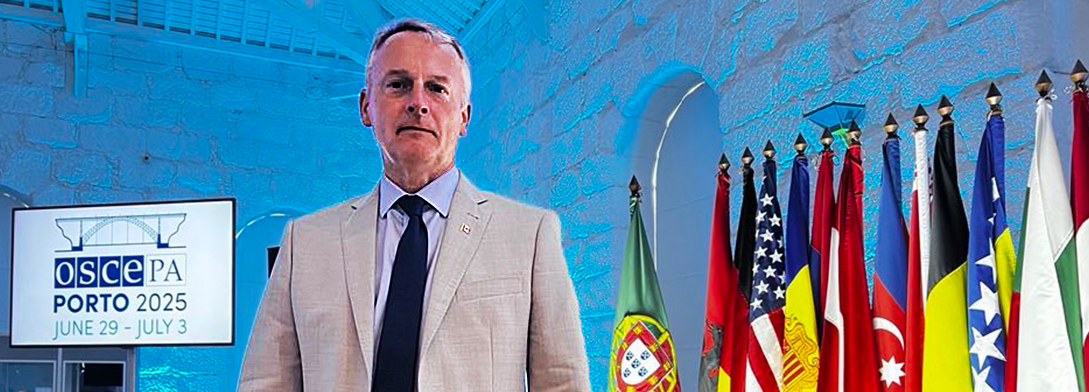
In July 2025, I had the privilege of attending sessions of the Parliamentary Assembly of the Organization of Security and Co-operation in Europe (OSCE). First conceived as a forum for dialogue between the West and Eastern Bloc countries in the 1970s, the organization added a parliamentary assembly in 1991 to strengthen ties among participating nations.
It even strengthens ties within participating nations. The Canadian delegation consisted of Conservatives, Liberals, Bloc MPs and unaligned senators. We work together to provide a Canadian perspective on global issues that affect us.
For example, I spoke on a topic that’s critical not only to Canada, but also to my province of Newfoundland and Labrador: threats to maritime infrastructure. My province is blessed with abundant offshore oil and gas, and plans are underway for the development of offshore renewable energy projects.
Yet threats from state and non-state actors are increasing. There have been incursions into our territorial waters. We’ve seen instances where undersea communications cables have been cut in European waters. And there is the ever-present practice of foreign surveillance.
As the country with the longest coastline in the world and a resource-rich North that’s becoming more accessible by sea, Canada is vulnerable. A resolution adopted at the assembly notes that “the seabed is crisscrossed with cables and pipelines that are relatively easy targets for sabotage” and that “offshore wind power parks and oil rigs are potentially in harm’s way.”
Sharing Canada’s concerns and experiences with our allies is an important step in protecting the infrastructure that connects and energizes the world. Through the resolution, the assembly agreed to recommend that the president of the OSCE appoint a special representative on maritime safety to co-ordinate members’ response to these threats.
Attending these sessions brings participating countries closer together and reminds us of our shared interests.
It is no secret, for instance, that tensions have grown in our relationship with our nearest neighbour. At the parliamentary level, however, I was heartened to see that close collaboration continues with our counterparts from the United States Congress.
Critical votes in Washington, D.C. at the time of the parliamentary assembly meant that the American delegation had to stay close to home. They asked us if we would present resolutions and amendments on their behalf — we were pleased to do so. Had Canada been in need, I know the Americans would have had our back. So we had theirs.
We may not always agree with the Americans, just as there is often non-alignment within our own delegation — hardly surprisingly considering our diverse political and geographical backgrounds. But the Canada-US relationship is long-standing and built on shared and hard-fought values. There are many American lawmakers who still remember this.
During the assembly, we also addressed the biggest current threat to European security and a grave concern to Canada: Russia.
The assembly reaffirmed its unwavering support for Ukraine’s freedom, sovereignty and independence, and strongly condemned Russia’s widespread and systematic violations of international humanitarian and human rights law.
At the assembly, I spoke directly to Russia’s disinformation campaigns and the dangers of its global propaganda. We have recently seen how Russia interfered in Moldova’s presidential elections, no doubt because Moldova has been a strong supporter of Ukraine, seeks to join the West via European Union membership, and does not have the protection of NATO’s Article 5, which states that an attack on one member is seen as an attack on all.
Groups like the OSCE Parliamentary Assembly are an effective countermeasure to relentless attacks. It allows parliamentarians to come together for face-to-face discussions that remind us of what we have in common; to meet threats with a united front; and to provide a forum for discussion even when thinking does not align.
Parliamentary diplomacy is necessary, it’s important and it pays off. As acting co-chair of the Canada-Europe Interparliamentary Association, executive member of the Canada-Commonwealth Interparliamentary Association, a longtime Canadian delegate on the Parliamentary Assembly of the Council of Europe and a regular member of many other parliamentary associations, I have seen the advantages of productive exchanges with our allies — even with those who are less friendly to Canada’s interests.
In an increasingly divided world, parliamentary diplomacy reminds us that we are not alone.
Senator David M. Wells has made many contributions to Canada-Europe relations, including as acting co-chair and vice-president of the executive committee of the Canada-Europe Parliamentary Association. He represents Newfoundland and Labrador in the Senate.
In an increasingly divided world, it is worth remembering that Canada is still among friends — and that we face the challenges of the day together.
In July 2025, I had the privilege of attending sessions of the Parliamentary Assembly of the Organization of Security and Co-operation in Europe (OSCE). First conceived as a forum for dialogue between the West and Eastern Bloc countries in the 1970s, the organization added a parliamentary assembly in 1991 to strengthen ties among participating nations.
It even strengthens ties within participating nations. The Canadian delegation consisted of Conservatives, Liberals, Bloc MPs and unaligned senators. We work together to provide a Canadian perspective on global issues that affect us.
For example, I spoke on a topic that’s critical not only to Canada, but also to my province of Newfoundland and Labrador: threats to maritime infrastructure. My province is blessed with abundant offshore oil and gas, and plans are underway for the development of offshore renewable energy projects.
Yet threats from state and non-state actors are increasing. There have been incursions into our territorial waters. We’ve seen instances where undersea communications cables have been cut in European waters. And there is the ever-present practice of foreign surveillance.
As the country with the longest coastline in the world and a resource-rich North that’s becoming more accessible by sea, Canada is vulnerable. A resolution adopted at the assembly notes that “the seabed is crisscrossed with cables and pipelines that are relatively easy targets for sabotage” and that “offshore wind power parks and oil rigs are potentially in harm’s way.”
Sharing Canada’s concerns and experiences with our allies is an important step in protecting the infrastructure that connects and energizes the world. Through the resolution, the assembly agreed to recommend that the president of the OSCE appoint a special representative on maritime safety to co-ordinate members’ response to these threats.
Attending these sessions brings participating countries closer together and reminds us of our shared interests.
It is no secret, for instance, that tensions have grown in our relationship with our nearest neighbour. At the parliamentary level, however, I was heartened to see that close collaboration continues with our counterparts from the United States Congress.
Critical votes in Washington, D.C. at the time of the parliamentary assembly meant that the American delegation had to stay close to home. They asked us if we would present resolutions and amendments on their behalf — we were pleased to do so. Had Canada been in need, I know the Americans would have had our back. So we had theirs.
We may not always agree with the Americans, just as there is often non-alignment within our own delegation — hardly surprisingly considering our diverse political and geographical backgrounds. But the Canada-US relationship is long-standing and built on shared and hard-fought values. There are many American lawmakers who still remember this.
During the assembly, we also addressed the biggest current threat to European security and a grave concern to Canada: Russia.
The assembly reaffirmed its unwavering support for Ukraine’s freedom, sovereignty and independence, and strongly condemned Russia’s widespread and systematic violations of international humanitarian and human rights law.
At the assembly, I spoke directly to Russia’s disinformation campaigns and the dangers of its global propaganda. We have recently seen how Russia interfered in Moldova’s presidential elections, no doubt because Moldova has been a strong supporter of Ukraine, seeks to join the West via European Union membership, and does not have the protection of NATO’s Article 5, which states that an attack on one member is seen as an attack on all.
Groups like the OSCE Parliamentary Assembly are an effective countermeasure to relentless attacks. It allows parliamentarians to come together for face-to-face discussions that remind us of what we have in common; to meet threats with a united front; and to provide a forum for discussion even when thinking does not align.
Parliamentary diplomacy is necessary, it’s important and it pays off. As acting co-chair of the Canada-Europe Interparliamentary Association, executive member of the Canada-Commonwealth Interparliamentary Association, a longtime Canadian delegate on the Parliamentary Assembly of the Council of Europe and a regular member of many other parliamentary associations, I have seen the advantages of productive exchanges with our allies — even with those who are less friendly to Canada’s interests.
In an increasingly divided world, parliamentary diplomacy reminds us that we are not alone.
Senator David M. Wells has made many contributions to Canada-Europe relations, including as acting co-chair and vice-president of the executive committee of the Canada-Europe Parliamentary Association. He represents Newfoundland and Labrador in the Senate.