


Visual Voices 2025: New Senate artworks salute the National Flag of Canada’s 60th anniversary
The Red Chamber is marking the 60th anniversary of the National Flag of Canada and the role senators played in its adoption with a new art exhibit in the Senate of Canada Building.
The exhibit features striking works by two accomplished visual artists, Aquil Virani and the late Judith Huntress. Installed ahead of Flag Day on February 15, 2025, the display is the third in the Senate’s Visual Voices program, a rotating exhibit launched in 2022 that features artworks with themes highlighting the work of Canada’s senators.
“In the early 1960s, Canadians’ representatives in Parliament were seized with choosing the right design for the country’s new national flag. While the final concept wasn’t universally loved at the time, I think it’s safe to say today that it was indeed the right choice,” said Senator Andrew Cardozo, chair of the Senate’s Artwork and Heritage Advisory Working Group, which oversees the Visual Voices program.
“Sixty years later, Canada’s red-and-white, maple leaf flag is an iconic symbol, recognized globally, that Canadians wear with great pride. Our flag has come to represent what we stand for as a country and it is worth celebrating and defending year after year.”
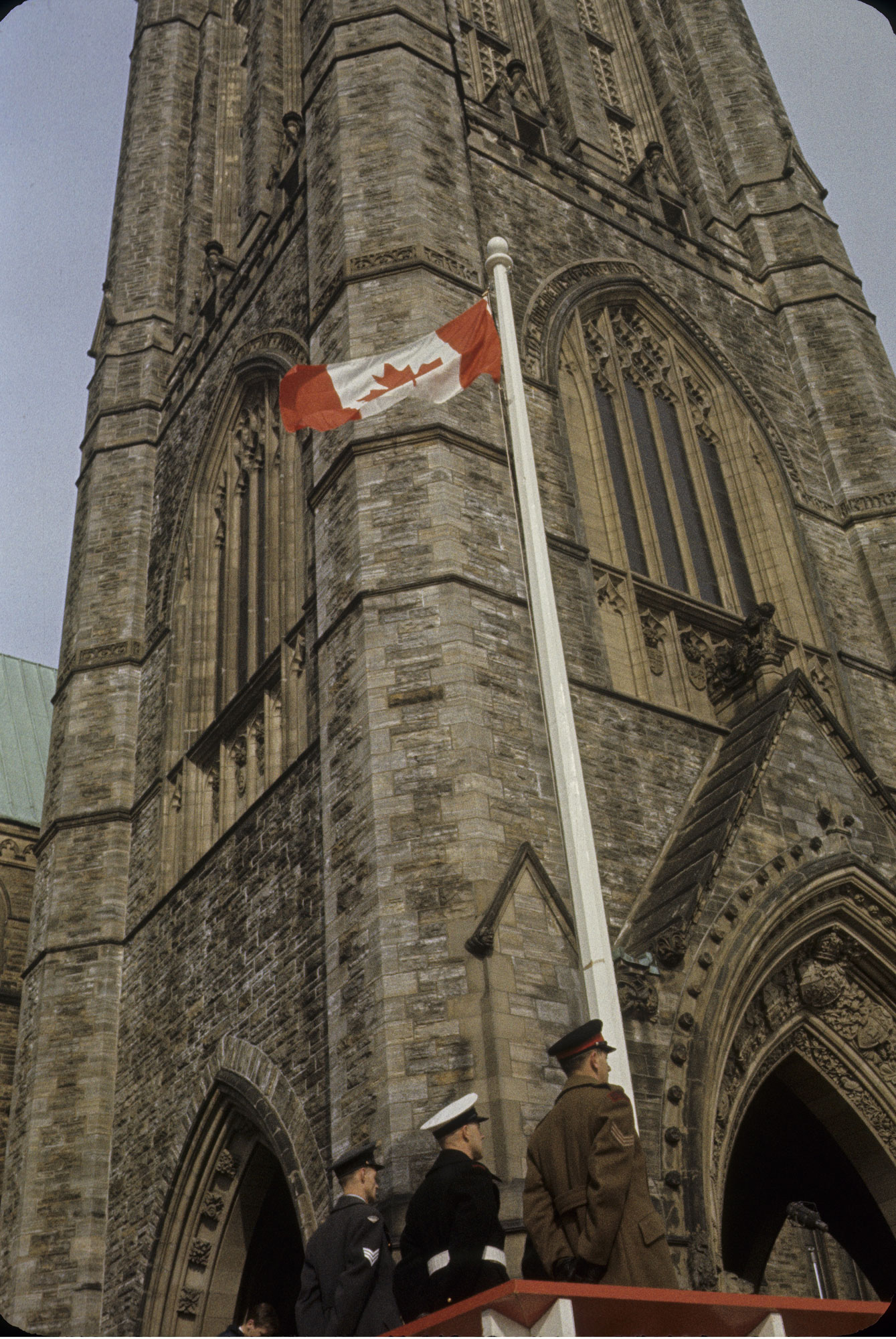 Canada’s new national flag is raised in front of the Peace Tower on Parliament Hill on February 15, 1965. (Photo credit: Duncan Cameron and Library and Archives Canada, Identification No. 3230220)
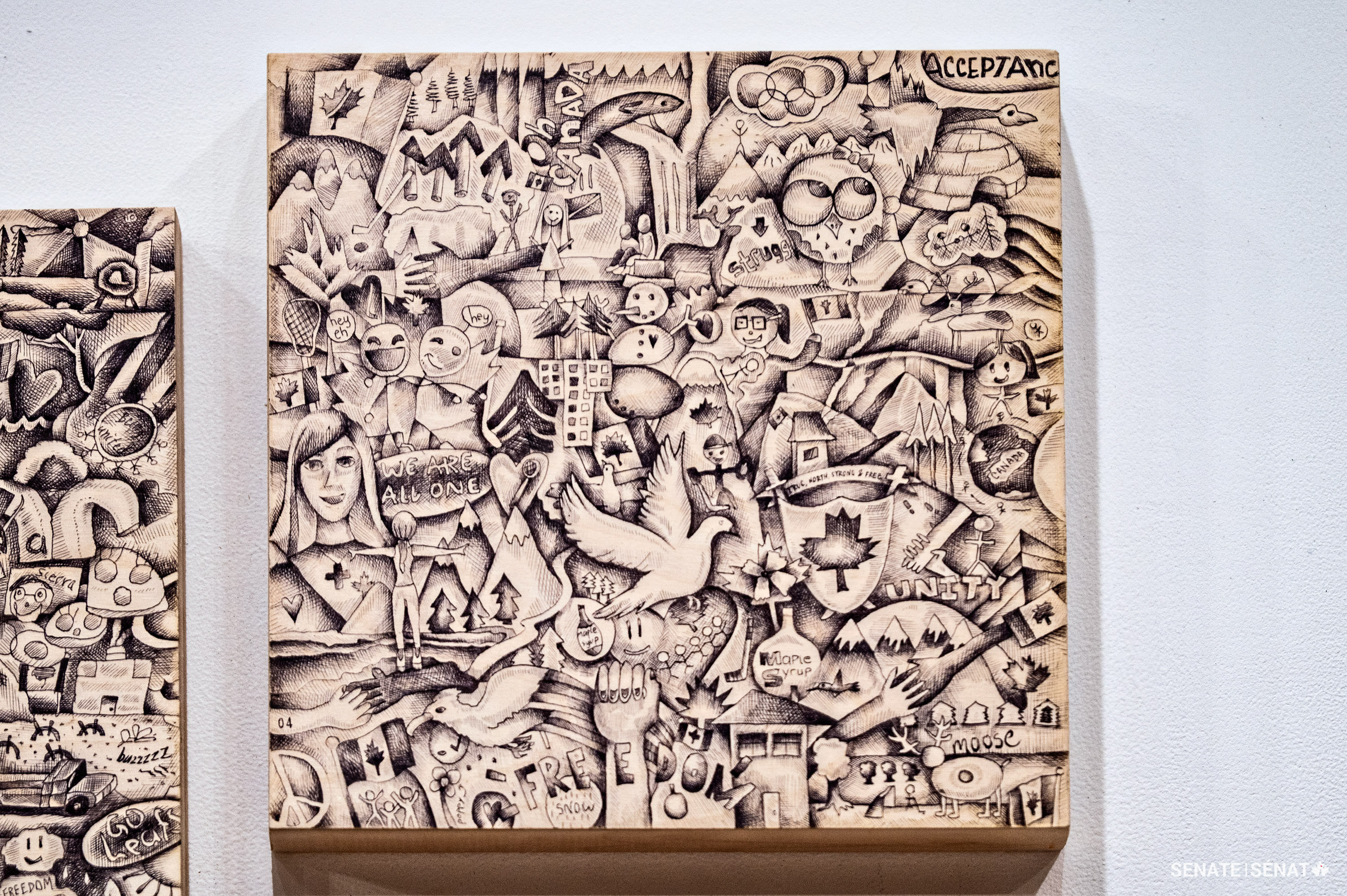 Aquil Virani in collaboration with Rebecca Jones, detail of Canada’s Self Portrait (2016). 18 birch panels and ink. 86.4 cm x 165.1 cm. Loan credit: Courtesy of the artist. The artwork incorporates 800 crowdsourced sketches about Canadian identity.
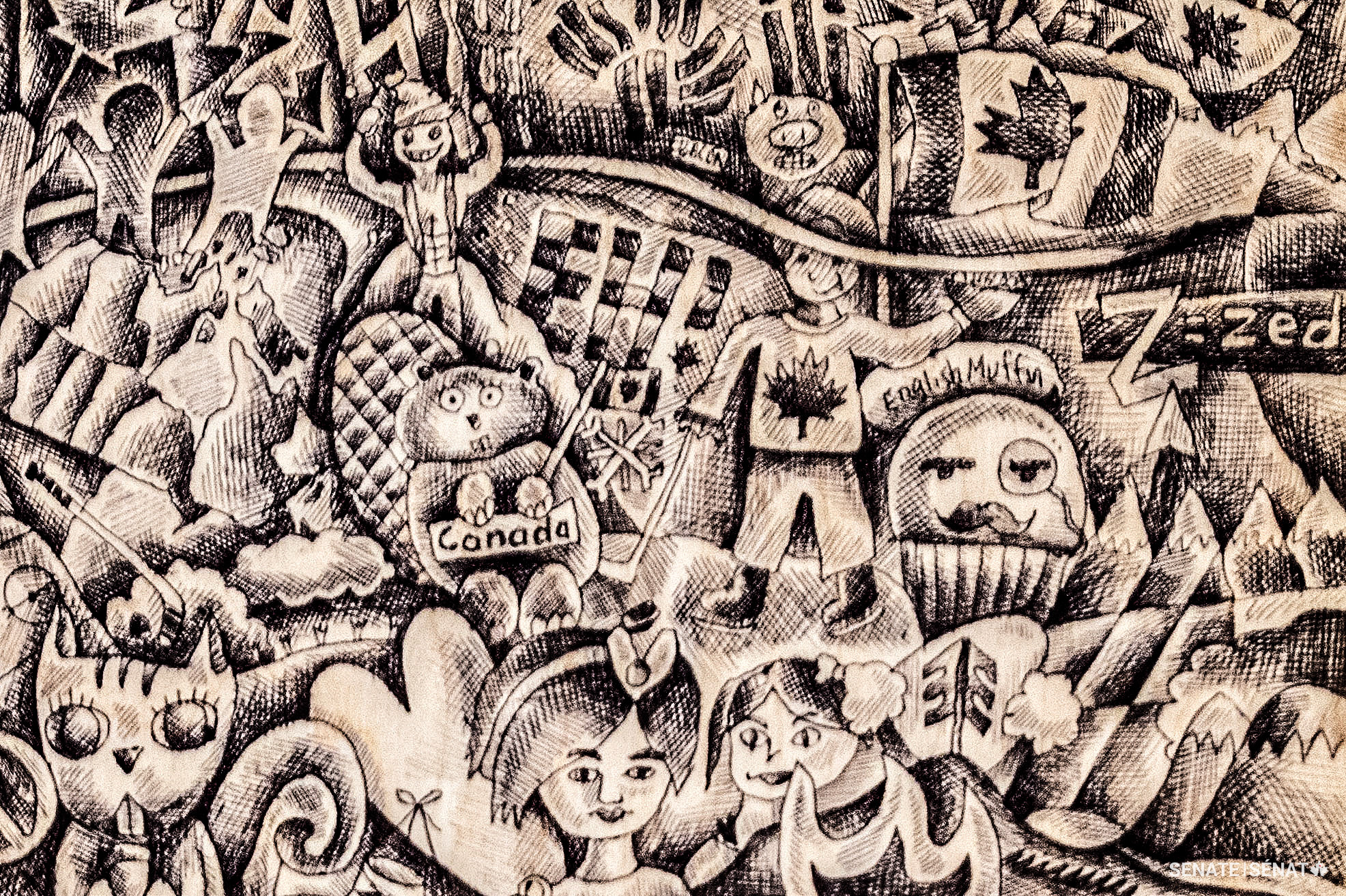 Aquil Virani in collaboration with Rebecca Jones, detail of Canada’s Self Portrait (2016). 18 birch panels and ink. Loan credit: Courtesy of the artist. Sketches of Canadiana can be found throughout the artwork, including Canada’s national flag and the beaver.
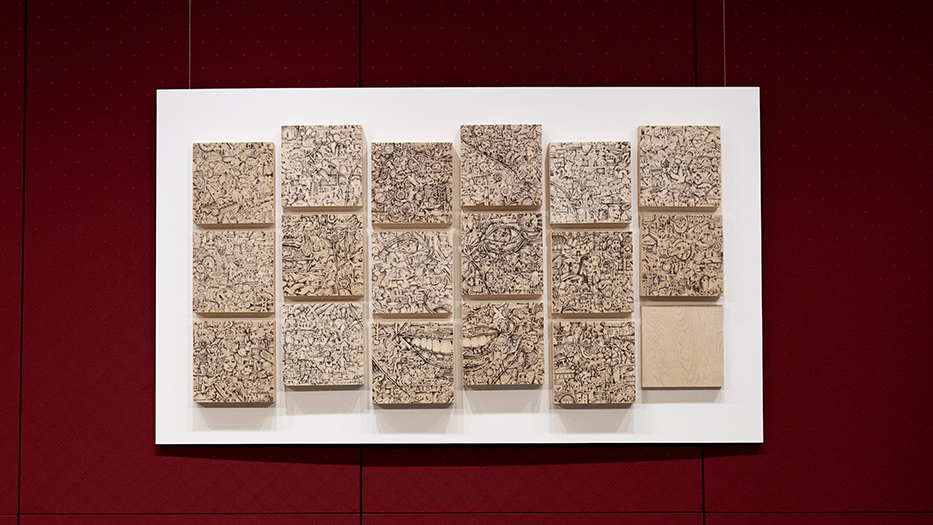
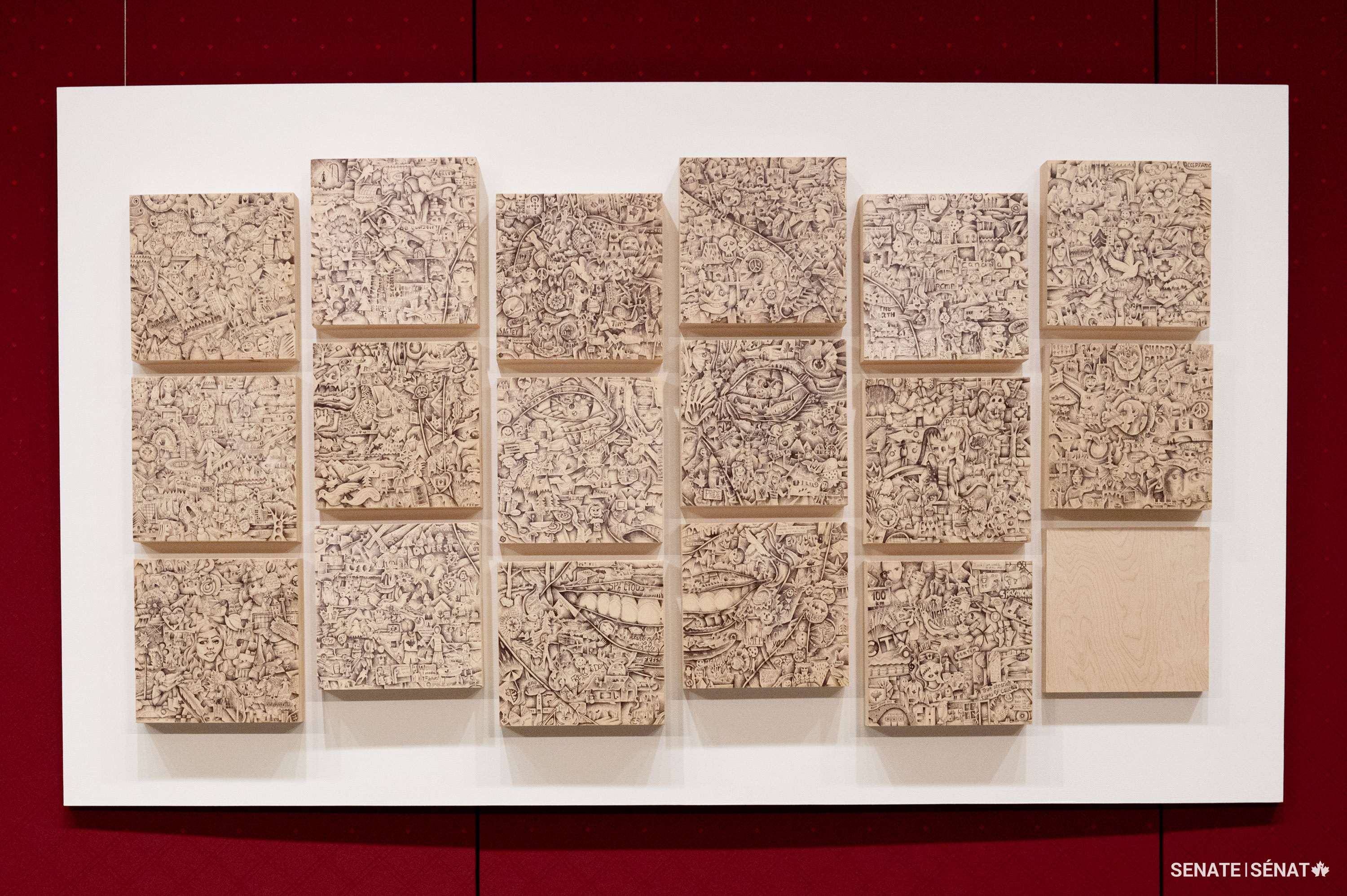 Aquil Virani in collaboration with Rebecca Jones, Canada’s Self Portrait (2016). 18 birch panels and ink. 86.4 cm x 165.1 cm. Loan credit: Courtesy of the artist
Canada’s Self Portrait is described by Aquil Virani as “a collaborative art project about who we are and what we stand for as Canadians.” Created by Virani, in partnership with Rebecca Jones, the award-winning artwork incorporates 800 crowdsourced sketches about Canadian identity — drawn by residents of all 13 provinces and territories — that the two creators solicited during a cross-country trip in 2014.
They then reproduced the sketches and integrated them into a large-scale ink piece, comprised of 18 birch panels. One panel was intentionally left blank to represent the untold story of Canada. The final work was unveiled and exhibited at the Canadian Museum of Immigration at Pier 21 in Halifax, Nova Scotia on July 1, 2016.
Born in Vancouver and based in Toronto, Virani says he uses art as a tool for social change and often invites public participation in his projects.
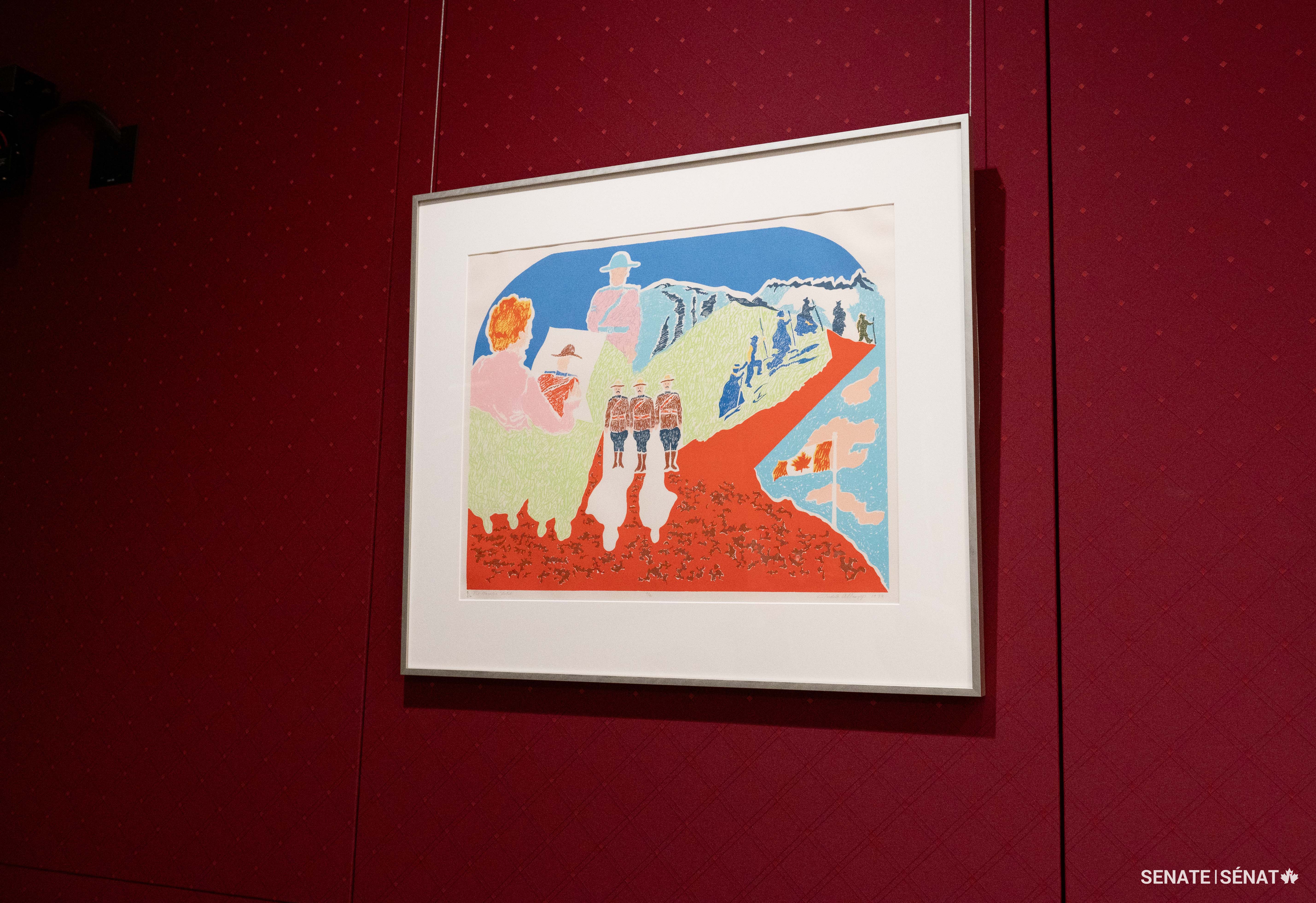 Judith Huntress, The Mountie Sketch (1973). Silkscreen. 55.5 cm x 71 cm. Loan credit: Canada Council Art Bank
The Mountie Sketch is a silkscreen work by artist Judith Huntress that depicts members of the Royal Canadian Mounted Police against an abstract Canadian landscape.
At the top left of the work, an artist draws a portrait of a Mountie in uniform. In the centre of the piece, three Mounties in uniform stand at attention. Towards the top right, the silhouettes of six people scale a hilltop, a snowy mountain range in the background. The Canadian flag, flying from a flagpole, blows in the wind towards the bottom right.
Huntress was a prolific silkscreen artist whose career spanned several decades. She exhibited across Canada and was a member of the Grand Western Canadian Screen Shop, the first artist co-operative in the Prairies. Huntress immigrated to Canada in 1968 and passed away in 2022.
“These stunning works of art, each in their own way, encourages the viewer to reflect on what it means to be Canadian and what makes our country unique,” said Senator Salma Ataullahjan, who sits on the Artwork and Heritage Advisory Working Group. “I look forward to discussing these themes with my fellow senators as we celebrate Flag Day — and for the duration of this special exhibit.”
 The Red Chamber is marking the 60th anniversary of the National Flag of Canada and the role senators played in its adoption with a new art exhibit in the Senate of Canada Building.
Canada’s flag, which has come to be one of the most recognized flags in the world, was selected by Parliament.
In the early 1960s, Lester B. Pearson — first as leader of the opposition and then as prime minister — championed the push for a new national flag that would replace the Union Jack and the Canadian Red Ensign. With Canada’s centennial celebrations fast approaching, he felt a new national flag was important to the country’s identity.
In 1963 and 1964, there was fierce debate in Parliament over early concepts for the new flag — a period often referred to as the Great Flag Debate. A parliamentary committee formed to submit a recommendation for the new flag considered thousands of concepts submitted by Canadians before shortlisting three designs.
The design the committee favoured unanimously — the stylized red maple leaf against a white background, with two thick red borders — was proposed by George Stanley, dean of arts at the Royal Military College in Kingston, Ontario.
After more passionate debate and hundreds of speeches, the House of Commons voted 163 to 78 in favour of that design during a late-night sitting on December 15, 1964. The Senate gave its approval on December 17, and Queen Elizabeth II signed a royal proclamation to make the new flag official on January 28, 1965. Shortly after, the new flag was raised for the first time on Parliament Hill, at the base of the Peace Tower, during a ceremony on February 15.
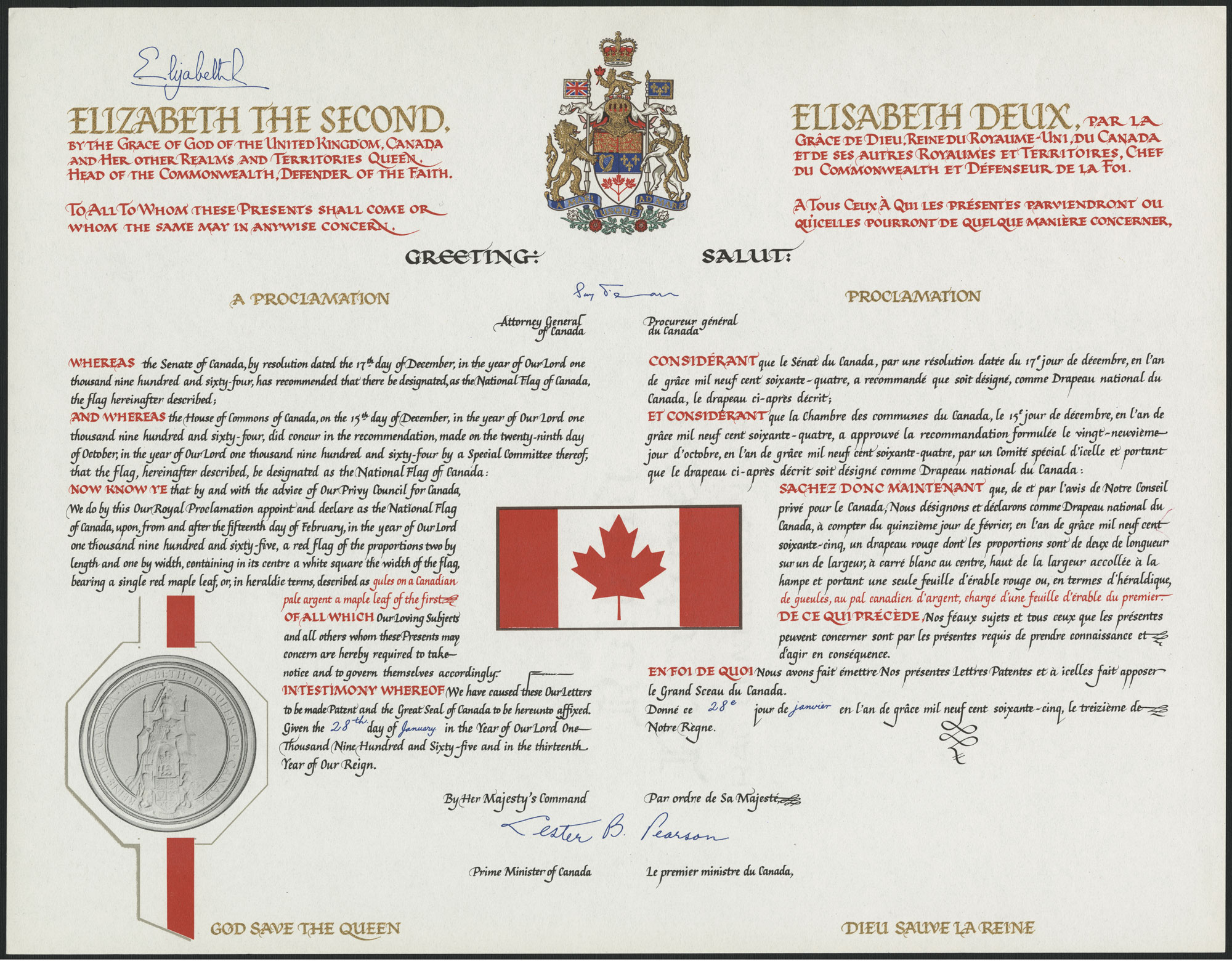 The Proclamation of the National Flag of Canada (reproduction). Queen Elizabeth II signed the document on January 28, 1965, after the House of Commons and the Senate approved the design of Canada’s new maple leaf flag in December 1964. (Photo credit: Library and Archives Canada, Accession No. 1989-253-1)
“The flag is the symbol of the nation’s unity, for it, beyond any doubt, represents all the citizens of Canada without distinction of race, language, belief or opinion,” the Honourable Maurice Bourget, then-speaker of the Senate, said during the ceremony.
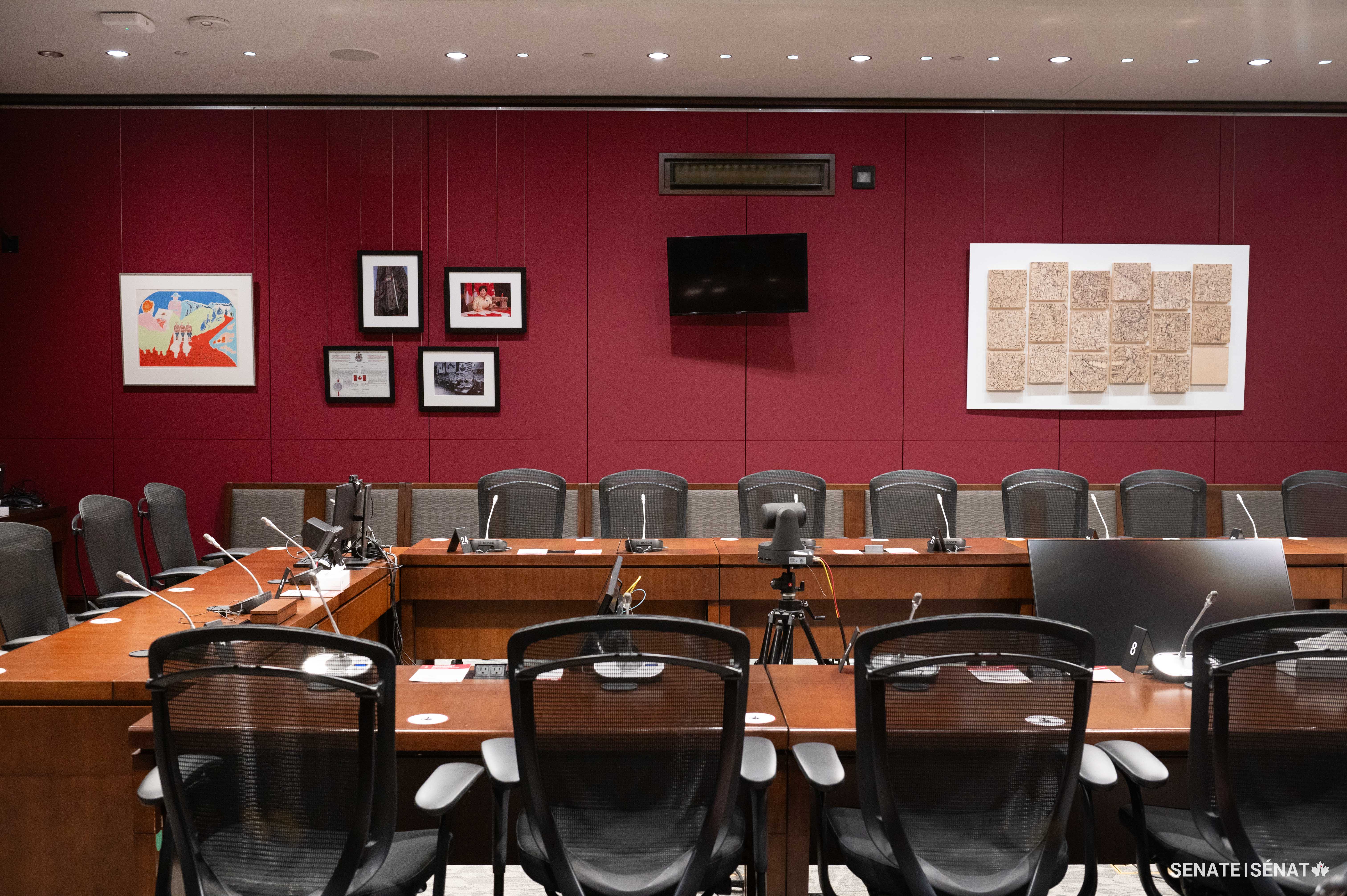
Canada’s Self Portrait and The Mountie Sketch, along with a copy of the proclamation and several archival images, will be on display in a Senate committee room until January 2026.
Related articles
Tags
Committee news
Visual Voices 2025: New Senate artworks salute the National Flag of Canada’s 60th anniversary
The Red Chamber is marking the 60th anniversary of the National Flag of Canada and the role senators played in its adoption with a new art exhibit in the Senate of Canada Building.
The exhibit features striking works by two accomplished visual artists, Aquil Virani and the late Judith Huntress. Installed ahead of Flag Day on February 15, 2025, the display is the third in the Senate’s Visual Voices program, a rotating exhibit launched in 2022 that features artworks with themes highlighting the work of Canada’s senators.
“In the early 1960s, Canadians’ representatives in Parliament were seized with choosing the right design for the country’s new national flag. While the final concept wasn’t universally loved at the time, I think it’s safe to say today that it was indeed the right choice,” said Senator Andrew Cardozo, chair of the Senate’s Artwork and Heritage Advisory Working Group, which oversees the Visual Voices program.
“Sixty years later, Canada’s red-and-white, maple leaf flag is an iconic symbol, recognized globally, that Canadians wear with great pride. Our flag has come to represent what we stand for as a country and it is worth celebrating and defending year after year.”
Canada’s new national flag is raised in front of the Peace Tower on Parliament Hill on February 15, 1965. (Photo credit: Duncan Cameron and Library and Archives Canada, Identification No. 3230220)
Aquil Virani in collaboration with Rebecca Jones, detail of Canada’s Self Portrait (2016). 18 birch panels and ink. 86.4 cm x 165.1 cm. Loan credit: Courtesy of the artist. The artwork incorporates 800 crowdsourced sketches about Canadian identity.
Aquil Virani in collaboration with Rebecca Jones, detail of Canada’s Self Portrait (2016). 18 birch panels and ink. Loan credit: Courtesy of the artist. Sketches of Canadiana can be found throughout the artwork, including Canada’s national flag and the beaver.
Aquil Virani in collaboration with Rebecca Jones, Canada’s Self Portrait (2016). 18 birch panels and ink. 86.4 cm x 165.1 cm. Loan credit: Courtesy of the artist
Canada’s Self Portrait is described by Aquil Virani as “a collaborative art project about who we are and what we stand for as Canadians.” Created by Virani, in partnership with Rebecca Jones, the award-winning artwork incorporates 800 crowdsourced sketches about Canadian identity — drawn by residents of all 13 provinces and territories — that the two creators solicited during a cross-country trip in 2014.
They then reproduced the sketches and integrated them into a large-scale ink piece, comprised of 18 birch panels. One panel was intentionally left blank to represent the untold story of Canada. The final work was unveiled and exhibited at the Canadian Museum of Immigration at Pier 21 in Halifax, Nova Scotia on July 1, 2016.
Born in Vancouver and based in Toronto, Virani says he uses art as a tool for social change and often invites public participation in his projects.
Judith Huntress, The Mountie Sketch (1973). Silkscreen. 55.5 cm x 71 cm. Loan credit: Canada Council Art Bank
The Mountie Sketch is a silkscreen work by artist Judith Huntress that depicts members of the Royal Canadian Mounted Police against an abstract Canadian landscape.
At the top left of the work, an artist draws a portrait of a Mountie in uniform. In the centre of the piece, three Mounties in uniform stand at attention. Towards the top right, the silhouettes of six people scale a hilltop, a snowy mountain range in the background. The Canadian flag, flying from a flagpole, blows in the wind towards the bottom right.
Huntress was a prolific silkscreen artist whose career spanned several decades. She exhibited across Canada and was a member of the Grand Western Canadian Screen Shop, the first artist co-operative in the Prairies. Huntress immigrated to Canada in 1968 and passed away in 2022.
“These stunning works of art, each in their own way, encourages the viewer to reflect on what it means to be Canadian and what makes our country unique,” said Senator Salma Ataullahjan, who sits on the Artwork and Heritage Advisory Working Group. “I look forward to discussing these themes with my fellow senators as we celebrate Flag Day — and for the duration of this special exhibit.”
The Red Chamber is marking the 60th anniversary of the National Flag of Canada and the role senators played in its adoption with a new art exhibit in the Senate of Canada Building.
Canada’s flag, which has come to be one of the most recognized flags in the world, was selected by Parliament.
In the early 1960s, Lester B. Pearson — first as leader of the opposition and then as prime minister — championed the push for a new national flag that would replace the Union Jack and the Canadian Red Ensign. With Canada’s centennial celebrations fast approaching, he felt a new national flag was important to the country’s identity.
In 1963 and 1964, there was fierce debate in Parliament over early concepts for the new flag — a period often referred to as the Great Flag Debate. A parliamentary committee formed to submit a recommendation for the new flag considered thousands of concepts submitted by Canadians before shortlisting three designs.
The design the committee favoured unanimously — the stylized red maple leaf against a white background, with two thick red borders — was proposed by George Stanley, dean of arts at the Royal Military College in Kingston, Ontario.
After more passionate debate and hundreds of speeches, the House of Commons voted 163 to 78 in favour of that design during a late-night sitting on December 15, 1964. The Senate gave its approval on December 17, and Queen Elizabeth II signed a royal proclamation to make the new flag official on January 28, 1965. Shortly after, the new flag was raised for the first time on Parliament Hill, at the base of the Peace Tower, during a ceremony on February 15.
The Proclamation of the National Flag of Canada (reproduction). Queen Elizabeth II signed the document on January 28, 1965, after the House of Commons and the Senate approved the design of Canada’s new maple leaf flag in December 1964. (Photo credit: Library and Archives Canada, Accession No. 1989-253-1)
“The flag is the symbol of the nation’s unity, for it, beyond any doubt, represents all the citizens of Canada without distinction of race, language, belief or opinion,” the Honourable Maurice Bourget, then-speaker of the Senate, said during the ceremony.
Canada’s Self Portrait and The Mountie Sketch, along with a copy of the proclamation and several archival images, will be on display in a Senate committee room until January 2026.