
Report
Executive summary
All children have a legal right to receive the level of care that is necessary for their well-being. When a parent is unable to provide such care, children are often traumatized, and governments take on the role of a parent. The vulnerability of children in care is substantial, particularly at the point when they age out of care and begin the transition to adulthood.
While Canadian provinces and territories offer a patchwork of varying supports to those leaving care, none compare to the level of care and support that would be provided by a loving parent. Too often, vulnerable youth instead face an abrupt transition on an arbitrary birthday, and are more vulnerable to poverty, homelessness, mental health challenges, and involvement with the criminal justice system.
Between October and November 2024, the Standing Senate Committee on Human Rights (the committee) held five meetings to study the complex issue of aging out of care. The committee heard from 28 witnesses and received five briefs that outlined the rights and vulnerabilities of children and youth aging out of child protection systems and other forms of out-of-home care. This report reflects the testimony received during that period.
The committee heard about the challenges associated with aging out of care, as well as positive practices in various provinces and territories. Throughout its study, the committee focused on the appropriate role of the federal government, considering that child protection systems are primarily within provincial, territorial and, increasingly, Indigenous jurisdictions.
The report is divided under five headings. First, under “Experiences of Aging out of Care,” the report unpacks Canada’s legal obligations and responsibilities regarding children’s rights. It recounts the vulnerabilities of aging out of care based on the testimony it received, including from those with lived experiences. This section also includes the vulnerabilities encountered by those in and out of care with a precarious immigration status, as well as those who face involvement with the criminal justice system. The committee notes that, while it was privileged to hear from several individuals formerly in care who showed great courage and resilience in overcoming significant obstacles, it did not hear from those with less positive outcomes who were failed by Canadian child protection systems.
Second, under “Jurisdiction over Child and Youth Protection in Canada,” the report discusses the jurisdictional complexities relating to child protection systems, including the federal government’s responsibility with respect to Indigenous child welfare. This bridges into the third section of the report, which provides an overview of the different approaches to post-majority support for youth who have aged out of care. This section highlights several promising programs throughout the country. It also discusses the post-majority support provided by Indigenous Services Canada stemming from findings by the Canadian Human Rights Tribunal that the federal government discriminated against children and youth in the First Nations Child and Family Services Program.
Fourth, the report calls for a paradigm shift in Canada’s child protection systems. The committee echoes calls for a more prevention-based approach to childcare and child protection to ensure the well-being of children and families. This section discusses the eight Equitable Standards for Transitions to Adulthood for Youth in Care, a roadmap developed by the Child Welfare League of Canada.
In the fifth and final section, entitled “Has Nothing Changed?” the committee acknowledges past work on this issue, including its own. This report builds on decades of previous recommendations by civil society as well as parliamentary and international organizations. The committee hopes that the time is now ripe for reforming the transition period for children and youth aging out of care.
Throughout the report, the committee provides recommendations for changing the way that Canada cares for children and youth in out-of-home care, to ensure that vital support networks are in place. The committee urges the federal government to carefully consider and respond to each of its recommendations.
Recommendations

National children and youth commissioner
That the Government of Canada introduce legislation to establish an independent, national children and youth commissioner with a mandate to monitor and report to Parliament on children’s rights and those of people in emerging adulthood in the country.

Framework to implement human rights commitments
That the Government of Canada introduce a national framework for implementation of the principles and obligations that Canada has committed to through the United Nations Convention on the Rights of the Child and of the International Covenant on Economic, Social and Cultural Rights, as it did with the United Nations Declaration on the Rights of Indigenous Peoples.

National database
That Statistics Canada establish a national database on child welfare by entering into agreements with provincial, territorial and Indigenous governments to obtain anonymized data disaggregated by age, sex, sexual orientation, gender identity and expression, disability, geographic location, race, ethnic and national origin and socioeconomic background, and by conducting surveys to track outcomes after leaving care.

National summit and action plan
That the Government of Canada convene a national summit with Indigenous governments, rights holders and organizations, the provinces and territories, and stakeholders with lived experience to develop a national action plan on supporting the transition to adulthood for youth in care. Guided by the Equitable Standards for Transitions to Adulthood for Youth in Care, and taking into account the unique vulnerabilities of certain youth based on factors such as age, sex, sexual orientation, gender identity and expression, disability, geographic location, race, ethnic and national origin and socioeconomic background, the action plan should:
- work toward a uniform readiness-based approach to aging out of care;
- extend Jordan’s Principle past the age of majority;
- address the child-welfare-to-prison pipeline; and
- set priorities, targets and respective responsibilities, respecting the jurisdiction of Indigenous Peoples, the provinces and territories over child and family services, including their authority to choose differing program models based on unique contexts and needs.

Wraparound supports for youth aging out of care
That the Government of Canada consult with relevant stakeholders, including provincial and territorial governments, to develop supports for youth aging out of care that are adequate to meet their needs, including access to post-secondary education, housing, mental health care and life skills training, as well as other forms of wraparound supports based on the eight pillars of Equitable Standards for Transitions to Adulthood.

Citizenship support
That Immigration, Refugees and Citizenship Canada ensure that children in care who arrived in Canada as immigrants, refugees or asylum seekers be provided with support to complete their pathway to citizenship, and that those who age out of care are protected from deportation.

Support for 2SLGBTQI+ children and youth
That the Government of Canada increase understanding, resources, and support for the unique experiences of 2SLGBTQI+ children and youth in care who are at increased risk and overrepresented within child welfare and protection systems.

Support for families
That the Government of Canada increase support for vulnerable families to reduce the need for out-of-home care, including through the Canada Child Benefit and the Child Disability Benefit.

Ottawa – Children living in government care lose out on most support services as soon as they reach the age of majority — a longtime problem that successive governments have neglected for decades.
In a report released Tuesday, December 9, 2025, the Senate Committee on Human Rights has renewed calls for significant reform to ensure vulnerable young adults are not abandoned to crime, addiction or homelessness. The committee, for example, heard of the “child-welfare-to-prison pipeline” — an all-too-common phenomenon in which troubled youth get caught up in the criminal justice system as their supports evaporate.
A significant factor complicating reform is that child and family services and youth protection fall under various provincial, territorial and Indigenous jurisdictions — there is no single system to reform. Thus, a British Columbian youth may be eligible to receive support up to the age of 27, while a Manitoban will in most cases be completely cut off from care after turning 18. Different jurisdictions also have different data collection practices, so even basic information such as the number of children in government care can be difficult or impossible to find.
Canada has a responsibility to safeguard the rights of children and youth, and to ensure they receive the protection and care necessary for their well-being. All levels of government must work together to create an environment in which young people can thrive.
Quick Facts
- The report makes eight recommendations aimed at improving direct supports and establishing systemic change, including that the federal government establish an independent national children and youth commissioner, and that the government convene a national summit with Indigenous, provincial and territorial governments, as well as stakeholders, to develop an action plan.
- The report also recommends establishing a national database on child welfare, which would include surveys to track outcomes after leaving care.
- The committee heard that approximately 6,700 young people age out of child protection systems each year, but that number is outdated; the number is likely higher.
Quotes
“The need of young people for adequate care does not disappear when they reach an arbitrary age. The federal government has an obligation to step up its support.”
- Senator Paulette Senior, Chair of the committee
“Our recommendations show where Canada should prioritize its efforts. We are advocating for more direct support for young people aging out of care, as well as for the broader systemic changes needed for Canada to live up to its responsibilities.”
- Senator Wanda Thomas Bernard, Deputy Chair of the committee
Associated Links
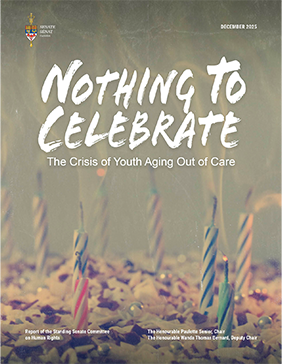
- Read the report: Nothing to Celebrate: The Crisis of Youth Aging out of Care.
- Follow the committee on social media using #RIDR.
- Subscribe to email alerts for Senate committees.
- Sign up for the Senate eNewsletter.
For more information:
Chelsea DeFazio
Communications Officer | Senate of Canada
343-576-1481 | chelsea.defazio@sen.parl.gc.ca
Senators who participated in this study

Paulette Senior
ISG - Ontario

Wanda Thomas Bernard
PSG - Nova Scotia (East Preston)

David M. Arnot
ISG - Saskatchewan

Mary Coyle
ISG - Nova Scotia (Antigonish)

Nancy Karetak-Lindell
ISG - Nunavut

Marilou McPhedran
Non-affiliated - Manitoba

Mary Robinson
CSG - Prince Edward Island

Kristopher Wells
PSG - Alberta
Ex-officio members of the committee: The Honourable Pierre Moreau, P.C., or the Honourable Patti LaBoucane-Benson, the Honourable Leo Housakos or the Honourable Yonah Martin, the Honourable Raymonde Saint-Germain or the Honourable Bernadette Clement, the Honourable Scott Tannas or the Honourable Rebecca Patterson, the Honourable Brian Francis or the Honourable Judy A. White
Senators who participated in the study during the First Session of the Forty-fourth Parliament: The Honourable Senators Ataullahjan (Chair), Bernard (Deputy Chair), Arnot, Gerba, Manning, Muggli, Omidvar (retired), Osler, Pate, Robinson, Ross, Senior, Simons, Youance and Wells (Alberta)
Ex-officio members of the committee during the First Session of the Forty-fourth Parliament: The Honourable Marc Gold, P.C., or the Honourable Patti LaBoucane-Benson, the Honourable Donald Neil Plett or the Honourable Yonah Martin, the Honourable Raymonde Saint-Germain or the Honourable Bernadette Clement, the Honourable Scott Tannas or the Honourable Rebecca Patterson, the Honourable Pierre J. Dalphond or the Honourable Judy A. White