


‘I don’t retire’: Senator David Adams Richards turns the page on his Red Chamber career
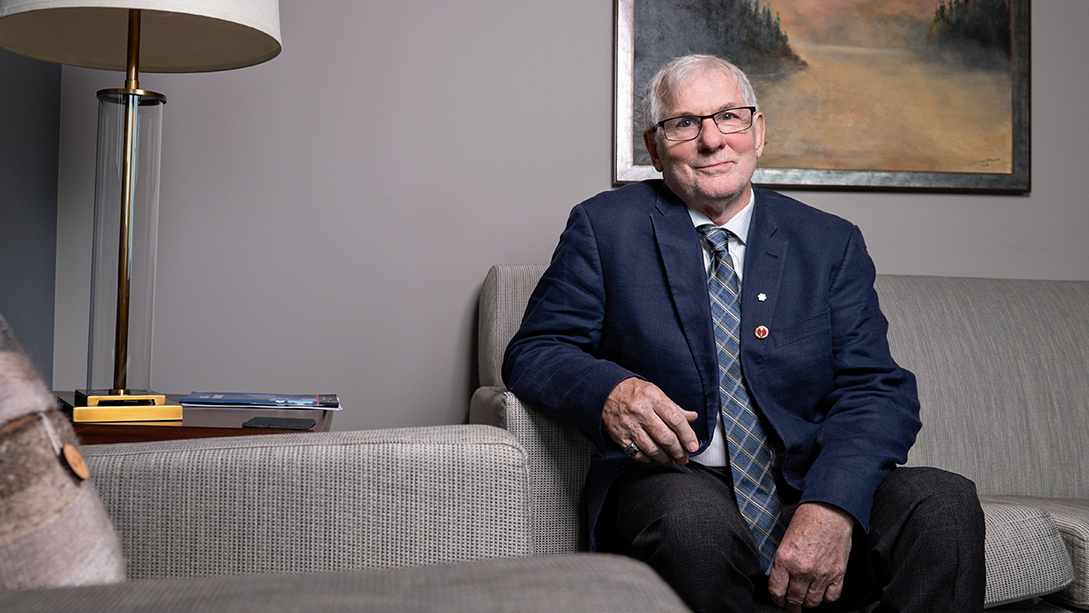
An award-winning novelist, non-fiction author and screenwriter, Senator David Adams Richards dedicated much of his writing to portrayals of working-class and poor communities in his home province of New Brunswick.
After joining the Senate in 2017, Senator Richards never stopped writing, publishing four more books between Senate sittings and committee meetings. While in the Red Chamber, he raised awareness of declining Atlantic salmon populations, promoted psychedelic-assisted therapies for veterans with PTSD, railed against the Online Streaming Act and poked fun at U.S. hockey commentators.
As he prepares to leave the Red Chamber on October 17, 2025, Senator Richards spoke to SenCAplus about his career and his next chapter.
You have said that you decided to become a writer after reading Oliver Twist at age 14.
What was it about this book that made you want to pick up the pen? I knew all the characters. I grew up in a society that middle-class suburbia probably never saw. I knew kids who struggled to get by day to day, and I knew kids whose dads were doctors and lawyers, so when I read Oliver Twist, I saw the same people in that book. I finished it in three days, and I realized two things: Charles Dickens was a great writer, and I wanted to be a writer too.
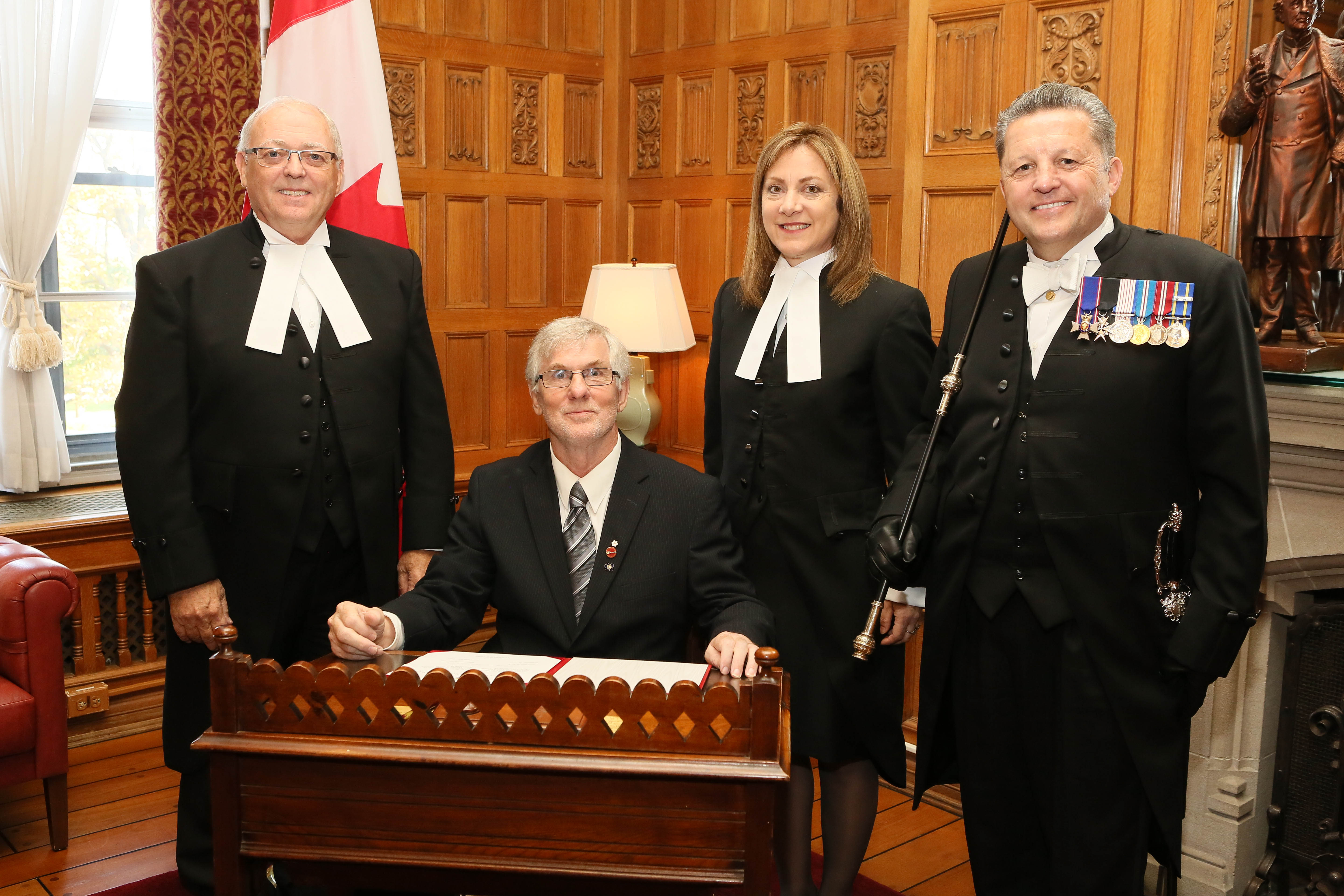 Senator David Adams Richards prepares to join the Red Chamber in 2017 accompanied by then-Senate speaker George J. Furey left, then-Senate clerk Nicole Proulx and Usher of the Black Rod J. Greg Peters.
You were appointed to the Senate in August 2017. Why did you decide to apply for the role?
My wife Peg encouraged me to apply because I kept talking about politics. I was concerned about the country’s defensive capabilities, the terrible plight of our veterans, and unemployment rates.
I had no expectation that I would ever be chosen as a senator, but it came to be. I am of the belief that if your prime minister asks you to do something and you can do it, then you should. I was completely new to politics, so I had to learn from the base up. It took me a while, which is the case for a lot of senators, but over time I found my feet.
You spoke about the characters in Oliver Twist and how they were familiar to you. Your own writing also often focuses on those who are marginalized and living in rural communities. How has your work as a senator allowed you to keep giving a voice to these groups?
I don’t know how successful a senator can be in this regard, but there are issues endemic in our national conscience that we should examine, including the opioid and methamphetamine crises, which are destroying many youth across the country. This should be a major focus in dealing with the problem of poverty and marginalization.
There are other issues that have specifically affected younger generations living in rural communities. I remember how the carbon tax hit the trucking business of my son’s friend. He used to own three trucks, and he ended up losing two because he couldn’t afford the diesel costs, and he couldn’t afford his drivers because the insurance increased. Also, the commodity that he was transporting to small rural stores became more and more expensive.
These issues not only bothered me, but they bothered a lot of senators no matter what side of the aisle I sat on.
A writerly life is often a solitary one, and you have even called yourself a recluse and an outcast. How did you reconcile these traits with the public-facing duties of a senator?
It was very strange. I never said hello to so many people in my life before becoming a senator. When I would write a novel, I would work for literally months without seeing anyone except for my family and people I encountered at the rink during my kids’ hockey practices. For the most part I was alone, and I didn’t mind that at all. That was the life I chose. The Senate is a different world. I’m very glad I entered it because I met many bright and good people who are some of the finest Canadians I know. I didn’t have to agree with them all, but I still thought they were working for a Canada that could benefit everyone.
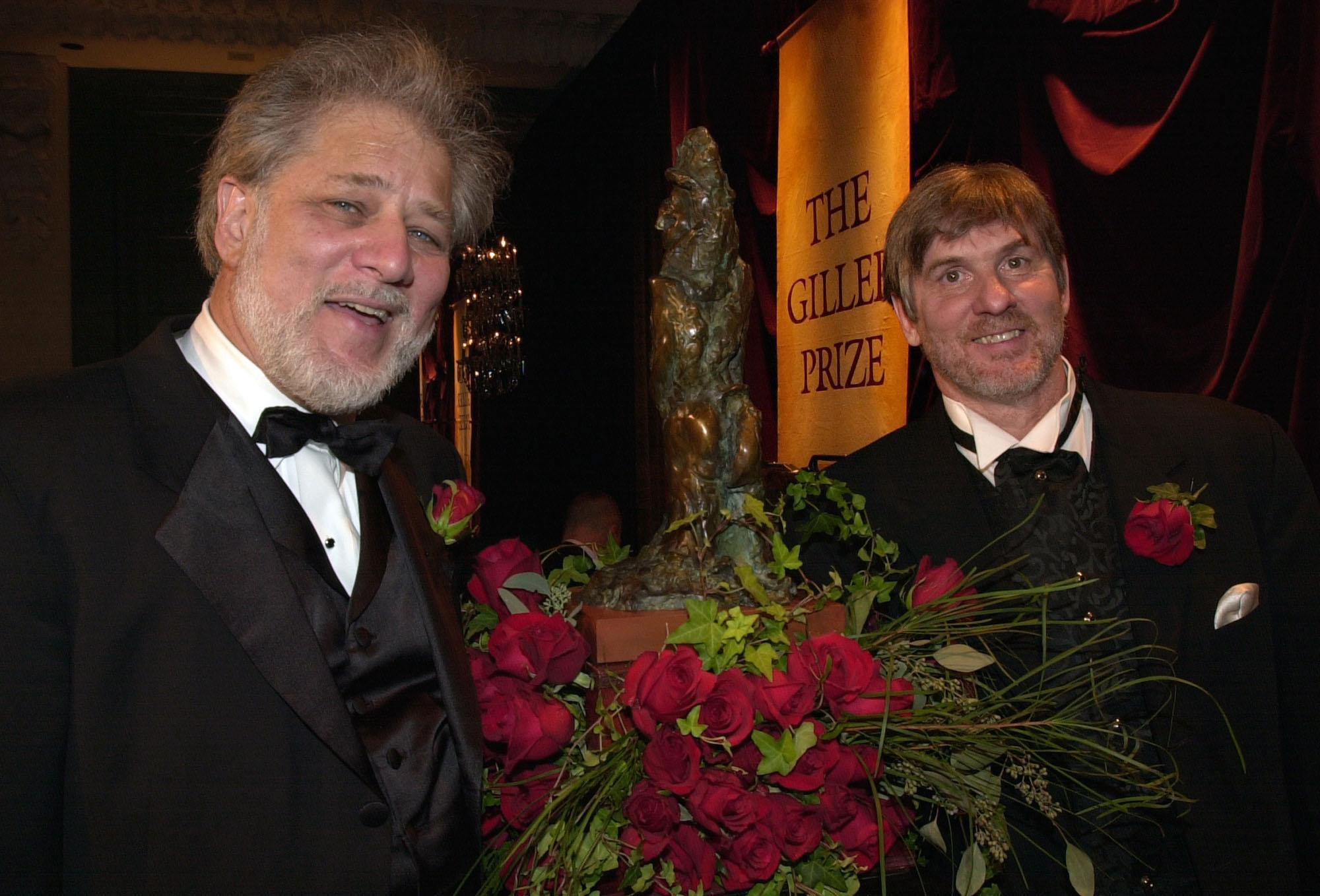 Senator Richards, right, shares the 2000 Giller Prize with author Michael Ondaatje. Ondaatje won for his novel Anil's Ghost, and Senator Richards for his novel, Mercy Among the Children. (CP PHOTO/Tannis Toohey)
You have published several books during your time in the Senate, and your next novel, Songs of Love on a December Night, is forthcoming. How did you manage to juggle writing with your Senate duties?
I can’t go a day without writing, which is unfortunate but that seems to be the way it is. I would always get an hour of writing in at night, in the afternoon or in the morning before I went to committee meetings. It wasn’t that hard to juggle both when I did it that way.
Your life, literary work and Miramichi were featured in a 2023 award-winning film, The Geographies of DAR. How did this film come about?
I met the director, Monique LeBlanc, years ago and I proposed that we do a script on the Escuminac Disaster of 1959, which was one of the greatest fishing disasters in Canada. It is a very complicated story, and that idea never came to fruition. But she had read my work and one day she proposed that she do a film on me and my life as a writer. She’s a brilliant director, and she put her heart and soul into this film.
As chair of the Senate’s Subcommittee on Veterans Affairs, you studied psychedelic-assisted therapies for veterans with PTSD. What struck you about this report and the evidence you heard from witnesses?
Many of these veterans returned from serving in horrible places at the age of 22 or 23, and they were left searching for things to help them cope every day, sometimes with opioids and alcohol. We heard from many who had contemplated or attempted suicide. I thought that if psilocybin and MDMA could relieve this pressure on these young people and help get their lives back in order, then it was worth further investigation.
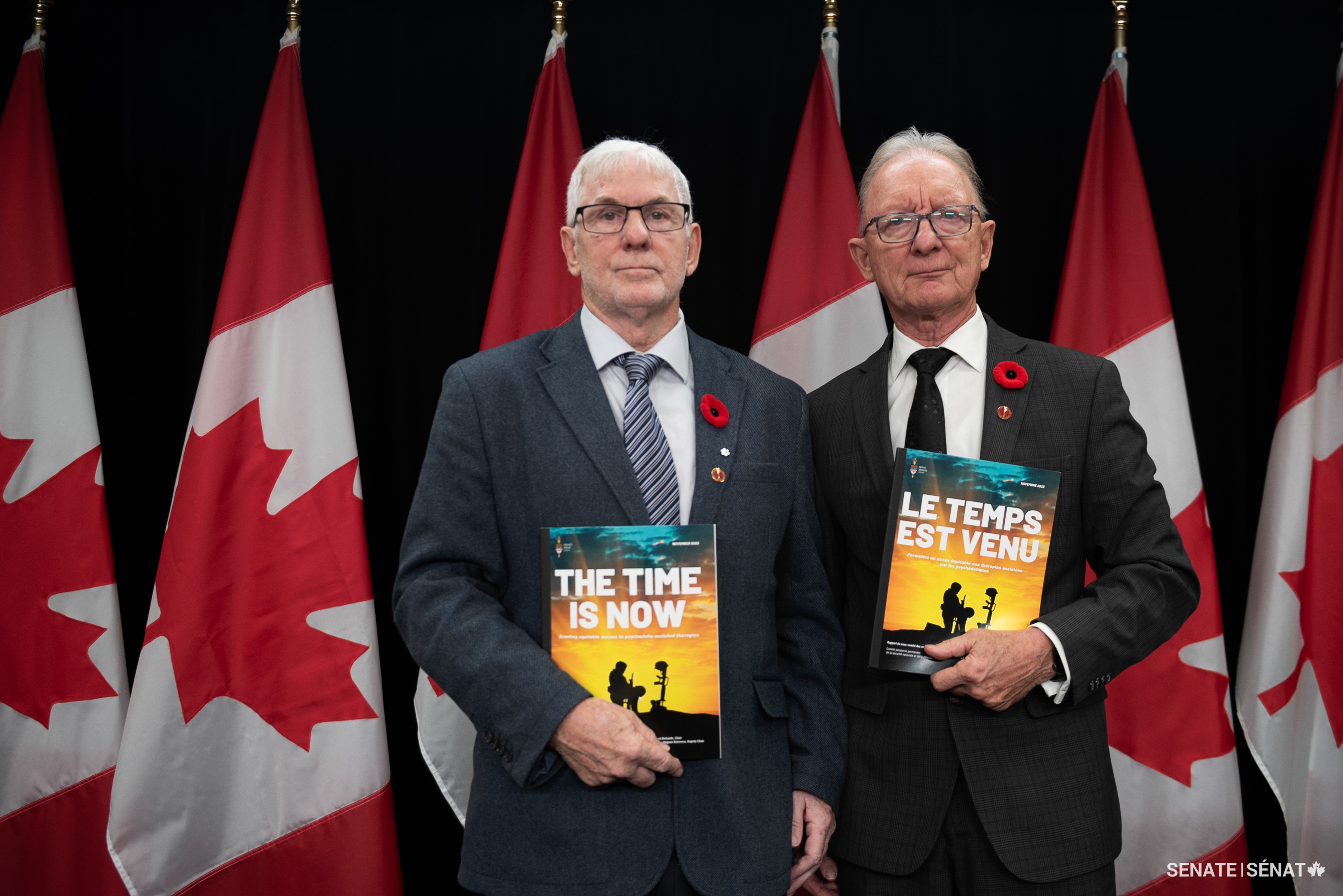 As chair of the Senate’s Subcommittee on Veterans Affairs, Senator Richards worked on the committee’s 2023 report on psychedelic-assisted therapies for veterans with PTSD. He stands with former senator Pierre-Hugues Boisvenu, the committee’s deputy chair at the time.
 Senator Richards, second from right, visits Veterans’ House Canada to meet its staff and learn more about effective approaches to reducing homelessness among veterans as part of the work of the Veterans Affairs subcommittee. Also shown, from left, are senators John M. McNair, Marty Deacon and Rebecca Patterson.
What other committee or legislative work are you proud of?
I’m proud of what I stood against, including the federal budgets because it was never clear to me where the money was going. I knew the budgets would pass, but I still voted against them in protest.
I also stood against Bill C-11, the Online Streaming Act, because I felt it was a form of censorship. I thought it would become rather dictatorial if the government started telling Canadian writers what they could and couldn’t write. I had support, including from author Margaret Atwood. I didn’t succeed in my opposition because the bill, of course, passed, but at least I took a stand.
There were other things that I tried to get done, including the protection of the Atlantic salmon, which is fundamental to our way of life on the Miramichi and the Restigouche, not only for us but for the First Nation peoples. The salmon are being decimated by the predatory seals and sea bass because there are no longer any culls. I haven’t thrown a line in two years because there’s no salmon left in the Miramichi rivers where I fish.
In a 2018 Senate Chamber speech that made headlines, you said U.S. hockey commentators have “utterly ruined” the sport by using “odious phrases” in their play-by-play reports. Why did you decide to raise this issue in the Chamber?
I didn’t expect it to make headlines; it was just a pet peeve I had. Hockey has always been deemed a kind of roller derby or wrestling match in some parts of the U.S. when it’s really a brilliant and beautiful game. It’s a ballet on ice at its best.
My major concern about the U.S. commentators is that the very nature of the game was lessened by their commentary. They don’t say that a goalie “saves” the goal anymore; they say the goalie “denies” the goal. They don’t call it the “boards”; they call it the “half wall.” Canadian commentators like Bob Cole and Danny Gallivan knew that going through centre ice or going from your blue line to the other blue line was just as important as the shot on the goal. Many American commentators, who grew up with basketball and baseball, simply do not understand this.
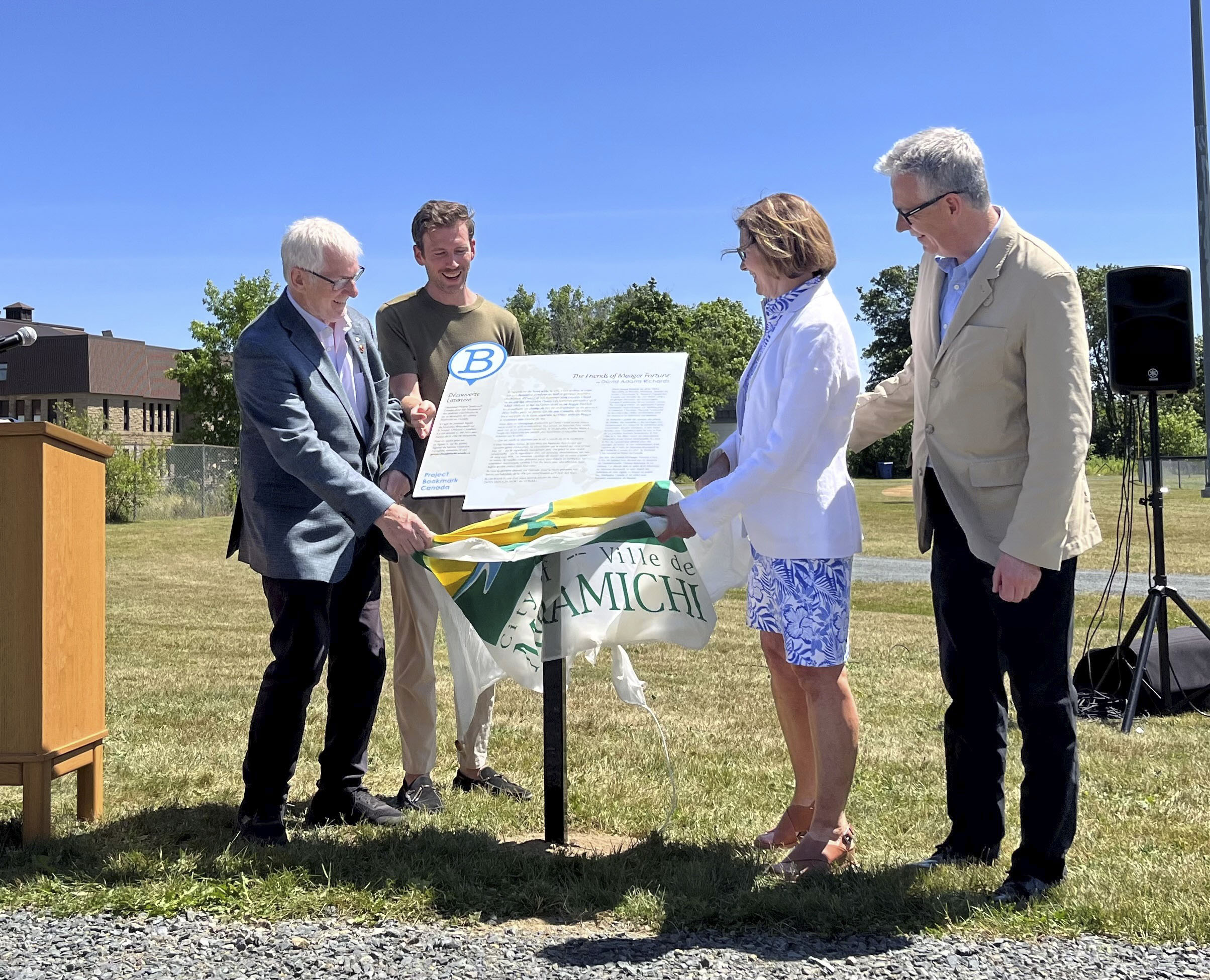 Senator Richards, left, helps to unveil the first Canadian Literary Trail Bookmark plaque in New Brunswick in July 2025. Also pictured are Miramichi Mayor Adam Lordon, second from left, the senator’s sister Mary Jane Richards and her husband Jeffrey Carleton. (Photo credit: Gail Harding, City of Miramichi)
What are your retirement plans?
I don’t retire. I just go home and write my books. I have a novel I’m working on now, and I have essays coming out next spring.
Would you ever write about your experience in the Senate?
I’ve given it a passing thought, but I don’t know if I will. We will see. I don’t know what I’ll write. I’m desperately worried about our country, not only the U.S. tariffs, but the idea that we’re in a morass of self-judgment and angst. There are many divisions in the country and none of it is good for a larger Canada.
This is a pivotal moment in Canadian history. It might all work out in the best way, but it’s going to take a lot of work.
Related articles
Tags
Committee news
‘I don’t retire’: Senator David Adams Richards turns the page on his Red Chamber career
An award-winning novelist, non-fiction author and screenwriter, Senator David Adams Richards dedicated much of his writing to portrayals of working-class and poor communities in his home province of New Brunswick.
After joining the Senate in 2017, Senator Richards never stopped writing, publishing four more books between Senate sittings and committee meetings. While in the Red Chamber, he raised awareness of declining Atlantic salmon populations, promoted psychedelic-assisted therapies for veterans with PTSD, railed against the Online Streaming Act and poked fun at U.S. hockey commentators.
As he prepares to leave the Red Chamber on October 17, 2025, Senator Richards spoke to SenCAplus about his career and his next chapter.
You have said that you decided to become a writer after reading Oliver Twist at age 14.
What was it about this book that made you want to pick up the pen? I knew all the characters. I grew up in a society that middle-class suburbia probably never saw. I knew kids who struggled to get by day to day, and I knew kids whose dads were doctors and lawyers, so when I read Oliver Twist, I saw the same people in that book. I finished it in three days, and I realized two things: Charles Dickens was a great writer, and I wanted to be a writer too.
Senator David Adams Richards prepares to join the Red Chamber in 2017 accompanied by then-Senate speaker George J. Furey left, then-Senate clerk Nicole Proulx and Usher of the Black Rod J. Greg Peters.
You were appointed to the Senate in August 2017. Why did you decide to apply for the role?
My wife Peg encouraged me to apply because I kept talking about politics. I was concerned about the country’s defensive capabilities, the terrible plight of our veterans, and unemployment rates.
I had no expectation that I would ever be chosen as a senator, but it came to be. I am of the belief that if your prime minister asks you to do something and you can do it, then you should. I was completely new to politics, so I had to learn from the base up. It took me a while, which is the case for a lot of senators, but over time I found my feet.
You spoke about the characters in Oliver Twist and how they were familiar to you. Your own writing also often focuses on those who are marginalized and living in rural communities. How has your work as a senator allowed you to keep giving a voice to these groups?
I don’t know how successful a senator can be in this regard, but there are issues endemic in our national conscience that we should examine, including the opioid and methamphetamine crises, which are destroying many youth across the country. This should be a major focus in dealing with the problem of poverty and marginalization.
There are other issues that have specifically affected younger generations living in rural communities. I remember how the carbon tax hit the trucking business of my son’s friend. He used to own three trucks, and he ended up losing two because he couldn’t afford the diesel costs, and he couldn’t afford his drivers because the insurance increased. Also, the commodity that he was transporting to small rural stores became more and more expensive.
These issues not only bothered me, but they bothered a lot of senators no matter what side of the aisle I sat on.
A writerly life is often a solitary one, and you have even called yourself a recluse and an outcast. How did you reconcile these traits with the public-facing duties of a senator?
It was very strange. I never said hello to so many people in my life before becoming a senator. When I would write a novel, I would work for literally months without seeing anyone except for my family and people I encountered at the rink during my kids’ hockey practices. For the most part I was alone, and I didn’t mind that at all. That was the life I chose. The Senate is a different world. I’m very glad I entered it because I met many bright and good people who are some of the finest Canadians I know. I didn’t have to agree with them all, but I still thought they were working for a Canada that could benefit everyone.
Senator Richards, right, shares the 2000 Giller Prize with author Michael Ondaatje. Ondaatje won for his novel Anil's Ghost, and Senator Richards for his novel, Mercy Among the Children. (CP PHOTO/Tannis Toohey)
You have published several books during your time in the Senate, and your next novel, Songs of Love on a December Night, is forthcoming. How did you manage to juggle writing with your Senate duties?
I can’t go a day without writing, which is unfortunate but that seems to be the way it is. I would always get an hour of writing in at night, in the afternoon or in the morning before I went to committee meetings. It wasn’t that hard to juggle both when I did it that way.
Your life, literary work and Miramichi were featured in a 2023 award-winning film, The Geographies of DAR. How did this film come about?
I met the director, Monique LeBlanc, years ago and I proposed that we do a script on the Escuminac Disaster of 1959, which was one of the greatest fishing disasters in Canada. It is a very complicated story, and that idea never came to fruition. But she had read my work and one day she proposed that she do a film on me and my life as a writer. She’s a brilliant director, and she put her heart and soul into this film.
As chair of the Senate’s Subcommittee on Veterans Affairs, you studied psychedelic-assisted therapies for veterans with PTSD. What struck you about this report and the evidence you heard from witnesses?
Many of these veterans returned from serving in horrible places at the age of 22 or 23, and they were left searching for things to help them cope every day, sometimes with opioids and alcohol. We heard from many who had contemplated or attempted suicide. I thought that if psilocybin and MDMA could relieve this pressure on these young people and help get their lives back in order, then it was worth further investigation.
As chair of the Senate’s Subcommittee on Veterans Affairs, Senator Richards worked on the committee’s 2023 report on psychedelic-assisted therapies for veterans with PTSD. He stands with former senator Pierre-Hugues Boisvenu, the committee’s deputy chair at the time.
Senator Richards, second from right, visits Veterans’ House Canada to meet its staff and learn more about effective approaches to reducing homelessness among veterans as part of the work of the Veterans Affairs subcommittee. Also shown, from left, are senators John M. McNair, Marty Deacon and Rebecca Patterson.
What other committee or legislative work are you proud of?
I’m proud of what I stood against, including the federal budgets because it was never clear to me where the money was going. I knew the budgets would pass, but I still voted against them in protest.
I also stood against Bill C-11, the Online Streaming Act, because I felt it was a form of censorship. I thought it would become rather dictatorial if the government started telling Canadian writers what they could and couldn’t write. I had support, including from author Margaret Atwood. I didn’t succeed in my opposition because the bill, of course, passed, but at least I took a stand.
There were other things that I tried to get done, including the protection of the Atlantic salmon, which is fundamental to our way of life on the Miramichi and the Restigouche, not only for us but for the First Nation peoples. The salmon are being decimated by the predatory seals and sea bass because there are no longer any culls. I haven’t thrown a line in two years because there’s no salmon left in the Miramichi rivers where I fish.
In a 2018 Senate Chamber speech that made headlines, you said U.S. hockey commentators have “utterly ruined” the sport by using “odious phrases” in their play-by-play reports. Why did you decide to raise this issue in the Chamber?
I didn’t expect it to make headlines; it was just a pet peeve I had. Hockey has always been deemed a kind of roller derby or wrestling match in some parts of the U.S. when it’s really a brilliant and beautiful game. It’s a ballet on ice at its best.
My major concern about the U.S. commentators is that the very nature of the game was lessened by their commentary. They don’t say that a goalie “saves” the goal anymore; they say the goalie “denies” the goal. They don’t call it the “boards”; they call it the “half wall.” Canadian commentators like Bob Cole and Danny Gallivan knew that going through centre ice or going from your blue line to the other blue line was just as important as the shot on the goal. Many American commentators, who grew up with basketball and baseball, simply do not understand this.
Senator Richards, left, helps to unveil the first Canadian Literary Trail Bookmark plaque in New Brunswick in July 2025. Also pictured are Miramichi Mayor Adam Lordon, second from left, the senator’s sister Mary Jane Richards and her husband Jeffrey Carleton. (Photo credit: Gail Harding, City of Miramichi)
What are your retirement plans?
I don’t retire. I just go home and write my books. I have a novel I’m working on now, and I have essays coming out next spring.
Would you ever write about your experience in the Senate?
I’ve given it a passing thought, but I don’t know if I will. We will see. I don’t know what I’ll write. I’m desperately worried about our country, not only the U.S. tariffs, but the idea that we’re in a morass of self-judgment and angst. There are many divisions in the country and none of it is good for a larger Canada.
This is a pivotal moment in Canadian history. It might all work out in the best way, but it’s going to take a lot of work.