


‘I wanted to represent my community’: Senator Mégie retires
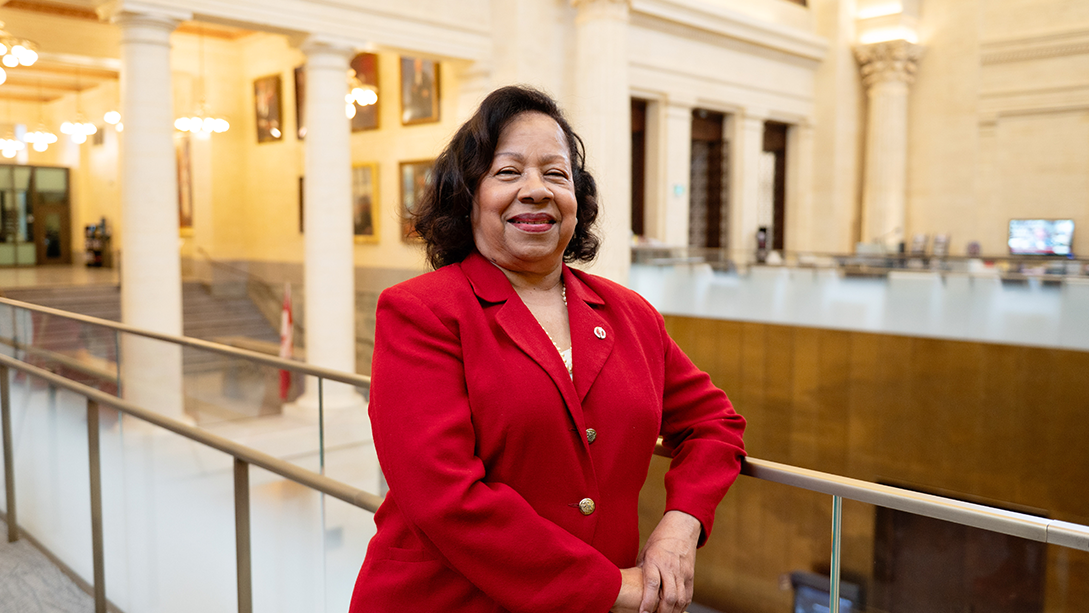
In 2016, four decades after immigrating to Canada to start a new life as a doctor in Quebec, Senator Marie-Françoise Mégie became the first woman of Haitian origin appointed to the Red Chamber. With decades of experience as a palliative care physician and a university professor, she contributed to numerous key health files before the Upper Chamber: medical assistance in dying, diabetes, sickle cell disease, the COVID-19 pandemic, senior care, systemic racism and many others.
 Senator Marie-Françoise Mégie during her Senate swearing-in ceremony in December 2016, with her daughters Aïda, left, and Sarah.
 Senator Mégie in her home country of Haiti as part of a parliamentary delegation in May 2017, alongside then-speaker of the Senate, the Honourable George J. Furey, and then-ambassador of Canada to Haiti, Paula Caldwell-St-Onge. (Photo credit: Office of Senator Marie-Françoise Mégie)
Ahead of her retirement on September 21, 2025, her Senate colleagues described her as a quietly dedicated parliamentarian who was always working behind the scenes to get things done.
Senator Mégie reflects on her career in medicine and public service.
Before your appointment to the Senate, you were a doctor for more than 30 years. Why did you choose medicine?
It goes back to my preteen years, when I was at a religious school for girls. Whenever a relative or student fell ill, we were always told to pray for them. It always made me wonder: we can pray, but it doesn’t mean that the person will actually get better. That’s when it occurred to me that the best way to help someone who is sick is to care for them, so I decided to become a doctor.
You immigrated to Canada from Haiti in 1976. Why did you decide to leave your homeland and move to Canada?
It was during the Duvalier regime — President François Duvalier was a dictator, and when he died, his son, Jean-Claude, took over. The political climate was such that a woman could not practise her profession without having to make certain compromises. That’s why I decided to leave the country. I had earned my medical degree in Haiti, and then I had to obtain my medical licence in Canada so that I could practise here.
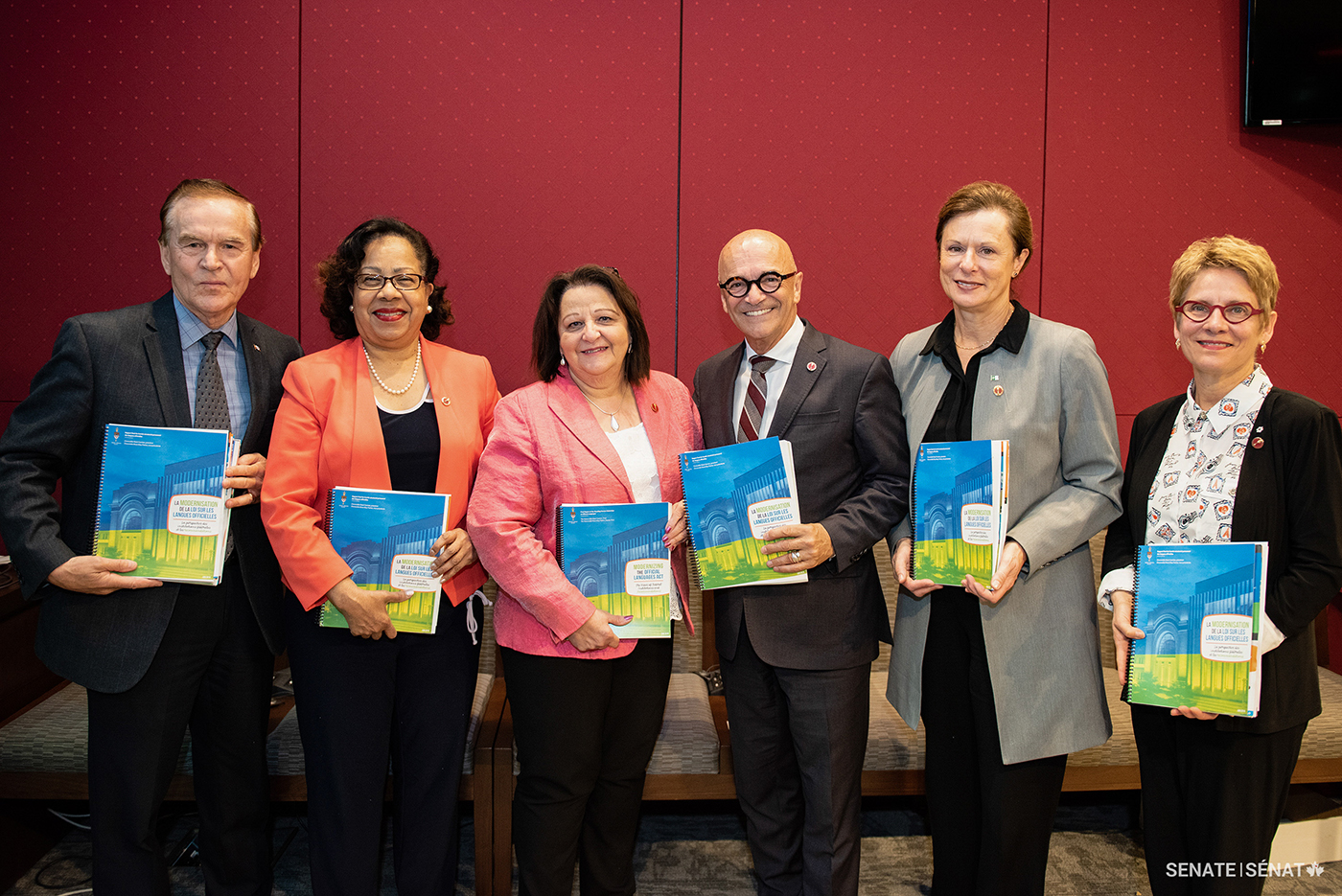 The members of the Senate Committee on Official Languages presented their report on modernizing official languages in Canada in June 2019. From left to right: former senator Percy Mockler, and senators Mégie, Rose-May Poirier, René Cormier, Lucie Moncion and Raymonde Gagné.
You’ve remained closely connected to Haiti, including as president of the Association of Haitian Physicians Abroad. Tell us about your work with this group.
Today, I’m one of the most senior members of the association, which is nearly 50 years old. Its main purpose was to bring together Haitian professionals living abroad so they wouldn’t feel alone. The association still organizes continuing education activities to help members continue to develop their skills and stay connected.
Another part of our mission is to help Haitian professionals who are newcomers to Canada integrate here. We also provide the Haitian Canadian community with medical support. A foundation was set up just for that, in cooperation with a number of Quebec community associations. Every year, we organize a preventative health day, with themed booths focused on various issues, including diseases affecting women, men and even seniors.
We are professionals who have emigrated from Haiti, who work here and who have received a lot from Canada. The association’s philosophy is to give back as much to our host country as to our homeland.
You were appointed to the Senate in 2016. Why did you want to become a senator?
I was planning to retire as a family physician that year, but a friend told me that I had served the community well and it was now time to serve all Canadians. The prime minister at the time, Justin Trudeau, had just established a new process for Senate appointments.
Being from Haiti, I was of the view that politics was a risky undertaking. I understood that the situation in Canada was different. My friend reassured me that it was the right time to get involved and serve as a role model for youth, showing them that they could one day join the ranks of the country’s decision makers. I decided to apply to the Senate because I wanted to represent my community.
During your career in the Red Chamber, you served on the Special Joint Committee on Medical Assistance in Dying. How did your experience with patients at the end of life help you with that work?
During my medical career, I helped establish a hospice. I was its first medical director. In those days, medical assistance in dying wasn’t being talked about in Quebec yet. The focus was on advance medical directives. Advance medical directives give a person the ability to indicate in advance the medical care they will accept or refuse to receive if they became incapable of consenting to care.
In 2014, Quebec adopted medical aid in dying as part of end-of-life care. I asked to be on the implementation committee at the Cité-de-la-Santé hospital in Laval, which served the hospice where I worked. Having that experience, I thought I would be a good candidate for Parliament’s Special Joint Committee on Medical Assistance in Dying when it was being created.

 Senators on a parliamentary mission to the United Nations in New York, in March 2023. From left, senators Michèle Audette, Julie Miville-Dechêne, Amina Gerba, Mégie, Rosemary Moodie and Kim Pate. (Photo credit: Office of Senator Marie-Françoise Mégie)
You’ve been on other committees, including the Senate Committee on Official Languages and the Senate Committee on Social Affairs, Science and Technology. What stands out most from your time on the committees?
What stands out most from my time on the Official Languages Committee is the report on modernizing the Official Languages Act. At the time, the act was 50 years old and had been revised only once, in 1988.
On the Social Affairs, Science and Technology committee, I had the chance to work on a bill to establish a national framework for diabetes. I had expertise in diabetic foot, so when MP Sonia Sidhu reached out and asked whether I wanted to lead the file in the Senate, I was delighted to be able to sponsor the bill. I was in my element. It was quite the feat, getting Bill C‑237 through the Senate in less than a month.
 Senator Mégie hosted one last breakfast at the Senate of Canada Building marking National Sickle Cell Awareness Day on June 19, 2025. (Photo credit: Office of Senator Marie-Françoise Mégie)
You developed a bill to designate March 11 as Pandemic Observance Day, in honour of COVID‑19 victims and front-line workers. Why should Canadians continue to commemorate the pandemic?
We mustn’t forget the people who died from COVID‑19 or the essential front-line workers who took care of them — sometimes putting their own lives at risk. Health professionals came together, adapting the way they worked in order to respond to the crisis and keep things from getting worse.
What the bill does is make March 11 of each year a day to reflect on what went right, what didn’t go so right and what measures we need to take to be better prepared for future pandemics.
 In 2017, Senator Mégie and then-senator Mobina S.B. Jaffer hosted an event celebrating Black History Month. Senator Mégie carried on the tradition, hosting yearly exhibitions at the Senate of Canada Building to highlight the contributions of Black people to the country.
You’ve worked to raise awareness of sickle cell disease, and you recently brought back a bill to establish a framework for the genetic blood disorder. What put the disease on your radar, and what do you hope the bill’s passage will achieve?
I have friends whose children have sickle cell disease, so it’s always been very present within my own circle. Those children experience tremendous pain and have to go to the hospital a lot. They can have strokes at a young age, which can leave them with disabilities. It’s a very serious disease.
We’ve known about sickle cell disease for 100 years, and, yes, there has been progress — today, antibiotics help to prevent deaths at a young age, and healthy lifestyle habits can provide relief from symptoms — but that doesn’t cure the disease.
Medical research on sickle cell disease is done in the broader context of genetic blood disorders, but it’s not very detailed. That’s why the purpose of my bill is to spread awareness among health professionals and the public. Urban centres typically have teams equipped to care for these patients, but rural areas don’t always have care providers with the necessary expertise.
 In February 2025, senators Mégie and Suze Youance, centre, welcomed members of Mosaïque Interculturelle for a visit to the Senate Chamber.
What are your retirement plans?
First, I’m going to make up for all the sleep I missed in my working years. Then, I’m going to look after my health and get back to leisure activities I had put on the back burner: theatre, movies, music and such. I was even offered piano lessons at Gregory’s Academy. We’ll see what comes next, but for now, I just want to focus on things I enjoy.
 Senator Mégie visits a dairy farm in Prince Edward Island with members of the Senate Committee on Social Affairs, Science and Technology for a fact-finding mission on migrant workers. Also pictured, from left, are senators Stan Kutcher, Flordeliz (Gigi) Osler, former senator Ratna Omidvar, and senators René Cormier, Rosemary Moodie and Donna Dasko.
Watch the tributes to Senator Marie-Françoise Mégie and her farewell speech in the Senate Chamber.
Related articles
Tags
Committee news
‘I wanted to represent my community’: Senator Mégie retires
In 2016, four decades after immigrating to Canada to start a new life as a doctor in Quebec, Senator Marie-Françoise Mégie became the first woman of Haitian origin appointed to the Red Chamber. With decades of experience as a palliative care physician and a university professor, she contributed to numerous key health files before the Upper Chamber: medical assistance in dying, diabetes, sickle cell disease, the COVID-19 pandemic, senior care, systemic racism and many others.
Senator Marie-Françoise Mégie during her Senate swearing-in ceremony in December 2016, with her daughters Aïda, left, and Sarah.
Senator Mégie in her home country of Haiti as part of a parliamentary delegation in May 2017, alongside then-speaker of the Senate, the Honourable George J. Furey, and then-ambassador of Canada to Haiti, Paula Caldwell-St-Onge. (Photo credit: Office of Senator Marie-Françoise Mégie)
Ahead of her retirement on September 21, 2025, her Senate colleagues described her as a quietly dedicated parliamentarian who was always working behind the scenes to get things done.
Senator Mégie reflects on her career in medicine and public service.
Before your appointment to the Senate, you were a doctor for more than 30 years. Why did you choose medicine?
It goes back to my preteen years, when I was at a religious school for girls. Whenever a relative or student fell ill, we were always told to pray for them. It always made me wonder: we can pray, but it doesn’t mean that the person will actually get better. That’s when it occurred to me that the best way to help someone who is sick is to care for them, so I decided to become a doctor.
You immigrated to Canada from Haiti in 1976. Why did you decide to leave your homeland and move to Canada?
It was during the Duvalier regime — President François Duvalier was a dictator, and when he died, his son, Jean-Claude, took over. The political climate was such that a woman could not practise her profession without having to make certain compromises. That’s why I decided to leave the country. I had earned my medical degree in Haiti, and then I had to obtain my medical licence in Canada so that I could practise here.
The members of the Senate Committee on Official Languages presented their report on modernizing official languages in Canada in June 2019. From left to right: former senator Percy Mockler, and senators Mégie, Rose-May Poirier, René Cormier, Lucie Moncion and Raymonde Gagné.
You’ve remained closely connected to Haiti, including as president of the Association of Haitian Physicians Abroad. Tell us about your work with this group.
Today, I’m one of the most senior members of the association, which is nearly 50 years old. Its main purpose was to bring together Haitian professionals living abroad so they wouldn’t feel alone. The association still organizes continuing education activities to help members continue to develop their skills and stay connected.
Another part of our mission is to help Haitian professionals who are newcomers to Canada integrate here. We also provide the Haitian Canadian community with medical support. A foundation was set up just for that, in cooperation with a number of Quebec community associations. Every year, we organize a preventative health day, with themed booths focused on various issues, including diseases affecting women, men and even seniors.
We are professionals who have emigrated from Haiti, who work here and who have received a lot from Canada. The association’s philosophy is to give back as much to our host country as to our homeland.
You were appointed to the Senate in 2016. Why did you want to become a senator?
I was planning to retire as a family physician that year, but a friend told me that I had served the community well and it was now time to serve all Canadians. The prime minister at the time, Justin Trudeau, had just established a new process for Senate appointments.
Being from Haiti, I was of the view that politics was a risky undertaking. I understood that the situation in Canada was different. My friend reassured me that it was the right time to get involved and serve as a role model for youth, showing them that they could one day join the ranks of the country’s decision makers. I decided to apply to the Senate because I wanted to represent my community.
During your career in the Red Chamber, you served on the Special Joint Committee on Medical Assistance in Dying. How did your experience with patients at the end of life help you with that work?
During my medical career, I helped establish a hospice. I was its first medical director. In those days, medical assistance in dying wasn’t being talked about in Quebec yet. The focus was on advance medical directives. Advance medical directives give a person the ability to indicate in advance the medical care they will accept or refuse to receive if they became incapable of consenting to care.
In 2014, Quebec adopted medical aid in dying as part of end-of-life care. I asked to be on the implementation committee at the Cité-de-la-Santé hospital in Laval, which served the hospice where I worked. Having that experience, I thought I would be a good candidate for Parliament’s Special Joint Committee on Medical Assistance in Dying when it was being created.
Senators on a parliamentary mission to the United Nations in New York, in March 2023. From left, senators Michèle Audette, Julie Miville-Dechêne, Amina Gerba, Mégie, Rosemary Moodie and Kim Pate. (Photo credit: Office of Senator Marie-Françoise Mégie)
You’ve been on other committees, including the Senate Committee on Official Languages and the Senate Committee on Social Affairs, Science and Technology. What stands out most from your time on the committees?
What stands out most from my time on the Official Languages Committee is the report on modernizing the Official Languages Act. At the time, the act was 50 years old and had been revised only once, in 1988.
On the Social Affairs, Science and Technology committee, I had the chance to work on a bill to establish a national framework for diabetes. I had expertise in diabetic foot, so when MP Sonia Sidhu reached out and asked whether I wanted to lead the file in the Senate, I was delighted to be able to sponsor the bill. I was in my element. It was quite the feat, getting Bill C‑237 through the Senate in less than a month.
Senator Mégie hosted one last breakfast at the Senate of Canada Building marking National Sickle Cell Awareness Day on June 19, 2025. (Photo credit: Office of Senator Marie-Françoise Mégie)
You developed a bill to designate March 11 as Pandemic Observance Day, in honour of COVID‑19 victims and front-line workers. Why should Canadians continue to commemorate the pandemic?
We mustn’t forget the people who died from COVID‑19 or the essential front-line workers who took care of them — sometimes putting their own lives at risk. Health professionals came together, adapting the way they worked in order to respond to the crisis and keep things from getting worse.
What the bill does is make March 11 of each year a day to reflect on what went right, what didn’t go so right and what measures we need to take to be better prepared for future pandemics.
In 2017, Senator Mégie and then-senator Mobina S.B. Jaffer hosted an event celebrating Black History Month. Senator Mégie carried on the tradition, hosting yearly exhibitions at the Senate of Canada Building to highlight the contributions of Black people to the country.
You’ve worked to raise awareness of sickle cell disease, and you recently brought back a bill to establish a framework for the genetic blood disorder. What put the disease on your radar, and what do you hope the bill’s passage will achieve?
I have friends whose children have sickle cell disease, so it’s always been very present within my own circle. Those children experience tremendous pain and have to go to the hospital a lot. They can have strokes at a young age, which can leave them with disabilities. It’s a very serious disease.
We’ve known about sickle cell disease for 100 years, and, yes, there has been progress — today, antibiotics help to prevent deaths at a young age, and healthy lifestyle habits can provide relief from symptoms — but that doesn’t cure the disease.
Medical research on sickle cell disease is done in the broader context of genetic blood disorders, but it’s not very detailed. That’s why the purpose of my bill is to spread awareness among health professionals and the public. Urban centres typically have teams equipped to care for these patients, but rural areas don’t always have care providers with the necessary expertise.
In February 2025, senators Mégie and Suze Youance, centre, welcomed members of Mosaïque Interculturelle for a visit to the Senate Chamber.
What are your retirement plans?
First, I’m going to make up for all the sleep I missed in my working years. Then, I’m going to look after my health and get back to leisure activities I had put on the back burner: theatre, movies, music and such. I was even offered piano lessons at Gregory’s Academy. We’ll see what comes next, but for now, I just want to focus on things I enjoy.
Senator Mégie visits a dairy farm in Prince Edward Island with members of the Senate Committee on Social Affairs, Science and Technology for a fact-finding mission on migrant workers. Also pictured, from left, are senators Stan Kutcher, Flordeliz (Gigi) Osler, former senator Ratna Omidvar, and senators René Cormier, Rosemary Moodie and Donna Dasko.
Watch the tributes to Senator Marie-Françoise Mégie and her farewell speech in the Senate Chamber.