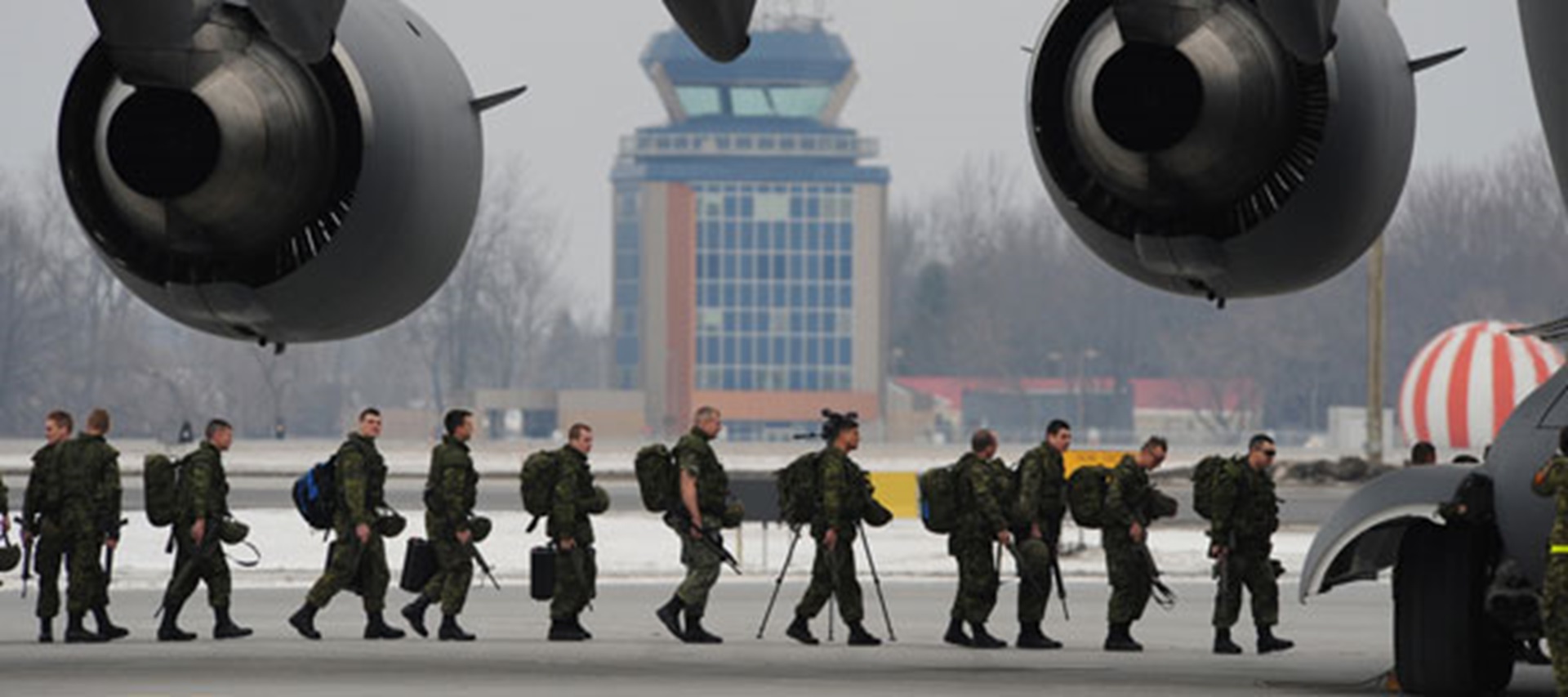

Canada's Coastlines:
The Longest Under-Defended Borders in the World
CHAPTER ONE:
Canada’s
LACK
OF RESOURCES
“At
the national level, virtually all of the organizations involved directly or
indirectly in maritime security appear to have significant capacity problems.
The escalator phenomenon prevailed during the 1990s fewer and fewer dollars
chasing greater and greater responsibilities.”
John F. Thomas,
Partner,
BMB Consulting Services, Former Coast Guard Commissioner
The Committee’s third report in
this series, For an Extra 130 Bucks… Update on Canada’s Military
Crisis (November, 2002), outlined in detail the lack of hardware and
personnel available to Canadian Forces after more than a decade of cutbacks in
Canada’s military spending. Since the focus of this report will be on new
approaches and new roles, we will keep this chapter on resource deficiencies
to minimum. However, to put the later chapters of the report in context, the
Committee decided to begin with this brief sketch of some of the resource
problems our Navy and other departments and agencies are faced with in
attempting to secure our coasts.
It will not take readers long to
recognize that Canada is not in the same league as countries like Japan, which
uses 130 maritime patrol aircraft for surveillance of a land mass equal to 38
per cent of the province of British Columbia.[1]
Or the United States, whose Coast Guard is generally regarded as the
third-largest navy in the world. Or Australia . . . the list goes on.
In January, 2003 Transport
Minister David Collenette announced a
five-year package of initiatives of up to $172.5 million to enhance the
security of Canada’s marine transportation system and maritime borders. This
was an encouraging initiative but, at an average of $34.5 million a year, it
is only a modest down payment on what is required if Canada’s maritime
defences are going to be shored up to a reasonable level.
Improved policy,
coordination and deployment of resources will take Canada a long way toward
this end, but all the improved structuring in the world is incapable of
countering inadequate resources.
Inadequacy
of Funding: The Canadian Coast Guard
The Canadian Coast Guard (CCG) is
rusting out. Although the CCG possesses 107 ships (see appendix IX, Volume 2),
the majority of them are reaching the end of their useful lives and the
federal government must make a decision soon as to whether to replace many of
these vessels or reduce their tasks. Charles Gadula, Director General,
Fleet Directorate, Marine Services, CCG told the Committee that it will
cost an estimated $350 million to replace those vessels that need to be
replaced now. This resource issue is of particular interest to the Committee,
since this report will be recommending an increase
in CCG tasks, not a decrease.
When the Chair of the Committee
cited a report that the CCG was forced to break off an exercise with U.S.
counterparts on the West Coast, Sylvain Lachance, Acting Director of the
General Fleet, acknowledged that money is short:
|
Mr. Lachance:
“We certainly have a capital problem.” Sen. Kenny:
“You cannot buy new ships, is that right?” Mr. Lachance:
“Not enough, that is correct.” |
The
Canadian Coast Guard now falls under the jurisdiction of the Department of
Fisheries and Oceans. Regarding the replacement of CCG vessels, the
Departmental written response was that “the Department of Fisheries is going
through a reassessment and realignment” process from which will flow a
capital plan for ship replacement. As of July, 2003 that plan was several
months from completion. Taking into account the need for government approval,
plus the process of issuing requests for proposals and tendering contracts,
plus the time it takes to build vessels, it is the Committee’s assessment
that given current government priorities, it is likely to be 2010 at the
earliest before the Canadian Coast Guard sees any new vessels.
John Adams, Commissioner of the
Canadian Coast Guard,
acknowledged that the CCG is currently “hurting” for funds. “Immediately
after 9/11, we were given an injection of funds to help us keep our vessels
out longer, but that money has now dissipated.” A reference to reports
that there have been shortages of both equipment and clothing for Coast Guard
personnel elicited the following response from Mr. Lachance: “There may
be cases, but it is not widespread.”
Although it is not properly funded
for the role, the Canadian Coast Guard has begun to conduct security
surveillance upon the request of other government agencies such as the RCMP
and the Canadian Navy. Turning surveillance into intelligence, of course,
requires the capacity to report the results of surveillance. Unfortunately,
the Canadian Navy is currently better able to communicate with the U.S. Navy
than it is with the Canadian Coast Guard:
|
Sen. Banks:
“A
Canadian frigate . . . can join an American task force, or vice versa, and
immediately be plugged into everything and there is no communications
problem at all, but the Canadian Navy cannot do the same thing with the
Canadian Coast Guard.” Capt. Larry
Hickey, Asst. Chief of Staff, Plans and Operations (for Maritime Forces
Atlantic, DND: “Right.” Sen. Banks: “That
is just really stupid.” Capt. Hickey: “That
is a function of investing the hardware and the systems need to pass the
information.” |
While
the Canadian Coast Guard is now being asked to play a surveillance (but
non-constabulary) role in the furtherance of national security, it clearly
does not have the resources it needs, let alone those required for a more
muscular role envisioned by the Committee. In
fact, the Auditor General reported in December, 2000 that the Canadian Coast
Guard is trying to perform five different sets of duties without proper
funding from the government departments and agencies that are benefiting from
CCG tasking.
Inadequacy
of Funding: The Canadian Navy
The Committee was told by a number
of senior naval officers that it is not Canadian Forces policy to
continually patrol Canadian waters, nor to play more than a support role
(primarily surveillance and intelligence) in defending Canadian waters through
interdiction of undesirable vessels.
During World War II Canada’s
Navy played a vital role in sinking German submarines and protecting Canadian
ships in and around Canada’s east coast and the Gulf of St. Lawrence. To the
Committee’s knowledge, no Canadian government has ever instructed the Navy
to do away with its patrol of the country’s home coasts. Nevertheless, such
patrols were largely abandoned over the years. Nor have they been restored now
that new threats have emerged.
This is partially a matter of
attitude as the mindset in the Canadian Forces has generally been that naval
vessels are best put to sea defending Canadian interests in other parts of the
world, rather than defending Canadian shorelines. It is also a matter of
practicality; naval vessels are often too big and some are too slow to conduct
efficient interdiction roles close to
Canada’s coastlines. But it is also a matter of funding.
Whether the Canadian Navy
continues to play the role it now plays in defending coastal waters - largely
one of surveillance - or whether it is called upon to become more involved in
interdiction, the Navy is under-funded. If
the Navy were called upon to upgrade its interdiction capabilities, it would
need new ships, such as cutters that can move quickly and far less expensively
than frigates.
On
June 30, 2003, Rear Admiral Glenn Davidson, Commander of the Maritime
Forces in the Atlantic (MARLANT), stated that the Navy was “taking a
pause” for a year to try to put its house in order. The Navy has finally
been forced to come to grips with a lack of funding and of rested personnel.
Sixteen of its eighteen sea-going vessels and 97 per cent of its personnel
have done service in the Persian Gulf since September 11, 2001. Canada is down
to one active ship in the Persian Gulf and has informed NATO that it will not
rejoin the NATO Standing Naval Force until the latter part of 2004.
The
12 frigates owned by Canada’s Navy are middle-aged and will soon require
their major midlife refits to perform their duties. Moreover, given the
extremely high usage rate of the frigates in the Persian Gulf and elsewhere
since September 11, 2001 the Navy’s ability to react to national and
international crises has become severely limited.
The
Committee has already commented on the sad state of the Sea
King helicopter fleet. During the height of Canadian participation in the
war on terror, two Canadian ships (HMCS
Regina and Algonquin) sailed without helicopters on board. Recently,
Canada’s Air Force has informed Canada’s Navy that it will be unable to
provide more than one serviceable Sea
King on each coast for deployment on board ship at any given time.
Helicopters, of course, are the eyes and ears of a fleet, and can often
be used to deal with potential threats before they get near a combat ship.
The
Canadian Navy’s main role in coastal defence at the moment - and perhaps far
into the future - is coordination of surveillance. Let us assume that the Navy
takes on no other significant responsibilities for coastal defence. Does it
have adequate resources to perform its current role? It is worth examining the
Navy’s capacity to coordinate surveillance under seven headings:
1.
Aurora Air Surveillance
2.
High Frequency Surface Wave Radar
3.
Satellite Surveillance
4.
Arctic Surveillance
5.
Maritime Coastal Defence Vessels
6.
Drones- Unmanned Aerial Vehicles
7.
Dirigibles
1.
Aurora Air Surveillance
Canada
provided a maritime patrol detachment of Aurora aircraft in the Persian Gulf
for 18 months, up to July 2003 reducing the capability of the Canadian
Forces’ ability to adequately patrol Canadian coastal waters. Aurora patrols
off the East and West Coasts were mostly restricted to about one a week. Even
the semi annual surveillance and sovereignty flights across the Arctic have
not been conducted for at least two years. The Aurora fleet is undergoing a
modernization program, but only 16 of 18 aircraft will be upgraded due to
financial limitations. Moreover, the three Arcturus aircraft used for training
and visual surveillance will be retired in 2005. Ergo, there will continue to
be limited resources available for “coastal surveillance flights” in the
foreseeable future.
In
the Navy’s Maritime Command Impact Study for 2003 obtained by the Ottawa
Citizen and published on Sept. 27, 2003, the option of hiring private
companies to conduct sovereignty patrols along Canada’s east and west coasts
is put forth. The reason: budget cuts and equipment shortages have hurt the
military’s ability to do the job: “Despite excellent working relations
with the Air Force, maritime air support is dwindling.”
Here
are a few examples of testimony heard by the Committee with regard to lack of
Canadian Forces resources for air surveillance off our coasts:
“We
have no standing naval patrols on either coast that are capable of keeping
watch over our maritime littoral . . . The Canadian Air Force lacks the
resources for aerial reconnaissance over any of our major ocean and sea going
areas. When they conduct occasional patrols, they are forced to use antiquated
aircraft, the Aurora patrol aircraft. These antiquated aircraft are
functioning with obsolete sensor systems and without the latest technology.”
Prof.
Wesley K. Wark, Assoc. Prof., Dept. of History, Munk Centre for
International Studies, University of Toronto
“I
do not have a great deal of difficulty at the moment with ships being deployed
in the Middle East. I have a bit of difficulty with Aurora aircraft being
deployed in the Middle East when we have few assets to conduct basic
surveillance at home.”
James C. Kelly, Research Fellow, Centre for Foreign Policy Studies,
Dalhousie University
“
. . . One must bring into question the ability of the Aurora
fleet to carry out the over-ocean surveillance missions and the cost of
doing so. At present, the full capability for this is not being used.
Peter
T. Haydon , Senior Research Fellow, Centre for Foreign Policy Studies,
Dalhousie University
2.
High Frequency Surface Wave
Radar Surveillance (HFSWR)
One
of the most positive developments in coastal surveillance is the
government’s commitment to this new type of radar. High frequency
electromagnetic signals are vertically polarized and propagate along the ocean
surface. Thus, they can detect low flying aircraft and surface targets beyond
the horizon. The HFSWR test models in Newfoundland can operate out to
approximately 200 nautical miles virtually unaffected by weather conditions
and are operational in all but the most severe of seas. This radar will go a
long way to upgrading the current patchwork system of coastal surveillance,
which is too often based on projections of where a vessel appeared to be
headed when it was spotted, rather than producing “real time” pictures of
where vessels are located at any given time.
The government is currently
funding two pilot installations (Cape Bonavista and Cape Race, both in
Newfoundland) with what the Committee was told
was a government commitment to “five or six more.” The
plan is to have these radar installations scanning approaches where vessel
traffic is greatest. This exciting world class technology, developed in
Canada, is likely to be introduced by other countries, such as the United
States and Australia, before Canada has it up and working. As this report went
to press, the proposal to put this technology in place had not even gone to
Treasury Board.
3.
Satellite Surveillance
The Committee was told that Canada
has no dedicated satellite surveillance capability, and rarely makes use of
satellite images from private companies other than Department of Fisheries and
Oceans contracts to track oil slicks from ships. Since satellite surveillance
is not a line item in the Navy’s budget, any decision to purchase satellite
coverage from a private company in any given situation is not a quick and easy
response.
Dedicated satellite surveillance
appears to be too costly for Canada’s military pocketbook, even if funding
were increased significantly (see appendix XIII, Volume 2). Obtaining the
desired coverage with a commercial imaging satellite would cost about $140,000
a day, per surveillance area, which works out to $51 million a year.
Satellites have the advantage of being able to survey a large area with
different levels of resolution. However, DND notes that satellites typically
only visit an area once every 24 hours, and it might not be possible to
refocus on a target the second time around. Given the cost, the Committee is
not critical of the Navy’s lack of satellite surveillance capacity. It
simply notes the lack of this capacity.
4.
Arctic Surveillance
Charles Gadula, Director
General, Fleet Directorate, Marine Services, Canadian Coast Guard,
told the committee that the CCG’s deployment for surveillance in the Arctic
is limited to six-ship coverage for 90 days each year. He added that, with
global warming, “Our view is that there
will be a greater need for Canadian government icebreaker support in the
Arctic, and we will need the capital replacement of Coast Guard ships to take
this into account.”
Dr. James A. Boutilier, Special
Advisor (Policy), Maritime Forces, Pacific Headquarters, Department of
National Defence,
testified that surveillance of the Arctic by Canada’s armed forces is
largely a myth:
“Experts
on the Arctic predict that commercial trans-arctic shipping may be only a
decade away. The Arctic sea route reduces the Northern Europe Northeast Asia
voyage by roughly 4,000 nautical miles. We have gone for 45 years without the
ability to move major naval assets into the Arctic. My colleagues who work in
the Arctic maintain that it is simply a question of time before there will be
commercial trans Arctic shipping. All of the evidence I have been able to
deduce is that our presence in the Arctic has been largely fictional.”
The
Committee knows of no government plans to increase surveillance in the Arctic.
Presumably, it could eventually decide to do so through the use of unmanned
aerial vehicles (UAVs) - strategic drones. The Arctic is unlikely to present a
terrorist threat, but there remain issues of sovereignty, safe transport, and
oil and mineral rights for which UAVs may prove useful.
5. Coastal Defence Vessels
The Navy’s maritime coastal
defence vessels (MCDV’s) are not, in fact, coastal
defence vessels. These ships are used
primarily for training naval reserves. The recent purchase of 12 of these
vessels, therefore will not add appreciably to Canada’s coastal defence
capabilities. Peter T. Haydon, Senior Research Fellow at the Centre for
Foreign Policy Studies, Dalhousie University, told the Committee that the
Canadian Navy needs “a new kind of coastal patrol vessel” capable
of moving as quickly as frigates but able to stay at sea for two to three
weeks. Vice-Admiral Ron Buck told us that the Navy is contemplating new
vessels that could be used for both training and patrol, but not only have
they not been built yet, they have not even been designed:
“We
have a plan to design other vessels that will be used primarily as training
vessels, but they will also do inshore patrol. They will have a higher speed. They are in the defence services program. They are awaiting
departmental approval and they will be in the 50 tonne range.”
The
Navy is currently so overtaxed performing what it believes to be its primary
role in blue water engagement far from Canadian shores that it is unlikely to
attach any kind of priority to upgrading its coastal defence capabilities.
6. Drones
The Army has
acquired a tactical unmanned target acquisition and surveillance drone, the
Sperwer UAV. It will be deployed with Operation ATHENA in Afghanistan.
Clearly, if the Army finds drone surveillance useful and economic, the Navy
would be interested in using them for coastal surveillance.
Drones permit
beyond-line-of-sight surveillance, and have been adopted for surveillance by
many countries since the Americans first introduced them to the battlefield in
the first Gulf War. The Department of National Defence website quotes Captain
Nathaniel Ng, Director Land Requirements: "We’ll actually be
able to see what’s over that next hill or on the other side of the wall. It
gives the commander a real-time image of what’s going on out there."
Eventually, the
tactical UAV system is intended to be one component of Intelligence
Surveillance Tactical Air Reconnaissance (ISTAR), a seamless surveillance and
communications system linking soldiers and commanders up and down the chain of
command. The Army plans to acquire smaller drones for use at the company level
and below.
"UAVs
are ideal for dull, dangerous and dirty missions," Capt Ng observes. "Why
have a pilot flying over an area for ten hours when a UAV can do the job? And
why put a pilot at risk when a UAV can gather the information?”
There is a difference between
strategic drones and tactical drones. The Committee considered the option of
using the recently fielded Global Hawk UAV for potential high level strategic
surveillance of Canada’s shores. These
large UAVs are capable of long hours on surveillance station (up to 24 hours)
and from high level can surveil a large area (approximately 40,000 square
kilometers). The down side to these UAVs is the present cost, in the
neighborhood of US$20 million - per copy and the support equipment and staff
required to operate them. Thus, the Committee has decided to discard the
option of strategic drones and will be recommending more cost-effective
options for coastal surveillance.
The Committee
believes that the use of tactical drones for surveillance should be considered
by the Canadian Navy, given their apparent effectiveness and relatively
inexpensive cost.
7.
Dirigibles
Most Canadians
probably associate blimps with aerial shots at sporting events. But, used in
conjunction with new optical technology, they can be very useful for security
surveillance. The U.S. Border Patrol and Homeland Security agents have begun
using a blimp to patrol Pacific Coast waters.
It is equipped
with a high resolution camera and the Littoral Airborne Sensor Hyper spectral
(LASH), an optical system that uses size and colour to identify objects that
would otherwise blend in with their surroundings. The LASH system, in itself,
cannot assure that an anomaly is a proper target, but it can do so in
conjunction with high resolution cameras and drones.
In that the Navy
cannot assemble the money or personnel to fully sustain its blue water role
over the next year, it is unlikely to even think about investing in
dirigibles.
The RCMP is supposed to have some
policing responsibilities both at major Canadian ports and on the Great Lakes
and other internal waters, but testimony showed the agency to be short of
resources to carry out its mandates.
Local police
and port security personnel have constabulary duties at the ports of Halifax,
Vancouver and Montreal, but the RCMP through its national ports project has
been reviewing security gaps at these ports that have been created by the
infiltration of organized crime. In
2002 it began to head up intelligence-led integrated teams called National
Ports Enforcement Teams at the three ports, working with other key players
such as CCRA and the local police force of jurisdiction. Their mandate
includes national security, organized crime and other criminality.
With respect
to the Great Lakes, while the Canadian Coast Guard has a presence, its primary
roles are search and rescue and boat safety. The interdict mandate belongs
largely to the RCMP. The RCMP are under-equipped and under-funded to conduct
these tasks.
The RCMP
at
the Three Major Ports
According to Supt. Ken Hansen,
Director of Federal Enforcement, over the next five years the RCMP will
receive $11.5 million of the federal government’s $172.5 million Maritime
Security package announced in January. That amounts to an average $2.3 million
a year, approved in May, 2003.
Some of
this funding will pay for enhanced criminal record checks on port employees,
and for Armed Ship Boarding Training for RCMP members. The RCMP believes that
it has received sufficient funding for these two programs.
However, the funding was enough for only eight additional investigators
at the three major ports, and the RCMP does not feel that this is adequate.
The third portion will pay for
eight investigators spread among the three major ports, new posts for the RCMP
who will supposedly manage the undermining of the organized crime that has
entrenched itself over the years. The RCMP will therefore help close security
gaps. In the words of Supt. Hansen:
“Any
organized crime presence in a port will increase the potential for terrorist
attack, because there is the possibility of corruption . . . you do not have
control over what is in the containers, where the port workers are, where the
containers are, and so on.”
In other words, when holes are
opened for criminals, they are opened for everyone. Closing these holes is to
be accomplished in conjunction with personnel from the Canadian Customs and
Revenue Agency and local police, with the RCMP taking the lead. Supt. Hansen
was bluntly honest with the Committee in saying that the RCMP had recognized
that the new government money with which it was supposed to fund this huge new
task was insufficient. As a result, the RCMP has been forced to take 16
officers from other assignments and redeploy them at the ports.
This might not constitute a
problem if the RCMP were a rich agency with extra personnel and funds to
spare. But it is no secret that it is not. For example, Senator Atkins asked RCMP
Assistant Commissioner W. A. Lenton how many helicopters the RCMP, the
agency responsible for interdiction on Canada’s coasts, has available to it
across the country. Assistant Commissioner Lenton began to count them on one
hand.
|
Sen. Atkins:
“That is pretty thin.” A/Commr. Lenton:
“Resources are thin, sir.” |
The RCMP asked for funding for 24
officers for the three major ports. The government funded only eight officers,
so the RCMP was forced to make up the difference. Even then, it is clearly
understaffed in the ports. An RCMP liaison officer to the Committee sent us a
document which states that "experience has shown that the original
estimate of 24 positions was too low. The displacement of crime from major
ports to smaller ports such as St-John's, Saint John, Quebec City, Hamilton
and Prince Rupert is also a growing concern."
The
RCMP on the St. Lawrence and on the Great Lakes
While Canada’s Atlantic and
Pacific coasts receive much of the attention, it is our border waters with the
United States the St. Lawrence River, the Great Lakes, and other adjoining
waters that some experts see as having the greatest potential for terrorist
activities.
“I
would think, from a security point of view, the highest threat areas are from
Vancouver down to the U.S.; the Great Lakes; and from Nova Scotia and New
Brunswick down to the U.S. I am not talking about vessels coming into Canada,
but going from Canada to the U.S.”
John
F. Thomas, Partner, BMB Consulting Services, Former Coast Guard Commissioner
When Supt. Hansen was asked
what he perceived to be the biggest challenges to the RCMP in its role of
countering terrorism across the country, the first one he mentioned was “a
lack of capacity to conduct armed ship boarding in the St. Lawrence Seaway,
although the new funds will give us the capability on either coast.”
A lack of capability to interdict
on the St. Lawrence Seaway constitutes a major hole in Canadian security, as
well as in North American security. On the East and West Coasts, the RCMP
often uses Canadian Coast Guard vessels for interdiction. But that capacity
has not been developed on the Seaway. So a lack of CCG capability amounts to a
lack of RCMP capability.
“It
is not just a matter of getting a platform. We have done 23 armed boardings in
the last five years. All but one have been on either coast. There has never
been a need in the past to conduct them. Therefore, we have not built that
capacity.”
Superintendent Ken Hansen, Director of Federal Enforcement, Royal Canadian
Mounted Police (RCMP)
Does
the fact that nearly all armed interdictions have been done on Canada’s East
and West Coasts mean there is no illegal behaviour occurring on the waters
between Canada and the United States? Hardly. The amount of smuggling that has
taken place on these waters over the years is legend, and if smuggling is
easy, other possibilities clearly exist.
John
F. Thomas, the former Coast Guard Commissioner,
outlined what he perceives to be the problem with small boats essentially
behaving as they please on these waters:
“Pleasure
boats are driven or sailed from Canada to the U.S., and operation licensing is
required. The licensing body is the CCRA, not the Coast Guard. That function
will be transferred to the Coast Guard. Currently, those licences are not
systematized, they are put in a box on a shelf. If you want to check who is
driving a particular boat and confirm that the operator should validly have
that boat, there are no systems that allow you to do that right now.
People
do come in on the container ships, and so on, but some of the smuggling has
been on fairly small boats. Drug smuggling is done on small boats. Pleasure
boats could do all of the [terrorist
activities] we are talking about. That is the area I see as being missed out .
. . We are starting to focus more and more on the larger commercial vessels
that are seen as being a primary threat, but we need to focus equally on the
smaller vessels because I see them as an even higher risk.”
Between
them, the RCMP and the Canadian Coast Guard admit that they do not have the
resources to even begin to address this higher risk.
This
chapter has focused on the shortage of resources at the Canadian Coast Guard,
the Canadian Navy, and the RCMP. We encountered many other areas in which
government funding has failed to respond to the magnitude of the threat that
now faces all North Americans.
We
heard evidence that CanMarNet, the information-sharing system between federal
agencies and departments that is supposed to lead to a more coordinated shield
against terrorism, is little more than a website where items of possible
interest can be posted. A proposal for a more sophisticated information
sharing system, called MIMDEX, has only been slowly working itself through the
system, and is waiting for approval from Treasury Board.
We
heard evidence that no new money has been diverted since September 11, 2001 to
intelligence research for graduate students or academics that might direct
them into the intelligence field.
These
are issues that will be addressed in following chapters. This chapter is here
only to remind Canadians that all the new approaches to surveillance,
intelligence, cooperation, administration and policy are likely to come to
nothing if adequate resources are not made available in the crucial area of
national and continental security. So far, north of the Canadian-U.S. border,
they have not been.
The
Need for
BETTER
SURVEILLANCE of
Canada’s Coastal Waters
“The
surveillance problem on our coast . . . is enormous. The areas of
responsibility are huge, with the bays along the coastline. Against a
determined and clever opponent, we are very vulnerable.” (Retired)
Commodore Hans Hendel, Consultant, Canadian Forces Staff College
“We
have no system in place to provide for any kind of systematic surveillance of
our maritime area, not on the East Coast, the West Coast, the Arctic, Great
Lakes or St. Lawrence Seaway . . . We have no standing naval patrols on either
coast that are capable of keeping watch over our maritime littoral. The
Canadian Air Force lacks the resources for aerial reconnaissance over any of
our major ocean and sea going areas.” Prof.
Wesley K. Wark, Assoc. Prof., Dept. of History, Munk Centre for International
Studies, University of Toronto
“You
are looking for something that is not quite right and only by looking at
everything can you decide what is not quite right.”
Peter T. Haydon, Senior Research Fellow, Centre for Foreign Policy Studies,
Dalhousie University
Watching
our Waters
“Domain
awareness” refers to the degree that Canadian enforcement authorities know
what is going on in their jurisdiction – both on Canada’s land mass and in
its coastal waters. Those coastal waters include:
TERRITORIAL
SEA: Canadian territory
stretching 12 nautical miles off coastal base lines and charted according to
treaties in the Great Lakes and border rivers; (see appendix XII, Volume 2)
CONTIGUOUS
ZONE: An additional 12
nautical miles beyond territorial seas; by international law, Canada is
allowed to prevent infringement of customs, fiscal, immigration or
environmental laws up to 24 nautical miles from its coasts; (see appendix XII,
Volume 2)
EXCLUSIVE
ECONOMIC ZONE: Areas of
the high seas extending beyond the contiguous zone extending out to 200
nautical miles from the coastline in which Canada is allowed jurisdiction over
natural resources. Canada can
generally only intercept and board vessels with permission of the flag state,
if there is a national security concern, or if Canadian authorities are in hot
pursuit from territorial waters (see appendix XII, Volume 2)
The
Committee made several recommendations in Defence of North America:
a Canadian Responsibility (September, 2002), to improve
surveillance of Canada’s coastal waters and ships approaching Canada’s
coastal waters by using a multifaceted “layered approach.”
The Committee recommended:
| · Adoption of a layered approach of reporting and monitoring to provide timely warning of vessels approaching Canadian waters; (Recommendation #1 page 13)
· That Canada negotiate reciprocal arrangements with other maritime nations to provide notice to one another when vessels are departing for each other’s territorial waters; (Recommendation #4 page 14) · Mandatory reporting procedures be introduced whereby all vessels (of a displacement to be determined by Canadian regulators) planning to enter Canadian waters be required to report from their departure harbour as to their Canadian destination and estimated time of arrival, with periodic updates during their voyage and upon arrival; (Recommendation #5 page 14) · A requirement that vessels (of a displacement to be determined by Canadian regulators) intending to enter Canadian waters be equipped with transponders to permit electronic tracking of all approaching vessels; (Recommendation #7 page 14) · New security measures on the Great lakes including:
|
Coastal surveillance is one area
in which the government has made some progress, although at a less urgent pace
than the Committee would have wished, and with a smaller funding commitment
than the Committee believes is necessary.
Witnesses
informed the Committee that several measures have been taken or will be taken
to improve Canada’s ability to identify vessels, crew, passengers and cargo
that might represent an approaching or arrived threat. Some of the measures
that have been introduced or announced include:
Loading in Foreign Ports
Canada is implementing a 24-hour
advance notification rule for marine cargo importation. Ocean carriers and
freight forwarders intending to ship to Canada will be required to submit data
on their cargo to the Canada Customs and Revenue Agency (CCRA) at least 24
hours before loading in a foreign port. The data will be sent electronically,
and will be processed by CCRA automated targeting systems. Based on risk
assessment, Customs officers will identify certain containers for examination
prior to loading.
This rule reflects United States
procedures and will provide a consistent reporting requirement for North
American marine shipments. It will not be mandatory until April, 2004 to give
companies time to prepare their operations and systems for implementation.
Entry
into Canadian Waters
Foreign ocean-going vessels
entering Canadian waters must obey a 24-hour rule and a new 96-hour rule.
These rules relate to the amount of notice that ships must give to the
Canadian Coast Guard-Department of Fisheries and Oceans in advance of their
entry into Canadian waters. The 24-hour rule is mandatory.
The 96-hour rule is not mandatory,
in the sense that there is no legal regulation behind it. The 96-hour rule
came into being after the September 11, 2001 terrorist attacks, when the Coast
Guard issued a "Notice to Mariners" directing all ships to also
report 96 hours before entering Canadian waters.
The 96-hour rule was an initiative
of the Interdepartmental Marine Security Working Group. The Group is still
discussing co-ordination issues related to the implementation of the rule,whether to make it mandatory, and what type of information ships will
have to provide.
Automated
Identification System
AIS is a
shipboard broadcast system that acts like a continuous and autonomous
transponder. Using the VHF maritime band, it broadcasts information such as
ship name, course and speed, and registration.
AIS was central to the December,
2002 International Maritime Organization (IMO) Conference that developed
maritime security amendments to the International Convention for the Safety
of Life at Sea. A key change was the requirement that AIS be installed on
all ocean-going ships of 300 gross tonnage and more, on cargo vessels of 500
gross tonnage and more not engaged
on international travel, and on passenger ships irrespective of size. The
agreed to deadline for compliance was December 31, 2004.
Canada supports the IMO decision.
Transport Canada is taking the lead in developing new regulations to implement
the AIS provision. The Coast Guard will develop the shore-based receiver
component of the AIS system. By the end of 2004, the above types of ships
entering Canadian waters will be required to have a transmitting AIS on board.
International
Ship and Port Security (ISPS) Code
This is one of the most
far-reaching amendments agreed to at the IMO conference. Transport Canada
notes that the Code “seeks to establish an international framework of
co-operation between governments, government agencies and the shipping and
port industries in order to detect and take preventive measures against
security incidents affecting ships or port facilities used in international
trade.” The Code comes into effect on July 1, 2004.
Transport Canada – as the
Government’s designated authority – will implement the ISPS Code. The
Department has said that its key responsibilities include “approving ship
and port facility security assessments and plans, verifying compliance with
the ISPS Code’s requirements, and exercising control and compliance measures
on foreign ships in Canada.” The Code will impose significant requirements
on shipping companies, port operations and governments, including the
development of security plans and assessments. Transport Canada will spend $
17.7 million over the next five years on the regulatory and inspection costs.
Improved
Coast Guard Surveillance
Witnesses
told the Committee that the Canadian Coast Guard has become much more
cooperative in identifying and tracking suspicious ships on behalf of other
agencies, such as the RCMP, Canada Customs and Revenue Agency and the Canadian
Navy. Before the Interdepartmental Marine Surveillance Working Group (IMSWG)
was created to improve cooperation between government departments and
agencies, there had been complaints that the Coast Guard was not always
responsive to surveillance requests from policing agencies. Now it reportedly
asks enforcement agencies what they require in terms of providing
identification of vessels of interest, tracking vessel progress, and providing
helicopter support for surveillance.
High Frequency Surface Wave Radar
Please
see discussion in Chapter 1, page 21.
Drones
Please see discussion in Chapter
1, page 25.
Great
Lakes Screening
Enhanced security screening
procedures for ships entering the St. Lawrence Seaway Great Lakes system
(introduced in the aftermath of September 11) have been refined and agreed to
by Canadian and U.S. authorities and were introduced at the opening of the
2002 shipping season.
Ships
must report to the Canadian and U.S. Seaway management corporations 96 hours
before they enter the St. Lawrence Seaway or Great Lakes.
The U.S. Coast Guard and the Canada Customs and Revenue Agency special
analysis units conduct the initial screening of the ship’s information and
submit the crew and passenger list to a centralized information centre.
Security boardings may take place
before vessels enter the St. Lawrence Seaway or Great Lakes. Security boarding typically take place at Pointe-aux-Trembles
or Montreal. But, depending on
the case, a boarding could take place at Sorel or perhaps as far away as
Quebec City. A ship can be
boarded if it does not report, reports incompletely, or is suspect for some
other reason. Based on Transport Canada’s assessment of the risk, it decides
which Canadian federal government departments and agencies should comprise the
boarding team.
If
there were no information on the ship, then inspectors from the U.S. St.
Lawrence Seaway Development Corporation and the Canadian St. Lawrence Seaway
Management Corporation would board the ship and conduct a seaway inspection
and risk assessment.
U.S.-Canada
Surveillance Planning
Subordinate to the Canada-U.S.
bi-national planning group is the Maritime Plans and Surveillance Working
Group that will concentrate on bi-national maritime security and surveillance.
This group will collaborate with groups like IMSWG and the NORAD Maritime
Surveillance Working Group to create joint military plans.
More
Funding for Fisheries Surveillance
The federal government has given
Fisheries and Oceans Canada funding for additional fisheries surveillance, and
requests for proposals have gone out to industry for some 4,000 to 5,000 hours
per year of surveillance capability, multi-engined aircraft, radar, IR sensors
and computers on board. Presumably fisheries surveillance could be dovetailed
with security surveillance, in the manner that Coast Guard planes and vessels
are now matching ships against “vessels of interest” lists being provided
by other agencies.
While
it is the intention of this report to focus on security in Canada’s coastal
waters rather than at ports, it is worth noting that Canada Customs and
Revenue Agency has introduced a number of improvements to its security
measures at sea ports, and is cooperating with its counterparts in the United
States to introduce improved security practices. Improvements include:
Passport Scanners
Primary inspection lines are now
equipped with passport scanners to determine whether or not an arriving person
should be referred to security as a high risk.
Ferry
Terminal Benchmarks
Canadian and U.S. ferry terminals
are now adhering to a series of joint benchmarks designed to improve security
and enhance interception of passengers of interest.
Examining
Canada-U.S. Vessel Identification System
Customs authorities in both
countries are working on systems to capture as much information as possible
regarding vessels entering their points, and consideration in being given to
creating a joint Canada-U.S. vessel identification system.
Targeting
Containers
Canada now has targeters of
suspicious containers in two U.S. ports (Tacoma and Newark) and the U.S. has
targeters in three Canadian ports: Vancouver, Montreal and Halifax.
Container
Scanners
Canada Customs and Revenue Agency
has begun using new technologies such as mobile/pallet gamma rays, scanning
systems, radiation detection equipment, hand-held ion scans, remotely-operated
vehicles, tool trucks, and biological and chemical weapons detectors in
Montreal, Halifax and Vancouver. Several ports have Vehicle and Cargo
Inspection Systems (VACIS) mobile gamma radiation scanners that can scan a
container in five seconds, which officials in Halifax testified have led to
the scanning or searching of 8 per cent of incoming containers, instead of the
3 per cent rate of recent years. Officials are also using, hand-held ion
scans, pallet x-ray equipment and rolling container X-rays that were designed
in Canada. U.S. authorities intend to introduce aspects of this system at
American ports.
Sharing
Security Tips
Canadian and American customs
authorities have been examining each other’s security setups to the end of
introducing best practices at ports in both countries.
High-Risk
Passengers
The two countries are also sharing
information about passengers deemed to be high risk attempting to enter either
country and have set up joint passenger analysis units in Miami and Vancouver.
But
Canada Could Do Much Better
The Committee applauds the
increased interest being shown in the crucial area of coastal surveillance. It
does, however, have a number of recommendations to make that would further
upgrade Canada’s coastal surveillance matrix.
1.
High Frequency Surface Wave Radar (HFSWR)
Several witnesses expressed
enthusiasm to the Committee that this Canadian invention will add
significantly to Canada’s domain awareness. Two test systems are currently
operating in Newfoundland, at Cape Bonavista and Cape Race. In addition to
these two pilot projects, a full-fledged capital project is being designed.
The Committee was told that the government has committed itself to funding
five or six more of these HFSWR installations, which will focus primarily on
high traffic areas frequented by commercial vessels, such as the Straits of
Juan de Fuca, the Gulf of St. Lawrence, and approaches to Halifax. However, as
mentioned earlier, this project has not yet
gone to Treasury Board.
HFSWR would be a great boon to the
concept of “layered surveillance” that the Committee has been advocating.
Current tracking of vessels of interest is sketchy. Spotters such as Coast
Guard officers may report a sighting and predict the course the vessel seems
to be taking, but intelligence officers’ assessment of where any vessel may
be at any given time is often based on information fed into the system as much
as 24 hours earlier. Vice Admiral Ronald Buck, Chief of Maritime Staff,
Department of National Defence, extolled the virtues of this radar that
“looks 200 kilometres out to sea” and that will help attach Canadian
“eyes and ears” to approaching ships:
“We
also have many other sources of information, whether it be vessel traffic
management reports, reports from a number of our allies it is called white or
commercial shipping that would all come into our operational centre, along
with this [radar] data. It would be keyed to other information we have so that
we would have a real-time picture of what is actually moving. That is a
capacity that we do not have today.”
This
is not a capacity that Canadian enforcement authorities will have in the
majority of Canada’s coastal waters, even if the Treasury Board approves
five or six additional installations. The Committee acknowledges that total
surveillance of every spot on our coastlines would be beyond Canada’s
resources, but believes the government should not restrict its HFSWR
surveillance strictly to high-traffic approaches to major ports.
“Everyone
would love to cover off the entire coastline,” said Mr. Frappier,
“but there are certain trade offs that must be made, in particular, for
fiscal reasons. [We] had to ensure that we at least had coverage of the areas
where most of the ships are coming in.”
It is time that the Government of
Canada made appropriate HFSWR coverage a reality, and that cost-saving not get
in the way of a reasonable amount of coverage.
High Frequency Surface Wave Radar has proven itself
an effective tool within a coastal surveillance matrix, and it is
cost-effective in comparison to satellite surveillance or continuous aerial
patrols. (see appendix XIII, Volume 2).
2.
Automated Identification System
AIS transponders were originally
introduced to ensure that ships traveling at night, in fog, or in other
difficult positions have a clear picture of where other ships are in relation
to them, to avoid collisions.
In conjunction with High Frequency
Surface Wave Radar, AIS receivers will allow surveillance personnel to
separate the blips that are acknowledging their presence from those that are
not. Those that are not reporting are likely to be of more interest for
follow-up surveillance from aircraft or patrol vessels than are those that do
report.
Class A transponders capable of
both transmitting and receiving location data have come down in price as
demand has increased. Such transponders currently cost in the neighbourhood of
$10,000-$12,000, installed.
The International Maritime
Organization has decided that Class A transponders must be installed in the
ocean going vessels of all its members by December, 2004.
Fishing vessels and other small vessels are not required to install a
transponder under the IMO decision. Canada supports both these positions.
A Class B AIS transponder is now
being developed. These transponders will be able to transmit, but not receive.
The cost is expected to be much lower than that of Class A transponders –
perhaps half the price.
3.
Use of Transponders
Transponders,
of course, require receivers if the data they transmit are to be of any use.
In Canada, these receivers would be the responsibility of the Canadian Coast
Guard under the Maritime Communications Traffic System (MCTS).
Canada’s AIS receivers,
according to Admiral Buck,
“would
largely be focused on the choke points. The additional ones on the East Coast
would cover the gulf area and approaches to the gulf. And on the West Coast,
the Straits of Juan de Fuca, potentially up to the Queen Charlottes and those
kinds of areas.”
Again, the layered surveillance
system will be confined to high traffic areas. Furthermore, current plans
confine it to very large vessels. Again, in the words of Admiral Buck:
“Right
now, the requirement for AIS will be on IMO-registered vessels of a certain
size. As time goes on, we will see whether it is appropriate to apply that to
other vessels. This is part of the consultation process that is going on right
now. We are not yet sure whether fishing vessels will be required to have
AIS.”
To Dr. James A. Boutilier,
Special Advisor (Policy), Maritime Forces, Pacific Headquarters, Department of
National Defence, this presents problems:
“The
problems lie in the expectation that these tracking devices will probably be
on ships over 300 tons. A number of the ships that we are looking at, illegal
vessels that are bought for $20,000 or $30,000, which is the amount that one
illegal migrant will be charged for passage, could be below that threshold.
The ship is completely expendable. It is a one way vessel. These vessels will
be more difficult to track because they are small. They do not necessarily
follow normal shipping routes, and they will not be subject to international
pressure to have these automatic tracking devices.”
4.
Canada’s Presence at Foreign Ports
In her appearance before the
Committee, Maureen Tracy, Acting Director General, Policy and Operations
Division, Canada Customs and Revenue Agency, spoke proudly of a joint
Canada-U.S. program under which U.S. Customs officers have been placed at the
ports of Halifax, Montreal and Vancouver to try to spot potentially dangerous
cargo headed for the United States from Canada, while Canadian customs
officers are placed at Newark, New Jersey, and Tacoma, Washington, to try to
spot suspicious containers headed for Canada.
“The
beauty of having the people in the U.S. and our Canadian ports,”
said Ms. Tracy,“ is that we can use our systems to jointly target
containers.”
One must question whether
terrorists or other types of delinquents wishing to target Canada would try to
approach our shores through the United
States, which has been on various colours of alert since September 11,
2001. Even if they were misguided enough to approach Canada via American
ports, would they not prefer, having already arrived in the United States, to
do their damage there?
Ms. Tracy acknowledged that the
United States “has a container security initiative where it places people
at foreign ports.” However, she said, other than Tacoma and Newark,
Canada is not interested in placing spotters at foreign ports in places like
Europe or Asia. “We do not believe that we need people at foreign
ports.” She explained that there was no need to place people at foreign
ports because, under the 24-hour rule, foreign ports can be advised to either
search or stop shipments that Canadian intelligence experts suspect might be
dangerous. “We do not believe it is necessary to have an officer over
there when you can do electronic targeting from home.”
When pressed by the Chair and
Senator Banks as to whether Antwerp might not make more sense that Tacoma, Ms.
Tracy confessed “in theory I would have to agree with you.”
The Committee believes that CCRA
should agree in practice, as well as theory. It suggests that putting people
in Newark and Tacoma can only be window dressing to counterbalance the reality
that the U.S. government is insisting on installing its agents at Canadian
ports.
5.
Drones
Drones,
used by the United States in the 1991 Gulf War, are being successfully
employed for surveillance around the world by far smaller countries than
Canada. They are capable of scanning more than 500 kilometres off our coasts.
Drones appear to be a much better
option for Canada than satellite surveillance or increased manned patrols.
Satellite surveillance is extremely expensive to rent, and is not often used
because it cannot be squeezed as a line item into the Navy’s budget. Dr.
Wesley K. Wark, Associate Professor of History at the Munk Centre for
International Studies, University of Toronto, pointed out that our Aurora
patrol aircraft, even if regular patrols were budgeted, are not properly
equipped for modern surveillance:
“The
Canadian Air Force lacks the resources for aerial reconnaissance over any of
our major ocean and sea-going areas. When they conduct occasional patrols,
they are forced to use antiquated aircraft, the Aurora patrol aircraft. These
antiquated aircraft are functioning with obsolete sensor systems and without
the latest technology.”
(In fairness, while Mr. Wark is
correct that the Auroras have been flying with outdated surveillance
equipment for some time, the Department of National Defence has now addressed
this issue. The Aurora Incremental Modernization Project has begun upgrading
16 of the 18 Auroras with new avionics, navigation and communications
equipment.)
6. Advance
Passenger Information
In
the wake of 9/11, U.S. and Canadian authorities introduced a regime under
which no aircraft leaves one country’s territory destined for the other
country’s territory without forwarding a manifest identifying the persons
scheduled to fly. This is known as the Advance Passenger Information/Personal
Name Record.
Maureen Tracy
told the committee that this system “will broaden out into the marine
cruise ship mode and ferry terminal mode at a later date.” She also said
that part of the problem with expanding the system from air to sea has been
that “I understand that cruise ship lines have much more limited
information.”
But a cruise ship should
have as much information as airlines do, and advance information on passengers
should be forwarded to Canadian authorities in a similar manner that flight
information is forwarded.
7.
RCMP Surveillance at
Ports
The
Committee noted earlier that surveillance at Canadian ports has been improved
in a number of ways, most notably in the use of improved scanning technology.
The Committee regrets, however,
that the Government of Canada has clearly under-funded new RCMP contingents at
the ports of Vancouver, Montreal and Halifax that are supposed to deal with
security gaps caused by the presence of organized crime. The RCMP originally
asked for 24 officers to staff investigative units at these three ports, and
was funded for only eight officers. It now realizes that even its original
request for 24 was insufficient. Furthermore, there is the danger that
organized crime will fan out to Canada’s smaller ports if the focus is on
the three large ports alone.
Port
surveillance is not the only area in which the RCMP is under-funded with
regard to its maritime duties. RCMP helicopters are also scarce, according to
the testimony of
| ASSISTANT COMMISSIONER W. A. LENTON, FEDERAL SERVICES DIRECTORATE, RCMP: “Through the marine security memorandum to cabinet, we have requested more resources, In reality, from an investigative perspective, we received eight in total. Therefore we have now redeployed internally 16 to make up 24 investigators, so that we have a team of eight for each of the three major ports that are of concern at this time. An additional three are dedicated toward the intelligence side of things.”
CHAIR: The so-called post 9/11 budget gave you eight additional people for ports in total, and you have reallocated since then? A/Commr LENTON: “ . . . our ultimate goal is to have eight dedicated permanent people in each of the three ports, Halifax, Montreal and Vancouver. CHAIR: By what date? A/Commr: That probably would be in place by the fall, I would expect.” SEN. ATKINS: How many helicopters are there for Canada? A/Commr: There is at least one in Moncton and I think that they still have one in Newfoundland. I do not believe that they have one at “H” division. I believe the one in Moncton services both Nova Scotia and New Brunswick . . . “ SEN. ATKINS: That is pretty thin. A/Commr: “The resources are thin, sir.” |
With respect to security
SURVEILLANCE on Canada’s coasts, the Committee recommends that:
2.1
At least eight and possibly more High Frequency Surface Wave Radar
sites be installed to monitor areas of heavy traffic on Canada’s coasts,
plus other coastal sites that terrorists might target as alternates to
high-traffic ports.
2.2
Tactical drones (Unmanned Aerial Vehicles (UAVs)) be introduced as
surveillance aids off both coasts.
2.3 The government conduct a study to ascertain whether the use of
higher-cost strategic drones should be introduced into Canada’s surveillance
matrix in the Arctic, as well as
the east and west coasts.
2.4 The Department of Transport require all vessels of more than 15 tonnes
to be equipped with transponders of at least Class B[2]
capacity by 2008.
2.5 The Royal Canadian Mounted Police (RCMP) be designated as the lead
police force at all Canadian air and sea ports with adequate funding to combat
security breaches caused by the presence of organized crime at those ports.
2.6 Canada Customs & Revenue Agency (CCRA) personnel be relocated from
the U.S. ports of Newark and Tacoma to major world ports where the likelihood
of terror-related embarkations is much more likely.
2.7 Significant numbers of Canadian Security and Intelligence Service
(CSIS) personnel be posted to major world ports to gather maritime
intelligence.
2.8 All cruise ships, ferries and other vessels approaching Canadian ports
be required to provide information on passengers and crew comparable to that
provided to immigration officials at Canadian airports under the Advance
Passenger Information/Personal Name Record Program.
2.9 Canada Customs & Revenue Agency (CCRA) ensure that there are
adequate trained personnel to operate the new technology introduced at
Canadian ports.
2.10 Goods confiscated by Canada Customs & Revenue Agency (CCRA) and
Royal Canadian Mounted Police (RCMP) in conducting their normal duties be
auctioned off and the funds raised be reinvested in the upgrading of policing
capabilities.[3]
[1] Testimony of Dr. James A. Boutilier, Special Advisor (Policy), Marine Headquarters, Department of National Defence.
[2] A Class B transponder is
able to transmit but not receive.