
Recommendations
RECOMMENDATION 1:
That the Government of Canada:
- clarify how it will help Canadians who remain unemployed or in need of support, including those who do not currently qualify for the Canada Emergency Response Benefit, when the benefit runs out; and
- provide declining benefits for the benefit based on income.
RECOMMENDATION 3 :
That the Government of Canada, with provinces, territories and Indigenous governments, give full, fair and priority consideration to a basic income guarantee.
RECOMMENDATION 5 :
That the Government of Canada consider extending the eligibility of the Canada Emergency Business Account to include businesses without a commercial banking
account, as well as extending the timeline for businesses to apply for loans.
RECOMMENDATION 7 :
That the Canada Revenue Agency publicly disclose the financial amounts recovered from ineligible and fraudulent claims to the government’s emergency benefits programs, with clear distinctions made by program and, if possible, those made as a result of error versus those proven to be intentionally fraudulent claims.
RECOMMENDATION 9 :
That the Government of Canada work with the governments of Yukon, Northwest Territories and Nunavut to ensure that northern airlines have sufficient financial support and access to gateway routes.
RECOMMENDATION 11 :
That Agriculture and Agri-Food Canada and Fisheries and Oceans Canada develop incentive programs to attract seasonal workers to the agriculture and fisheries sectors.
RECOMMENDATION 13 :
That the Government of Canada, particularly Statistics Canada, enhance its data collection and reporting practice by including additional details on region, race, ethnicity and gender.
RECOMMENDATION 15 :
That the Minister of Finance provide a substantive economic and fiscal update quarterly for the remainder of the economic crisis; and continue providing Parliament with bi- weekly reports on its emergency response measures.
RECOMMENDATION 2 :
That Employment and Social Development Canada put in place measures to ensure that workers in seasonal industries continue to qualify for Employment Insurance.
RECOMMENDATION 4 :
That the Government of Canada consider the adoption of a progressive, or scalable, eligibility threshold for the Canada Emergency Wage Subsidy; and that the duration of the subsidy be extended for particularly hard-hit sectors.
RECOMMENDATION 6 :
That the Government of Canada consider modifying the Canada Emergency Commercial Rent Assistance program to make it more effective and accessible to small businesses facing financial hardship.
RECOMMENDATION 8 :
That Employment and Social Development Canada consider providing funding to post- secondary institutions, as appropriate, to enable them to deliver comparable financial assistance to international students in need.
RECOMMENDATION 10 :
That Agriculture and Agri-Food Canada enhance its business risk management programs, particularly the AgriStability program, in all provinces and territories.
RECOMMENDATION 12 :
That Indigenous Services Canada develop a loans and contributions program that is proportionate to the needs of Canadian Indigenous businesses, regardless of their size.
RECOMMENDATION 14 :
That the Government of Canada provide timely and clear disclosure of the details of its assets and liabilities, especially regarding the inclusion of all Crown corporations’ debt, in its financial documents, such as the public accounts, budgets and economic and fiscal updates.
RECOMMENDATION 16 :
That it is time to return to traditional procedures for approval by Parliament of government spending in order to provide appropriate oversight of government expenditures.

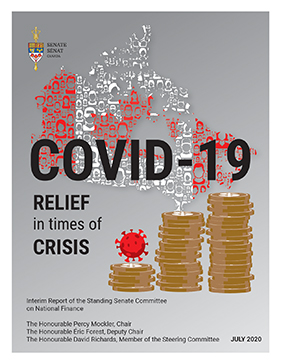
Ottawa – The federal government should return the power to approve spending to Parliament and provide quarterly fiscal and economic updates for the duration of the COVID-19 pandemic, the Senate Committee on National Finance said in an interim report released Tuesday.
The committee has been studying the government’s response to the pandemic and its economic consequences. The government’s response has been robust — many witnesses expressed sincere appreciation for the financial supports that were quickly put in place and that likely prevented a more severe economic crash. However, the government has used extraordinary powers to achieve these aims.
On March 24, 2020, Parliament passed Government Bill C-13, the COVID-19 Emergency Response Act, which granted the government considerable spending power and exempted the government from having to request Parliament’s approval to expand its borrowing authority. The Parliamentary Budget Officer, in his evidence to the committee, noted these powers are “unprecedented … in Canadian history.”
While the committee recognizes the initial need for a quick response to the pandemic — and applauds those who worked hard to launch extensive support programs — the government continues to use its new powers to put in place additional spending measures. Parliament has a fundamental role in reviewing and approving government spending, and the threat of COVID-19 shows no sign of abating in the near term. Consequently, the committee recommends a return to traditional parliamentary procedures with regard to government spending.
The committee also recommends that the government provide quarterly financial updates for the duration of the economic crisis to ensure Canadians, parliamentarians and policy-makers have accurate information about the country’s financial health.
Canada has so far avoided economic disaster. It must now plan for recovery — the livelihood of many Canadians depends on it. The committee will focus on recovery strategies when it continues its study in the fall, and it will make recommendations about how to build a smarter, fairer and more sustainable economy.
Quick Facts
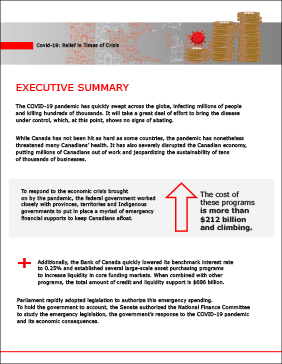
- The total cost of federal financial support programs is $212 billion and rising. The government is also providing credit and liquidity support of $686 billion.
- Businesses and their employees have been deeply hurt by the pandemic. In response, the government created the Canada Emergency Wage Subsidy, which pays out 75% of employee wages to businesses that have suffered a 30% drop in their gross revenue. However, some witnesses said the threshold is set too high and the program — initially expected to cost $71 billion — has so far only paid out $18 billion. The committee recommends adopting a scalable threshold for this benefit, so more businesses will receive the support they need to survive.
- The Canada Emergency Response Benefit (CERB) has been a lifeline to Canadians. It provides up to $2,000 a month for people who have stopped working because of COVID-19. As currently structured, people who return to work part time are cut off from the benefit, even if Employment Insurance cannot meet their financial needs. The committee therefore recommends restructuring CERB as a declining benefit, based on income, which could also provide an incentive for people to return to work.
- The committee also recommends that the government consider a basic income guarantee. The Parliamentary Budget Officer told senators that having a basic income in place prior to the pandemic could have reduced the need for the Canada Emergency Response Benefit.
Quotes
“As life with COVID-19 becomes the new normal, it is important that parliamentarians adapt. While the government and public service acted with commendable speed in implementing crucial financial supports, public and parliamentary scrutiny of spending measures will be crucial for Canada’s economic recovery.”
- Senator Percy Mockler, Chair of the committee
“The Canada Emergency Response Benefit shows the need for simple and effective income support in uncertain economic times. Many witnesses and senators strongly suggested that the government consider implementing a basic income guarantee to mitigate the economic uncertainties that will inevitably arise in the post-COVID world.”
- Senator Éric Forest, Deputy Chair of the committee
“The pandemic has caused tremendous upheaval for people across the country. We hope that our study will lead to improved programs and services that will see all Canadians share in the economic recovery. We look forward to laying out a vision for this recovery when we continue our study.”
- Senator David Richards, member of the Subcommittee on Agenda and Procedure
Associated Links
- Read the report: COVID-19: Relief in times of crisis.
- Follow the committee on social media using the hashtag #NFFN.
- Sign up for the Senate eNewsletter.
For more information:
Alexandra Scott-Larouche
Public Relations Officer | Senate of Canada
613-614-1180 | media@sen.parl.gc.ca
Senators who participated in this study

Percy Mockler
C - New Brunswick

Éric Forest
ISG - Quebec (Gulf)

Peter M. Boehm
ISG - Ontario

Jean-Guy Dagenais
CSG - Quebec (Victoria)

Marty Deacon
ISG - Ontario (Waterloo Region)

Pat Duncan
GRO - Yukon

Rosa Galvez
ISG - Quebec (Bedford)

Peter Harder, P.C.
PSG - Ontario

Marty Klyne
PSG - Saskatchewan

Tony Loffreda
ISG - Quebec (Shawinegan)

Elizabeth Marshall
C - Newfoundland and Labrador

David Richards
C - New Brunswick

Larry W. Smith
C - Quebec (Saurel)
Ex-officio members of the committee: The Honourable Senator Marc Gold, P.C. (or Raymonde Gagné), The Honourable Senator Donald Plett (or Yonah Martin)
Other Senators who have participated in the study: The Honourable Senators Dasko, Forest-Niesing, Lankin, P.C., McCallum, Miville-Dechêne, Pate and Patterson