
Recommendations
RECOMMENDATION 1:
That the Government of Canada respond to this report without delay.
RECOMMENDATION 2:
That a parliamentary committee conduct further study on the issue of forced and coerced sterilization of persons in Canada with the goal of identifying solutions to stop the practice, and that the testimony gathered during the Standing Senate Committee on Human Rights’ scoping study on this topic during the first session of the forty-second Parliament be incorporated in the future study. Survivors, affected groups and other stakeholders should be consulted on how to proceed in a sensitive manner with such a study.
Ottawa – In a report released on Thursday, the Senate Committee on Human Rights urges Parliament to further investigate and find ways to stop the heinous practice of forced and coerced sterilization of persons in Canada.
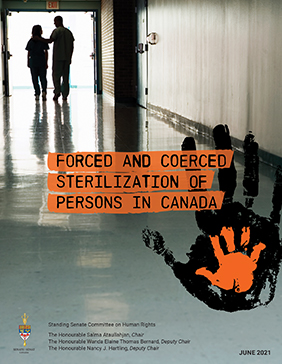
The new report, Forced and Coerced Sterilization of Persons in Canada, outlines findings of the Senate committee’s 2019 preliminary study into the history and scope of forced and coerced sterilization in Canada. Senators on the committee remain deeply troubled by what they learned from witness testimonies and submissions.
While it’s been documented that Indigenous women have been subjected to forced and coerced sterilization throughout Canada’s history, the committee’s hearings confirmed this horrific practice continues today and raised concerns that it affects numerous marginalized and vulnerable groups in the country.
As a result, the Senate Committee on Human Rights believes a larger study of forced and coerced sterilization is necessary and recommends that a parliamentary committee undertake this effort, with the goal of identifying solutions to stop the practice.
The committee asserts that survivors be consulted on how to conduct an in-depth study in a sensitive manner and on how to prevent their revictimization. To identify solutions, parliamentarians should examine how Peru and other jurisdictions have put an end to the practice and established a process to provide reparations to survivors.
The Senate Committee on Human Rights also recommends the federal government respond to their report, without delay.
Quick Facts
- Reproductive rights are considered part of the right to security of the person guaranteed by section 7 of the Canadian Charter of Rights and Freedoms as well as numerous international law instruments.
- The practice of forced and coerced sterilization of marginalized and vulnerable groups — including Indigenous women, African Canadian women, people with disabilities and people who are intersexed —has a long history in Canada; cases of forced or coerced sterilization have been reported as recently as 2019.
- The precise number of Indigenous women who have been subjected to forced and coerced sterilization in Canada is unclear, it is therefore critical that accurate data be compiled.
- Class-action lawsuits have been brought forward in Saskatchewan, Manitoba, Ontario, British Columbia, Quebec, New Brunswick and Nova Scotia and Alberta on behalf of Indigenous women who claim they were subjected to forced or coerced sterilizations.
Quotes
“The committee’s hearings confirmed that forced and coerced sterilization is not confined to Canada’s past and clearly continues today. The prevalence of this horrific practice is both underreported and underestimated. Parliament must not delay in studying the issue further and proposing ways to put it to an end.”
- Senator Salma Ataullahjan, Chair of the committee
“The committee is deeply concerned that, along with Indigenous women, other vulnerable and marginalized groups in Canada are affected by forced and coerced sterilization, including women with disabilities, racialized women, intersex children and institutionalized persons. Parliamentarians must understand the full scope of this problem if we are to initiate effective and meaningful solutions.”
- Senator Wanda Thomas Bernard, Deputy Chair of the committee
“It is paramount that any further study of forced and coerced sterilization by a parliamentary committee be culturally appropriate and trauma informed. We must not revictimize the survivors who courageously share their painful experiences to help us understand how to stop this practice from occurring in Canada.”
- Senator Nancy J. Hartling, Deputy Chair of the committee
Associated Links
- Read the report: Forced and Coerced Sterilization of Persons in Canada
- Related article: Human rights committee to study the forced and coerced sterilization of persons in Canada
- Follow the committee on social media using the hashtag #RIDR
- Sign up for the Senate eNewsletter
For more information:
Ben Silverman
Public Relations Officer | Senate of Canada
613-614-1180 | ben.silverman@sen.parl.gc.ca
Senators who participated in this study

Salma Ataullahjan
C - Ontario (Toronto)

Wanda Thomas Bernard
PSG - Nova Scotia (East Preston)

Nancy J. Hartling
ISG - New Brunswick

Yvonne Boyer
ISG - Ontario

Yonah Martin
C - British Columbia

Marie-Françoise Mégie
ISG - Quebec (Rougemont)

Thanh Hai Ngo
C - Ontario

Kim Pate
ISG - Ontario

Scott Tannas
CSG - Alberta
Ex-officio members of the committee: The Honourable Senator Marc Gold, P.C. (or Raymonde Gagné), The Honourable Senator Donald Plett (or Yonah Martin)
Senators who participated in the study during the First session of the Forty-second Parliament (2019): The Honourable Senators Ataullahjan, Bernard, Boyer, Cordy, Cormier, Hartling, LaBoucane-Benson, Moncion, Ngo, Pate, Petitclerc and Wells