
Recommendations
RECOMMENDATION 1 :
That the Department of Innovation, Science and Economic Development and Natural Resources Canada further incentivize research and innovation to expand the forest products coming from forests in Canada.
RECOMMENDATION 2:
That the Government of Canada, in collaboration with provincial and territorial governments:
a. support community forests and Canada’s 400,000 private woodland owners to build resilience in their forests; and
b. support the development of watermanagement infrastructure by provinces, territories and municipalities to help address anticipated extremes of water availability.
RECOMMENDATION 3:
That Agriculture and Agri-Food Canada, Natural Resources Canada and universities:
a. increase investment in research related to longer-term adaptation and resiliencebuilding; and
b. ensure that research results are shared with agricultural producers and forest owners/managers.
RECOMMENDATION 4:
That Agriculture and Agri-Food Canada and Natural Resources Canada work with provincial and territorial counterparts and universities to enhance extension services related to adaptation in agriculture and forestry.
RECOMMENDATION 5:
That Agriculture and Agri-Food Canada, Environment and Climate Change Canada, and Natural Resources Canada:
a. ensure that information that will build resilience in farm and forest land, such as predicted precipitation data and floodplain maps, is collected, analysed and made available to Canadian agricultural producers and forest owners/managers; and
b. expand and further develop incentives that recognize and reward resilient practices and the provision of ecosystem services.
RECOMMENDATION 6:
That Environment and Climate Change Canada and Natural Resources Canada develop systems for better monitoring of biodiversity to provide early warning indicators of biodiversity loss and to support resilience.
RECOMMENDATION 7:
That Environment and Climate Change Canada re-examine exemptions permitted for agricultural activities under the Federal Greenhouse Gas Pollution Pricing Act, with special attention to competitiveness for producers and food affordability for Canadians. In particular, the department should consider the following exemptions from carbon pricing:
a. exempt the fuel costs for machinery that heats or cools a building used for farming by including “property that is used for the purpose of providing heating or cooling to a building or similar structure” in the definition of eligible farming machinery; and
b. exempt propane and natural gas under the definition of a qualifying farm fuel for all farming activities.
RECOMMENDATION 8:
That Environment and Climate Change Canada, building on existing provincial models, develop offset protocols that would allow agricultural producers and forest owners/managers in provinces applying the federal carbon pricing backstop to receive additional income through carbon credits.
RECOMMENDATION 9:
That Agriculture and Agri-Food Canada, the Department of Innovation, Science and Economic Development through its granting councils, Environment and Climate Change Canada and Natural Resources Canada, undertake and/or support research that will help to establish baseline levels of soil organic carbon to support the development of offset protocols for carbon sequestration across Canada.
RECOMMENDATION 10:
That Agriculture and Agri-Food Canada, Environment and Climate Change Canada and Natural Resources Canada work together and with their provincial/territorial counterparts to implement policies that promote greenhouse gas emissions reductions in agriculture and forestry.
RECOMMENDATION 11:
That the Government of Canada fully implement the policy measures contained in the Pan-Canadian Framework and seek additional measures to ensure that Canada meets its international commitment on greenhouse gas emissions reductions.
RECOMMENDATION 12:
That the Department of Innovation, Science and Economic Development expand the amount of research funding available for applied climate change research and multi-disciplinary research.
RECOMMENDATION 13:
That the Government of Canada:
a. ensure that research funding is available for high-level assessment to determine the most effective, economical investments in climate change action; and
b. continue to implement programs and initiatives that reduce greenhouse gas emissions by encouraging the use of new materials, such as advanced bioproducts, and new technologies to sequester carbon, like constructing tall buildings with wood.
RECOMMENDATION 14:
That Agriculture and Agri-Food Canada, in collaboration with its provincial and territorial counterparts:
a. enhance extension services to help farmers reduce greenhouse gas emissions; and
b. support those already using lower-emissions approaches, including organic farming.
RECOMMENDATION 15:
That Agriculture and Agri-Food Canada, Environment and Climate Change Canada and Natural Resources Canada work with their provincial and territorial counterparts to ensure that there are incentives available across Canada for beneficial management practices.
RECOMMENDATION 16:
That Environment and Climate Change Canada work toward a Clean Fuel Standard that includes an increased blend mandate for ethanol in gasoline, to lower its carbon intensity.
Ottawa – The federal government must protect Canada’s agriculture and forestry sectors from rising costs associated with the coming carbon pricing regime — which could see consumers pay more for goods, the Senate Committee on Agriculture and Forestry said in a report released Tuesday.
The committee is keenly aware of the need to combat climate change, but senators also worry that producers and consumers will suffer hardship from the imposition of carbon pricing.
In its report, the committee outlines the effects of climate change on Canada’s agriculture, agri-food and forestry sectors, and examines the potential effect of carbon pricing on producers and consumers. The report also suggests ways the federal government can support these sectors as they make their contribution toward meeting Canada’s emissions reduction targets.
The committee has made a number of recommendations to strike an appropriate balance between protecting the environment and supporting the foundation of Canada’s economic well-being — Canadian workers and consumers.
Innovation will be crucial to Canada’s success. The report makes recommendations to strengthen Canada’s innovators by, for example, supporting research into the most effective and economical investments in taking action against climate change, and by expanding and developing incentives that recognize and reward resilient practices and the provision of ecosystem services.
Other recommendations are intended to insulate producers — and thus consumers — from possible increases in production costs. These include recommendations to exempt fuel costs for heating and cooling machinery used in farming, as well as propane and natural gas used in farming activities, to provide incentives for beneficial management practices, and to develop offset protocols that would allow agricultural producers and forest owners and managers to receive income through carbon credits.
These carefully considered recommendations are intended to help Canada play its part in combating climate change while supporting Canadian producers and consumers. The committee urges the federal government to act on them.
Quick Facts
- Canada’s agriculture and agri-food sector accounted for one in eight jobs in Canada in 2014, employing 2.3 million people and generating nearly $112 billion or 6.7% of Canada’s gross domestic product (GDP) in that year.
- Between 2015 and 2016, growth in Canada’s forestry sector doubled Canada’s overall economic growth, surging by 2.4%. It contributed $23.1 billion, or 1.4%, of Canada’s GDP during that timeframe.
- Agriculture is responsible for 10% of Canada’s greenhouse gas emissions, though producers are increasingly using innovative techniques to trap carbon in the ground.
Quotes
“To achieve a sustainable future we must provide incentives that spur innovation and motivate Canadians to make positive changes. It will not be easy, but our report makes thoughtful, evidence-based recommendations that will allow more Canadians to help our country combat climate change.”
- Senator Diane Griffin, Chair of the committee.
“Canada’s agriculture, agri-food and forestry sector workers contribute billions of dollars to the Canadian economy. We are impressed at their efforts to shrink their carbon footprint; our report shows how the federal government can support their work to increase the sustainability of their operations.”
- Senator Ghislain Maltais, Deputy Chair of the committee.
Associated Links
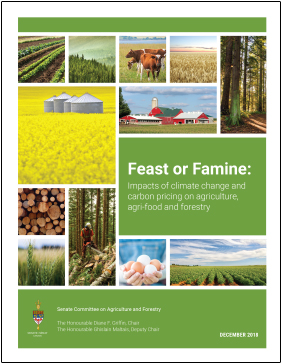
- Read the report, Feast or Famine: Impacts of climate change and carbon pricing on agriculture, agri-food and forestry.
- Read about the committee’s March 2018 fact-finding mission to Vancouver and Calgary and to Halifax and Montreal.
- Follow the committee on social media using the hashtag #AGFO.
- Sign up for the Senate’s eNewsletter.
For more information, please contact:
Sonia Noreau
Public Relations Officer
Senate of Canada
613-614-1180 | sonia.noreau@sen.parl.gc.ca
SENATORS WHO PARTICIPATED IN THIS STUDY

Diane F. Griffin
CSG - Prince Edward Island

Ghislain Maltais
C - Quebec (Shawinegan)

Salma Ataullahjan
C - Ontario (Toronto)

Wanda Thomas Bernard
PSG - Nova Scotia (East Preston)

Robert Black
CSG - Ontario

Douglas Black
CSG - Alberta

Jean-Guy Dagenais
CSG - Quebec (Victoria)

Norman E. Doyle
C - Newfoundland and Labrador

Terry M. Mercer
PSG - Nova Scotia (Northend Halifax)

Julie Miville-Dechêne
PSG - Quebec (Inkerman)

Victor Oh
C - Ontario (Mississauga)