
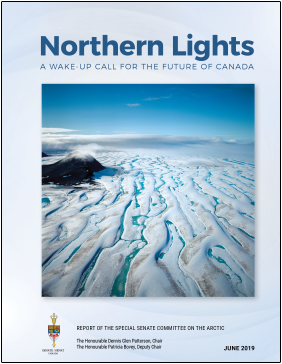
Introduction of the Chair and Deputy Chair
Northern Lights: A Wake-Up Call for the Future of Canada is the result of the Senate Special Committee on the Arctic’s year-long study. Its title reflects the urgency resulting from a history of neglect and disregard, and the deep connection to the land and environment, and references the aurora borealis and its link to Northern people’s ancestors. It underlines the plethora of future opportunities of Canada’s north. The North IS the future of Canada in countless ways. The issues are urgent; the recommendations require immediate action.
The parameters are the six themes of the government’s Arctic Policy Framework (APF). Mandate letters of the Minister of Crown-Indigenous Relations and the Minister of Intergovernmental and Northern Affairs, had the stated goal to “continue to advance work on a shared Arctic Leadership model and support northern programming, governing institutions, and scientific initiatives.” The APF was not released by the time of our writing. May this report assist in developing a living, comprehensive long-term Arctic policy.
The testimonies we heard, and information garnered on the committee’s fact-finding mission to Canada’s North, proved that multiple issues intersect, affecting the daily lives of Northerners as well as well as Canada’s national security and international relations. Time and internet connectivity precluded an exhaustive study, but it became clear the committee should be permanent, charged with further work and monitoring the many concerning situations. These interconnecting issues include northerners’ health, economy, housing, security, education, food, culture, language, communications, climate change, shipping and more. The breadth and scope of the Arctic is vast. The concerns are now covered by many government departments. We believe the continued collegial, constructive and consensus-based approach of a single, non-partisan parliamentary committee, wholly focused on the north, will be foundational in moving the APF forward.
Government policies must align with the various priorities of northerners, both Indigenous and non-Indigenous, empowering northerners to create their own programs and initiatives. The ultimate goal, in our committee’s view, should be the eventual devolution of decision-making powers about northern issues to northern institutions - decisions about the North must be made in the North, for the North and by the North.
We thank former Senator Charlie Watt for his dedicated efforts to establish a Special Senate Arctic Committee. We also thank committee and office staffs, the clerks and analysts. All have contributed greatly to ensure the committee operated as efficiently as possible. We thank the artists, right holders, copyright holders and photographers, too, for permission to use their work in this report. It is an honour to present works of art by Canadian artists, these being particularly germane to the scope of the report. Finally, we would like to convey our sincere appreciation to all the witnesses who appeared before the committee and the warmth of those whom we met on tour. Your testimony and all your comments were critical to our conclusions and recommendations.
With everything we have heard and seen regarding the very serious issues the North faces and the Arctic being an essential part of Canada, we believe that the Special Senate Committee on the Arctic become a permanent Standing Committee of the Senate of Canada.
Read the introduction in:
Executive Summary
For far too long, the Arctic and northern regions have been neglected by Canada. Crises remain unresolved and the well-being of residents, left to tackle enormous challenges on their own, has been overlooked. Arctic residents are more than up to the task of resolving these challenges and they know what needs to be done. It is essential that the Government of Canada recognize that the Arctic requires greater attention, investment and consistent support from the federal government, to complete Canada’s nation-building project. The impact of federal underinvestment hits hardest on the Arctic’s greatest asset, Indigenous youth. Opportunities for nation-building can no longer be missed.
As highlighted by the title of this report, Northern Lights: A Wake-Up Call for the Future of Canada, the Special Senate Committee on the Arctic (the committee) understands that the Arctic is Canada’s future. This report is an urgent wake-up call. The committee’s mandate was to study the “significant and rapid changes to the Arctic and impacts on original inhabitants.”As the Government of Canada prepares a new policy framework for the Arctic, this study recommends important changes for federal policy in areas such Canada’s sovereignty and safety, devolution of federal programs and services and investments in infrastructure to support the well-being and future prosperity of Arctic communities. This report, like others before it, makes recommendations that Arctic residents have raised time and time again.
Canada’s Sovereignty in the Arctic
Arctic residents keenly observed other countries’ interest in the region’s natural resources and the Northwest Passage. The committee recommends that the Government of Canada ensure the Canadian Arctic security and safety and assert and protect Canada’s sovereignty in the Arctic. In the committee’s view, actions ensuring prosperous, sustainable and safe Arctic communities are vital to enhance Canada’s ability to project its Arctic foreign policy, including sovereignty in the region.
Empowering Arctic Residents
The committee heard from numerous federal departments with responsibilities related to the Arctic, often working in silos. Indigenous and territorial leaders stressed that policy, legislation and service delivery must occur in the North, by the North, for the North. The committee therefore recommends that the Government of Canada develop a strategy that: 1) empowers Arctic and northern governments to assume roles in delivering federal programs and services to its residents; and 2) devolves federal programs and services related to the Arctic and northern regions to local, territorial and Indigenous governments.
Infrastructure Building to Face the Challenges of a Changing Arctic
With little infrastructure in many communities in the Arctic, people struggle to access water and sanitation, housing, good schools and healthcare. As the climate warms and permafrost thaws, the urgency of the Arctic’s challenges come into plain view: traditional food supplies are threatened; homes are endangered by the rising seas and the ice becomes unsafe for travel.
Understanding that Arctic communities deserve better, the committee recommends that the Government of Canada: 1) complete a building code adapted to Arctic conditions and the effects of climate change; 2) implement an action plan to mitigate the effects of climate change on existing and new infrastructure, including housing; 3) take immediate measures to address the housing crisis in the Arctic by funding a complete continuum of Arctic housing; and 4) report on the effects of its investments on housing annually to local, Indigenous and territorial governments. Broadband telecommunications access in the Arctic is unavailable, poor and, where available, expensive and often unreliable. The committee agrees with witnesses that broadband access is necessary and recommends that the Government of Canada establish a broadband telecommunications action plan with dedicated funds to support fibre deployment to underserved regions in the Canadian Arctic by March 2020.
The committee strongly believes that the social, cultural and economic well-being of Arctic residents should be the cornerstone of the forthcoming federal policy framework for the Arctic and northern regions. Implementation of the recommendations put forward by this report will contribute to the effectiveness of that framework for the future of Canada.
Read the executive summary in:
Recommendations
HEALTHY ECONOMIES TO BENEFIT THE ARCTIC
RECOMMENDATION 1
That the Government of Canada adopt a consistent definition of the Arctic with respect to legislation, policy directives and programs.
RECOMMENDATION 2
That the Government of Canada develop a strategy that: 1) empowers Arctic and northern governments to assume roles in delivering federal programs and services to its residents; and 2) devolves federal programs and services related to the Arctic and northern regions to local, territorial and Indigenous governments.
RECOMMENDATION 3
That the Government of Canada: 1) provide greater financial support towards the implementation of comprehensive land claims agreements, including land use planning processes and governance of regulatory boards; and 2) consult and cooperate with Indigenous and territorial governments to develop co-management regimes with respect to the Arctic offshore waters.
RECOMMENDATION 4
That the Government of Canada appoint a Minister of Northern Affairs in control of its own parliamentary appropriation and that this cabinet position report annually to Parliament on its activities.
RECOMMENDATION 5
That the Government of Canada, in partnership with Indigenous and territorial governments, establish an Arctic Infrastructure Bank to fund new infrastructure and mitigate the effects of climate change on existing infrastructure, and to ensure the funds are directed based on Arctic needs.
RECOMMENDATION 6
That the Government of Canada: 1) direct the National Research Council to complete a building code adapted to Arctic conditions and the effects of climate change; 2) implement an action plan to mitigate the effects of climate change on existing and new infrastructure, including housing; 3) take immediate measures to address the housing crisis in the Arctic by funding a complete continuum of Arctic housing; and 4) report on the effects of its investments on housing annually to local, Indigenous and territorial governments.
RECOMMENDATION 7
That the Government of Canada establish a broadband telecommunications action plan with dedicated funds to support fibre deployment to underserved regions in the Canadian Arctic by March 2020.
RECOMMENDATION 8
That the Government of Canada ensure Arctic and northern communities have reliable and secure forms of energy, including renewable energy and alternates to diesel based on locally identified priorities and opportunities.
RECOMMENDATION 9
That the Government of Canada support Indigenous and/or territorial governments to: 1) increase funding for Basic Adult Education in the Arctic; 2) ensure students can pursue studies in their Indigenous language; and 3) support the Government of Nunavut to establish a university in the Eastern Arctic.
RECOMMENDATION 10
That the Government of Canada, in partnership with Indigenous and territorial governments, build upon and support existing territorial education and labour force strategies based on Arctic peoples’ priorities and needs, to decrease the reliance on southern workers.
RECOMMENDATION 11
That Employment and Social Development Canada and Innovation, Science and Economic Development Canada: 1) immediately adapt its skills and employment programs to the educational attainment and labour force realities of the Arctic; 2) with Indigenous and territorial governments, use data to better target federal investments in post-secondary education and training to Arctic peoples’ priorities and the labour market to meet the needs of this generation of Arctic youth; and 3) invest in post-secondary education and training in such areas as trades, arts and conservation sectors, or other priorities as identified by northerners.
CULTURE AS A PATHWAY TO STRONG AND HEALTHY COMMUNITIES
RECOMMENDATION 12
That the Government of Canada, with Indigenous, territorial and local governments, take immediate measures to address the social determinants of health that takes into account Indigenous norms, values and languages in the Arctic and northern regions with specific investments, goals and measurable outcomes reported annually to both houses of Parliament.
RECOMMENDATION 13
That Canadian Heritage increase its investments in the Northern Aboriginal Broadcasting Program and extend multi-year, flexible funding specific to Arctic recipients so they can produce content in the Indigenous language of their choice.
RECOMMENDATION 14
The Government of Canada, in close collaboration with local, Indigenous and territorial governments, support the development of multi-use community centres for the practice of arts, culture and language.
RECOMMENDATION 15
That the Government of Canada and the Canada Council for the Arts work with Indigenous and Arctic arts organizations, to provide local outreach to Arctic and northern artists, including specific supports to emerging artists in such areas as building capacity to apply for grants and to exhibit their work.
SCIENCE, INDIGENOUS KNOWLEDGE AND ENVIRONMENTAL CONSERVATION
RECOMMENDATION 16
That the Government of Canada collaborate with territorial governments, Arctic Indigenous governing bodies, academic institutions and industry to grow the scientific capacity of northern agencies and peoples responsible for devising adaptation efforts to climate change.
RECOMMENDATION 17
That the Government of Canada create mechanisms for Arctic Indigenous representational organization’s input into federal research governance bodies, and partner with Arctic Indigenous governing bodies and communities in setting Arctic research priorities as it relates to funding requirements.
RECOMMENDATION 18
That the Government of Canada, with Indigenous governing bodies and organizations, develop a government-wide policy to direct how Indigenous knowledge and science can be better synergized to reflect a holistic approach, including the recognition of intellectual property rights of Indigenous knowledge holders.
RECOMMENDATION 19
That the Government of Canada: 1) Support community-driven environmental conservation efforts; 2) Recognize the central role of co-management bodies in the Arctic when proposing environmental conservation initiatives; and 3) Ensure collaborative governance in environmental decision-making.
RECOMMENDATION 20
That the Government of Canada recognize socio-economic and cultural equity opportunities in Arctic environmental conservation and invest in the development of infrastructure and Indigenous environmental stewardship initiatives that support a conservation economy.
THE ARCTIC IN A GLOBAL CONTEXT
RECOMMENDATION 21
That the Government of Canada enhance support for the University of the Arctic to provide Arctic youth with international learning opportunities and enable the network to increase its activities in Canada and throughout the circumpolar Arctic.
RECOMMENDATION 22
That the Government of Canada increase support for international Arctic scientific cooperation, while ensuring that scientific activities conducted in the Canadian Arctic are focused on the knowledge needs of local Arctic residents.
RECOMMENDATION 23
That the Government of Canada ensure the Canadian Arctic’s security and safety and assert and protect Canada’s sovereignty in the Arctic.
RECOMMENDATION 24
That the Government of Canada, on an immediate basis, establish a robust governance regime to regulate activities in Canada’s Arctic waters, including shipping corridors, and bonding and insurance requirements. Such a regulatory regime must include the active involvement and participation of Arctic Indigenous governing bodies and communities.
RECOMMENDATION 25
That the Government of Canada enhance maritime and aerial situational awareness of the Canadian Arctic, including improving the icebreaking capacity of the Canadian Coast Guard, and equipping the Canadian Rangers’ with marine capabilities.
RECOMMENDATION 26
That the Government of Canada propose the establishment of a Pan-Arctic Infrastructure Bank at the Arctic Council and ensure an improved investment climate and trade flow in the circumpolar Arctic Region.
RECOMMENDATION 27
That, to ensure regional stability and facilitate information-sharing, the Government of Canada establish a forum dedicated to Arctic security issues involving the participation of all Arctic states.
RECOMMENDATION 28
That, to reinforce international Arctic cooperation, the Government of Canada increase its involvement at the Arctic Council as well as bolster funding for Indigenous permanent participants of the Council.
RECOMMENDATION 29
That the Government of Canada increase Arctic Indigenous representation at international forums and treaty negotiations related to the Arctic, including the United Nations Convention on the Law of the Sea
RECOMMENDATION 30
That the Government of Canada address the urgent need to enhance search and rescue and emergency protection infrastructure in the Arctic, and ensure Arctic Indigenous communities are involved in the management of this infrastructure.

Ottawa – Canada’s Arctic is in crisis. The urgency results from decades of neglect and disregard, climate change and lack of infrastructure. The Special Senate Committee on the Arctic released its report Northern Lights: A Wake-Up Call for the Future of Canada on Tuesday, concluding its intense year-long study and is telling Canadians that “the North IS the future of Canada.”
The report’s title reflects the deep connection northerners past and present have to the land and environment, and speaks to future opportunities of and for Canada’s North.
The six themes of the government’s Arctic Policy Framework (APF), a framework not yet released, are all addressed in the report’s four chapters: Healthy Economies, Culture and Language, Science and Indigenous knowledge, and the Arctic in the Global Context. Testimonies heard emphasized the intersection of issues, including health, the economy, housing, security, education, food, culture, language, communications, climate change, shipping and conservation. All affect the daily lives of northerners and Canada’s national security and international relations. All are critical.
The committee concluded that government policies must align with priorities of northerners, both Indigenous and non-Indigenous. The federal government must empower Arctic and northern governments to assume roles in delivering federal programs and services to residents, and it must devolve programs and services to local, territorial and Indigenous governments.
Decisions about the North must be made in the North, for the North and by the North.
Quick Facts
- Canada’s Arctic is over 40% of our landmass and home to many isolated communities.
- The effects of climate change are felt even stronger in Canada’s Arctic, which is warming up at almost three times the global rate and the thawing permafrost will require housing infrastructure renewal in order to deal with the changing landscape.
- Lack of suitable infrastructure remains one of the biggest obstacles to Arctic residents, including access to clean water and sanitation, housing and education.
Quotes
“The devolution of decision-making responsibilities to northerners is something that I have been fighting for my entire political career. Northerners are on the front lines of these rapid changes and, as such, are best positioned to make decisions on how to quickly and effectively respond to them. No one understands the realities of the North like those who live there.”
- Senator Dennis Patterson, Chair of the committee
“Preserving and embracing northern cultures and languages is essential. So too is empowering communities through traditional knowledge, education and training, and protecting Canada’s sovereignty and safety on land and water.”
- Senator Patricia Bovey, Deputy Chair of the committee
Associated Links
- Read the report: Northern Lights: A wake-up call for the future of Canada.
- Follow the committee on social media using the hashtag #ARCT.
- Sign up for the Senate eNewsletter.
For more information:
Sonia Noreau
Public Relations Officer | Senate of Canada
613-614-1180 | sonia.noreau@sen.parl.gc.ca
Senators who participated in this study

Dennis Glen Patterson
CSG - Nunavut

Patricia Bovey
PSG - Manitoba

Dawn Anderson
C - Northwest Territories

Mary Coyle
ISG - Nova Scotia (Antigonish)

Donna Dasko
ISG - Ontario

Joseph A. Day
Non-affiliated - New Brunswick (Saint John-Kennebecasis)

Nicole Eaton
C - Ontario

Richard Neufeld
C - British Columbia

Victor Oh
C - Ontario (Mississauga)
Ex-officio members of the committee: the Honourable Senators Peter Harder, P.C. (or Diane Bellemare), or (Grant Mitchell), Larry W. Smith (or Yonah Martin), Yuen Pau Woo (or Raymonde Saint-Germain) and Joseph A. Day (or Terry M. Mercer).
The committee would like to recognize the following Senators who are no longer serving members of the committee whose contribution to the study was invaluable: the Honourable Senators: Yvonne Boyer, Rosa Galvez, Marilou McPhedran, Kim Pate and Charlie Watt (retired).
Other Senators who have participated in the study: the Honourable Senators: Gwen Boniface, Colin Deacon, Marc Gold, Mobina Jaffer, Mary Jane McCallum, Paul E. McIntyre and Carolyn Stewart Olsen.