
Recommendations
RECOMMENDATION 1:
The federal government establish a Royal Commission on Taxation to examine Canada’s tax system with the goal of improving the efficiency, simplicity and international competitiveness of the system and that the commission complete its study within the next three years.
RECOMMENDATION 2:
The federal government act immediately to implement measures that would encourage companies to continue to invest in Canada, such as reducing the corporate income tax rate and temporarily allowing the full and immediate deduction of capital expenditures.
RECOMMENDATION 3:
The federal government take action to improve Canada’s regulatory regime, aiming to balance competing interests and ensure project completion.
RECOMMENDATION 4:
The federal government assist companies in commercializing their intellectual property through better protections in international trade agreements, increased funding for research and development and expanding the Scientific Research and Experimental Development investment tax credit program.
RECOMMENDATION 5:
The federal government should, on an urgent basis, improve Canada’s trade infrastructure, with particular focus on bottlenecks within Canada’s gateway transportation networks including rail, pipelines, roads and port infrastructure.
It should also re-examine the Beyond the Border Initiative, and encourage the implementation of those measures in Canada and the United States that would expedite the transportation of goods across the Canada-United States border.
RECOMMENDATION 6:
The federal government focus on expediting trade in emerging, fast-growing economies, such as China and India. It should continue to negotiate and implement free trade agreements and provide other support programs for businesses exporting beyond North America.

Ottawa – Canada must overhaul its tax system and make it more friendly to business if the country is to remain competitive, the Senate Committee on Banking, Trade and Commerce said in a report released Tuesday, October 16, 2018.
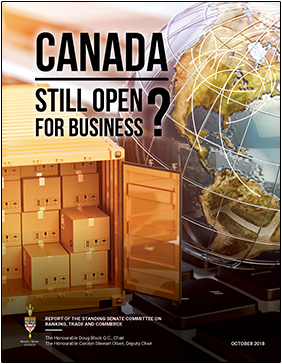
The report, Canada: Still Open for Business? examines new and emerging issues for Canadian importers and exporters with respect to the competitiveness of Canadian businesses. Recent tax changes in the United States, for example, have reduced Canada’s competitive advantage. In the short term, the federal government must take steps — like cutting the corporate tax rate — to curb the flight of investment and talent to the south. In the long term, the committee recommends that the government set up a Royal Commission on Taxation to make long-overdue reforms to Canada’s dated tax system.
Meanwhile, stalled energy projects have damaged Canada’s reputation as a country that can get things done and highlighted the urgent need for trade infrastructure. The lack of pipelines prevents Canada from getting the best price for its oil resources, which costs money and jobs.
Businesses, professionals and capital are increasingly mobile. The federal government must create a hospitable climate for these economic growth drivers or Canada risks being left behind. The committee’s report makes six recommendations to keep Canada open for business.
Quick Facts
- The last Royal Commission on taxation took place in 1962. Piecemeal change has taken place in the intervening years, making the tax system more burdensome. It has been decades since the last major overhaul of the tax system.
- In December 2017, the U.S. corporate income tax rate fell from approximately 39.1% to 26.0%, when accounting for subnational rates. At 26.7%, Canada’s rate went from being far lower than the U.S. rate to slightly higher, effectively eliminating Canada’s main corporate tax advantage over the United States.
- Witnesses identified protection of intellectual property as a particular concern for high-tech firms; a lack of robust protection makes these companies less inclined to expand outside of Canada.
- Within the last two years, three major pipeline projects have faced major regulatory challenges. The Energy East and Northern Gateway pipeline projects were cancelled in 2017 and the Trans Mountain pipeline was first purchased by the federal government and then had its approval overturned by the courts in 2018.
- Over three quarters of Canadian exports and more than half of Canadian imports go to and come from the United States. The committee believes the government should pursue closer trading relationships with other countries to reduce Canada’s reliance on the U.S.
Quotes
“Canada must show the world that it is willing to encourage innovation by allowing industry to be more productive. Businesses can choose the jurisdiction that best suits their needs. We have to make sure that Canada can compete.”
- Senator Doug Black, Q.C., Chair of the committee.
“If the federal government fails to implement these recommendations, Canada risks being left behind and our economic prosperity will decline — not just in one region but from coast to coast to coast.”
- Senator Carolyn Stewart Olsen, Deputy Chair of the committee.
Associated Links
- Read the report, Canada: Still Open for Business?
- Follow the committee on Twitter, Facebook and Instagram using the hashtag #BANC.
- Sign up for the Senate’s eNewsletter.
For more information, please contact:
Sonia Noreau
Public Relations Officer
Communications Directorate
Senate of Canada
613-614-1180 | sonia.noreau@sen.parl.gc.ca
Senators who participated in this study

Douglas Black
CSG - Alberta

Carolyn Stewart Olsen
C - New Brunswick

Jean-Guy Dagenais
CSG - Quebec (Victoria)

Joseph A. Day
Non-affiliated - New Brunswick (Saint John-Kennebecasis)

Sabi Marwah
ISG - Ontario

Scott Tannas
CSG - Alberta

David Tkachuk
C - Saskatchewan

Pamela Wallin
CSG - Saskatchewan

Howard Wetston
ISG - Ontario
Ex-officio members of the committee: The Honourable Senators Peter Harder, P.C., Diane Bellemare, Grant Mitchell, Larry W. Smith, Yonah Martin, Joseph A. Day, Terry M. Mercer, Yuen Pau Woo and Raymonde Saint-Germain
Other Senators who have participated in the study: The Honourable Senators Pierre J. Dalphond, Linda Frum, Ghislain Maltais, Richard Neufeld and Betty Unger