
Report
Highlights
In Canada, health and language are both areas of shared jurisdiction. People have high expectations that the federal government will take on a leadership role in protecting the language rights of the Canadian population when it comes to health care. In a context where the various levels of government are working to build a stronger Canada, every Canadian should be able to receive health services in the official language of their choice.
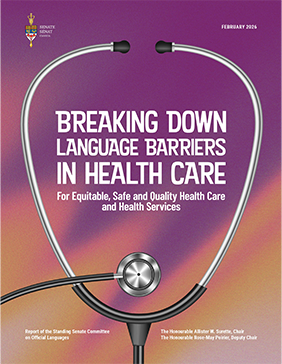
In this report, the Standing Senate Committee on Official Languages outlines the findings resulting from a series of public hearings held over 18 months on the theme of access to health care services in the minority language. In total, 121 witnesses and 36 written submissions led the Senate Committee to make 14 recommendations. The recommendations focus on reducing language barriers in health care.
This report is directed at various federal ministers and partners in an effort to ensure equitable, safe and quality care. It advocates for the right of health system users to receive services in a language they understand and in which they would like to be understood. Accordingly, this approach would lead to improved health outcomes.
The Senate Committee notes that health inequities come at a cost, and official language minority communities are often the ones paying the price. The lack of planning across the health care services continuum is partly responsible for these poor outcomes. However, the federal government could set the standard of offering a full range of services in the official language of choice in all care settings and at all stages of life. Of course, this would require continued collaboration with all its partners.
The Senate Committee is calling on the federal government to review some of its statutes and practices in order to better align needs, service delivery and available capacities. Including language objectives in federal health legislation is one of the solutions to be considered. Another is adopting a regulatory framework that clearly defines the requirements for consulting official language minority communities and for language clauses.
The Senate Committee suggests that the next government-wide strategy on official languages should enhance support for minority post-secondary institutions and community organizations. These commitments should be paired with mechanisms that promote stable, multi-year funding. In addition, sectors with the most pressing needs should be prioritized in order to promote better health outcomes for official language minority communities. This would involve increased efforts to address the need for bilingual workers in health care, including by developing a fast-track immigration gateway for francophone and bilingual health care workers.
The Senate Committee believes that if federal institutions adopted a language lens tailored to the needs of official language minority communities, it would lead to better outcomes. In addition, it appears necessary to promote national language standards among all partners. These actions must be accompanied by up-to-date research on official language minority communities. This research needs to integrate linguistic variables into data collection, using an intersectional approach that meets the needs of vulnerable communities. Implementing these approaches would encourage the adoption of best practices. The more these practices are systematic and shared, the more that health services for the minority population will improve, which will lead to better health outcomes.
The Senate Committee is in favour of establishing best practices for language concordance and the active offer of services in both official languages. Examples given during the public hearings include identifying a patient’s language of choice, indicating bilingual resources and services, providing language training for health professionals and supplying professional interpretation. The federal government should draw inspiration from this input. Integrating these practices across the Canadian health care system cannot be achieved unless the necessary resources are available. This means not only recruiting and retaining bilingual professionals, but also identifying them in order to facilitate access to available services.
In addition, the Senate Committee urges the federal government and its partners to take into account the language needs of the population when planning the deployment of new technologies and when considering privatization practices within health care. In all cases, the active offer of services of equal quality in both official languages and consultations with official language minority communities must be encouraged.
In summary, rigorous, strategic and systematic planning for health services in the minority language is the ideal to be achieved. However, it is possible only with the collaboration of all health partners involved. The Senate Committee calls on the federal government to send a clear and unequivocal message about the importance of ensuring that every Canadian has access to health services in the official language of their choice.
Recommendations
Revising the Canada Health Act
Recommendation 1
That the federal government review the Canada Health Act to ensure that federal health investments adhere to the principles of the Official Languages Act and formally support health care services for official language minority communities.
Defining language clauses
Recommendation 2
That the President of the Treasury Board include in the regulations governing the implementation of Part VII of the Official Languages Act a clear definition of language clauses. These must include obligations with respect to:
- consultations with communities;
- data collection on these communities;
- identification of the results to be achieved;
- implementation oversight;
- transparency; and
- accountability.
Recommendation 3
That the President of the Treasury Board work with the Minister of Health to include these language clauses in all bilateral health agreements during the next round of negotiations with the provinces and territories.
Enhancing direct funding for community organizations
Recommendation 4
That the Minister responsible for Official Languages enhance support for community organizations in the next government-wide official languages strategy, with stable, multi-year funding mechanisms that will encourage collaboration between organizations and with all health partners.
Enhancing direct funding for post-secondary institutions
Recommendation 5
That the Minister responsible for Official Languages increase support for minority post-secondary institutions in the next government-wide official languages strategy, with measures developed in consultation with the institutions and in collaboration with the provinces and territories, professional bodies and accrediting bodies. These measures will target:
- the long-term sustainability of existing programs;
- the development of new health education programs in areas that are in demand;
- the development of a pan-Canadian language training strategy for professionals from here and abroad;
- the reduction of language barriers in entry-to-practice; and
- the reduction of language barriers in the transition into the workforce.
Attracting bilingual workers
Recommendation 6
That the Minister of Jobs and Families work with the Minister of Immigration, Refugees and Citizenship and the Minister responsible for Official Languages to ensure that foreign credential recognition efforts take into account the needs of official language minority communities with regard to bilingual health care workers. That, in the next government-wide official languages strategy, the federal government develop a fast-track immigration gateway for francophone and bilingual health care workers.
Supporting the continuum of health care
and services in the minority language
Recommendation 7
That all federal institutions apply a language lens tailored to the needs of official language minority communities in all their diversity, including those from vulnerable communities, when developing health programs, policies and initiatives.
Recommendation 8
That the Minister of Health support the implementation of the “Access to Health and Social Services in Official Languages” standard with all health partners across the continuum of health care and services.
Accelerating language data collection
and the sharing of disaggregated data
Recommendation 9
That Health Canada, Statistics Canada and the Canadian Institute for Health Information work with all health partners to integrate language variables into:
- databases on population health;
- the provision of or demand for health services; and
- the health workforce.
That this data be widely shared, particularly to inform the positive measures taken by decision-makers within federal institutions to ensure the health of official language minority communities and to support the decision making of other health partners.
Supporting intersectional research and analyses
Recommendation 10
That the Canadian Institutes of Health Research, with support from Canadian Heritage and Innovation, Science and Economic Development Canada, and in consultation with official language minority communities:
- develop and systematically apply a language lens to health research;
- encourage researchers involved in health care research funded by the federal government to measure the linguistic impact of their research; and
- support existing research chairs dedicated to health in official language minority communities and consider creating new research chairs to address the needs of vulnerable communities.
That federal institutions provide targeted support for research into the health of these communities in all their diversity and that they identify the measures to be taken to meet their differentiated health needs.
Supporting language concordance measures
in collaboration with all partners
Recommendation 11
That the federal government ensure that all health care partners apply language concordance best practices, such as linguistic identification of patients, identification of bilingual resources and services, language training for health care professionals and professional interpretation, while providing the human, financial and material resources necessary to ensure their integration into the Canadian health care system as a whole.
Striving for a standardized active offer practice
Recommendation 12
That the federal government ensure that all health care partners apply active offer best practices, while providing the human, financial and material resources necessary to ensure their integration into the Canadian health care system as a whole.
Ensuring that official languages are reflected in new practices
Recommendation 13
That the federal government work with provincial and territorial governments to develop a pan-Canadian strategy to provide telemedicine services, digital services and virtual care in official language minority communities, and that it take into account the needs of these communities in the deployment of artificial intelligence tools for health care.
Recommendation 14
That the federal government ensure that provincial and territorial governments apply the standards applicable to private companies acting on behalf of public health institutions for
- the active offer of services of equal quality in both official languages; and
- consultation with official language minority communities.

Ottawa – Canadians without access to health services in the official language of their choice risk suffering negative health outcomes, according to a report by the Senate Committee on Official Languages.
The committee’s first-ever in-depth study of the health sector examines the challenges of providing health care services in official language minority communities. These challenges include a shortage of bilingual health workers, a lack of national language standards among all health care partners, a lack of data on minority language communities, and a lack of planning across the health services continuum.
Over the course of 18 months, the committee heard many stories of how language barriers can affect the quality, security and equity of care offered to patients. The report makes 14 recommendations aimed at ensuring every Canadian has access to health services in the official language of their choice. These recommendations include enshrining language clauses in bilateral health agreements, increasing funding for community organizations and post-secondary institutions, fast-tracking immigration for francophone and bilingual health care workers while also improving foreign credentials recognition, prioritizing language needs when deploying new technologies and improving language data collection.
The committee urges the federal government to show leadership in ensuring all Canadians have equitable access to health care in the official language of their choice.
Quick Facts
- The committee heard from 121 witnesses and received 36 submissions over an 18-month period.
- According to consultations carried out in 2022 by Health Canada, anglophone and francophone minority communities have difficulty accessing health services in their own language. Primary care, long-term care, home care and mental health are among the sectors with the greatest challenges.
- Health was enshrined in the modernized Official Languages Act as a sector essential to enhancing the vitality of official language minority communities.
- Statistics Canada’s Survey on the Official Language Minority Population, published in 2024, illustrates the challenges faced by English-speaking adults in Quebec and French-speaking adults outside Quebec in accessing health services. The same challenges were raised in the testimonies heard by the committee.
Quotes
“Canada’s universal health care system is a pillar of the country, yet many Canadians face significant barriers when accessing health services in the language of their choice. Under the modernized Official Languages Act, Canadians have a right to expect federal institutions to take concrete, positive steps to facilitate and improve access to health services in patients’ official language throughout the Canadian health care system.”
- Senator Allister Surette, Chair of the committee
“Whether at the doctor’s office, in the emergency room or in a long-term care facility, patients living in a province where language guarantees exist rightly expect to receive health care in the official language of their choice. However, this is sadly not the reality for many living in minority settings — and that must change.”
- Senator Rose-May Poirier, Deputy Chair of the committee
Associated Links
- Read the report: Breaking Down Language Barriers in Health Care: For Equitable, Safe and Quality Health Care and Health Services.
- Follow the committee on social media using the hashtag #OLLO.
- Subscribe to email alerts for Senate committees.
- Sign up for the Senate eNewsletter.
For more information:
Sabryna Lemieux
Communications Officer | Senate of Canada
343-598-3547 | Sabryna.Lemieux@sen.parl.gc.ca
Multimedia
Senators who participated in this study

Allister Surette
ISG - Nova Scotia

Rose-May Poirier
C - New Brunswick (Saint-Louis-de-Kent)

René Cormier
ISG - New Brunswick

Amina Gerba
PSG - Quebec (Rigaud)

Lucie Moncion
ISG - Ontario

Rebecca Patterson
CSG - Ontario
Ex-officio members of the committee: The Honourable Senator Pierre Moreau, P.C., or the Honourable Senator Patti LaBoucane-Benson, the Honourable Senator Leo Housakos or the Honourable Senator Yonah Martin, the Honourable Senator Raymonde Saint-Germain or the Honourable Senator Bernadette Clement, the Honourable Senator Scott Tannas or the Honourable Senator Rebecca Patterson, the Honourable Senator Francis Brian or the Honourable Senator Judy A. White
Other senators who participated in the study: The Honourable Senator Réjean Aucoin, the Honourable Senator Michèle Audette, the Honourable Senator Claude Carignan, P.C., the Honourable Senator Jean-Guy Dagenais (retired), the Honourable Senator Pierre J. Dalphond, the Honourable Senator Raymonde Gagné, the Honourable Senator Tony Loffreda, the Honourable Marie-Françoise Mégie (retired), the Honourable Senator Julie Miville-Dechêne, the Honourable Senator Percy Mockler (retired), the Honourable Senator Suze Youance