
Report
Recommendations
RECOMMENDATION 1
That Immigration, Refugees and Citizenship Canada, in collaboration with provincial and territorial governments and in consultation with municipalities, francophone minority communities, professional bodies and employers, adopt a francophone immigration policy without delay. The policy must:
- address all partners, that is, the federal government, provincial and territorial governments, municipalities, community organizations, francophone immigration networks, French-language schools, French-language post-secondary institutions, professional bodies and employers;
- cover the entire francophone integration pathway;
- include ambitious francophone immigration objectives adapted to the needs of the various regions, including a new target for francophone immigrants settling outside Quebec;
- recognize, in the specific case of New Brunswick, the equality of the two linguistic communities set out in section 16.1 of the Canadian Charter of Rights and Freedoms;
- ensure interdepartmental and intergovernmental coordination;
- clearly state the responsibilities of all relevant federal departments; and
- harmonize the approach to francophone immigration with those of access to housing, labour shortages and international education.
That Immigration, Refugees and Citizenship Canada monitor the implementation of the policy’s objectives, targets and indicators and periodically report to Parliament and the public.
RECOMMENDATION 2
That Immigration, Refugees and Citizenship Canada, in collaboration with provincial and territorial governments and in consultation with francophone minority communities, set a new target for francophone immigrants settling outside Quebec. The target must:
- focus on the remedial character of language rights and restoring the demographic weight of francophone minority communities;
- be adapted to the needs of each province and territory and to the realities of the various regions; and
- be part of the francophone immigration policy, be monitored and reported on and be revised upwards periodically.
RECOMMENDATION 3
That Statistics Canada be mandated by the federal government to update language projections based on 2021 Census data in order to inform the development, adoption, implementation and monitoring of measures and programs that will support the new target of francophone immigrants settling outside Quebec.
RECOMMENDATION 4
That Immigration, Refugees and Citizenship Canada, in collaboration with provincial and territorial governments and in consultation with francophone minority communities, adapt its measures and programs to the needs of the Canadian Francophonie and align them with the objectives of the francophone immigration policy. To this end, the department must:
- create a separate economic immigration program for francophone minority communities that addresses their labour force needs and that includes specific measures for the education, early childhood and health care sectors;
- create francophone streams in family sponsorship, refugee resettlement and provincial nominee programs;
- create an immigration pilot in rural francophone communities;
- tap the pool of francophone international students as part of the Francophone Immigration Strategy.
RECOMMENDATION 5
That Immigration, Refugees and Citizenship Canada, in collaboration with provincial and territorial governments and in consultation with municipalities and francophone minority communities, determine the proportion of francophone applicants to be recruited in each immigration category, clearly state its objectives in this regard in the current Immigration Levels Plan, and update the federal–provincial/territorial action plan to increase francophone immigration outside Quebec accordingly.
RECOMMENDATION 6
That the Minister of Immigration, Refugees and Citizenship Canada and the Minister of Official Languages increase funding for francophone immigration in the 2023–2028 Action Plan for Official Languages and update the Francophone Immigration Strategy. The new strategy must:
- strengthen the recruitment, reception and retention capacities of francophone minority communities and francophone immigration networks;
- enable French-language school boards and their schools, as well as French-language post-secondary institutions, to participate fully in its implementation;
- support employers in facilitating the recruitment of francophone or bilingual workers;
- have clear objectives for the entire francophone integration pathway and for all community development sectors;
- make the Welcoming Francophone Communities initiative permanent and expand it to other communities across the country;
- promote collaboration with partner organizations to make the communities in question aware about diversity issues so that immigrants are welcomed and integrated with respect; and
- encourage other communities to implement the reception model at Pearson International Airport in their communities.
RECOMMENDATION 7
That Immigration, Refugees and Citizenship Canada review its recruitment and promotion activities for francophone immigration. To this end, the department must:
- increase the capacity of visa offices in sub-Saharan Africa and evaluate needs in member countries of the Francophonie;
- better promote the realities of francophone minority communities in all member countries of the Francophonie, including the existence of French-language post-secondary institutions capable of welcoming francophone international students; and
- facilitate the reception and resettlement of francophone refugees from member countries of the Francophonie.
RECOMMENDATION 8
That Global Affairs Canada develop a francophone diplomatic strategy aligned with the Francophone Immigration Strategy and provide the necessary resources to institutions and organizations in francophone minority communities to participate in international recruitment and promotion activities.
RECOMMENDATION 9
That Immigration, Refugees and Citizenship Canada and Global Affairs Canada make their employees, partners and subcontractors aware of the existence and importance of institutions and organizations in francophone minority communities as factors in the success of the francophone integration pathway as well as equity, diversity, inclusion and gender equality issues.
RECOMMENDATION 10
That Immigration, Refugees and Citizenship Canada review its practices in order to streamline processes and practices that have a direct impact on the achievement of the Francophone Immigration Strategy objectives. To this end, the department must:
- actively collaborate with Employment and Social Development Canada, provincial and territorial governments, French-language post-secondary institutions and professional bodies to find lasting solutions to foreign credential recognition that are responsive to the labour needs of francophone minority communities;
- reduce barriers to study permits for francophone international students who choose to study at a French-language post-secondary institution, speed up the processing of applications and increase transparency around decisions; and
- reduce the administrative burden on institutions in francophone minority communities.
RECOMMENDATION 11
That Immigration, Refugees and Citizenship Canada, in collaboration with provincial and territorial governments and in consultation with francophone minority communities, facilitate the transition of francophone candidates to permanent residence. To this end, the department must:
- facilitate access to work permits for francophone or bilingual temporary residents and access to post-graduation work permits for francophone international students;
- provide financial incentives to employers who wish to hire francophone or bilingual candidates;
- make French-language settlement services and language training available to temporary workers and francophone international students; and
- expand services under the Welcoming Francophone Communities initiative to temporary workers and francophone international students.
RECOMMENDATION 12
That Immigration, Refugees and Citizenship Canada create an assistant deputy minister position who will support the Minister of Immigration, Refugees and Citizenship in reviewing the Francophone Immigration Strategy, adopting the francophone immigration policy, setting a new target for francophone immigrants settling outside Quebec, and assuming the resulting oversight and reporting responsibilities.

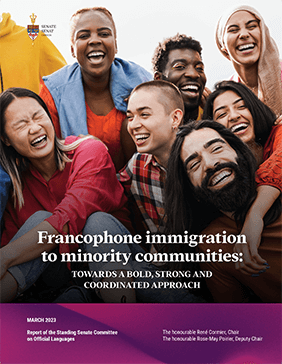
Ottawa – Increasing the immigration of French speakers to Canada’s francophone minority communities is necessary to halt the decline of the Canadian Francophonie, the Senate Committee on Official Languages said in a report released Thursday, March 30, 2023.
The survival and vitality of francophone minority communities depend largely on immigration, as an aging population, a declining birth rate and language transfers create demographic challenges. A stronger and more co-ordinated approach is required to set ambitious targets for French-speaking immigrations settling outside Quebec.
The federal government had set a target to have 4.4% of francophone immigrants settle outside Quebec by 2023. It met this goal — based on the demographic weight of the Canadian Francophonie in 2001 — only in the second-last year of its implementation period. One researcher noted that the target itself was not based on clear objectives while another researcher said current immigration practices have contributed to the decline of the francophone population. A new, ever-increasing target adapted to regional realities and based on reliable data is needed.
The committee heard that programs targeting francophone immigrants have been implemented. Express Entry, a selection mechanism for economic immigrants, now awards extra points to francophone or bilingual candidates; the federal immigration minister expressed confidence that this change will result in more teachers and health-care professionals settling in francophone minority communities. But francophone organizations advocated for programs tailored to their needs, including a separate economic immigration program and francophone streams in other existing programs.
While significant progress has been made on francophone immigration in the last decade, a more ambitious national Francophone Immigration Strategy is required to reverse the decline of Canada’s francophone minority communities. This report makes a number of practical recommendations to support a vital, thriving Canadian Francophonie.
Quick Facts
- The demographic weight of the Canadian Francophonie continues to fall. Since 2001, New Brunswick, Ontario and Manitoba have experienced the sharpest declines — despite all three provinces having provincial francophone immigration targets — while Yukon and the Northwest Territories have seen a small increase in their French-speaking population.
- The federal target to have 4.4% of francophone immigrants settle outside of Quebec by 2023 was set in mid-2000s. It only attained this goal in 2022.
Quotes
“Francophone immigration is crucial to ensure the sustainability of the French language and the development of the Canadian Francophonie. This bold report offers concrete avenues for action to build welcoming and thriving Francophone communities.”
- Senator René Cormier, Chair of the committee
“The threat to the French language in Canada can be overcome with bold, targeted immigration policies. The federal government must not delay in making these crucial changes.”
- Senator Rose-May Poirier, Deputy Chair of the committee
“Our committee is determined to give francophone minority communities the support they need to flourish. While the recommendations in our report are ambitious, they are also achievable.”
- Senator Raymonde Gagné, member of the Subcommittee on Agenda and Procedure
“We have heard representations from francophone minority communities across Canada. They are determined to maintain their language and culture. We are determined to support them.”
- Senator Jean-Guy Dagenais, member of the Subcommittee on Agenda and Procedure
Associated links
- Read the report: Francophone immigration to minority communities: Towards a bold, strong and coordinated approach.
- Follow the committee on social media using the hashtag #OLLO.
- Subscribe to email alerts for Senate committees.
- Sign up for the Senate eNewsletter.
For more information:
Jérémie Spadafora
Communications Officer | Senate of Canada
343-550-6111 | jeremie.spadafora@sen.parl.gc.ca
Senators who participated in this study

René Cormier
ISG - New Brunswick

Rose-May Poirier
C - New Brunswick (Saint-Louis-de-Kent)

Bernadette Clement
ISG - Ontario

Jean-Guy Dagenais
CSG - Quebec (Victoria)

Pierre J. Dalphond
ISG - Quebec (De Lorimier)

Raymonde Gagné
Non-affiliated - Manitoba

Marie-Françoise Mégie
ISG - Quebec (Rougemont)

Percy Mockler
C - New Brunswick

Lucie Moncion
ISG - Ontario
Ex-officio members of the committee: The Honourable Marc Gold, P.C. or Raymonde Gagné, The Honourable Donald Neil Plett or Yonah Martin
Other Senators who have participated in the study:
The Honourable Senators Mobina S.B. Jaffer, Tony Loffreda and Yonah Martin.
Government Reponse