
Report
Executive summary
The Standing Senate Committee on Fisheries and Oceans (the committee) undertook a study on ocean carbon sequestration and its use in Canada. The committee learned a great deal about land-based installations that sequester carbon by adding alkaline materials (such as limestone) to rivers and harbours – a process called alkalinity enhancement.
This technology has the potential to remove carbon dioxide (CO2) out of the air and sequester it in the marine environment for long periods of time; a service that, if applied, could be essential to meeting Canada’s climate action targets.
The report outlines a path forward for the Government of Canada to help this new, innovative sector flourish. A focus on implementing safe and reliable land-based ocean alkalinity enhancement methods, backed by independent science, is crucial. As is fostering and securing social licence through collaboration with proponents and stakeholders such as Indigenous and local communities, ocean users and other knowledge holders.
To help answer outstanding questions about the sector, the Government of Canada should publish a research strategy to guide the science undertaken in parallel with projects.
The Government of Canada should create a regulatory framework that enables innovation and balances risks with opportunities, and includes a robust monitoring, reporting and verification (MRV) protocol. This will help ensure that the carbon credits produced in Canada are of the highest quality and industry leading.
The committee ascertained that Canada is a global leader in the research and development of land-based ocean alkalinity enhancement technology. Canada must now strive to be a global leader in the implementation and scaling of this technology and in the establishment of enabling regulations.
Recommendations
Recommendation 1: Setting national carbon dioxide removal targets
The committee recommends that, in addition to setting emissions reduction targets, the Government of Canada also set national carbon dioxide removal targets and that it do so by the end of the 2026 calendar year.
Recommendation 2: The importance of land-based ocean alkalinity enhancement methods
The committee recommends that the Government of Canada formally recognize, by the end of the 2026 calendar year, land-based ocean alkalinity enhancement methods as valuable tools in the fight against climate change in order to give compliance market value to high quality carbon removal credits.
Recommendation 3: Canada’s approach to consultations
The committee recommends that the Government of Canada champion a two-tiered approach to consultation alongside a trusted, independent third party. The first tier includes broad public consultations and information sharing about carbon dioxide removal methods (including marine-based methods). The second tier focusses on consultations for specific project proposals. This approach to consultation should be in place by the end of the 2027 calendar year.
Recommendation 4: Claiming sovereign jurisdiction over the regulation of land-based ocean alkalinity enhancement projects
The committee recommends that the Government of Canada immediately release a statement that asserts that land-based ocean alkalinity enhancement projects are regulated by existing domestic legislation and regulations.
Recommendation 5: A streamlined application process
The committee recommends that the Government of Canada streamline the application process for land-based ocean alkalinity enhancement projects (and for other marine and ocean-based projects at a later date), through the use of a new sector-specific regulatory sandbox that includes all federal regulators.
Recommendation 6: A land-based ocean alkalinity enhancement research strategy
The committee recommends that the Government of Canada, in collaboration with relevant stakeholders, establish a marine carbon dioxide removal and storage research strategy specific to land-based ocean alkalinity enhancement projects. This strategy would identify the research questions that must be answered in order to ensure that land-based ocean alkalinity enhancement technologies are: 1) safe for ecosystems; 2) effective at storing carbon; 3) scalable; and 4) producing high quality and marketable carbon credits.
Recommendation 7: Developing a robust monitoring, reporting and verification protocol
The committee recommends that the Government of Canada, in order to help build public confidence and an effective carbon market, develop a robust monitoring, reporting and verification protocol (MRV protocol). This MRV protocol should help ensure that marine carbon dioxide removal projects can effectively measure the amount and permanence of the carbon it captures and stores.
Recommendation 8: Establishing a marine carbon dioxide removal task force
The committee recommends that the Government of Canada champion a multi departmental and multi-organizational task force, composed of representatives from federal, provincial, and territorial departments and agencies and other relevant stakeholders and knowledge holders, to work towards the development of a marine carbon dioxide removal regulatory framework for Canada. The regulatory framework should be in place by the end of the 2027 calendar year.
Recommendation 9: Creating a national marine carbon dioxide removal strategy
The committee recommends that the Government of Canada position the country as an industry world leader in marine carbon dioxide removal, by establishing a national strategy for the sector that includes an evidence-based, agile approach to permitting, monitoring, measurement, investment and reporting.
Glossary
Carbon dioxide (CO2): A greenhouse gas that is emitted through various means, including the burning of fossil fuels.
Carbon dioxide emissions reduction: Methods or technologies employed to avoid the release of new CO2 emissions into the atmosphere.
Carbon dioxide sequestration/removal: Methods or technologies employed to remove CO2 that is already present in the atmosphere and to store it.
Carbon storage: The process of storing captured CO2 in a manner that is long lasting, including in marine environments.
Land-based ocean alkalinity enhancement: The process of adding an alkaline material, such as limestone, to internal waters, such as rivers or harbours, with the aim of modifying (or rebalancing) the water’s pH to counteract ocean acidification. These alkaline materials originate from a land-based facilities.
Marine carbon dioxide removal (mCDR): Marine-based methods of sequestering/removing and storing CO2.
Monitoring, reporting and verification (MRV) protocol: A protocol that allows for the effective measurement of the CO2 sequestered by a particular carbon dioxide removal method (marine or otherwise) and of the durability of its storage.
Ocean acidification: The long-term change in the chemistry and pH of ocean waters caused by the ocean’s absorption of CO2 from the atmosphere. When CO2 is absorbed into water, it reacts and forms an acid (carbonic acid), which decreases the water’s pH.
Ocean alkalinity enhancement (OAE): The process of adding an alkaline material, such as limestone, to ocean waters with the aim of modifying (or rebalancing) the water’s pH to counteract ocean acidification.
Technological readiness levels (TRLs): A scale used by Natural Resources Canada to measure the readiness of different technologies. The scale ranges from one to nine, with nine meaning that the technology is at the late-stage demonstration phase.

Ottawa – Using oceans to remove carbon could turn the tide in the fight against climate change, and Canada is striving to become a global leader in this new technology, the Senate Committee on Fisheries and Oceans said in a report released on February 5th, 2026.
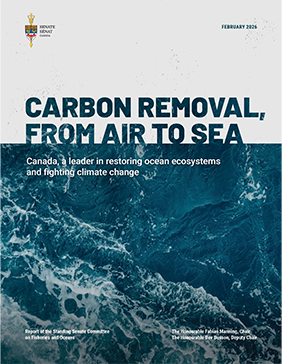
The report, Carbon Removal, From Air to Sea, summarizes the committee’s findings from its study on the removal and storage of carbon dioxide in the ocean and Canada’s use of this technology. So-called alkalinity enhancement has the potential to remove carbon from the air and store it in the ocean for long periods of time, which could help Canada meet its climate action targets.
The committee is making nine recommendations to the federal government to support responsible research, development, implementation and regulation of marine carbon removal methods — including land-based ocean alkalinity enhancement — and to help make Canada a leading player in this emerging field. The recommendations include calls to create a national strategy, set national carbon removal targets, build a regulatory framework and conduct thorough consultations, among others.
The committee urges the government to act quickly to firmly establish the country as a leader in the implementation and regulation of this promising technology.
Quick Facts
- Oceans produce 50% of the world’s oxygen and absorb 30% of all carbon dioxide emissions. Oceans are believed to be able to sequester two to 10 times more carbon than forests.
- Alkalinity enhancement is the process of adding an alkaline material — like powdered limestone rock — to oceans, rivers and harbours to aim to modify the acidification and rebalance the water’s pH. In Atlantic Canada, this method has been used to help reverse the negative effects of acid rain on river ecosystems, as well as to store carbon. It is also being tested in the Halifax Harbour.
- The committee primarily heard about land-based ocean alkalinity enhancement technologies, which use alkaline materials originating from facilities on land.
Quotes
“The federal government must support the responsible growth of the marine carbon removal sector through a national strategy, removal targets, a regulatory framework and early consultations about this technology to build social licence with the public and Indigenous communities.”
- Senator Fabian Manning, Chair of the committee
“The committee heard that further research is essential to fully understand the short, medium and long-term effects of land-based ocean alkalinity enhancement before scaling up this technology. The oceans are large, complex ecosystems with immense potential for improving our environment…any changes we introduce should be expedited, balancing this exciting and promising potential with the appropriate scientific research.”
- Senator Bev Busson, Deputy Chair of the committee
“Marine carbon dioxide removal is a promising tool in the fight against climate change. Canada holds the opportunity to become a global leader in the implementation and regulation of these innovative and potentially planet-saving technologies.”
- Senator Colin Deacon, member of the committee
Associated Links
- Read the report: Carbon Removal, From Air to Sea
- Follow the committee on social media using the hashtag #POFO.
- Subscribe to email alerts for Senate committees.
- Sign up for the Senate eNewsletter.
For more information:
Monica Granados
Communications Officer | Senate of Canada
343-550-5448| Monica.Granados@sen.parl.gc.ca
Senators who participated in this study

Fabian Manning
C - Newfoundland and Labrador

Bev Busson
ISG - British Columbia

Victor Boudreau
ISG - New Brunswick

Rodger Cuzner
PSG - Nova Scotia

Colin Deacon
CSG - Nova Scotia

Baltej S. Dhillon
ISG - British Columbia

Brian Francis
PSG - Prince Edward Island

Amina Gerba
PSG - Quebec (Rigaud)

Rose-May Poirier
C - New Brunswick (Saint-Louis-de-Kent)

Paul (PJ) Prosper
CSG - Nova Scotia

Mohamed-Iqbal Ravalia
ISG - Newfoundland and Labrador

Allister Surette
ISG - Nova Scotia
Ex officio members of the committee: The Honourable Pierre Moreau, P.C., or the Honourable Patti LaBoucane-Benson, The Honourable Leo Housakos or the Honourable Yonah Martin, The Honourable Raymonde Saint-Germain or the Honourable Bernadette Clement (until January 4, 2026), The Honourable Lucie Moncion or the Honourable Joan Kingston (since January 5, 2026), The Honourable Scott Tannas or the Honourable Rebecca Patterson (until January 4, 2026), The Honourable Flordeliz (Gigi) Osler or the Honourable Robert Black (since January 5, 2026), The Honourable Judy A. White
Other senators who have participated in the study: The Honourable Salma Ataullahjan, The Honourable Réjean Aucoin, The Honourable Jean-Guy Dagenais (retired), The Honourable Pat Duncan, The Honourable Jane Cordy (retired), The Honourable Margo Greenwood, The Honourable Stan Kutcher, The Honourable Marilou McPhedran, The Honourable Kim Pate, The Honourable Iris Petten, The Honourable Krista Ross