
Report
Executive Summary
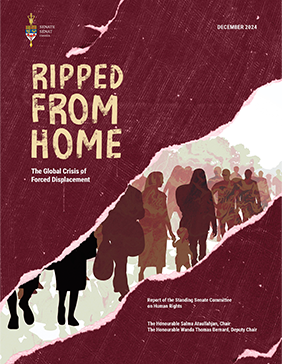
Between October 2023 and June 2024, the Standing Senate Committee on Human Rights (the committee) undertook a study on global forced displacement, hearing from 42 witnesses during eight public meetings, and receiving written submissions from a range of experts and stakeholders.
The committee was alarmed to hear that global forced displacement is a crisis at a scale without precedent since the end of the Second World War. Conflicts in Sudan, Ukraine and Gaza are among the most pressing emergencies currently driving global displacement. At the same time, tens of millions of refugees have been in camps or other protracted situations for more than 20 years, with no end in sight.
Globally, there is no credible plan to address the scale of the displacement crisis, which is expected to grow as climate change increasingly fuels devastating changes to environmental, economic and physical wellbeing.
International and Canadian law have long recognized universal rights relating to global forced displacement. Among these are the right to seek asylum from persecution in another country, and the right not to be returned to a country where the rights to life or freedom are threatened because of race, religion, nationality, political opinion or membership in a particular social group.
These rights promise the most basic level of human security. The committee was therefore disturbed to hear that they are nevertheless under direct threat in various jurisdictions, and are at broader risk of being compromised by the sheer scale of the global displacement crisis.
Canada’s leadership on issues of global forced displacement is commendable, but the overall results have been insufficient. While there are no easy solutions, Canada has the opportunity and the moral obligation to lead at multiple levels: nationally, regionally, and internationally. Through careful consideration of the nexus between peace and security, development and human rights, Canada will be well positioned to help develop strategies that are proportional to the scale of human suffering that is at stake.
This report offers recommendations to the Government of Canada based on the testimony that the committee heard between October 2023 and June 2024. The committee urges the government to carefully consider and respond to each of its recommendations.
Recommendations
Based on the testimony heard during this study, the committee has the following 15 recommendations for the Government of Canada, grouped according to their scope: global, regional and national.
Global
Recommendation 1
That the Government of Canada make forced displacement a top foreign policy priority and adjust its international efforts to align with this objective. In addition, the Government of Canada must ensure that Immigration, Refugees and Citizenship Canada and Global Affairs Canada coordinate their efforts globally, regionally and domestically.
Recommendation 2
That the Government of Canada lead with like-minded international partners to advocate for mandatory, proportional contributions from United Nations member states to the Office of the United Nations High Commissioner for Refugees (UNHCR) and the United Nations Relief and Works Agency for Palestine Refugees in the Near East (UNRWA), ensuring that both agencies have stable and sufficient funding over the long term.
Recommendation 3
That the Government of Canada increase voluntary, unearmarked contributions to the United Nations High Commissioner for Refugees (UNHCR) and the United Nations Relief and Works Agency for Palestine Refugees in the Near East (UNRWA), and encourage other countries to do the same.
Recommendation 4
That the Government of Canada lead like-minded international partners to develop a global plan for rapid progress on protracted situations, including detailed benchmarks for responsibility-sharing and timelines for implementation.
Recommendation 5
That the Government of Canada increase its support to countries that host refugees, including for education and training in refugee camps, and encourage other countries to do the same.
Recommendation 6
That the Government of Canada increase private sponsorship and expand its support for the Global Refugee Sponsorship Initiative and the Resettlement Diplomacy Network, while advocating for the principle of additionality.
Recommendation 7
That the Government of Canada recognize climate displacement as an existential crisis and take an international leadership role on mitigating and adapting to climate change. This includes fully funding Canada’s climate finance commitments and addressing climate migration through international instruments such as the Convention on Statelessness.
Recommendation 8
That the Government of Canada work with like-minded partners to leverage the role of international institutions such as the World Bank, the International Monetary Fund and the World Trade Organization, as well as regional institutions such as the Inter-American Development Bank to reduce the burden on host countries.
Regional
Recommendation 9
That the Government of Canada take a leadership role in crafting regional responses on displacement issues in the Americas, including through the sharing of infrastructure and resources, increased commitments to protection pathways, and pursuit of a Canada–United States–Mexico regional framework on human smuggling.
Recommendation 10
That the Government of Canada craft public policy exceptions to the Canada–United States Safe Third Country Agreement based on a principled evaluation of how United States refugee law differs from Canadian refugee law, including with respect to gender, disability, and the treatment of unaccompanied minors. In addition, the federal Cabinet must ensure that it meets its legal obligation to continually review the policies, practices and human rights record of the United States to verify its status as a safe third country, and to withdraw from the agreement if doing so is supported by evidence that it is not a safe country for refugees.
National
Recommendation 11
That the Government of Canada expand the Economic Mobility Pathways Pilot internationally and that Immigration, Refugees and Citizenship Canada continue to innovate new pathways for refugees, bearing in mind the importance of retaining a robust government-assisted refugee program.
Recommendation 12
That Immigration, Refugees and Citizenship Canada consider introducing new pathways for refugees based on specific human rights considerations, such as for victims of gender-based violence and people displaced by climate change, and develop related training for judges, lawyers and immigration officials.
Recommendation 13
That the Government of Canada examine its differential responses to displacement crises in view of its obligations to equality rights and its commitment to an anti-racism strategy, and that it work to reduce differential outcomes based on race.
Recommendation 14
That the Immigration and Refugee Board of Canada address lengthy delays and backlog by accelerating its modernization of technology to increase efficiency while safeguarding the rights of all claimants, including those who face particular vulnerabilities based on their gender, gender identity, race, disability, sexual orientation, age, or other intersecting factors.
Recommendation 15
That the Government of Canada work with its provincial and territorial counterparts to address gaps in refugee services, including health care and other settlement programming.
Ottawa – As the number of people forcibly displaced from their home countries surpasses 114 million, Canada must pull its weight and work with its allies to address this growing crisis, the Senate Committee on Human Rights said in a report released Tuesday, December 3, 2024.
Conflicts in Ukraine, the Middle East and Sudan are contributing to global forced displacement on a scale not seen since the end of the Second World War. Climate change is also driving people from their homelands and threatens many more.
The burden of supporting the millions of forcibly displaced people is not shared equally. Canada, by its very geography, is protected from the large-scale movement of refugees, which leaves other countries to shoulder the load. The host countries with the largest refugee populations are Iran, Türkiye, Germany, Colombia and Pakistan, which host between 2.1 million and 3.4 million refugees each. Canada can do more.
In all, the committee is making 15 recommendations to the federal government with global, regional and national scope, including to increase funding to humanitarian aid groups and countries that host refugees, and to work with international allies to develop a plan — with detailed benchmarks — for responsibility sharing.
Quick Facts
- Of the 114 million forcibly displaced people worldwide, 45.6 million are children.
- Wealthy countries spend more than $20 billion every year just to assess refugee claims, which is four times more than what is available to address the needs of refugees in the Global South.
- Canada’s Private Sponsorship of Refugees Program, established in 1979, has been lauded as a model with clear benefits. Under this program, sponsors agree to supply care, lodging, settlement assistance and support for 12 months following the refugee’s arrival in Canada, or until the refugee becomes self-sufficient.
Quotes
“Escalating conflicts throughout the world are creating a growing class of people who have been forcibly displaced from their homes. Canada must increase the support it provides to countries that host refugees and to organizations that provide life-saving aid to some of the world’s most vulnerable people.”
- Senator Salma Ataullahjan, Chair of the committee
“The numbers are alarming because we are not talking about numbers at all — we are talking about people. Men and women ripped from their homes. Children torn from all that they have ever known. We urge the government to increase its support for these global diasporas.”
- Senator Wanda Thomas Bernard, Deputy Chair of the committee
“While recent hostilities have unleashed a fresh wave of forcibly displaced people, we cannot forget that tens of millions of people have been living in limbo for decades, with no end in sight. Canada can help to bring them back from the margins. It’s time we live up to our responsibilities.”
- Senator Kim Pate, Member of the Subcommittee on Agenda and Procedure
Associated Links
- Read the report: Ripped from Home: The global crisis of forced displacement.
- Follow the committee on social media using the hashtag #RIDR.
- Subscribe to email alerts for Senate committees.
- Sign up for the Senate eNewsletter.
For more information:
Chelsea DeFazio
Communications Officer | Senate of Canada
343-576-1481 | chelsea.defazio@sen.parl.gc.ca
Senators who participated in this study

Salma Ataullahjan
C - Ontario (Toronto)

Wanda Thomas Bernard
PSG - Nova Scotia (East Preston)

Kim Pate
ISG - Ontario

David M. Arnot
ISG - Saskatchewan

Amina Gerba
PSG - Quebec (Rigaud)

Fabian Manning
C - Newfoundland and Labrador

Flordeliz (Gigi) Osler
CSG - Manitoba
Ex-officio members of the committee: The Honourable Marc Gold, P.C., or the Honourable Patti LaBoucane-Benson, The Honourable Donald Neil Plett or the Honourable Yonah Martin, The Honourable Raymonde Saint-Germain or the Honourable Bernadette Clement, The Honourable Scott Tannas or the Honourable Rebecca Patterson, The Honourable Pierre J. Dalphond or the Honourable Judy A. White
Other Senators who have participated in the study: The Honourable Sharon Burey, The Honourable Andrew Cardozo, The Honourable Bernadette Clement, The Honourable Jane Cordy (retired), The Honourable Nancy J. Hartling (member of the Subcommittee on Agenda and Procedure until April 2024), The Honourable Mobina S. B. Jaffer (retired), The Honourable Frances Lankin, P.C. (retired), The Honourable Marilou McPhedran, The Honourable Marie-Françoise Mégie, The Honourable Ratna Omidvar (retired), The Honourable Paula Simons, The Honourable Judy A. White