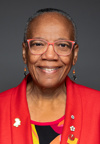
The Honourable Lillian Eva Dyck
Inquiry--Debate Adjourned
December 10, 2020
Honourable senators, when I look around this chamber and see other senators virtually participating in this inquiry about Lillian Dyck, and seeing your accomplishments in what you have done in your professional and personal lives: How many of us have had themselves portrayed in a play? Imagine the story of your life on a stage. This is a story of Lillian Eva Dyck.
It was the summer of 2017 when many of us rushed off to the National Arts Centre to see Café Daughter. We were excited because this was the story of our colleague, Senator Dyck, the storyline of a bright student working up in a small Saskatchewan town. It was the 1950s, and the landscape in this prairie environment, like the landscape in all parts of the country, was one of racism and it wasn’t hidden. For the daughter of a Chinese father and a Cree mother, barriers were everywhere. Her mother asked her to hide her Cree heritage.
Honourable senators, I was moved by the play, and it reminded me of growing up in Campbellton, New Brunswick in the 1950s. My new friend was Kit Wong; he had just arrived from Hong Kong. His uncle owned the Glory Café. Across the river was the Indian reserve. I have memories as a child of Kit and Indigenous young children facing community bullies.
Lillian’s dad owned the Victory Café, like Kit in my hometown. She was very bright and it was her strength of intellect and personality which broke down barrier after barrier.
She became connected to her Cree heritage, and that was transformative. Instead of being shameful to be, as she said, an Indian, she found another level of strength. Here is what she said:
In fact, I have to laugh when I think of what a residential school survivor told me, who was a real character, and said you have to learn to man up. Stand your ground and not let it defeat you.
Well, as history has shown, the neuroscientist Dr. Lillian Dyck has more than manned up. As the song goes, she did it her way. Lillian Dyck has fought the good fight. Her voice at every level has been heard, from the university, to the Senate, to the Highway of Tears which is Highway 16 in British Columbia, where many Indigenous women were murdered.
By the way, the Highway of Tears, honourable senators, is a recent book by author Jessica McDiarmid. It’s a must read. I recommend it.
Here in the Senate, we have witnessed Lillian’s leadership, her passion and compassion. I sit behind her. I always had a box of Kleenex. I knew when she would be overcome by emotion. The issues she dealt with were personal. When someone hurt, she hurt. But she had a lighter side, and I liked to make her laugh. That’s the Lillian Dyck I will remember.
Shortly after she retired, we had a telephone chat. For one day she said she missed this place and even watched the proceedings. But the next day she returned to her favourite place. Somewhere out in the prairie she is bird watching, and she is watching whooping cranes. She was excited to tell me about her secret hiding place, a place where you can find peace of mind and a piece of time to reflect on where you have been and where you are.
Senator Lillian Dyck has always lived in the moment. In her words, “You don’t just live for yourself. You live for those around you.”
Thank you, Lillian, for spending time on your life’s journey with us. The Senate is better for it, the country is better for it, your province is better for it. As a Café Daughter, you have served and served well. Thank you.
Honourable senators, I’m honoured to share my voice today. I want to speak today on behalf of all Canadians, particularly women in general, and especially racialized women, to thank the Honourable Lillian Dyck, who retired from the Senate this past summer. I think it’s fitting that we are doing this today, International Human Rights Day, and also the last day of the 16 Days of Activism against Gender-Based Violence.
Senator Dyck, on behalf of women in Canada, we thank her for being a trailblazer. We thank her for being a tireless advocate. We thank her for her demonstration of grace and tenacity during the most challenging situations. We thank her for being a strong role model and mentor for young women leaders.
When I reflect on her life’s journey and all the contributions that she has made — and many colleagues have spoken about those wonderful contributions — I personally stand in awe, and I am truly grateful for the work she has done to break through so many barriers. She is truly a trailblazer: a woman of distinction in science, a woman of distinction in academia, a woman of distinction in her communities, and a woman of distinction here in the Senate. She has fearlessly advocated for the rights of those who do not have a voice.
My only regret is that I did not get an opportunity to work closely with Senator Dyck prior to her retirement. However, I do hope to create some opportunities to work together in the future.
Honourable senators, I wish our colleague Senator Dr. Dyck the very best in her retirement and truly look forward to seeing what she does in her next chapter. Thank you.
Honourable senators, there are five more senators on the list to speak this evening, and I know as well that Senator Dalphond is prepared to move the adjournment. We only have a little over a minute left. I don’t think it’s fair to call upon another senator and interrupt them less than a minute into their speech.
If the Senate is in agreement, I will call upon Senator Dalphond to adjourn, and when we return, the rest of the people who wish to speak will have their 15 minutes, because this is an inquiry, not Senators’ Statements. Is it agreed, honourable senators?