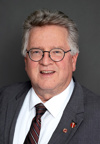
Challenges and Opportunities of Canadian Municipalities
Inquiry--Debate Continued
March 28, 2023
Honourable senators, the sun hadn’t yet come up on September 30, 2021, when people started to gather at the Port Lands. If you were watching from a distance away, you would have seen something quietly momentous happening as the sun rose.
The Mohawk Council of Akwesasne hosted city council, staff, the Cornwall Police Service and other local officials for a tobacco burn ceremony. We were about 40 people — most of us wearing orange, and all of us muted in the dawn light.
It is difficult for me to express the emotion of that morning. The gathering was one of promise. This historic meeting was a commitment that we were in this together, and that we wouldn’t let each other down as we set precedent as equal partners.
I want to tell you about the future of the Port Lands and its potential, but, first, the background.
The Port of Cornwall opened in 1967 and served as a space to unload raw materials, such as coal and cotton, and materials for the factories of such companies as Courtaulds and Domtar, the backbone of our local economy for many years.
In 1987, Transport Canada started operating the Cornwall port. By 2016, the divesting process had begun, and Akwesasne and Cornwall had signed an historic agreement to co-own 16 acres of land. This partnership was no accident. The federal government insisted on an equal partnership, committing to this divestment only if it was to both communities. Transport Canada endowed $5 million for the remediation of the property.
In 2020, two councils broke bread together for the first time in 10 years. As mayor, it was my top priority to bring our two communities closer, and I’m grateful for my friendship with Akwesasne Grand Chief Abram Benedict and for his continued leadership on this ambitious project.
By 2021, we had worked in partnership to demolish a derelict building and create a temporary green space that would invite folks from either side of the river to enjoy the Port Lands. We launched a public consultation to see how residents in both communities wanted to see the space grow. Not long after, I was appointed to the Senate and resigned as mayor. However, my interest in the success of the Port Lands has not wavered. There is a call for proposals now to bring engaging community events to the Port Lands this summer, and work is progressing on environmental assessments.
Yet, this past year has been challenging for progress at the Port Lands. We always knew that it would be hard, and that the solutions for forging ahead would require compromise. This will take time, work and money. Building friendships takes work. Educating communities about truth takes time. Developing a framework for this new partnership takes proper financing.
But the challenges inherent in the development of the Port Lands are also incredible opportunities — opportunities to build bonds of friendship among Cornwall and Akwesasne leaders and residents; opportunities to show the rest of Canada how shared economic development can take place; and opportunities to show the federal government how municipalities can be actors for change in truth and reconciliation.
This statement is in response to the inquiry launched by my friend, Senator Simons. Its objective is to draw the Senate’s attention to the challenges and opportunities of Canadian municipalities and to the importance of understanding and redefining the relationships between our municipalities and the federal government.
I can’t think of a better and more relevant example than the Port Lands because all politics is local. Nothing has a bigger impact on the daily lives of Canadians than their municipality. If we want to move reconciliation forward in meaningful ways, municipalities must have a seat at the table. Municipalities are not the only ones looking for recognition. Indigenous communities need a seat at the table too.
I will tell you a story: Back in 2020, cruise ship passengers were quarantined at a conference centre in Cornwall — that is back when we were saying “coronavirus” and not “COVID-19.” The community felt blindsided. This was long before we understood what COVID-19 was, and residents wanted information and answers. After hosting a press conference, I met with an Indigenous leader and spoke about feeling disrespected by the federal government. And she responded, “Welcome to my world.”
In launching this inquiry, Senator Simons argued that municipalities urgently need fiscal and political resources to lead us to a more just, prosperous and creative future. Her inquiry has prompted statements from my distinguished colleagues.
Senator Éric Forest suggested that the federal-municipal relationship can evolve and that other changes are necessary.
Senator Omidvar showed how cities are ideally positioned to come up with innovative, local solutions to national and world problems.
Senator Cotter told us that our communities are the starting point for our identity. We take pride in where we come from. The health and prosperity of our towns and cities matter today more than ever.
Senator Sorensen, a former mayor too, spoke to the gap between what municipalities are expected to do and the funding they have access to in order to meet those needs.
Senator Ravalia pointed out the unique status of municipalities in Newfoundland and Labrador and talked about the fight to support cities that are being crushed under heavy administrative and financial burdens.
Senator Cormier talked about something that is of interest to all of us, specifically the role that municipalities play in protecting and promoting our official languages.
I couldn’t agree more with them. Municipalities are often small, under-resourced and occupied by daily tasks, such as removing snow, scheduling ice times, delivering transit services and managing goose poop along the St. Lawrence River — you wouldn’t believe how much time I spent as mayor talking about goose poop and about a million other issues. Yet, all day, every day, municipalities are leaders, and they should be recognized, resourced and supported as such.
What Cornwall and Akwesasne are attempting to do together at the Port Lands is unheard of in Canada. Co-ownership by a First Nation and a municipality of strategic waterfront property is a unique approach that should bring economic and social benefits to both communities. During consultations, the public’s imagination ran wild, and it was clear that they wanted to make the space their own. They wanted an accessible area that included boardwalks and green spaces, as well as an opportunity for artists and vendors to bring the community together. There was a strong interest in connections with the water, fishing, boating, swimming, canoeing, a pier, a dock and another marina. Most agreed that the project was extremely important to both Cornwall and Akwesasne. They said that the Port Lands project could add vibrancy to our area, bring in tourists and offer expanded public access to the waterfront.
There is so much work to do — not only to bring residents’ vision to life, but also to finish developing how this partnership will work on a day-to-day basis. Tasks like putting up a sign, coordinating tax payments and completing an environmental assessment can be challenging. Luckily, Akwesasne and Cornwall are up to the challenge. In divesting the Port Lands to these communities, the federal government entrusted us with a huge responsibility. It was as though they were saying to us, “So, let’s see what you can do.”
I’m proud that Akwesasne and Cornwall were trusted to take a huge step in economic development and, more importantly, in reconciliation. I hope that together they lay the groundwork for more municipalities to be able to take the lead.
If I could redefine the relationship between the municipalities and the federal government, if I could wave my magic wand, I would make two wishes. First, I would wish that Canada would trust its municipalities to take big steps in areas such as climate change, immigration, social issues and especially reconciliation. Second, I would wish that Canada would provide the municipalities with adequate resources and give them opportunities like the ones I described today to meet the objective of establishing relationships and a dialogue with Indigenous communities.
Second, it’s important that Canada provides support when things get difficult — because they always do. Municipalities want to be treated as equal partners, consulted and considered during strategic planning, implementation and beyond. Municipalities want communication — talk to them. Give them a seat at the table, and you may be surprised by their contributions.
Thank you. Nia:wen.
Honourable senators, it is my pleasure to rise to speak to Senator Simons’s inquiry that calls on our chamber to explore the challenges and opportunities that municipalities face, as well as the importance of understanding and redefining the relationship between Canada’s municipalities and our federal government. I would also like to thank my honourable colleague for introducing this very important inquiry. Municipalities play a critical role in each and every one of our lives. If there is one thing I know, it’s rural. I have spent my life in and around rural communities, advocating for rural residents. With that being said, I hope to highlight the role of rural municipalities, the unique challenges and opportunities they face and the importance of continued federal support for all things rural today.
As many of you know, I’m a lifelong resident of Fergus, Ontario. It’s where my ancestors settled in 1834, and it’s where I continue to reside today. Fergus is a rural community most famous for its scenic river views, waterfalls, limestone gorge and the annual Fergus Scottish Festival.
Now, I’ll share a little history lesson: Fergus has deep Scottish roots dating back to 1833 when settlers called it “Little Falls” because of its scenic waterfalls.
In 1858, with a population of 1,000, the town was incorporated and renamed Fergus in honour of one of its Scottish founders, Adam Fergusson. While you may be wondering why I wanted to share this information with you today, I believe it’s important to show that the history of our rural communities is woven into the history of our country as many of them predated Confederation. Unfortunately, municipalities that encompass rural Canada are sometimes forgotten when governments are developing policies that impact Canadians from coast to coast to coast.
As a senator, I have met with countless community leaders across rural Canada to learn more about the concerns and needs of their communities. The rural residents and leaders that I have met are always one thing, regardless of where they live or work: They are consistently clear in what their communities need to prosper and thrive. Typically, they need support from their province and the federal government to help achieve their goals and realize projects related to infrastructure, community development and access to services. Their stories and ideas have both inspired and informed how I approach issues here in the Red Chamber.
Rural communities have their own unique set of challenges and opportunities, and should be treated as such. While in many areas rural population growth has slowed, these communities still play a critical role in our economy providing food, fresh water, recreation and resources for those living within and beyond their boundaries. They all have a story to tell, and I am hopeful that more will be done to bridge the rural-urban divide in the years to come.
While our community histories are important for understanding those who live there, it is also important to take a step back and reflect on the role of the municipalities’ governance that helps build and develop these rural regions. Each municipality — large and small, rural and urban — has a governing body.
Our local governments play an integral role in the everyday lives of their residents. From waste disposal and public transit to fire services, policing, community centres and libraries, municipal governments are responsible for it all.
Fergus is located within Centre Wellington, a township within Wellington County. As such, Fergus is supported by both the Centre Wellington Council and the Wellington County Council. Both councils, along with every municipal government from coast to coast to coast, provide residents with the support they need to live, work and play in their communities.
I am proud to have served as the Ward 5 representative on Wellington County Council before being appointed to the Senate. It gave me the opportunity to really understand how municipalities operate and the important ways in which it affects each and every one of us.
I’d like to take this time to acknowledge the good work of both Centre Wellington and Wellington County Councils, and congratulate those who were elected in last autumn’s municipal elections. I look forward to seeing what can be achieved over the course of this term and I extend my very best wishes to all councillors in supporting their communities.
Today, municipal governments in rural and urban communities play a complex role in the lives of their residents. The environments in which they operate have become much more complex and demanding. With that comes more complex challenges they must face. In the case of rural communities, many face challenges they cannot afford to address alone.
At this time, I’d like to acknowledge the Association of Municipalities Ontario, or AMO, and the Rural Ontario Municipal Association, or ROMA, for their efforts to support municipalities across Ontario and, in turn, help to strengthen and enhance their efforts to support their residents.
AMO works to make municipal governments stronger and more effective. Through their organization, Ontario’s 444 municipalities, rural and urban, work together to achieve shared goals and meet common challenges.
I believe that our municipalities benefit immeasurably from the support of these organizations, as well as others in Ontario and across Canada. It is clear that organizations like AMO and ROMA, or the many other wonderful organizations that my colleagues have mentioned in their speeches, provide immeasurable value to communities across this country.
Late last year, we welcomed the Minister of Rural Economic Development in this chamber for Ministerial Question Period. We heard, through a number of questions, about a wide array of challenges that rural Canadians face and opportunities for the federal government to provide support, including through access to reliable broadband, developing and enhancing rural transportation, increasing access to health services, immigration programs, housing and community building, among many others.
In order to better support rural municipalities, I call on this chamber and the federal government to adopt a rural lens when exploring the challenges and opportunities that municipalities face.
Aging infrastructure, competing priorities and access to critical services are just a few challenges that rural municipalities face. However, they simply cannot address these challenges alone. For example, in my community of Centre Wellington, there are 113 bridges, three quarters of which are in need or near need of replacing. I am also hopeful that this inquiry encourages the federal government to re-evaluate and redefine its relationship with municipalities.
It is clear that both rural and urban municipalities require long-term financial and policy-driven support that will encourage long-lasting, positive changes.
The Canada Community-Building Fund, or the former Gas Tax Fund, provides some support to some municipalities. It is clear that more support is needed, though, especially for those underserved communities.
Another support for rural Ontario, the Rural Ontario Institute, or ROI, is a charitable not-for-profit that delivers programs that develops strong leaders who are critical voices around opportunities and key issues facing rural and northern Ontario. This organization is close to my heart, as I was previously the chief executive director and I know just how hard their team works to support rural communities across the province.
I would also like to take a few minutes to highlight an initiative by the University of Guelph: the People’s Archive of Rural Ontario, also known as PARO. PARO has done an amazing job of capturing the resilience and revitalization of rural Ontario through the many stories of communities, individuals and experiences pulled together in one place. If you have never heard of PARO, I invite you to visit their website at www.ruralontario.org to learn more.
I am proud of initiatives like this that are working to help to bridge the gap between rural and urban across Canada, but much more needs to be done.
Honourable colleagues, we cannot ignore that rural municipalities require the same attention as their urban counterparts. It is not enough to treat these communities as an afterthought. These municipalities are just as important as their urban counterparts, and I hope that this inquiry and future federal policies will reflect that.
Thank you. Meegwetch.