
Recommendations
Recommendation 1:
With the understanding that Defence Administrative Order and Directive (DAOD) 9005-1 (Sexual Misconduct Response) is to be promulgated, the committee recommends that DAOD 5012-0 (Harassment Prevention and Resolution), 5019-1 (Personal Relationships and Fraternization), 5019-5 (Sexual Misconduct and Sexual Disorders) and 9005-1, along with the relevant Treasury Board policies, be reviewed with specific attention to the recommendations made by the ERA. They should be amended to clarify the definitions of certain terms, such as harassment, sexual misconduct and adverse personal relationships, as well as to address the concepts of consent, hostile work environment, military sexual trauma, and duty to report. The revisions to the DAODs should therefore use plain language terminology as much as possible, as well as terminology consistent with relevant definitions, such as sexual assault, found in the Criminal Code of Canada.
In addition, the suite of relevant DAODs (5012-0, 5019-1, 5019-5 and 9005-1) should be made consistent with the most recent federal legislation addressing harassment and violence that occurs in the course of employment – An Act to amend the Canada Labour Code (harassment and violence), the Parliamentary Employment and Staff Relations Act and the Budget Implementation Act, 2017 – as follows: “harassment … means any action, conduct or comment, including of a sexual nature, that can reasonably be expected to cause offence, humiliation or other physical or psychological injury or illness to an individual, including any prescribed action, conduct or comment.” The DAODs should continue to cover harassment within the meaning of the Canadian Human Rights Act (i.e. based on race, national or ethnic origin, colour, religion, age, sex, sexual orientation, marital status, family status, disability, pardoned conviction and conviction for which a record suspension has been ordered). Policy documents and directives should also clearly state that complainants of harassment have the option to pursue their complaint outside of the military system should they so choose.
Specifically, DAOD 5012-0 should be redefined to cover the harassment that potentially could occur outside the workplace for CAF members, given the nature of military organizations as “total institutions” where members of the military live, work, train and socialize together. DAOD 5012-0 should also cover:
- sexual harassment through the use of various forms of social media; and
- examples of conduct that, while not exhaustive, will assist in understanding what constitutes prohibited sexual harassment, such as:
- use of belittling language referring to body parts;
- unwelcome sexual invitations or requests;
- unnecessary touching or patting;
- leering at a person’s body;
- unwelcome and repeated innuendo or taunting about a person’s body, appearance or sexual orientation;
- suggestive remarks or other verbal abuse of a sexual nature; or
- visual displays of degrading or offensive sexual statements or images.
Recommendation 2
That the mandate and resources of the Sexual Misconduct Response Centre (SMRC) be reviewed to better respond to the needs of individuals seeking support and that an external review mechanism be established to measure the Centre’s effectiveness.
Recommendation 3:
That the Sexual Misconduct Response Centre provide its clientele with as much information as possible about the various complaint mechanisms, as well as the possible advantages and disadvantages of the military justice system and the civil justice system. Complainants in either the military or civil justice system should be provided with legal and therapeutic support through qualified civilian service providers by the SMRC, or the CAF should provide adequate funds to complainants to retain their own legal and therapeutic support for at least one year, with the option of applying for an extension. In all cases, the CAF should provide adequate funding to cover travel and other costs that complainants and their witnesses may incur in relation to the resolution of their complaint.
Recommendation 4: That the CAF and the Department of National Defence (DND) implement evidence-based policies and practices to ensure that all CAF members, former CAF members, and civilians working for either organization who have experienced or been affected by sexual misconduct receive the medical, psychological, social, legal, and financial support that they need to heal from military sexual trauma, in any form. Support programs under these policies must be purpose-built for survivors of sexual trauma and respond to the individual clinical needs of members using them, while maintaining gender sensitivity and being culturally relevant. Spouses and children of military members who have been affected by sexual misconduct should be provided a similar level of support. Policies and programs must take into consideration the particular support needs of CAF members who are single, as well as those deployed or on tasking. In support of this recommendation, Queen’s Regulations and Orders, Volume 1 - Chapter 34 (Medical Services) should be amended to ensure that all individuals listed above have the appropriate and adequate entitlements to care.
To be effective in ensuring the expected results, the Chief of Defence Staff (CDS) should utilize the expertise available within the External Advisory Council, recently established by the CAF, by allocating additional support personnel and finances, including appropriate stipends. The External Advisory Council should be given a renewable five year mandate, which would allow them the time to use their expertise to review summaries of all investigations of any form of military sexual trauma (with gender noted but other identifying details removed), so that they can assess outcomes, identify issues of concern and make recommendations for improvement in how complaints are being handled. These advisors would not have enforcement authority, but their advice would go to the CDS or the Vice Chief of Defence Staff (VCDS) for the initial five years of their mandate, and all officers with any area of management responsibility in the chain of command would be advised as to the areas for improvement that they are directed to implement, with timelines for delivery to enable the CDS or VCDS to make specific annual public reports to the Minister of National Defence as to what actions if any are being taken, in response to the findings and recommendations of the advisory group. An effectiveness review should be conducted after the first five years.
Recommendation 5
That DND/CAF employ uniformed clinical psychologists or health care professionals with equivalent skills in post sexual trauma recovery and that they be available to all current and former CAF members. CAF members must have access to psychologists or other medical professionals who have received training on how to aid survivors of sexual misconduct even while deployed or on a tasking.
Recommendation 6
That the government review the laws, regulations, and policies that result in little or no information being available to current and former CAF members affected by sexual misconduct regarding the outcomes of administrative review processes, following their report of an incident of sexual misconduct and the filing of a complaint.Recommendation 7
That there be better oversight and accountability of Operation HONOUR commitments, including more frequent reporting of progress achieved and the production of quarterly reports. That an independent external committee also be created to assess the effectiveness of the measures put in place under Operation HONOUR, given that the Sexual Misconduct Response Centre cannot be considered an external body. One possible option could be to give the newly established External Advisory Council the authority to have an official oversight role.Recommendation 8
hat DND and CAF improve the collection and dissemination of data on harmful and inappropriate sexual behaviour (HISB) within their organization, including how visible minorities, lesbian, gay, bisexual, transgender, queer and two-spirit (LGBTQ2) members and other designated groups are affected by HISB. The SMRC could play a role with regards to centralized data collection.
Ottawa – The Canadian Armed Forces (CAF) is not doing enough to understand, respond to and prevent sexual misconduct in the military, finds the Senate Committee on National Security and Defence in its most recent report.
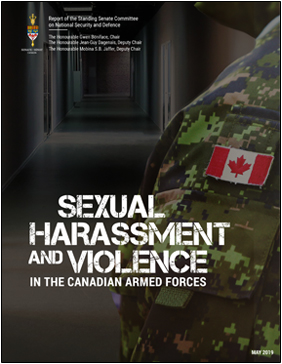
The committee spent six months studying harmful and inappropriate sexual behaviour in the Canadian military and the impact of changes made since 2015. It is publishing its findings in the committee’s report titled Sexual Harassment and Violence in the Canadian Armed Forces.
After speaking to 15 witnesses and reviewing publicly available information, the committee has learned that recent attempts to address the issue are lacking.
In 2014, Maclean’s and L’actualité reported that sexual assault in the military takes place about five times per day. In response, the CAF hired, former Supreme Court Justice, the Honourable Marie Deschamps to study the military’s policies and practices related to sexual assault and sexual harassment.
The Deschamps report led the CAF to launch in 2015 Operation HONOUR, which aimed to eliminate harmful and inappropriate sexual behaviour within the military and established the Sexual Misconduct Report Centre. The committee finds that while this operation addresses some of the concerns raised in the Deschamps report and in the media at the time, it does not go far enough and fails to sufficiently support the very people it was intended to protect.
Among the committee’s recommendations are policy changes: to make it clear that complainants can pursue their case outside of the military system should they so choose; to provide adequate funding and resources to the Sexual Misconduct Report Centre so that it can adequately support complainants; and to ensure that the CAF makes available medical, psychological, social, legal, and financial support to all CAF members, former members and DND civilians, who experience or are affected by sexual misconduct in their “workplace”, with the understanding that military organizations are “total institutions” where members live, work, train and socialize together.
Immediate and decisive action must be taken to avoid further cases of military sexual trauma and the further erosion of the CAF’s ability to attract and retain qualified Canadians through a safe work environment and satisfying career prospect.
Quick Facts
• The committee makes eight recommendations to the federal government calling for changes to CAF policies, support for victims (including assistance navigating the military or civilian justice system), and oversight and accountability mechanisms for Operation HONOUR’s commitments.
• The 2018 Statistics Canada survey results of Sexual Misconduct in the CAF will be reported later this month. The most recent survey, completed in 2016, found that among Regular Force members, 27.3% of women and 3.8% of men have experienced sexual assault at least once since joining the CAF.
• The same survey found that in the 12 months prior to their participation in the survey, roughly four in five (79%) members of the Regular Force saw, heard or were personally targeted by sexualized behaviour.
Quotes
“It is beyond the time for action. The government has a responsibility to ensure that all workplaces — and especially those in the military — are safe for every single Canadian. Though some steps were taken in 2015, more needs to be done by the government to rectify this situation. ”
- Senator Gwen Boniface, Chair of the committee
“The harrowing experiences of victims were brought to light through witness testimony. What has been made clear to our committee is that concrete action must be taken in order to safeguard the survivors when these types of abuses happen.”
- Senator Jean-Guy Dagenais, Deputy Chair of the committee
“Each and every person who puts their life on the line for this country deserves the utmost respect. No one should have to endure harassment of any kind in the workplace, least of all our heroic soldiers in uniform.”
- Senator Mobina S.B. Jaffer, Deputy Chair of the committee
Associated Links
• Read the report, Sexual Harassment and Violence in the Canadian Armed Forces.
• Follow the committee on social media using the hashtag #SECD.
• Sign up for the Senate eNewsletter.
For more information, please contact:
Sonia Noreau
Public Relations Officer
Communications Directorate |Senate of Canada
613-614-1180 | sonia.noreau@sen.parl.gc.ca
Senators who participated in this study

Gwen Boniface
ISG - Ontario

Jean-Guy Dagenais
CSG - Quebec (Victoria)

Mobina S. B. Jaffer
ISG - British Columbia

Pierre-Hugues Boisvenu
C - Quebec (La Salle)

Marc Gold, P.C.
Non-affiliated - Quebec (Stadacona)

Diane F. Griffin
CSG - Prince Edward Island

Paul E. McIntyre
C - New Brunswick

Marilou McPhedran
Non-affiliated - Manitoba

Victor Oh
C - Ontario (Mississauga)

Donald Neil Plett
C - Manitoba (Landmark)

André Pratte
ISG - Quebec (De Salaberry)

David Richards
C - New Brunswick
Ex-officio members of the committee: Peter Harder, P.C. (or Diane Bellemare, or Grant Mitchell), Larry W. Smith (or Yonah Martin), Joseph A. Day (or Terry M. Mercer), Yuen Pau Woo (or Raymonde Saint-Germain)
Other senators who have participated in the study: Wanda Elaine Thomas Bernard and Norman E. Doyle