
Recommendations
RECOMMENDATION 1:
Transport Canada and Innovation, Science and Economic Development Canada expeditiously create a joint policy unit to coordinate federal efforts and implement a national strategy on automated and connected vehicles.
RECOMMENDATION 2:
Transport Canada engage with provincial and territorial governments, through the Canadian Council of Motor Transport Administrators, to develop a model provincial policy for the use of automated and connected vehicles on public roads. The department should also involve municipalities in this engagement process.
RECOMMENDATION 3:
Transport Canada strengthen its work on automated and connected vehicles with the United States through the Regulatory Cooperation Council, to ensure that these vehicles will work seamlessly in both countries.
RECOMMENDATION 4:
Transport Canada urgently develop vehicle safety guidelines for the design of automated and connected vehicles. The guidelines should identify design aspects for industry to consider when developing, testing and deploying such vehicles on Canadian roads. The guidelines should also be updated regularly to keep pace with the evolution of automated and connected vehicle technology.
RECOMMENDATION 5:
Innovation, Science and Economic Development Canada allocate the 5.9 gigahertz spectrum that it has set aside for use in dedicated short-range communications systems, while continuing to reserve this spectrum for connected vehicle uses.
RECOMMENDATION 6:
Transport Canada, in cooperation with the Communications Security Establishment and Public Safety Canada, develop cybersecurity guidance for the transportation sector based on best practices and recognized cybersecurity principles. The guidance should include advice on original equipment, replacement equipment and software updates.
RECOMMENDATION 7:
Transport Canada work with Public Safety Canada, the Communications Security Establishment and industry stakeholders to address cybersecurity issues and to establish a real-time crisis connect network, and that Transport Canada report regularly on their progress.
RECOMMENDATION 8:
The Government of Canada table legislation to empower the Office of the Privacy Commissioner to proactively investigate and enforce industry compliance with the Personal Information Protection and Electronic Documents Act .

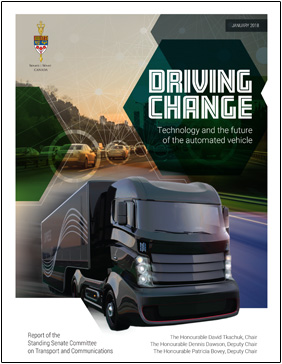
Driverless cars are already a reality but Canada is ill-prepared for their arrival, the Senate Committee on Transport and Communications said Monday.
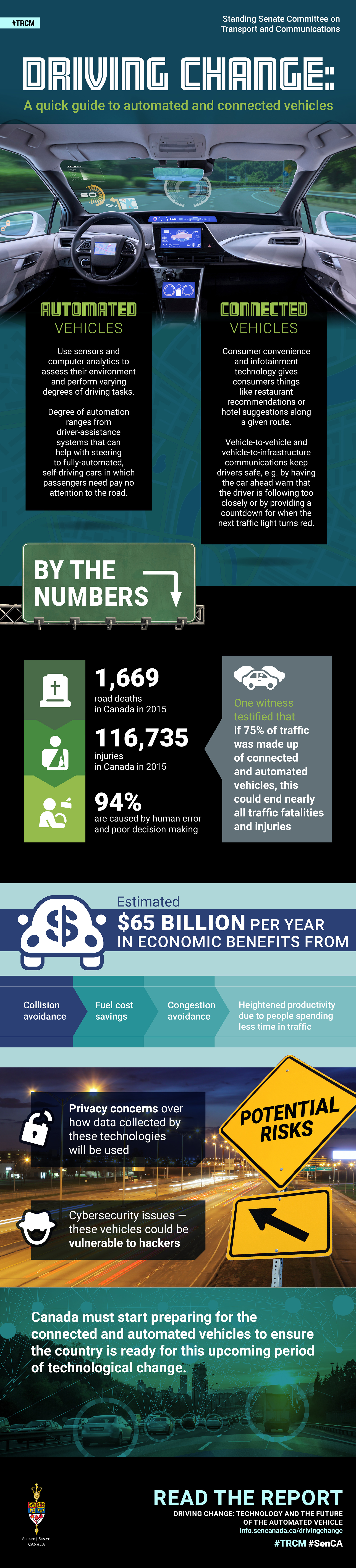
Automated and connected vehicles are the future of transportation. Fully automatic cars will one day be capable of performing virtually all driving tasks, while connected vehicles — cars that can interact with their environment and relay information to the driver — offer new levels of safety and instant access to information.
The committee has been studying these emerging technologies along with the risks and rewards they offer. After questioning experts and taking fact-finding missions to meet top researchers, senators have released a report making 16 recommendations to set Canada up for success.
Broadly speaking, the recommendations urge various government departments to work with innovators to lay the groundwork for policy that will encourage the responsible development of this technology. The committee believes a coordinated national strategy will be necessary to ensure Canadians benefit from these technologies.
A national strategy would also allow the government to prevent potential harms. Strong cybersecurity measures will be necessary to maintain public safety and confidence, and rigorous oversight is required to ensure personal information gleaned from connected and automated vehicles is securely held and not exploited.
Canada cannot afford to delay. Connected and automated vehicle technology is here to stay. The federal government must ensure the country is prepared so that Canadians can take full advantage of the next generation of transportation.
Quick Facts
- One witness testified that automated vehicles capable of transporting people within a city could be a reality within the next 10 to 15 years.
- As many as 94% of collisions are caused by human error and poor decision making. Automated and connected vehicle technology could significantly reduce the number of collisions.
-
Federal leadership is required to ensure the country is ready for this period of rapid technological change.
Quotes
“This study should serve as a roadmap for the government. It is essential for Canada to be well-prepared for the fast-approaching future of transportation.”
- Senator David Tkachuk, Chair of the committee.
“These new technologies hold great promise but they do not come without risks. Canadians need assurance that their personal information will be protected.”
- Senator Patricia Bovey, Deputy Chair of the committee.
“We are on the cusp of a transportation revolution and Canada must be ready. Cities were ill-prepared when ride sharing came to Canada; we cannot afford to repeat this mistake.”
- Senator Dennis Dawson, Deputy Chair of the committee.
“This forward-looking report is intended to ensure Canadians benefit from these exciting technological changes while mitigating potential risks. Now it’s up to the government to act.”
- Senator Michael L. MacDonald, committee member.
Associated Links
- Read the report, Driving Change: Technology and the future of the automated vehicle.
- Learn more about the committee’s fact-finding missions to the University of Waterloo, BlackBerry QNX and the University of Alberta.
- Follow the committee on social media using the hashtag #TRCM.
- Sign up for the Senate’s eNewsletter.
For more information, please contact:
Sonia Noreau
Public Relations Officer
Communications Directorate
Senate of Canada
613-614-1180 | sonia.noreau@sen.parl.gc.ca
Multimedia
Senators who participated in this study

David Tkachuk
C - Saskatchewan

Dennis Dawson
PSG - Quebec (Lauzon)

Patricia Bovey
PSG - Manitoba

Pierre-Hugues Boisvenu
C - Quebec (La Salle)

René Cormier
ISG - New Brunswick

Raymonde Gagné
Non-affiliated - Manitoba

Rosa Galvez
ISG - Quebec (Bedford)

Diane F. Griffin
CSG - Prince Edward Island

Michael L. MacDonald
C - Nova Scotia (Cape Breton)

Terry M. Mercer
PSG - Nova Scotia (Northend Halifax)

Thanh Hai Ngo
C - Ontario

Donald Neil Plett
C - Manitoba (Landmark)
Ex officio members: Peter Harder, P.C. (or Diane Bellemare), (or Grant Mitchell) Larry W. Smith (or Yonah Martin) Yuen Pau Woo (or Raymonde Saint-Germain) Joseph Day (or Terry M. Mercer)
Other Senators who have participated from time to time in the study: Lynn Beyak, Jean-Guy Dagenais, Tony Dean, Norman E. Doyle, Michael Duffy, Art Eggleton P.C., Marc Gold, Stephen Greene, Nancy J. Hartling, Ghislain Maltais, Bob Runciman, Raymonde Saint- Germain, Betty Unger and Ratna Omidvar.