
Recommendations
RECOMMENDATION 1:
That the Canadian Armed Forces ensure that no member is released from the Canadian Forces until all benefits and services from all sources, including the Canadian Forces pension and Veterans Affairs benefits and services, are in place.
RECOMMENDATION 2:
That Veterans Affairs Canada make every effort to simplify the administrative complexity inherent in the delivery of its programs and address the confusion created by having several programs with similar objectives.
RECOMMENDATION 3:
That Veterans Affairs Canada ensure that a maximum ratio of 25 veterans per case manager is maintained by regularly monitoring workloads and staffing levels of front-line staff.
RECOMMENDATION 4:
That the Department of National Defence and Veterans Affairs Canada create “release centres,” where decisions can be made with respect to transition supports and where releasing members have greater access to supports and services from Veterans Affairs Canada. The Subcommittee also recommends that consideration be given to co-locating these centres on military bases and/or with recruitment centres, with staff from the new Canadian Armed Forces Transition Group.
RECOMMENDATION 5:
That the Canadian Armed Forces and Veterans Affairs Canada collaborate to ensure that before a member is released, the individual has a complete file ready, which includes their service record and history of medical treatment and which will be easy to access by VAC should the veteran need to access the department’s services at a later time.
RECOMMENDATION 6:
That a navigator service be put in place, both within the Canadian Armed Forces and the Department of Veterans Affairs, and be staffed with current and/or retired CAF members, to guide and support military personnel through the release process, and afterward, if they need to access VAC services later in time.
RECOMMENDATION 7:
That one easy, navigable, common Web portal be created containing all relevant information on the benefits and services from Veterans Affairs and the Canadian Armed Forces.
RECOMMENDATION 8:
That the Canadian Armed Forces and Veterans Affairs Canada collaborate to issue an identification card to members prior to release that includes a recognition of military service, and a VAC identification number to allow either the veteran or VAC to follow up.
RECOMMENDATION 9:
That the Canadian Armed Forces and Veterans Affairs Canada collaborate to streamline their medical approval processes to ensure that veterans are not required to undergo duplicate medical determinations or tests.
RECOMMENDATION 10:
That the Canadian Armed Forces and Veterans Affairs Canada immediately determine and establish competitive compensation rates for mental health professionals to support CAF members and veterans.
RECOMMENDATION 11:
That the Canadian Armed Forces and Veterans Affairs Canada collaborate to ensure that all releasing members and veterans can access career counselling in order to determine a new objective in life and the means to achieve it.
RECOMMENDATION 12:
That the Department of National Defence and Veterans Affairs Canada seek more formal arrangements, through contracts or memoranda of understanding, to give veterans priority in accessing health, education and social services provided by provincial and territorial governments.
RECOMMENDATION 13:
That the Canadian Armed Forces and Veterans Affairs Canada develop linkages with local police services to support police in their encounters with veterans and serving members, and to ensure that veterans and serving members who interact with police are referred to appropriate VAC services.
Ottawa – A sluggish, overly complex transition process is causing unnecessary suffering to thousands of men and women whose military careers come to end after making unfathomable sacrifices in the defence of Canada, the Senate Subcommittee on Veterans Affairs said in a report released Wednesday.
Unless the transition system is fixed, its failings threaten to compromise Canada’s national security.
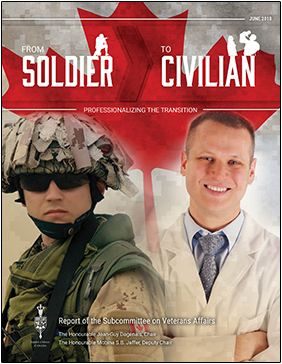
The report, From Soldier to Civilian: Professionalizing the transition, calls on the federal government to implement immediate changes to a transition process that — despite years of well-publicized and well-founded criticism — remains stubbornly inefficient.
Soldiers face layers of bureaucracy when they leave the forces, which delays the provision of compensation that is rightfully theirs, does a disservice to their contributions to Canada and discourages people from enlisting.
The report makes 13 recommendations, including three that the subcommittee believes should be implemented immediately:
- No armed forces member should be released until all benefits and services from all sources are in place.
- Veterans Affairs Canada should maintain a maximum ratio of 25 veterans per case manager.
- The Canadian Armed Forces and Veterans Affairs Canada should issue an identification card prior to the release of a member of the forces. The card should include recognition of military service and an identification number to allow for quick and efficient follow-up either by Veterans Affairs or by the veteran.
Canada demands much from members of its armed forces; the government has an obligation to honour their service by properly supporting their transition to civilian life.
Quick Facts
- Between 9,000 and 10,000 military members are released from service each year.
- One third have difficulty making transition to civilian life.
- Approximately 1,600 are released for medical reasons.
Quotes
“The subcommittee members believe that the men and women who made unfathomable sacrifices to defend our country deserve to see these improvements implemented without delay.”
- Senator Jean-Guy Dagenais, Chair of the subcommittee.
“The recruiting of men and women into the Canadian Armed Forces is done in a professional manner. That same standard of professionalism should be in place when they are released.”
- Senator Mobina S.B. Jaffer, Deputy Chair of the subcommittee.
“It is vital that we establish mechanisms that will provide expedient continuity of care and that full elements of support are in place by Veterans Affairs Canada prior to release to facilitate seamless transition.”
- Michael L. Blais, president of Canadian Veterans Advocacy.
“The government needs to ensure that resources and programs are in place to meet veterans’ needs. The government needs to review the accessibility of these programs and ensure that front-line staff are available and knowledgeable to assist veterans and their families.”
- Ray McInnis, service bureau director of the Royal Canadian Legion.
Associated Links
- Read the report, From Soldier to Civilian: Professionalizing the transition.
- Follow the committee on social media using the hashtag #VEAC.
- Sign up for the Senate’s eNewsletter.
For more information, please contact:
Sonia Noreau
Public Relations Officer
Communications Directorate
Senate of Canada
613-614-1180 | sonia.noreau@sen.parl.gc.ca
Multimedia
Senators Jean-Guy Dagenais (subcommittee chair) and Mobina S.B. Jaffer (subcommittee deputy chair) share findings of the Subcommittee on Veterans Affairs’ report at a press conference in Ottawa on Wednesday, June 13, 2018.

Senators who participated in this study

Jean-Guy Dagenais
CSG - Quebec (Victoria)

Mobina S. B. Jaffer
ISG - British Columbia

Gwen Boniface
ISG - Ontario
Other Senators who have participated from time to time in the study: The Honourable Daniel Lang, Ghislain Martin, Fabian Manning, Raymonde Saint-Germain, Pamela Wallin and Vernon White.