Study Background
The Standing Senate Committee on Official Languages studied, under its general mandate, the proposed reform to the Official Languages Act released by the Minister of Economic Development and Official Languages on February 19, 2021. In light of the evidence heard and the large number of briefs received (45) from stakeholders, the committee would like to communicate key points from its study, which occurred prior to the introduction of Bill C-32 on June 15, 2021.
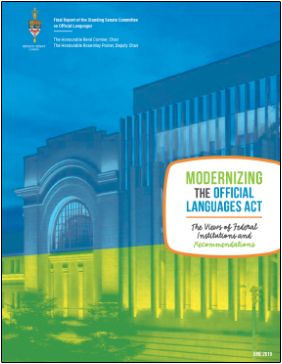
In general, many of the commitments in the proposed reform address recommendations outlined in the committee’s final report on modernizing the act, released in June 2019, and the stakeholders consulted on the reform plan reacted positively.
That said, the witness testimonies and briefs highlighted a number of concerns for the long term, including deficiencies in and issues with the act that remain unresolved, even with the proposed reform. Some stakeholders have conflicting positions. Accordingly, a thoughtful and careful review of any future legislative, regulatory and administrative changes will be required.
But one thing is clear: the numerous responses and palpable enthusiasm generated by the study on the proposed reform show that stakeholders expect parliamentarians to continue working on this file.
The committee on official languages has identified the key points raised by stakeholders. Senators hope that the evidence provided will inform parliamentarians’ review of Bill C-32 as it moves through the legislative process. After studying this subject for more than two years, the committee found that the modernization of the federal language regime remains a pressing issue and looks forward to studying the contents of the government’s bill.
Key Points Raised in Testimony and Briefs
Without attempting to provide a comprehensive analysis on the federal government’s proposed reform to the Official Languages Act, the committee would like to highlight the following key points raised in stakeholders’ testimonies and written briefs.
- Legislative proposals to enshrine the Court Challenges Program in the act, develop a government plan for official languages and review the act and its regulations every 10years are all elements of the reform plan that garnered consensus. These commitments also meet the committee’s expectations.
- Stakeholders applauded the government’s intention in the preamble of the act to protect and support key institutions in official language minority communities. However, they also expressed high expectations for the adoption of a broad definition of comprehensive and cross-institutional minority language services that cover — among others — minority and bilingual post-secondary institutions and community media, as well as institutions in the health, economic development and arts and culture sectors. This request is consistent with the recommendations in the committee’s 2019 report.
- Most stakeholders supported eliminating the exemption in section 16 of the act in order to require the appointment of bilingual judges to the Supreme Court of Canada. However, the committee noted — as did some briefs — that this legislative proposal would not guarantee that a francophone litigant can be understood by all the justices on the bench. Given the pressure to make the highest court in the country more representative, the committee agrees with the arguments made in testimony and briefs that the principles of inclusion, diversity and linguistic duality can be reconciled in the appointment process. That said, further efforts are still needed to improve the language skills of federally appointed judges, as recommended by the committee in 2019.
- Stakeholders all recognized the unique reality and vulnerable status of the French language and the importance of progressing toward the substantive equality of Canada’s official languages. The proposed means for doing so, however, elicited varying reactions. The addition of asymmetrical components in the act could undermine the principle of the equality of status of French and English recognized by the act and the Canadian Constitution. A careful review of the proposed measures and their impacts is now required, with consideration given to the specific needs and challenges of Quebec’s English-speaking communities.
- Testimonies and briefs agreed on the importance of including the remedial nature of language rights in the principles for interpreting the act; the proposed reform is silent on this matter. The committee’s 2019 recommendations support this change.
- The recognition of existing Indigenous language rights and the federal government’s intention to modernize the act without infringing on the rights enshrined in the Indigenous Languages Act were well received by most of the stakeholders consulted. In general, some consensus emerged on reconciling support for ancestral languages with support for linguistic duality.
- Stakeholders welcomed the legislative proposal to govern the enumeration of rights-holders under section 23 of the Canadian Charter of Rights and Freedoms. However, they want stronger commitments to ensure the collection of data on official languages and official language minority communities and to make that data accessible. Stakeholders consider this data critical to achieving the objectives of the act.
- Recent events in the news have shown that post-secondary institutions’ capacity to offer bilingual programs and serve official language minority communities is weakening. They emphasized the importance of including all parts of the education continuum in the act. They highlighted weaknesses in the implementation and oversight of federal education transfers. Echoing the committee’s recommendations from 2019, the testimonies and briefs called for federal–provincial/territorial agreements to be governed by the act, for binding language clauses and reporting requirements to be included and for mandatory key stakeholder consultation. These remarks apply to other areas that affect the development of official language minority communities, such as health care and the devolution of services to other levels of government.
- The proposed reform calls for strengthening and adding gradations to the powers of the Commissioner of Official Languages to ensure better compliance with the act. Stakeholders were generally satisfied with the proposed measures, although some still asked for an Official Languages Tribunal, as recommended by the committee in 2019. Some testimonies and briefs insisted on adding administrative monetary penalties and damages to the list of powers available to the commissioner. As recommended by the committee, the amounts collected through these penalties could be used to fund projects that promote official languages or support the development of official language minority communities.
- Stakeholders enthusiastically welcomed the government’s commitment to adopt regulations under Part VII of the act and hope they are drafted and implemented quickly. Some testimonies and briefs called for clarification of the terms for implementing Part VII itself, by defining “positive measures,” ensuring effective and mandatory consultation of communities and ensuring the penalty powers granted to the Commissioner of Official Languages also apply to Part VII, among other measures.
- The Treasury Board’s role in implementing Part VII of the act, as proposed in the reform plan, meets the committee’s expectations and was generally well received among stakeholders. However, the committee had also called for the Treasury Board to be assigned responsibility for horizontal coordination of the act, which the proposed reform does not do; this omission does not meet the committee’s expectations and does not have unanimous support among stakeholders. Expectations are high for defining clear governance mechanisms and ensuring coordinated implementation of the act. The committee acknowledges the investments in Budget 2021 for Canadian Heritage and the Treasury Board to modernize the act.
- The idea of including the language obligations of federally regulated private businesses in the act raised questions and provoked varied reactions. Some stakeholders are concerned that the addition of legislative obligations solely targeting the French language and francophones or specific provinces would violate the principle of the equality of status of French and English recognized by the act and the Canadian Constitution. As the committee was unable to review the findings of the expert panel on the language of work and service of federally regulated private businesses, these proposed measures and their impacts will need to be carefully reviewed.
- The COVID-19 pandemic has exacerbated the disregard for language rights in the federal public service. This public health crisis has highlighted the challenges that must be overcome with regard to the provision of services in both official languages, the language of work of federal public servants and the growing need for high-quality translation and interpretation resources. The testimonies and briefs called for clarifying the language rights of travellers, drafting regulations on language of work under Part V and enshrining in the act the Translation Bureau’s role in its implementation — requests that are all consistent with the committee’s 2019 recommendations.
- As the committee pointed out in its 2019 final report, there is still no official French version of some parts of the Constitution, which were adopted in English only. During the study of the proposed reform, stakeholders reiterated that the resolution of this issue has been delayed and asked the federal government to take the lead and ensure the adoption of a French version of constitutional texts, meeting the obligation set out in section 55 of the Constitution Act, 1982.
The above remarks cover only some of the comments brought to the committee’s attention during its study on the proposed reform this year. The committee encourages the federal government and stakeholders to consider the study’s rich testimonies and briefs as the bill to amend the act, Bill C-32, is considered in Parliament.

The Standing Senate Committee on Official Languages today released a list of key points stemming from its study of the proposed reforms to the Official Languages Act, released by the Minister of Economic Development and Official Languages on February 19, 2021.
The reform plan and the committee’s study generated substantial interest and reaction. In light of the evidence heard and the 45 briefs received during the study, and as the government moves ahead with Bill C-32 to amend the Official Languages Act, the committee wished to provide an update on what senators and stakeholders had to say.
The committee is pleased that many of the commitments in the reform plan address recommendations outlined in its June 2019 final report on modernizing the act. In general, the stakeholders consulted reacted positively to the intended reform. That said, stakeholders’ testimonies and briefs still highlighted a number of concerns for the long-term, including deficiencies in and issues with the act that remain unresolved. Consequently, a thoughtful and careful review of the upcoming legislative, regulatory and administrative changes will be required.
The key points raised by the committee and stakeholders during the study are available on this webpage. The committee hopes the wealth of evidence provided will inform parliamentarians’ review of Bill C-32 as it proceeds through the legislative process.
Quick Facts
- The Minister of Economic Development and Official Languages was mandated by the current government to introduce a bill to modernize and strengthen the Official Languages Act and to improve oversight and coordination of the act.
- The Minister of Economic Development and Official Languages released a document outlining the government’s intended reform of the act, entitled English and French: Towards a Substantive Equality of Official Languages in Canada, on February 19, 2021.
- The committee devoted two public hearings to a study on the proposed reform (May 31, 2021, and June 7, 2021).
- The committee previously conducted a five-part study — between 2017 and 2019 — on the modernization of the act, which resulted in four interim reports and one final report.
- In its June 2019 final report, the committee made 20 recommendations to the federal government for how to address problems with the implementation of the act in four main areas: leadership and cooperation, compliance, enforcement principles and judicial bilingualism.
- Budget 2021 provides $6.4 million to Canadian Heritage and $2.3 million to the Treasury Board of Canada Secretariat over two years, starting in 2021–2022, to modernize the act.
Quotes
“I would like to extend my thanks to all stakeholders for their passion and commitment in engaging with the committee’s study on the government’s proposed reform to the Official Languages Act. The strong enthusiasm and varied reactions generated by the study show this work is not over. The committee will continue to monitor this file closely and follow the evolution of Bill C-32 with great interest.”
— Senator René Cormier, Chair of the committee
“The proposed reform to the Official Languages Act highlights the unique reality and vulnerable status of the French language in Canadian society. The act’s modernization is a vital and urgent issue, both for the province of Quebec and francophone minority communities across the country.”
— Senator Jean-Guy Dagenais, Deputy Chair of the committee
“The Official Languages Act is critical to our social contract. Because of that, the act’s modernization must take into account the needs of all Canadians, including the unique needs and challenges of Quebec’s English-speaking communities.”
— Senator Larry W. Smith, Deputy Chair of the committee
Associated Links
- Learn more about the committee.
- Follow the committee on social media using the hashtag #OLLO.
- Subscribe to the Senate’s eNewsletter.
For more information:
Michael Forian
Public Relations Officer | Senate of Canada
613-614-1180 | media@sen.parl.gc.ca