
Recommendations
RECOMMENDATION 1:
That the Government of Canada take all steps necessary to implement, without delay, the Truth and Reconciliation Commission Calls to Action relating to the overrepresentation of Indigenous Peoples in the federal correctional system, notably:
- Call to Action 30, which calls on the Government of Canada to commit to eliminating the overrepresentation of Indigenous Peoples in custody by 2025, and to issue detailed annual reports on this effort;
- Call to Action 32, which calls on the Government of Canada to amend the Criminal Code to allow trial judges to depart from mandatory minimum sentences and restrictions on the use of conditional sentences; and
- Call to Action 34, which calls on the Government of Canada to undertake reforms to the criminal justice system to better address the needs of federally-sentenced persons with Fetal Alcohol Spectrum Disorder (FASD), including:
- providing increased community resources and powers for courts to ensure that FASD is properly diagnosed, and that appropriate community supports are in place for those with FASD;
- enacting statutory exemptions from mandatory minimum sentences of imprisonment for federally-sentenced persons affected by FASD;
- providing community, correctional, and parole resources to maximize the ability of people with FASD to live in the community; and
- adopting appropriate evaluation mechanisms to measure the effectiveness of such programs and ensure community safety.
RECOMMENDATION 2:
That the Government of Canada work with Indigenous communities, provinces and territories to develop a strategy designed to prevent the overincarceration of Indigenous Peoples, particularly those with intellectual disabilities and mental health issues, and that takes into account the unique and intersecting sociohistorical factors that are closely linked to and exacerbate their mental health issues.
RECOMMENDATION 3:
That the Government of Canada work with civil society organizations, communities, provinces and territories to develop targeted strategies, in addition to economic, educational and social programs to address the root causes of the overrepresentation of Black persons in the federal correctional system, including systemic racism and historical discrimination. Such strategies could include the creation of a guaranteed minimum income program.
RECOMMENDATION 4:
That the Government of Canada, in consultation with relevant interest groups, provinces and territories, develop targeted strategies, including economic, educational and social programs designed to address the root causes of women’s incarceration, with particular attention to Indigenous women and those with disabling mental health issues.
RECOMMENDATION 5:
That the Correctional Service of Canada, in consultation with internal and external stakeholders and experts, develop a strategy that respects the rights of all federally-sentenced persons, irrespective of security classification, have equal access to effective correctional programming to ensure their successful reintegration into society.
RECOMMENDATION 6:
That the Correctional Service of Canada initially classify all federally-sentenced women as minimum security and that in keeping with the recommendations of the 1990 report, Creating Choices: The Report of the Task Force on Federally Sentenced Women and the 1996 Commission of Inquiry into certain events at the Prison for Women in Kingston, it work with independent experts and civil society organizations to develop a rights-based security re-assessment tool that recognizes the complex needs of federally-sentenced women to ensure they are not unnecessarily and arbitrarily overrepresented in higher security classifications.
RECOMMENDATION 7:
That the Correctional Service of Canada ensure that parole officers have all the information required, particularly in relation to federally-sentenced Indigenous Peoples, to conduct intake assessments and penitentiary placement decisions that take into account the sociohistorical backgrounds of federally-sentenced persons as well as their sex, gender, race and ethnicity.
RECOMMENDATION 8:
That the Correctional Service of Canada work with independent experts to ensure the Custody Rating Scale places more weight on the context within which crimes were committed, attaches more weight to dynamic risk factors and accounts for the unique experiences of marginalized and vulnerable groups with a view to developing clear rights-based guidelines on the use of this tool. In addition, the Custody Rating Scale should be applied uniformly and consistently across the country.
RECOMMENDATION 9:
That the Correctional Service of Canada repeal its policy obligating federally-sentenced persons convicted of homicide to serve a minimum of two years in maximum security.
RECOMMENDATION 10:
That the Government of Canada amend the Criminal Code of Canada to allow judges the discretion to not impose mandatory minimum penalties, and that the Department of Justice Canada undertake a comprehensive review of mandatory minimum penalties with a view to determining which should be revised or repealed.
RECOMMENDATION 11:
That the Correctional Service of Canada work with relevant interest groups and independent experts to ensure correctional plans focus on support and accommodation and availability of programs and services to address the unique experiences and reintegration challenges of marginalized and vulnerable groups, and that programming is made effective and available to all federally-sentenced persons.
RECOMMENDATION 12:
That the Correctional Service of Canada facilitate, and eliminate all barriers inhibiting, the exercise and practice of religious and spiritual beliefs in federal penitentiaries. The Correctional Service of Canada should ensure correctional officers respectfully handle religious items and articles such as Medicine Bundles.
RECOMMENDATION 13:
That the Correctional Service of Canada reduce the cost of room and board and the cost for accessing the telephone. The Correctional Service of Canada should also review the cost of living in federal penitentiaries, as well as the cost of preparing for release and increase the salaries of federally-sentenced persons accordingly.
RECOMMENDATION 14:
That the Correctional Service of Canada provide federally-sentenced persons’ committees with the opportunity to manage canteen as well as shopping for effects and/or reinstate outside shopping as a work placement for federally-sentenced persons classified as minimum security.
RECOMMENDATION 15:
That the Correctional Service of Canada provide federally-sentenced persons with food that adequately meets their dietary needs both in terms of quality and quantity, and ensure that specialized diets for religious, cultural, medical or ethical reasons are respected.
RECOMMENDATION 16:
That the Correctional Service of Canada make available hygiene products that reflect the needs of federally-sentenced Black and other racialized persons and ensure that these products are affordable.
RECOMMENDATION 17:
That the Correctional Service of Canada recognize the important role families and communities of support can play in the rehabilitation and reintegration of federally-sentenced persons, including by:
- facilitating their involvement in the correctional process;
- ensuring that family visits are not cancelled as a punitive measure even when federally-sentenced persons are placed in structured intervention units;
- making every effort to avoid cancelling family visits for security reasons that are out of the federally-sentenced person’s control, including lockdowns; accelerating efforts to roll out family visits via electronic and video conference options and ensure that its policies make clear that video conferences are not a substitute for in-person family visits; and
- reviewing its use ion scanners and all risk threat assessment related to the use of ion scanners in order to ensure appropriate procedures are followed and that discriminatory patterns are assessed and redressed so that human rights as enumerated in the Canadian Charter of Rights and Freedoms are not breached.
RECOMMENDATION 18:
That the Correctional Service of Canada facilitate parenting via section 81 agreements for federally-sentenced Indigenous Peoples and non-Indigenous persons, in addition to providing full access to the Mother-Child Program by working with the provinces and territories to eliminate barriers preventing federally-sentenced women from accessing Mother-Child Programming.
RECOMMENDATION 19:
That the Correctional Service of Canada increase its use of section 81 of the Corrections and Conditional Release Act with a view to ensuring that federally-sentenced persons, particularly federally-sentenced Indigenous women and men, are able to build and/or maintain ties with their families, communities and culture.
RECOMMENDATION 20:
That the Correctional Service of Canada work with the provinces, territories, medical associations and professional governing and licensing bodies to ensure professional standards are adhered to and doctors are available in federal penitentiaries on a full-time basis and registered nurses on a 24-hour basis.
RECOMMENDATION 21:
That the Correctional Service of Canada establish a policy to ensure that only medical professionals have the authority to determine whether a federally-sentenced person requires medical attention.
RECOMMENDATION 22:
That the Correctional Service of Canada increase the provision of dental care in federal penitentiaries to reflect the needs of federally-sentenced persons, with an emphasis on preventative dental care.
RECOMMENDATION 23:
That the Correctional Service of Canada increase efforts to develop more contracts with provinces and territories to establish alternatives to federal correctional facilities for aging federally-sentenced persons and those with acute medical conditions as well as mental health issues pursuant to section 29 of the Corrections and Conditional Release Act.
RECOMMENDATION 24:
That the Correctional Service of Canada provide additional rights-based training to correctional staff to ensure they are sensitive to the complex needs of aging, as well as physically and mentally ill federally-sentenced population. The Correctional Service of Canada should also make federal correctional facilities more accessible for federally-sentenced persons with mobility issues.
RECOMMENDATION 25:
That the Correctional Service of Canada implement the following measures to ensure federally-sentenced persons with mental health issues receive appropriate support:
- conduct a culturally appropriate mental health assessment of all federally-sentenced persons entering the federal correctional system within 30 days of admission;
- ensure that mental health beds are contracted in psychiatric facilities pursuant to section 29 of the Corrections and Conditional Release Act;
- ensure that mental health professionals are available in every federal penitentiary on a 24-hour basis and that they are the first responders to all mental health crises.
RECOMMENDATION 26:
That the Correctional Service of Canada implement a holistic approach to mental health by:
- providing all employees, as a condition of employment, with appropriate mental health and mental health crisis intervention training that is consistent with their vocational role. Further, the Correctional Service of Canada shall establish appropriate standards for training, ensure that all trainees demonstrate that they have met the standard and that ongoing evaluations of the quality, quantity and outcomes of the training be conducted and used to inform annual improvement of the training; and
- evaluating the Peer Offender Prevention Service program at Stony Mountain Institution with a view to expanding it nationally to federal penitentiaries of all security levels.
RECOMMENDATION 27:
That the Correctional Service of Canada ensure that federally-sentenced persons with mental health issues, or whom exhibit behaviours that may indicate a mental health issue, who are placed in structured intervention units are evaluated within 24 hours of their placement by a recognized mental health care professional.
RECOMMENDATION 28:
That the Correctional Service of Canada expand its use of section 29 agreements and contract the development/provision of mental health services and beds in provincial psychiatric hospitals to provide adequate mental health services for federally-sentenced persons.
RECOMMENDATION 29:
That the Correctional Service of Canada work with independent academics, lawyers, representatives of civil society organizations and other experts on corrections to:
- review the application of its use of force policies by correctional officers, with a view to reducing use of force incidents and addressing the disconnect between the policies and their application;
- review and enhance training to correctional officers on the use of force, with a focus on reducing the disproportionate use of force against federally-sentenced Indigenous Peoples, Black persons and persons with mental health issues, and that it regularly monitor the results of this training and adjust as necessary; and
- develop employment incentives and commendations for correctional officers and other staff that incentivize interventions that de-escalate conflict and result in no use of force by individuals and on penitentiary-wide bases.
RECOMMENDATION 30:
That the Correctional Service of Canada reverse its policy allowing correctional officers to carry inflammatory agents on their person and provide additional training on the proper and restricted use of inflammatory agents and de-escalation strategies as alternatives to the use of force.
RECOMMENDATION 31:
That the Correctional Service of Canada, in consultation with internal and external stakeholders and experts, develop and implement robust, effective and rights-based oversight and accountability mechanisms for use of force incidents to ensure that correctional staff who use disproportionate force are held accountable.
RECOMMENDATION 32:
That the Correctional Service of Canada seriously consider the use of body-worn cameras for correctional officers to promote transparency and accountability.
RECOMMENDATION 33:
That the Correctional Service of Canada ensure that Structured Intervention Units adhere to the most recent court decisions and respect Canada’s human rights obligations and international commitments, including by:
- eliminating the use of solitary confinement for all federally-sentenced persons;
- taking into account the different needs and experiences of particular groups, including LGBTQI2-S persons and women;
- eliminating solitary confinement in excess of 15 days;
- providing meaningful human contact and continued access to programming as well as 24-hour access to health and mental health services; and
- establishing judicial oversight to review all Structured Intervention Unit placements and decisions.
RECOMMENDATION 34:
That the Correctional Service of Canada immediately end the use of separation by any name with youth, women and those with disabling mental health issues, and implement mental health assessments and judicial oversight to eliminate the overrepresentation of federally-sentenced Indigenous Peoples, Black persons, other racialized persons and persons with mental health issues in Structured Intervention Units.
RECOMMENDATION 35:
That the Correctional Service of Canada urgently take all necessary measures to implement and promote a human rights culture within the federal correctional system, including by:
- enforcing a zero-tolerance policy with regards to mistreatment and abuse of federally-sentenced persons by correctional staff and contracted employees and other service providers;
- enhancing harassment prevention and resolution training among managers and staff;
- fostering a healthy and human rights promoting work environment where staff can report abuse without fear of reprisal; and
- responding promptly and effectively to mistreatment complaints from staff and federally-sentenced persons by other staff or federally-sentenced persons.
RECOMMENDATION 36:
That the Correctional Service of Canada improve its training for correctional personnel regarding human rights standards and principles of equality and non-discrimination, including in relation to race, sex, sexual orientation, gender identity and expression, and mental health.
RECOMMENDATION 37:
That the Correctional Service of Canada provide educational outreach for federally-sentenced persons regarding human rights standards and principles of equality and non-discrimination, including in relation to race, sex, sexual orientation, gender identity and expression, and mental health.
RECOMMENDATION 38:
That the Correctional Service of Canada ensure that the access to justice rights of federally-sentenced persons are respected and upheld, including by:
- responding to and resolving the backlog of grievances filed by federally-sentenced persons, and ensuring the rapid resolution and redress of all future grievances;
- establishing an independent review process for grievances filed by federally-sentenced persons to eliminate the risk of reprisals by implicated staff and ensure confidence in the grievance process;
- properly educating its employees with respect to the rights of incarcerated persons and informing them of the Service’s commitment to seeing that these rights are respected and enforced, in keeping with the Arbour Commission recommendations. As a result, conduct human rights training for federally-sentenced persons and staff similar to that provided for regional advocates by the Canadian Association of Elizabeth Fry Societies; and
- incorporating an external review process to assess and remedy the gaps between law and policies regarding access to justice rights and the application of these laws and policies.
RECOMMENDATION 39:
That the Department of Justice, in keeping with the recommendation made by the Arbour Commission, examine legislative mechanisms by which to create sanctions for correctional interference with the integrity of a sentence and that such sanctions provide that if illegalities, gross mismanagement or unfairness in the administration of a sentence renders the sentence harsher than that imposed by the court:
- In the case of a non-mandatory sentence, a reduction of the period of imprisonment be granted, to reflect that the punishment administered was more punitive than the one intended, should a court so find; and
- In the case of a mandatory sentence, the same factors be considered as militating towards earlier release.
RECOMMENDATION 40:
That the Correctional Service of Canada provide federally-sentenced persons with internet access for secondary and post-secondary programming, as well as the guidance, resources and educational courses and programs they need to fulfil their career objectives, which should be included in and supported by correctional plans. The Correctional Service Canada should also work with universities and other post-secondary institutions to develop courses for federally-sentenced persons modeled after the Walls to Bridges program and deliver these courses in federal correctional facilities across the country.
RECOMMENDATION 41:
That the Correctional Service of Canada work with CORCAN and community-based businesses and organizations to develop a broader range of programs, training, employment and volunteer opportunities for federally-sentenced persons to increase availability of, and opportunities for, internships and paid work experience in federal correctional facilities with updated wages.
RECOMMENDATION 42:
That the Correctional Service of Canada work with CORCAN, local businesses, community partners and other stakeholders to reopen and expand penitentiary farms in federal correctional facilities across the country and consider a therapeutic model in conjunction with community partners.
RECOMMENDATION 43:
That the Breakaway program be funded by the Correctional Service of Canada and expanded nationally and made available to federally-sentenced persons in all penitentiaries, particularly maximum security penitentiaries, and to federally-sentenced persons who are not serving a life sentence.
RECOMMENDATION 44:
That the Correctional Service of Canada conduct a Gender-Based Analysis Plus of its funding allocations for correctional programming to ensure that all correctional programming reflects the needs and desires of federally-sentenced persons.
RECOMMENDATION 45:
That the Correctional Service of Canada ensure that all federally-sentenced deaf and hard of hearing persons are able to access correctional programming through appropriate access to relevant medical devices and reliable interpretation services.
RECOMMENDATION 46:
That the Correctional Service of Canada work with independent experts and civil society organizations involved in the rehabilitation and community integration of federally-sentenced Black persons and otherwise racialized persons to develop and fund correctional programming and integration opportunities as are available pursuant to sections 29, 81 and 84 of the Corrections and Conditional Release Act.
RECOMMENDATION 47:
That the Correctional Service of Canada support the work of civil society organizations and facilitate their access to federal correctional facilities to provide vital programming and connection to the community, especially for vulnerable and marginalized groups.
RECOMMENDATION 48:
That the Correctional Service of Canada work with Indigenous communities, Elders, civil society organizations and other stakeholders involved in the rehabilitation and reintegration of federally-sentenced Indigenous Peoples to develop culturally relevant programming that reflects the individual protocols of the region and ensure, where possible, timely access to this programming as well as other types of CSC programming that are beneficial for reintegration, such as CORCAN.
RECOMMENDATION 49:
That the Correctional Service of Canada increase the number of spaces in the Pathways program to ensure all eligible federally-sentenced Indigenous Peoples may participate, as appropriate.
RECOMMENDATION 50:
That the Correctional Service of Canada provide parole officers involved in the development of correctional plans the appropriate training and resources to ensure federally-sentenced Indigenous peoples are able to take full advantage of the Pathways program.
RECOMMENDATION 51:
That the Correctional Service of Canada increase the number of section 81 agreements by raising awareness of this section and guiding communities through the process as well as funding the establishment of individualized options as well as group Healing Lodges.
RECOMMENDATION 52:
That the Correctional Service of Canada provide federally-sentenced Indigenous Peoples with access to Elders from their regions in accordance with established Indigenous protocols, while prioritizing the employment of Indigenous Peoples from the land on which Correctional Service of Canada Healing Lodges are located to work in these facilities.
RECOMMENDATION 53:
That the Correctional Service of Canada, in consultation with internal and external stakeholders and experts, modernize programming for women to meet the diverse and complex needs of this population.
RECOMMENDATION 54:
That the Correctional Service of Canada consult federally-sentenced women on the types of employment they hope to obtain upon release and provide access to CORCAN opportunities and community-based vocational training that reflects their interests.
RECOMMENDATION 55:
That recognizing the histories of abuse of federally sentenced women, the resulting negative impact on the mental health of women and deleterious impact on prisoner-staff relationships, as well as the negligible contribution to the safety and security of penitentiaries, the Correctional Service of Canada cease the use of routine strip searching of federally sentenced women.
RECOMMENDATION 56:
That the Correctional Service of Canada ensure consistent and transparent application of its security protocols so that the access of civil society organizations working with federally-sentenced persons is facilitated to federal penitentiaries and their important work is not only continued but enhanced.
RECOMMENDATION 57:
That the Correctional Service of Canada ensure that federally-sentenced persons are prepared for parole hearings when they are first eligible for conditional release. This preparation should include ensuring timely access and funding for programs, and wraparound and proactive community integration plans. The preparation should also include an improved planning process, periodical review and correction of errors in federally-sentenced persons’ files, and educational outreach on the parole application process.
RECOMMENDATION 58:
That the Parole Board of Canada conduct a review to assess whether the use of videoconferencing for parole board hearings hinders a federally-sentenced person’s chances of obtaining parole, and if so, to limit this practice to the extent that doing so is beneficial for federally-sentenced persons.
RECOMMENDATION 59:
That the Parole Board of Canada and the Correctional Service of Canada conduct a review to examine barriers to conditional release for federally-sentenced persons with mental health issues and develop a strategy to address the findings of this review.
RECOMMENDATION 60:
That the Parole Board of Canada implement without delay its plans to develop a culturally relevant gender-informed decision-making process for parole hearings.
RECOMMENDATION 61:
That the Correctional Service of Canada and the Parole Board of Canada develop and implement a strategy to reduce barriers to early release for federally-sentenced Black persons, which should include a review of the Secure Threat Group designation policy and its disproportionate application to Indigenous Peoples and racialized groups.
RECOMMENDATION 62:
That the Correctional Service of Canada take all necessary steps to eliminate barriers to federally-sentenced Indigenous Peoples’ access to early release, including by ensuring timely access to culturally specific and gender appropriate correctional programs and providing educational outreach on the parole application process and the culturally specific parole hearings available to them.
RECOMMENDATION 63:
That the Parole Board of Canada conduct a rights-based review of the training it provides to Parole Board members regarding hearings with federally-sentenced Indigenous Peoples to assess the effectiveness of this training, and address any gaps identified by this review.
RECOMMENDATION 64:
That the Correctional Service of Canada increase the use of section 84 releases by raising awareness of this section among federally-sentenced Indigenous Peoples, Indigenous communities, and parole officers, including educational outreach programs on how to prepare a section 84 release plan.
RECOMMENDATION 65:
That the Correctional Service of Canada expand the application of section 84 releases to other vulnerable and marginalized groups, including federally-sentenced Black persons, LGBTQI2S and the ill and aging population.
RECOMMENDATION 66:
That the Correctional Service of Canada substantially increase funding for civil society groups and reallocate resources to community corrections to address the growing population of federally-sentenced persons under community supervision and associated issues, including limited space in community-based residential facilities, unmanageable caseloads for community parole officers, and access to community-based programming.
RECOMMENDATION 67:
That the Correctional Service of Canada consult with community parole officers and civil society groups with a view to ensuring they have sufficient resources to assist federally-sentenced persons in their reintegration.
RECOMMENDATION 68:
That the Correctional Service of Canada, in collaboration with provincial, territorial, municipal and community partners, ensure that federally-sentenced persons ahead of their release have identification, medication, housing, employment and other necessities to increase chances of successful reintegration.
RECOMMENDATION 69:
That Public Safety Canada reduce the wait periods and eliminate the cost and application requirements of the record suspension/pardon process to increase the availability of this service without discrimination on the basis of means.
RECOMMENDATION 70:
That the Correctional Service of Canada implement a human rights-based approach in all its policies, programs and practices that accounts for the complex and unique needs of the diverse groups that are vulnerable and marginalized in our society and the federal correctional system.
RECOMMENDATION 71:
That the Correctional Service of Canada and other relevant government departments respond to the committee’s recommendations in this report without delay.
Multimedia

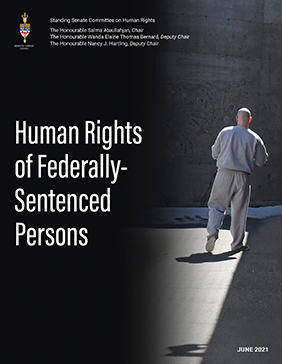
The human rights of people serving sentences must be at the heart of Canada’s correctional system if its goals of safety, rehabilitation and effective reintegration are to be achieved, the Senate Committee on Human Rights says in a report released on Wednesday.
The report outlines 71 recommendations to safeguard human rights in the federal correctional system, with a focus on equality rights, non-discrimination and improving the services and supports available to incarcerated persons – especially to Indigenous, Black and other racialized people, women and those with mental health concerns.
Over the course of two years prior to the COVID-19 pandemic, senators visited penitentiaries across every region of the country, where they heard from federally-sentenced persons, correctional staff and leading experts.
Once incarcerated, people depend on the Correctional Service of Canada (CSC) to respect and safeguard their rights. Unfortunately, the committee found human rights were too often sacrificed in the name of security or budgets.
Among the troubling evidence the committee heard and observed were dirty and cramped living conditions; inadequate or inappropriate meals; cells inaccessible to wheelchair users; prohibitive pricing and limited choices when purchasing basic personal items; and cancelled family visits. The committee also heard from federally-sentenced persons who: did not have timely access to doctors; had their teeth pulled due to irregular dental care; were denied the opportunity to practice their religious or spiritual beliefs; and experienced racism and discrimination, among other human rights concerns.
Recent evidence indicated the arrival of the COVID-19 pandemic exacerbated some of the human rights challenges inside federal penitentiaries, as public health restrictions led to more frequent lockdowns, restricted visits, less access to health care and a reduced capacity in programs.
The report’s recommendations address a wide range of concerns raised during the study, including the root causes of incarceration and the over-representation of Indigenous, Black and other racialized persons in penitentiaries, the provision of basic needs and health care and the need for diverse rehabilitation and reintegration programs, as well as strengthened oversight and accountability for use of force and segregation-like practices. The report calls for CSC and other relevant government departments to respond to the recommendations without delay.
The committee concludes that the country’s correctional system must be grounded in the respect for and enforcement of human rights, both to keep our communities safe and to better equip incarcerated persons – a diverse and complex population – with the right tools to successfully rejoin society.
Quick Facts
- Between 2017 and 2019, the committee visited 28 federal penitentiaries, held 30 meetings and gathered testimony from 155 witnesses. An interim report was released in February 2019.
- Following its fact-finding missions, the committee in 2021 accepted further submissions to examine the impacts of the COVID-19 pandemic and of recent legislative changes on human rights in federal penitentiaries.
- The Canadian Charter of Rights and Freedoms, the Canadian Human Rights Act and the Corrections and Conditional Release Act protect the human rights of federally-sentenced persons and enshrine the obligations of the government to uphold these rights.
- Federally-sentenced persons often faced myriad challenges before their incarceration, including poverty, homelessness, trauma, abuse, mental health issues, addiction and limited education.
- Individuals from marginalized and vulnerable communities, whose challenges are amplified by systemic racism and discrimination — such as Indigenous and Black persons — are incarcerated at disproportionate levels.
Quotes
“This landmark study gives the public and policymakers rare insight into the lives of federally-sentenced persons. It is my hope that this report can be used to both enhance the protection of human rights and fulfill the long-term goal of making communities safer.”
- Senator Salma Ataullahjan, Chair of the committee
“There is no space for racism, sexism, transphobia, homophobia, ableism and or any other form of discrimination in the federal correctional system. By recognizing the humanity and the unique needs of marginalized and vulnerable groups, federally-sentenced persons will be better prepared for release and more likely to avoid recidivism.”
- Senator Wanda Thomas Bernard, Deputy Chair of the committee
“The committee is deeply grateful to each person who shared their stories as part of this study. We remain concerned by the level of frustration, hopelessness and despair expressed by people serving sentences across the country, who said they often feel demeaned and ignored by a system that continually prioritizes security interests over their basic human rights.”
- Senator Nancy J. Hartling, Deputy Chair of the committee
Associated Links
- Read the report: Human Rights of Federally-Sentenced Persons
- Follow the committee on social media using the hashtag #RIDR
- Sign up for the Senate eNewsletter
For more information:
Ben Silverman
Public Relations Officer | Senate of Canada
613-614-1180 | ben.silverman@sen.parl.gc.ca
Senators who participated in the study

Salma Ataullahjan
C - Ontario (Toronto)

Wanda Thomas Bernard
PSG - Nova Scotia (East Preston)

Nancy J. Hartling
ISG - New Brunswick

Yvonne Boyer
ISG - Ontario

Yonah Martin
C - British Columbia

Marie-Françoise Mégie
ISG - Quebec (Rougemont)

Thanh Hai Ngo
C - Ontario

Kim Pate
ISG - Ontario

Scott Tannas
CSG - Alberta
Ex-officio members of the committee: The Honourable Senator Marc Gold, P.C. (or Raymonde Gagné), the Honourable Senator Donald Plett (or Yonah Martin)
Senators who participated in the study during the First Session of the Forty-second Parliament: The Honourable Senators Andreychuk, Ataullahjan, Bernard, Boisvenu, Bovey, Boyer, Brazeau, Cordy, Cormier, Eaton, Fraser, Hartling, Hubley, Kutcher, Maltais, Martin, McPhedran, Munson, Ngo, Omidvar, Pate, Petitclerc, Plett, Poirier, Simons, Unger, Wells, and White