
Report
Executive summary
Are Global Affairs Canada (GAC) and the Canadian foreign service fit for purpose? This is the question that prompted the Standing Senate Committee on Foreign Affairs and International Trade (the committee) to conduct the first substantive examination of the Canadian foreign service in more than 40 years. The global environment has changed dramatically since 1981 when the Royal Commission on Conditions of Foreign Service published its report, not least because of globalization, new geopolitical alignments, and technological advancements.
This changing global environment has led a growing list of countries to reassess the work and capacities of their foreign services and foreign ministries. These countries include the United States, the United Kingdom, Norway, and Germany – all of which have conducted, or are in the process of performing, diplomatic modernization exercises. The committee visited these four countries during its study to gain a comparative perspective on the foreign services and foreign ministries of Canadian partner countries. The experiences of these countries are particularly relevant to GAC as it undertakes its own multi-year organizational transformation aimed at strengthening Canada’s diplomatic capacities.
Drawing on witness testimony and lessons learned during its fact-finding missions, this report offers 29 recommendations for modernizing Canadian diplomacy. The committee’s recommendations span areas that include organizational structure and coherence, recruitment, career management, and conditions of foreign service. Specifically, the committee recommends that GAC run an annual entry-level foreign service officer recruitment campaign to fill all foreign service vacancies and better enable the deployment of surge resources in emergency situations. It also recommends that GAC establish a training roadmap for all Canada-based staff as part of a career management framework and increase its investment in official-language and foreign-language training.
On conditions of foreign service, the committee recommends that the Government of Canada undertake a complete modernization of the Foreign Service Directives to ensure they align with the current and evolving realities faced by Canada’s public servants and their families. It further recommends that GAC dedicate additional human and financial resources to better support families posted abroad, including by identifying ways to facilitate employment of any accompanying spouse or partner. Other committee recommendations include that GAC encourage the horizontal movement of employees in and out of the department; consider how separate agency status could allow GAC to improve its human resources regime; and empower Canada’s locally engaged staff with more leadership opportunities. Finally, the committee recommends the establishment of an advisory group to support the implementation of the recommendations contained in this report.
Fundamentally, the committee’s study emphasized that diplomacy and the work of Canada’s diplomatic and foreign service professionals are essential to advancing Canada’s domestic and global interests. From managing Canada’s diplomatic and trade relations, to responding to consular and humanitarian emergencies, GAC personnel represent and advance Canada’s interests abroad with distinction. However, a lack of recruitment and investment in Canada’s diplomatic capacities and capabilities over much of the past two decades has undermined Canada’s ability to influence and shape global issues and effect change. The committee believes that the Government of Canada needs to reinvest in Canadian diplomacy to ensure that GAC and the Canadian foreign service are fit for purpose and prepared to meet the complex global challenges of the decades to come.
Recommendations
Recommendation 1
Global Affairs Canada should greatly enhance its domestic public outreach and education efforts, including by fostering relationships between the Canadian foreign service and Canadian educational institutions.
Recommendation 2
Global Affairs Canada should strengthen policy coherence and break silos between trade, diplomacy and development cooperation.
Recommendation 3
Global Affairs Canada should better reflect emerging trends in the field of development cooperation in training modules offered by the Canadian Foreign Service Institute. Training should include a greater focus on planning and project management in development cooperation.
Recommendation 4
Global Affairs Canada should encourage all foreign service officers and non-rotational staff, regardless of their area of expertise, to strengthen their knowledge of development cooperation policy and its application.
Recommendation 5
Global Affairs Canada should evaluate options to allow foreign service officers in the international assistance stream and development cooperation specialists to seek postings outside of developing countries.
Recommendation 6
In foreign policy files involving multiple federal departments and agencies, the Government of Canada should clearly identify the role of each party, including the department or agency taking the coordinating or lead policy role. The Government of Canada should also identify the role that Canada’s missions abroad can play in advancing key foreign, trade and international development policy files.
Recommendation 7
Global Affairs Canada should examine its current senior management structure and evaluate options for reducing the number of senior officials with the objective of reallocating resources made available by that process. It should also explore ways to empower mid-level management by delegating more authority to directors general and other executives.
Recommendation 8
The Government of Canada should ensure that Global Affairs Canada’s senior officials, including deputy ministers, have in-depth knowledge of and experience in international affairs.
Recommendation 9
Global Affairs Canada should run an annual entry-level foreign service officer recruitment campaign with the aim of filling all vacancies in the Canadian foreign service and creating a redundancy that would enable Global Affairs Canada to deploy surge resources faster and more adeptly in emergency situations. The department should also ensure that recruitment processes, including the steps and expected timeframe for each step, are communicated clearly to applicants.
Recommendation 10
Global Affairs Canada should strive to build a workforce that is representative of the diversity of Canadian society. It should identify and address barriers faced by minority groups in the department, including Black and Asian Canadians and Indigenous peoples. It should also review and accelerate the implementation of its Equity, Diversity and Inclusion strategies, plans and policies, including policies aimed at supporting the career advancement of traditionally underrepresented groups in the department and the Canadian foreign service.
Recommendation 11
Global Affairs Canada should evaluate options for replacing the public service entrance exam as the mechanism for testing applicants to the Canadian foreign service with other tests and processes that better assess the skills and competencies required by Canadian foreign service officers.
Recommendation 12
Global Affairs Canada should recruit more mid-career professionals from other government departments, as well as from outside of government, including the private sector, civil society organizations, educational institutions and think tanks.
Recommendation 13
Global Affairs Canada should establish a training roadmap for all Canada-based staff as part of a career management framework that includes access to a range of functional, geographic and practical skill-based training courses at the Canadian Foreign Service Institute.
Recommendation 14
Global Affairs Canada should establish a pathway in the Canadian foreign service for specialists who would be expected to maintain, with the support of relevant training, specific geographic, functional and/or linguistic expertise and competencies over the course of their career.
Recommendation 15
Global Affairs Canada should play a more active role in conflict mediation and resolution and should underwrite that capability with relevant employee training and career management support.
Recommendation 16
Global Affairs Canada should maintain a Legal Affairs Bureau and a Legal Advisor at the Assistant Deputy Minister level within the department.
Recommendation 17
Global Affairs Canada should promote the equal use of French and English within the department, ensure that ab initio official language training is maintained, and expand official language training opportunities to all other employees, including both Canada-based staff and locally engaged staff.
Recommendation 18
Global Affairs Canada should increase its investment in foreign-language training and should provide regular opportunities for Canada-based staff that have been trained in a foreign language to maintain that linguistic expertise over their career.
Recommendation 19
Global Affairs Canada should ensure that all new employees have formalized access to a mentor, and the department should establish mentorship and job shadowing opportunities that all employees can access throughout their careers.
Recommendation 20
The Clerk of the Privy Council should issue a directive to Deputy Ministers, Heads of Separate Agencies, and Heads of Federal Agencies calling on them to encourage Canadian federal public servants to pursue secondments, interchanges and other forms of temporary assignments in and out of the federal public service, including, as appropriate, with other government departments and agencies, private sector companies, multilateral bodies, educational institutions and civil society organizations.
Recommendation 21
As part of its career management framework, senior management at Global Affairs Canada should emphasize that horizontal movement by employees in and out of the department is valued and recognized with regard to career progression, including promotions and postings abroad.
Recommendation 22
Global Affairs Canada should recognize the value and contributions of locally engaged staff to the work of the department by providing them with greater training, interchange and leadership opportunities as well as ways of contributing to the work of the wider department.
Recommendation 23
The Government of Canada should undertake a complete modernization of the Foreign Service Directives to ensure that they are adapted to the current and evolving realities faced by Canada’s public servants and their families, including with regard to issues related to diversity, inclusion and accessibility. In particular, the Foreign Service Directives should recognize the diversity of family composition, including the realities of single and/or unaccompanied individuals. The modernization of the Foreign Service Directives should also aim to simplify administrative procedures and remove excessive administrative requirements.
Recommendation 24
Global Affairs Canada should dedicate additional human and financial resources to improve ongoing support to personnel posted abroad, including by identifying ways to facilitate employment of any accompanying spouse or partner.
Recommendation 25
The Government of Canada should review the Foreign Service Directives to ensure that they reflect the realities of personnel and family members living with a disability or special needs. It should also reduce the administrative burden imposed on personnel seeking accommodation from Working Group B with regard to a disability or a special needs case.
Recommendation 26
Global Affairs Canada should establish a pathway for integrating non-rotational Canada-based staff into the Canadian foreign service, and the department should improve the process for non-rotational subject-matter experts to apply for overseas postings.
Recommendation 27
The Government of Canada should examine the possibility of seeking separate agency status for Global Affairs Canada. This examination should consider how separate agency status could allow Global Affairs Canada to restructure the department and redesign its human resource regime while also maintaining a capacity for interdepartmental mobility. It should also include an evaluation of lessons learned from the creation of separate agencies within the Government of Canada.
Recommendation 28
The Government of Canada should affirm Global Affairs Canada as a central agency with responsibility for coordinating Canada’s approach to international policy files across the federal government.
Recommendation 29
Global Affairs Canada should establish an advisory group to assist with the implementation of the recommendations contained in this report. The advisory group should include internal and external representatives, including current and former Global Affairs Canada employees, as well as parliamentarians, academics, and civil society representatives.

Ottawa – Canada’s foreign service would benefit from increased staffing and specialization if it is to meet the urgent challenges of the 21st century, the Senate Committee on Foreign Affairs and International Trade said in a report released Wednesday, December 6, 2023.
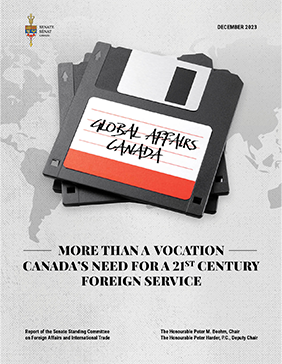
The report, More than a Vocation: Canada’s Need for a 21st Century Foreign Service, is the first substantive examination of the Canadian foreign service since 1981. It sought to answer the question of whether Global Affairs Canada (GAC) and the foreign service is still fit for purpose. The report reveals multiple areas in which GAC should improve.
GAC has staffing issues that stem from a suspension of most entry-level foreign service recruitment between 2009 and 2019. As a result, GAC placed a greater emphasis on generalist employees. While there are many advantages to a flexible workforce, it is also essential to have staff with deep knowledge of major global actors. Report recommendations address these issues.
The report is particularly timely given the profound geopolitical upheaval that has jeopardized the well-being of Canadians abroad. Witnesses said GAC lacks adequate “surge capacity” to respond to crises like those in the Middle East and Ukraine — crises that can quickly become questions of survival for Canadians abroad. Significant reforms are required to help Canada’s foreign service rise to these challenges.
Quick Facts
- Foreign language capacity at Global Affairs Canada has diminished in recent decades, with an insufficient number of staff who can speak Mandarin, Russian and Arabic. The committee recommends increasing foreign language training and hiring more specialists with geographic, functional and linguistic expertise.
- Given ongoing global turmoil and the testing of international treaties and the rule of law, Global Affairs Canada must maintain its expertise and leading role in international law for the Government of Canada.
- Until this study took place, the most recent study on Canada’s foreign service was the 1981 Royal Commission on Conditions of Foreign Service.
Quotes
“As a former career foreign service officer, I know that Global Affairs Canada and the foreign service are staffed by world class professionals who are immensely skilled and dedicated to serving Canada. That said, the capacity of the foreign service to serve the public and advance Canada’s interests abroad must be strengthened so the foreign service is able to meet the challenges of the 21st century.”
- Senator Peter M. Boehm, Chair of the committee
“Recent events have shown how crucial the foreign service is for the welfare of Canadians overseas. Our ability to support our own citizens in emergency situations could be greatly improved. Our report has identified the areas of greatest need within the foreign service — we urge the government to respond accordingly.”
- Senator V. Peter Harder, P.C., Deputy Chair of the committee
“There’s no diplomatic way to say it: Canada’s foreign service is in decline. Where Canada once punched above its weight, we are now scarcely able to step into the ring. The world faces challenges unseen for generations — we need a capable foreign service to advance our interests.”
- Senator Michael L. MacDonald, member of the Subcommittee on Agenda and Procedure
“While never a dominant power, Canada and its values of peace, order and good government have been respected around the world. This report makes clear what has become increasingly evident — that our foreign service needs more support. It is essential to address this swiftly.”
- Senator Stephen Greene, member of the Subcommittee on Agenda and Procedure
Associated Links
- Read the report: More than a Vocation: Canada’s Need for a 21st Century Foreign Service.
- Follow the committee on social media using the hashtag #AEFA.
- Subscribe to email alerts for Senate committees.
- Sign up for the Senate eNewsletter.
For more information:
Amely Coulombe
Communications Officer | Senate of Canada
343-575-7553 | amely.coulombe@sen.parl.gc.ca
Senators who participated in this study

Peter M. Boehm
ISG - Ontario

Peter Harder, P.C.
PSG - Ontario

Gwen Boniface
ISG - Ontario

Mary Coyle
ISG - Nova Scotia (Antigonish)

Marty Deacon
ISG - Ontario (Waterloo Region)

Amina Gerba
PSG - Quebec (Rigaud)

Stephen Greene
CSG - Nova Scotia (Halifax - The Citadel)

Leo Housakos
C - Quebec (Wellington)

Michael L. MacDonald
C - Nova Scotia (Cape Breton)

Mohamed-Iqbal Ravalia
ISG - Newfoundland and Labrador

David Richards
C - New Brunswick

Yuen Pau Woo
ISG - British Columbia
Ex-officio members of the committee: The Honourable Senator Marc Gold, P.C., or Patti LaBoucane-Benson, The Honourable Senator Donald Plett or Yonah Martin
Other Senators who have participated in the study: The Honourable Senator Ataullahjan, The Honourable Senator Boisvenu, The Honourable Senator Busson, The Honourable Senator Cardozo, The Honourable Senator Cordy, The Honourable Senator Manning, The Honourable Senator Marwah (resigned), The Honourable Senator Mégie, The Honourable Senator Moncion, The Honourable Senator Oh, The Honourable Senator Omidvar, The Honourable Senator Patterson (Ontario)