
Report
Executive Summary
The Standing Committee on Audit and Oversight (the committee) was created in October 2020 to provide oversight to the Senate’s internal and external audits, for the purposes of integrity, independence, transparency and accountability. The committee reached its full membership in June 2021, following the Senate’s nomination of two external members to join the committee’s four senator members, making it the only Senate committee with non-parliamentarians providing an independent (or outside), expert perspective. This external membership in the audit and oversight committee is an important aspect of the Senate’s governance model.
The committee’s first task was to establish the Senate Audit and Oversight Charter, which the Senate adopted in June 2022. Establishing such a charter is a best practice, and work that the committee considered essential to the foundation of the new governance model, which separates the role of the committee responsible for managing the financial and administrative matters of the Senate, the Standing Committee on Internal Economy, Budgets and Administration (CIBA), from the committee responsible for oversight, the Standing Committee on Audit and Oversight (AOVS). These two committees are important pillars of the Senate’s governance structure; the Senate Administration supports these committees, and is responsible for day-to-day management and support functions.
Next, the committee reviewed and reached agreement on the approach to structuring the Senate’s internal audit function, with the conclusion that the Senate would benefit from a flexible model, with in-house internal audit expertise and outsourced specialized skills as needed and, most importantly, a multi-year risk-based internal audit plan following best practices and professional standards. This led to the decision to establish the permanent internal position of a Chief Audit Executive. This individual, while part of the Senate Administration, would be directly accountable to the committee and have both internal and external resources available as needed and on the basis of factors such as institutional knowledge of and familiarity with Senate operations, staff continuity and the technical expertise required.
As the committee set about finding a Chief Audit Executive to lead a new internal audit function, it also continued to consider practices and lessons learned in other legislatures. Over the summer recess, in July 2023, the committee undertook a fact-finding mission to London, United Kingdom (U.K.), to meet with its counterparts in both the House of Lords and House of Commons. The U.K. study led to some important insights on how the committee can enhance its oversight on key matters and on how it can support the transition to a new internal audit function, which the committee reported on to the Senate in September 2023.
The committee finalized its search and hired a Chief Audit Executive in October 2023. After a successful onboarding, supported by the committee’s guidance and the contributions of Senate Administration management, the committee’s focus shifted to the Senate’s governance, risk management and control arrangements. The Senate’s financial statements are audited each year by an external auditor, but there are other areas that could benefit from independent assessments, reviews and audits. The committee was especially interested in developing a better appreciation for how internal audit can add value for the Senate. Accordingly, under the direction of the committee, the Chief Audit Executive led the development of the Senate’s first risk-based internal audit plan, which the committee anticipates will be presented to the Senate for adoption in fall 2024, with planned internal audits starting in fiscal 2024–2025.
As well, in December 2023 and March 2024, the committee considered the Senate Administration’s institutional risk register, and met with Senate Administration management to discuss key risks and related mitigation measures, as well as matters related to cybersecurity.
With respect to the committee’s external audit mandate, in December 2023, the committee met with the external auditor in its oversight of the financial statement audit for the year ended March 31, 2023; after the conclusion of the audit, the committee reviewed the audited financial statements in February 2024 and completed its annual assessment of the external auditor in March 2024. In addition, the committee reviewed the requirements for the Senate’s next external auditor, as the contract with the current external auditor concludes with the financial statement audit for fiscal 2023–2024.
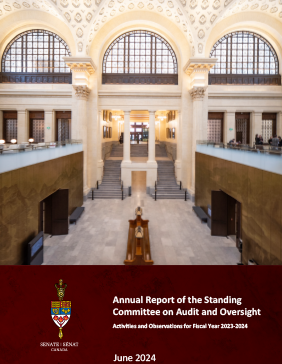
This report summarizes the work of the committee during the 2023–2024 fiscal year. It also presents observations from committee members on some of the main audit and oversight matters noted to date.
In continuing its work, the committee is focused on ensuring that it is positioned to provide independent, transparent and ongoing oversight to support the Senate in its accountability. In particular, the committee will seek to make certain that the Senate’s new internal audit function delivers findings and recommendations that contribute to the efficiency and effectiveness of operations. Moreover, the committee’s observations and recommendations to the Senate and its oversight of management’s implementation of action plans will support the institution as it looks to continuous improvement.

Ottawa – The Standing Committee on Audit and Oversight released its 2024 annual report on June 6, 2024. Highlights include the hiring of a Chief Audit Executive, whose responsibilities include leading the Senate’s internal audit function in support of the committee’s commitment to integrity, independence, transparency and accountability.
Amipal Manchanda became the Senate’s first Chief Audit Executive in October 2023. Under the direction of the committee, Mr. Manchanda led the development of the Senate’s first risk-based internal audit plan. The committee believes that a robust, risk-based internal audit plan will support the institution in demonstrating the importance of implementing sound governance and risk management and ensure control processes are in place. Over time, it will provide the Senate with insight into the optimal use of resources and effective mitigation of risks. Mr. Manchanda has also met with senators and directors of the Senate Administration to present the role and scope of the internal audit function.
The committee will support the next steps in implementing the risk-based internal audit plan with the aim of ensuring that the work of internal audit is positioned to provide evaluation and analysis on the existence, effectiveness and adequacy of risk management, control and governance processes in the Senate.
The committee also reported observations to the Senate for improving accountability and oversight, in particular, opportunities for making the financial reporting process more transparent and effective.
Quick facts
- Amipal Manchanda became the Senate’s first Chief Audit Executive in October 2023. He has extensive experience in the federal public service and in the private sector. He most recently served on the North Atlantic Treaty Organization (NATO) Board of Auditors, which audits NATO expenditures. His responsibilities are set out in Chapter 6 of the Senate Audit and Oversight Charter.
- The committee’s work also included reviewing requirements for the Senate’s external auditor, as the contract with the current auditor concludes with the financial statement audit for the 2023-24 fiscal year; the committee will then select an external auditor and provide oversight of the external audit on an ongoing basis.
- The Standing Committee on Audit and Oversight was created in October 2020 to provide oversight of the Senate’s operations and expenditures. Its responsibilities are set out in the Senate Audit and Oversight Charter. To bolster its independence, the committee includes two members who are not senators. These external members are highly qualified chartered professional accountants who have expertise in the internal audit function.
Quotes
“The committee welcomes Amipal Manchanda as the Senate’s first Chief Audit Executive (CAE). We are fortunate to have a CAE with the high level of knowledge, skills and abilities that Mr. Manchanda brings to the position. We acknowledge and appreciate the foundational work he has done in preparing the Senate’s first risk-based internal audit plan and his commitment to the Senate’s values of transparency and accountability.”
- Senator Marty Klyne, Chair of the committee
“We look forward to supporting the implementation of the risk-based internal audit plan in order to contribute to the Senate’s continuous improvement with respect to internal audit findings and recommendations. We are committed to increasing the efficiency and effectiveness of our operations.”
- Senator David M. Wells, Deputy Chair of the committee
“Our committee appreciates the co-operation it has received in pursuit of our mandate. We recognize the importance of the input from senators and the professionalism and openness of management of the Senate Administration.”
- Senator Hassan Yussuff, Deputy Chair of the committee
Associated links
- Read the report: Annual Report of the Standing Committee on Audit and Oversight.
- Follow the committee on social media using the hashtag #AOVS.
- Subscribe to email alerts for Senate committees.
- Sign up for the Senate eNewsletter.
For more information:
Amely Coulombe
Manager, Strategic Communications | Senate of Canada
343-575-7553 | amely.coulombe@sen.parl.gc.ca
Senators who participated in this study

Marty Klyne
PSG - Saskatchewan

David M. Wells
C - Newfoundland and Labrador

Hassan Yussuff
ISG - Ontario

Colin Deacon
CSG - Nova Scotia
Other members of the committee: Hélène F. Fortin, External Member, Robert Plamondon, External Member
Other senators who have participated in the study: The Honourable Renée Dupuis (retired), The Honourable Percy E. Downe