
Report
Executive Summary
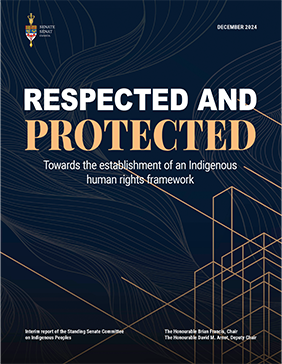
The Standing Senate Committee on Indigenous Peoples issues this report, Respected and Protected: Towards the establishment of an Indigenous human rights framework, to provide advice to the Government of Canada as it considers creating a new institution. The recommendations made by the committee are guided by 46 witnesses who reflected on the mandate and powers that a new Indigenous human rights mechanism could have.
The committee makes eight recommendations, intended to promote, respect, protect and fulfill the human rights of Missing and Murdered Indigenous Women and Girls and 2SLGBTQI+ people. All witnesses who testified before the committee agreed that a new Indigenous-focused human rights mechanism was required, and several made recommendations to improve the current human rights protection system and its operations.
The fundamental recommendation made in this report is that the Government of Canada should table legislation to establish a new Indigenous human rights ombudsperson and tribunal. The committee is of the view that this mechanism should be governed, led and operated by Indigenous peoples and have the power to investigate, compel information, conduct systemic inquiries, facilitate the resolution of complaints and provide education and legal services. A new mechanism should be able to make and enforce binding orders, including in relation to remedies, and award costs. Such a mechanism should be independent, transparent and informed by the principles enshrined in the United Nations Declaration on the Rights of Indigenous Peoples and the United Nations Paris Principles. Ultimately, such institutions should be based on the traditions, cultures and laws of Indigenous peoples.
It is our sincere hope that the Government of Canada will respond to the key finding of the National Inquiry into Missing and Murdered Indigenous Women and Girls to better promote, respect, protect and fulfill Indigenous peoples’ human rights.
Recommendations
Recommendation 1
A gap in data related to missing and murdered Indigenous women and girls 2SLGBTQI+ people hinders the public’s understanding of the scale of the crisis, and limits effective responses to prevent violence. Therefore, the committee recommends:
That the Government of Canada ensure that Indigenous-specific data and information should be collected, accessed and used by Indigenous peoples for accountability and transparency.
Recommendation 2
In the interest of making better quality information publicly available to Indigenous women, girls and 2SLGBTQI+ people for transparency and accountability, the committee recommends:
- That Statistics Canada provide the committee with semi-annual progress reports starting in June 2025 on its Missing Persons Data Standard Project;
- That Statistics Canada provide the committee with semi-annual progress reports starting in June 2025 and preliminary data outcomes on the Disaggregated Data Action Plan;
- That Statistics Canada increase funding to Juristat for more in-depth analysis of disaggregated Indigenous data, based on the priorities of Indigenous governments, organizations and Indigenous women, girls and 2SLGBTQI+ people; and
That Crown-Indigenous Relations and Northern Affairs Canada provide an overview to the committee of statistical and data outcomes from the Indigenous-led Data Projects program.
Recommendation 3
The committee therefore recommends:
That the Canadian Human Rights Commission, in partnership with Indigenous peoples, undertake broad consultations to identify existing barriers preventing Indigenous peoples from bringing complaints to the Canadian Human Rights Commission and develop an Indigenous-led strategy that is culturally responsive and inclusive to remove those barriers and increase access to justice; and
That the Canadian Human Rights Commission provide the committee with semi-annual progress reports on its work to reduce barriers experienced by Indigenous peoples starting in June 2025.
Recommendation 4
The committee therefore recommends:
That the Government of Canada table amendments to the Canadian Human Rights Act to better support all complainants, including amendments to:
- refer to the United Nations Declaration on the Rights of Indigenous Peoples and Canada’s other international human rights obligations to ensure that these instruments inform the Canadian Human Rights Act’s interpretation and application;
- expand the mandate of the Canadian Human Rights Commission to directly support individuals with systemic complaints before the Canadian Human Rights Tribunal; and
explore the need to increase the cap on compensation for pain and suffering that may be awarded by the Canadian Human Rights Tribunal.
Recommendation 5
That the Government of Canada ensure that the Canadian Human Rights Commission and Canadian Human Rights Tribunal are adequately funded, and that the Canadian Human Rights Commission receive additional funding for the additional responsibilities proposed in the preceding recommendation to support individuals with systemic complaints.
Recommendation 6
That the Government of Canada provide the committee with an update on any efforts it has made towards the implementation of the American Declaration on the Rights of Indigenous Peoples and related inter-American human rights instruments.
Recommendation 7
That the Government of Canada table legislation which:
- Establishes an Indigenous Human Rights Ombudsperson and Tribunal that is grounded by Indigenous expertise, laws, cultural values, the rights enshrined by the United Nations Declaration on the Rights of Indigenous Peoples, and which meets the international minimum standards for oversight of states actions like the United Nations Paris Principles and the Venice Principles;
- Places the development, leadership and governance of the Indigenous Human Rights Ombudsperson and Tribunal in the hands of diverse Indigenous peoples;
- Enables the Indigenous Human Rights Ombudsperson to investigate, compel documents, information and testimony, conduct systemic inquiries, facilitate resolution of complaints, including complaints of reprisal and provide education and legal services;
- Empowers an Indigenous Human Rights Tribunal to establish its own operating procedures, provide remedies – including in cases of retaliation, impose sanctions, make and enforce binding orders, and award costs; and
- Ensures that the Indigenous Human Rights Ombudsperson offices have regional reach and are accessible to Indigenous peoples in their languages.
Recommendation 8
The committee further recommends that Crown-Indigenous Relations and Northern Affairs Canada provide the committee with semi-annual progress reports on steps taken toward implementing recommendations made in the Call for Justice 1.7 Report beginning in June 2025.

Ottawa – A new Indigenous human rights ombudsperson and tribunal — governed, led and operated by Indigenous people — should be established to fill urgent needs unmet by existing human rights mechanisms in Canada, the Senate Committee on Indigenous Peoples said in a report released Thursday, December 12, 2024.
Indigenous peoples’ human rights must be promoted, respected and protected. The committee heard that Indigenous peoples require a new system to be established as existing human rights mechanisms are often not Indigenous-led or culturally sensitive, and that lengthy delays at the Canadian Human Rights Commission and Tribunal can allow discrimination to persist.
A new Indigenous human rights mechanism should be based on traditional Indigenous knowledge, Indigenous laws and Indigenous dispute resolution practices. The committee agrees with witnesses that the development, leadership and governance of any new mechanisms should be in the hands of diverse Indigenous peoples.
To ensure that it is effective, the new mechanism should be given robust powers. The committee recommends that the Indigenous Human Rights Ombudsperson and Tribunal be empowered to investigate, compel documents and testimony, and conduct systemic inquiries, among other matters.
Quick Facts
- The committee’s recommendation to establish a new Indigenous human rights ombudsperson and tribunal amplifies the Call for Justice 1.7 made in the final report of the National Inquiry into Missing and Murdered Indigenous Women and Girls.
- The federal government has released its own report on the possibility of establishing a new Indigenous human rights mechanism, which included specific budget investments; however, a suggested implementation timeline envisioned a bill introduced in the House of Commons by June 30, 2024.
- The report makes other recommendations intended, among other things, to reduce barriers that prevent Indigenous people from making use of Canada’s existing human rights mechanisms and to improve data collection relating to missing and murdered Indigenous women and girls.
Quotes
“Indigenous peoples deserve a human rights system that protects their rights and responds to their needs. The current system is simply not enough.”
- Senator Brian Francis, Chair of the committee
“We urge the federal government to establish an Indigenous-led, culturally appropriate, and effective tribunal structure that is empowered to make binding rulings and order substantive remedies.”
- Senator David M. Arnot, Deputy Chair of the committee
“Witnesses expressed real concerns with the way Canada upholds the rights of Indigenous peoples — or doesn’t. An Indigenous-led ombudsperson and tribunal are urgently needed.”
- Senator Paul (PJ) Prosper, member of the Subcommittee on Agenda and Procedure
Associated Links
- Read the report: Respected and Protected: Towards the establishment of an Indigenous human rights framework.
- Follow the committee on social media using the hashtag #APPA.
- Subscribe to email alerts for Senate committees.
- Sign up for the Senate eNewsletter.
For more information:
Chelsea DeFazio
Communications Officer | Senate of Canada
343-576-1481 | chelsea.defazio@sen.parl.gc.ca
Senators who participated in this study

Brian Francis
PSG - Prince Edward Island

David M. Arnot
ISG - Saskatchewan

Mary Coyle
ISG - Nova Scotia (Antigonish)

Margo Greenwood
ISG - British Columbia

Nancy J. Hartling
ISG - New Brunswick

Yonah Martin
C - British Columbia

John M. McNair
ISG - New Brunswick

Donald Neil Plett
C - Manitoba (Landmark)

Paul (PJ) Prosper
CSG - Nova Scotia

Karen Sorensen
PSG - Alberta

Scott Tannas
CSG - Alberta

Judy A. White
PSG - Newfoundland and Labrador
Ex-officio members of the committee: The Honourable Marc Gold P.C. or the Honourable Patti LaBoucane-Benson, the Honourable Donald Neil Plett or the Honourable Yonah Martin, the Honourable Raymonde Saint-Germain or the Honourable Bernadette Clement, the Honourable Scott Tannas or the Honourable Rebecca Patterson, the Honourable Pierre J. Dalphond or the Honourable Judy A. White
Other Senators who have participated in the study: The Honourable Michèle Audette, the Honourable Gwen Boniface, the Honourable René Cormier, the Honourable Renée Dupuis (retired January 2024), the Honourable Patti LaBoucane-Benson, the Honourable Dennis Patterson (retired December 2023)