
Recommendations
RECOMMENDATION 1
In order to move forward with the full implementation of Mi’kmaq, Wolastoqiyik, and Peskotomuhkati rights-based fisheries, the committee recommends the following three-step plan:
- In the immediate, the committee recommends that the Government of Canada take steps, in cooperation with the Mi’kmaq, Wolastoqiyik, and Peskotomuhkati, to review, and amend or modify as necessary, all relevant laws, regulations, policies, and practices regarding rights-based fisheries to ensure they are in line with Canada’s domestic and international obligations, including the Constitution Act, 1982 and the United Nations Declaration on the Rights of Indigenous Peoples.
- In the interim, the committee recommends that the Minister of Fisheries, Oceans and the Canadian Coast Guard use section 4.1 of the Fisheries Act to negotiate and enter into nation-to-nation agreements with the Mi’kmaq, Wolastoqiyik, and Peskotomuhkati that will result in true shared decision-making.
- As a permanent step, the committee recommends that the Government of Canada introduce new legislation in Parliament, in cooperation with the Mi’kmaq, Wolastoqiyik, and Peskotomuhkati, to create a new legislative framework that will allow for the full implementation of rights-based fisheries.
RECOMMENDATION 2
To create more certainty for both First Nation fishers and non-Indigenous fishers, to reflect the priority of rights-based fisheries, and in light of the failure of the current “buyback” approach, the committee recommends that, to implement rights-based fisheries, the Government of Canada pursue a reallocation approach, rather than the current “buyback” approach. This new approach would reduce the number of traps, or the quota allocated to non-Indigenous fishers, and this access would be transferred to the Mi’kmaq, Wolastoqiyik, and Peskotomuhkati.
RECOMMENDATION 3
The committee recommends that Canada’s response to the United Nations’ Committee on the Elimination of Racial Discrimination (in response to reference: CERD/EWUAP/103rd Session/2021/MJ/CS/ks) be immediately made public in its entirety.
RECOMMENDATION 4
The committee recommends that all federal government departments and agencies immediately take effective actions to address and eliminate institutional and systemic racism in their laws, regulations, policies, and practices.
Specifically, the committee recommends that the Government of Canada work in cooperation with the Mi’kmaq, Wolastoqiyik, and Peskotomuhkati, to appoint an independent panel of experts to produce a report with specific recommendations to address the prevalence of institutional and systemic racism within Fisheries and Oceans Canada, the Royal Canadian Mounted Police and other departments and agencies responsible for the enforcement of Mi’kmaq, Wolastoqiyik, and Peskotomuhkati rights-based fisheries and to describe a plan to address the systemic racism identified. The resulting report should be tabled in both Houses of Parliament no later than one year after the tabling of this report and referred to the Standing Senate Committee on Fisheries and Oceans.
RECOMMENDATION 5
The committee recommends that the Government of Canada in general, and Fisheries and Oceans Canada in particular, respect and truly integrate Indigenous laws, principles and knowledge with other scientific information and data into fisheries decision-making processes, including Netukulimk, Msit No'kmaq (All my Relations) and Etuaptmumk (Two-Eyed Seeing).
The committee further notes that seasonal limits and other restrictions cannot continue to be imposed unilaterally. The Government of Canada must immediately begin to develop conservation measures, in cooperation with the Mi’kmaq, Wolastoqiyik, and Peskotomuhkati, and ensure that Indigenous laws, principles and traditional knowledge are given equal value and legitimacy in implementing rights-based fisheries.
RECOMMENDATION 6
The committee recommends that the Government of Canada provide the Mi’kmaq,Wolastoqiyik, and Peskotomuhkati with the capacity (e.g., financial, legal, policy) they require to negotiate the full implementation of their rights-based fisheries with the Government of Canada.
RECOMMENDATION 7
The committee recommends that the responsibility for negotiating the full implementation of rights-based fisheries be transferred from Fisheries and Oceans Canada to Crown-Indigenous Relations and Northern Affairs Canada. As such, Crown-Indigenous Relations and Northern Affairs Canada would become the lead negotiating department and Fisheries and Oceans Canada would assume an advisory role. The committee further requests that this change be made immediately and no later than one year after the tabling of this report.
RECOMMENDATION 8
The committee strongly recommends that the Government of Canada endorse and fully implement the actions and recommendations of the Federal Special Representative, Allister Surette’s report entitled Implementing the right to fish in pursuit of a moderate livelihood: Rebuilding trust and establishing a constructive path forward, and more specifically, the third recommendation of his report.
RECOMMENDATION 9
In order to move forward and ensure everyone has a strong understanding of rights-based fisheries:
- The committee recommends that Crown-Indigenous Relations and Northern Affairs Canada, Fisheries and Oceans Canada and the Royal Canadian Mounted Police, in cooperation with the Mi’kmaq, Wolastoqiyik, and Peskotomuhkati, develop tools to engage and educate the public about rights-based fisheries, including where these rights originated, how they have been affirmed, how they are being implemented, and how they differ from other types of fisheries.
- The committee recommends that relevant federal departments and agencies, including Crown-Indigenous Relations and Northern Affairs Canada, Fisheries and Oceans Canada and the Royal Canadian Mounted Police, provide effective and ongoing education and training to their employees on the past and present context of Indigenous Peoples in Canada. The committee also recommends that those employees identified as working both directly and indirectly with the Mi’kmaq, Wolastoqiyik, and Peskotomuhkati also be provided with effective and ongoing education and training on rights-based fisheries.
RECOMMENDATION 10
To ensure that this report’s recommendations are fully implemented, the committee requests that the Government of Canada produce progress reviews. These progress reviews would provide updates on the progress departments and agencies, including Crown-Indigenous Relations and Northern Affairs Canada, Fisheries and Oceans Canada and the Royal Canadian Mounted Police, have made towards implementing all the recommendations made by the committee in this report. The Government of Canada should produce progress reviews annually for a minimum of five years, and the first progress review should be produced no later than one year after the tabling of this report. All progress reviews should be tabled in both Houses of Parliament and be referred to the Standing Senate Committee on Fisheries and Oceans. In addition, the committee reserves the right to request that the relevant federal ministers appear before the committee to speak to annual progress reviews and to answer questions.

Halifax, July 12, 2022 – More than 23 years after a Supreme Court of Canada ruling affirmed the treaty fishing rights of certain First Nations, the federal government has failed to fully implement Indigenous rights-based fisheries, according to a new report by the Senate Committee on Fisheries and Oceans.
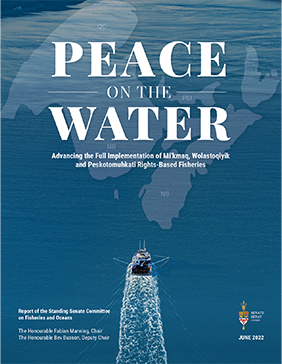
Peace on the Water: Advancing the Full Implementation of Mi’kmaq, Wolastoqiyik and Peskotomuhkati Rights-Based Fisheries examines the federal government’s response to the Marshall decision and the implementation of the rights of First Nation communities in parts of Atlantic Canada and Quebec to fish in pursuit of a moderate livelihood.
The scope of the study focuses on the 1999 Supreme Court of Canada ruling in R. v. Marshall, which upheld the treaty rights of First Nation communities to fish in pursuit of a “moderate livelihood” by catching and selling fish year-round. This decision affected 35 Mi’kmaq, Wolastoqiyik and Peskotomuhkati First Nations in New Brunswick, Prince Edward Island, Nova Scotia and the Gaspé region of Quebec.
Witnesses told the committee that the failure of consecutive federal governments to fully implement rights-based fisheries has resulted in tension, disagreements and violence between First Nations and non-First Nations fishers in parts of Atlantic Canada and Quebec. The committee also heard several allegations of systemic racism within federal departments and agencies, including Fisheries and Oceans Canada and the Royal Canadian Mounted Police. Witnesses testified how federal authorities have pursued an enforcement approach that has surveyed and criminalized First Nation fishers, yet failed to protect them from acts of intimidation and violence. Further, the committee heard how Fisheries and Oceans Canada prioritizes commercial fisheries over rights-based fisheries.
The study makes 10 recommendations on how the federal government can fully implement Indigenous rights-based fisheries, including reallocating commercial traps to the Mi’kmaq, Wolastoqiyik and Peskotomuhkati, developing tools to educate the public about rights-based fisheries, and integrating Indigenous laws, principles and knowledge with scientific data into decision-making processes. The report concludes that there is no “one-size-fits-all” approach to implementing Indigenous rights-based fisheries and that any solutions must be reached in collaboration with First Nation communities.
Quick Facts
- Fisheries across Canada fall into two categories. Rights-based fisheries are based on Aboriginal or treaty rights set out in historic and modern treaties between the Crown and Indigenous peoples. Privilege-based fisheries, like commercial or recreational fisheries, are often fee-based and subject to limitations through licencing and regulation.
- Writing for the majority, Supreme Court Justice Ian Binnie found that the Peace and Friendship treaties negotiated between the British Crown and First Nation communities in 1760 and 1761 “affirm the right of the Mi’kmaq people to continue to provide for their own sustenance by taking the products of their hunting, fishing and other gathering activities and trading for what in 1760 was termed ‘necessaries’.”
Quotes
“We have heard loud and clear from First Nation witnesses that there is no one-size-fits-all approach to implementing Indigenous rights-based fisheries. It is crucial that the federal government immediately take steps to co-manage rights-based fisheries with First Nations across the country.”
- Senator Fabian Manning, Chair of the committee
“It has been 23 long years since the Marshall ruling. The Mi’kmaq, Wolastoqiyik and Peskotomuhkati communities are still waiting for their fishing rights to be fully implemented. They should not have to wait any longer.”
- Senator Bev Busson, Deputy Chair of the committee
“We need to focus on a reconciliation approach to distributing fishing licences instead of a ‘buyback’ approach. The exercise of Indigenous rights cannot, and should not, be contingent on the federal government’s ability to buy back licences from commercial fishers.”
- Senator Brian Francis, member of the Subcommittee on Agenda and Procedure
Associated Links
- Read the report: Peace on the Water: Advancing the Full Implementation of Mi’kmaq, Wolastoqiyik and Peskotomuhkati Rights-Based Fisheries
- Learn more about the Senate Committee on Fisheries and Oceans.
- Follow the committee on social media using the hashtag #POFO.
- Sign up for the Senate eNewsletter.
For more information:
Ben Silverman
Communications Officer | Senate of Canada
343-574-4950 | ben.silverman@sen.parl.gc.ca
Multimedia
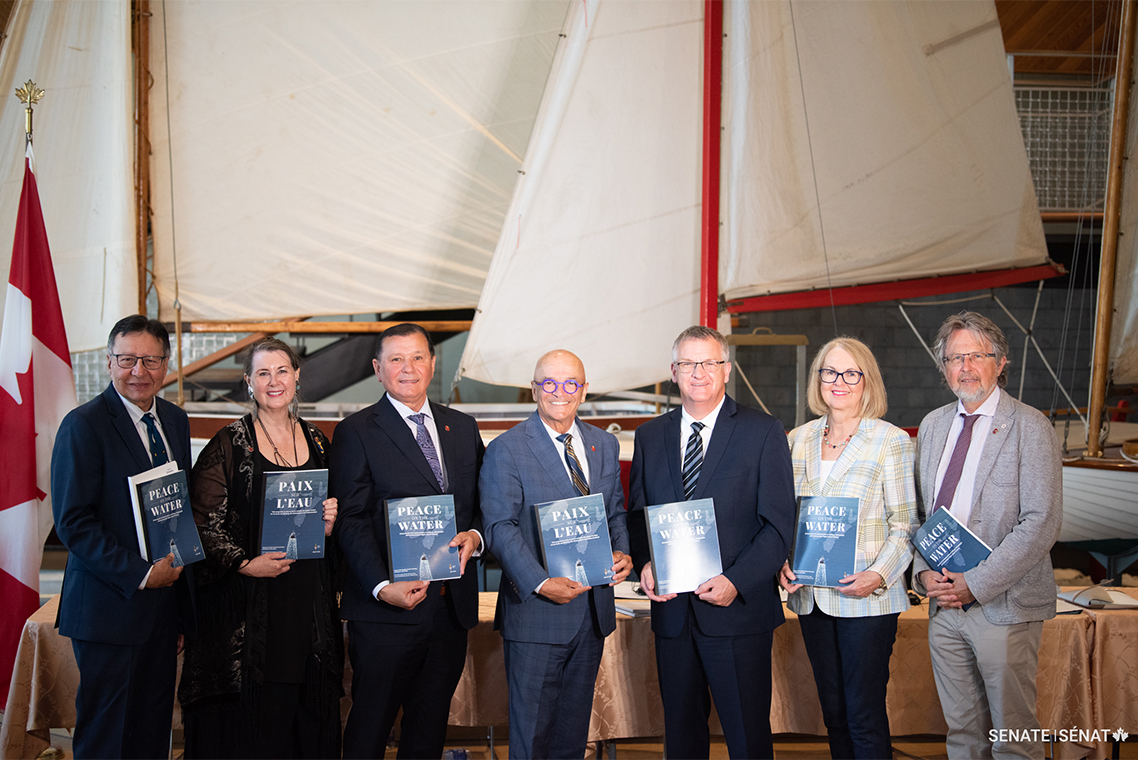
Senators Dan Christmas, Marilou McPhedran, Brian Francis, René Cormier, Fabian Manning, Jane Cordy and Stan Kutcher hold copies of the Senate Committee on Fisheries and Oceans’ report after the press conference at the Maritime Museum of the Atlantic in Halifax.
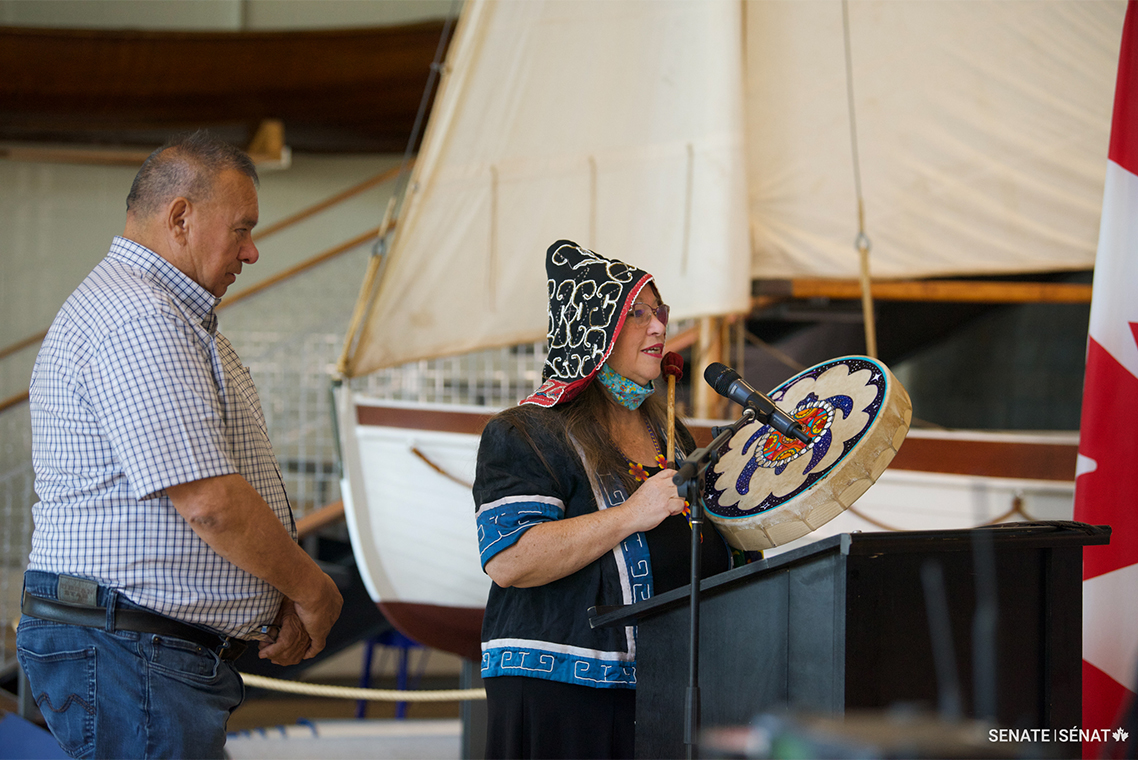
Grand Chief Norman Sylliboy (Mi’kmaq Grand Council) and Elder Catherine Martin offered opening remarks, a traditional prayer and a song before the Senate Committee on Fisheries and Oceans’ press conference at the Maritime Museum of the Atlantic in Halifax.
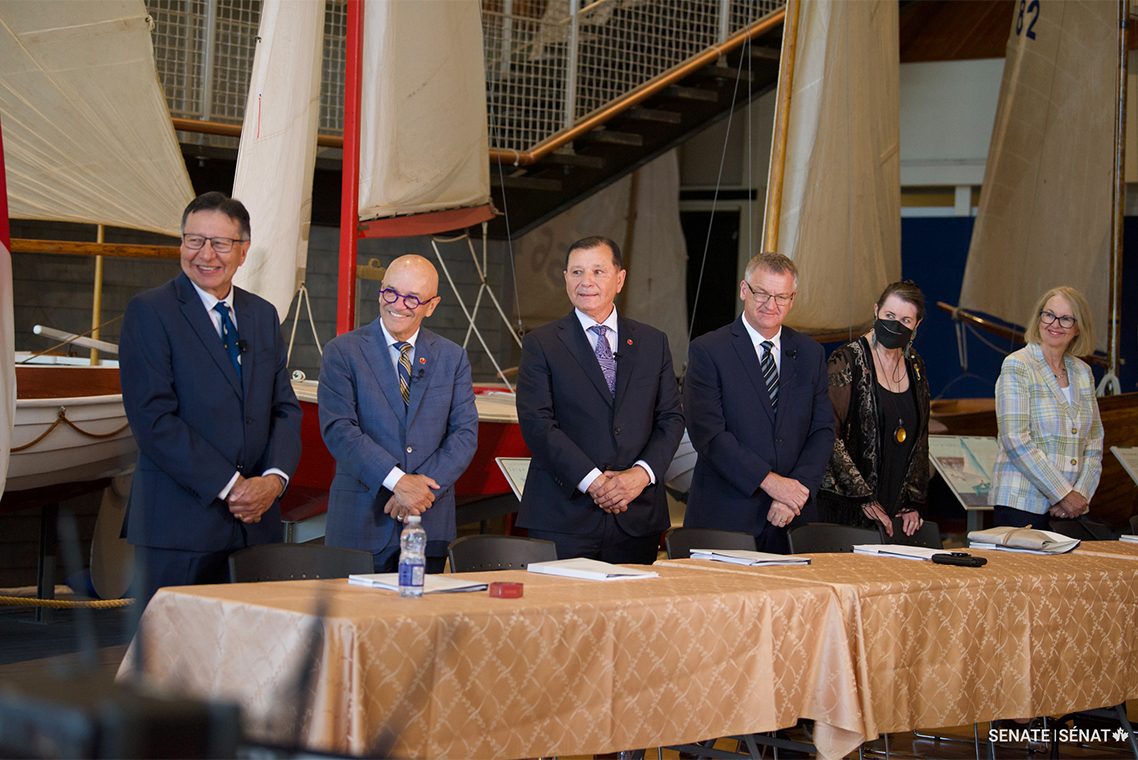
Senators Dan Christmas, René Cormier, Brian Francis, Fabian Manning, Marilou McPhedran and Jane Cordy during the Senate Committee on Fisheries and Oceans’ press conference at the Maritime Museum of the Atlantic in Halifax.
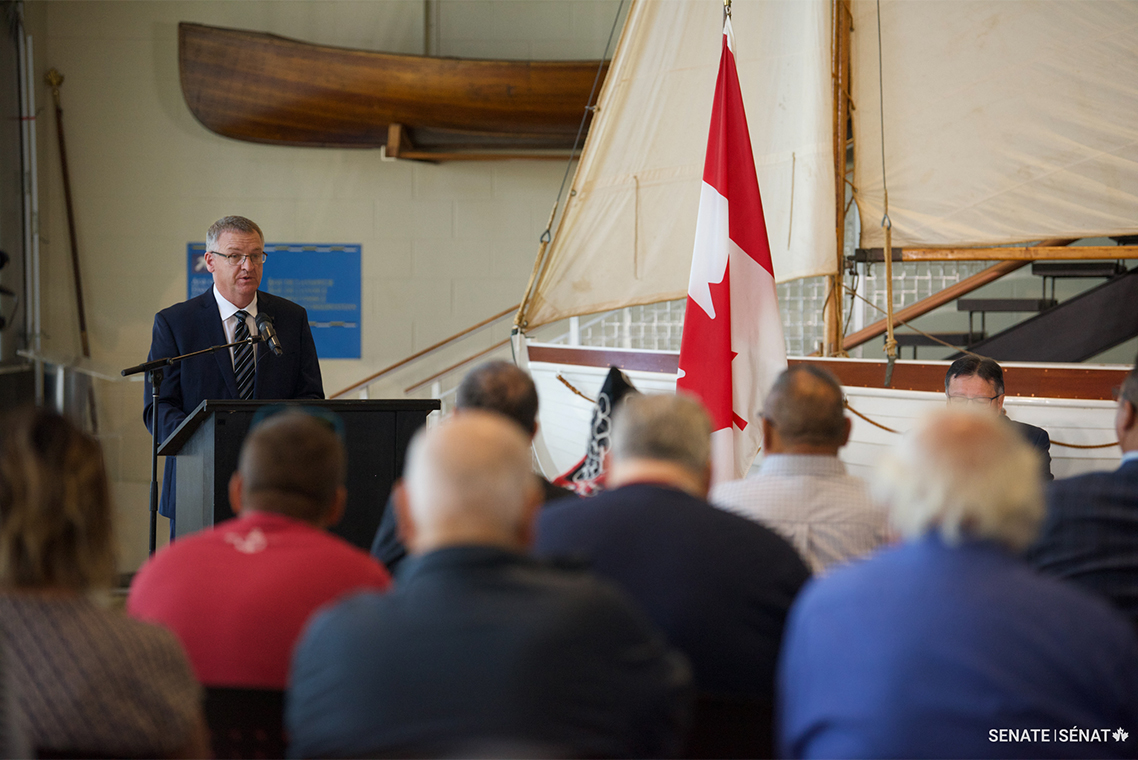
Senator Manning speaks at the Senate Committee on Fisheries and Oceans’ press conference at the Maritime Museum of the Atlantic in Halifax.
Senators who participated in this study

Fabian Manning
C - Newfoundland and Labrador

Bev Busson
ISG - British Columbia

Salma Ataullahjan
C - Ontario (Toronto)

Dan Christmas
ISG - Nova Scotia

Jane Cordy
PSG - Nova Scotia

René Cormier
ISG - New Brunswick

Brian Francis
PSG - Prince Edward Island

Stan Kutcher
ISG - Nova Scotia

Marilou McPhedran
Non-affiliated - Manitoba

Jim Quinn
C - New Brunswick

Mohamed-Iqbal Ravalia
ISG - Newfoundland and Labrador
Ex-officio members of the committee: The Honourable Senator Marc Gold, P.C. (or Raymonde Gagné), the Honourable Senator Donald Neil Plett (or Yonah Martin)
Other Senators who have participated in the study: The Honourable Senators Campbell, McCallum and Ringuette
Government Response