
Report
Executive summary
From March 2022 to April 2023, the Standing Senate Committee on National Security, Defence and Veterans Affairs conducted a study of issues relating to security and defence in the Arctic, including Canada’s military infrastructure and security capabilities. In some respects, that study complemented earlier studies undertaken by a number of parliamentary committees. During hearings in Ottawa, and fact-finding trips to the Canadian Arctic and the headquarters for the North American Aerospace Defense Command (NORAD) in Colorado Springs, Colorado, the committee heard about three themes: the international security environment and the Arctic; Arctic security and increased access to the region; and military capabilities and security infrastructure in the Arctic.
Chapter One: The International Security Environment and the Arctic
According to witnesses, Russia’s invasion of Ukraine in February 2022 has important consequences for Arctic security and defence. Although they did not feel that there is a direct military threat to the Canadian Arctic at this time, witnesses were concerned about Russia’s military modernization in the region, especially of its Arctic bases. Despite battlefield losses resulting from its invasion of Ukraine, Russia’s military capabilities remain formidable.
Witnesses also discussed China’s goals and activities in the Arctic. The country has called itself a “near-Arctic state,” and has demonstrated that it has strategic and economic interests in the region. Moreover, for witnesses, the collaboration between Russia and China on certain issues could provide the latter with more access to natural resources and strategic locations in the Arctic.
As well, witnesses noted that one Arctic-related consequence of Russia’s invasion of Ukraine in 2022 has been an interruption in some activities of the Arctic Council, the principal body for Arctic cooperation. Canada, Denmark, Finland, Iceland, Norway, Sweden and the United States have suspended most cooperation with Russia concerning Arctic issues, but they have strengthened cooperation among themselves, including as it relates to security and defence.
In the view of witnesses, the European Arctic and the North American Arctic face different military threat levels, with the level being higher for the former than for the latter. Finland’s accession to the North Atlantic Treaty Organization (NATO) on 4 April 2023 created a new border between NATO and Russia. If Sweden accedes to NATO, all Arctic states except Russia will be NATO members.
Witnesses drew particular attention to security threats posed by weapons that could travel over the Arctic to target North America. NORAD, which is jointly commanded by Canada and the United States, is responsible for detecting and defending against some types of threats to North America. However, new types of missiles – including hypersonic missiles and long-range cruise missiles – could constitute a challenge for NORAD’s current surveillance capabilities.
Chapter Two: Arctic Security and Increased Access to the Region
According to witnesses, the interpretation of the term “Arctic security” should be assessed on an ongoing basis. Instead of a narrow interpretation focused on military security, witnesses argued that the concept should include a more intersectional approach that considers environmental, health, social, economic and Indigenous perspectives. In the past, some Government of Canada actions aimed at increasing military security in the Arctic, such as the forced relocation of Inuit to secure Canadian Arctic sovereignty during the Cold War, have harmed Indigenous communities in the region. For that reason, decisions relating to Arctic security and defence must be made with the full involvement of local and Indigenous governments.
Witnesses identified climate change as a major concern for the Canadian Arctic and its inhabitants. Climate change compounds security risks in the region and is having significant impacts on Indigenous peoples in the Arctic. The Department of National Defence and the Canadian Armed Forces (CAF) are making efforts to ensure that military infrastructure can adapt to the impacts of climate change in the region, such as the melting of permafrost. Climate change also has increased the likelihood of natural disasters in Canada’s North, which requires more military and whole-of-government operations in response.
Increased human activity in the Arctic resulting from climate change presents a security challenge for Canada, including in relation to control of Canada’s borders and Arctic waters, environmental disasters, and search and rescue incidents. The number of annual vessel voyages – or transits – in the Arctic has more than tripled since 1990, including from commercial and tourist traffic. Several federal departments and agencies are collaborating with local communities in implementing measures to meet this challenge. However, witnesses identified additional steps that the Government of Canada could take to respond better to current and future security challenges.
Witnesses also discussed the potential impacts of the current geopolitical environment and climate change on international disputes, disagreements and claims relating to the Arctic. The territorial and maritime disputes involving Canada are well managed, as partly evidenced by the June 2022 agreement between Canada and Denmark concerning the status of an uninhabited island between Canada and Greenland. However, the previously productive dialogue among Russia, Canada and other Arctic states claiming an extended continental shelf in the region has been suspended following Russia’s 2022 invasion of Ukraine.
Chapter Three: Military Capabilities and Security Infrastructure
The CAF’s Joint Task Force North, which comprises 340 personnel and is headquartered in Yellowknife, Northwest Territories, is responsible for most Canadian military operations north of the 60th parallel. As part of its Arctic operations, the CAF works with other federal entities, territorial governments and allies. NORAD uses the CAF’s capabilities and infrastructure in the Arctic, including its fighter jets and forward operating locations, to provide aerospace surveillance and control in Canada’s North. The Canadian Rangers, many of whom are Indigenous, are another component of the country’s military presence in the Canadian Arctic. Witnesses highlighted the importance of the Canadian Rangers to Canada’s sovereignty and security in the Arctic.
Canada has several ongoing and proposed defence procurement projects relating to Arctic security and defence. Witnesses noted various aspects of the Government of Canada’s June 2022 announcement concerning $38.6 billion in spending over 20 years as the country’s contribution to the modernization of NORAD. This modernization will include the development of such new surveillance systems as “over-the-horizon” radars, which will improve the ability of the CAF and NORAD to detect aerospace threats – including hypersonic and long-range cruise missiles – approaching North America. However, witnesses also identified concerns about a “gap period” between when adversaries will be able to deploy these missiles and the time at which the over-the-horizon radars and other new systems will be in place, suggesting that NORAD might face challenges in detecting various threats during this period.
Canada’s recently announced purchase of 88 F-35 Lightning II fighter jets will contribute to improved aerospace capabilities for Canada. The funding announcement concerning the NORAD modernization plan includes upgrades to aerial infrastructure in the Arctic, such as the forward operating locations. For example, as part of NORAD modernization, the runway in Inuvik – used for both military and civilian purposes – will be extended. As well, witnesses proposed the acquisition of additional aerial capabilities, including for search and rescue.
The new Arctic and Offshore Patrol Ships could enhance the capabilities of the Royal Canadian Navy and the Canadian Coast Guard when they are conducting Arctic operations. Witnesses acknowledged that these vessels could improve Canada’s ability to exercise sovereignty in its Arctic waters, but they questioned the adequacy of the infrastructure – including for refueling – to support the vessels’ operations. Regarding submarines, witnesses described various technologies that could allow future submarines to operate under Arctic sea ice, although they recognized that it could take several decades for Canada to procure such capabilities. Witnesses also suggested that unmanned underwater sensors could be used as an alternative to the procurement of submarines.
Regarding the defence procurement process, witnesses provided differing views. Some suggested that the process is working well. However, others expressed concerns about Canada’s will and its ability to purchase military capabilities on time and on budget.
The Government of Canada aims to ensure that northern and Indigenous communities benefit from spending on Arctic security and defence, such as by awarding contracts to Indigenous-owned firms. Concerning infrastructure, witnesses identified opportunities for multi-purpose infrastructure that could contribute to security and defence while also benefitting local communities.
Conclusion
A number of the issues discussed by witnesses – including an ever-changing geopolitical context, rising interest and activity in the Arctic, climate change in the North and its impacts, infrastructure challenges and the defence procurement process – have also been examined in previous parliamentary committee reports relating to the Arctic, and to Canada’s security and defence. The Government of Canada has taken some actions designed to enhance security and defence in the Arctic – such as the publishing its Arctic and Northern Policy Framework, releasing of the NORAD modernization plan and procuring of Arctic and Offshore Patrol Ships –but more must be done.
Having traveled to the Canadian Arctic, the committee underscores the risks facing the region and the urgency with which the Government of Canada should make investments in security and defence capabilities, as well as in social and economic infrastructure, in the Arctic. We must not let this moment pass by.
Recommendations
RECOMMENDATION 1
That the Government of Canada include, in the next defence policy, a section on Arctic security and defence. Recognizing that the international security environment is deteriorating, this section should outline how Arctic security and defence issues have evolved since the previous defence policy was released in 2017. As well, it should identify the Government’s plans to address – on an expeditious basis – threats to Canada, including to the Arctic, as well as new threats that could enter North America through the Arctic.
RECOMMENDATION 2
That the Government of Canada provide an annual update about Canada’s Arctic-related security and defence priorities and plans. Such updates should be provided to relevant stakeholders, including the premiers of Canada’s provinces and territories, as well as the leaders of local Indigenous organizations and governments. When providing these updates, the Government should ensure that discussions with stakeholders relating to Arctic security and defence are both open and honest.
RECOMMENDATION 3
That the Government of Canada continue to work with the Governments of Denmark, Finland, Iceland, Norway, Sweden and the United States to identify ways to strengthen cooperation regarding Arctic security and defence issues.
RECOMMENDATION 4
That the Government of Canada, in the next defence policy, outline Canada’s approach to deterring adversaries in the Arctic, including during the expected “gap period” between when adversaries could deploy new weapons systems and when the North American Aerospace Defense Command will have the technology to detect them.
RECOMMENDATION 5
That the Government of Canada, during the development of the next defence policy, examine whether changes to Canada’s policy on ballistic missile defence are required.
RECOMMENDATION 6
That the Government of Canada use existing or new institutionalized mechanisms to partner with Indigenous peoples in the Arctic, including to obtain their views about security and defence in the region. These partnerships should be undertaken in accordance with the Indigenous rights outlined in modern treaties as they relate to the use and management of land and resources.
RECOMMENDATION 7
That the Government of Canada, through the National Search and Rescue Secretariat, establish – by 31 March 2024 – a permanent Arctic search and rescue roundtable. This roundtable should comprise representatives of federal, territorial and Indigenous governments, and of community-based organizations and government entities involved in search and rescue, including the Canadian Rangers. Its goals should include the development of a comprehensive Arctic search and rescue strategy.
RECOMMENDATION 8
That the Government of Canada ensure that standards relating to the cruise ship sector in the Canadian Arctic complement management plans developed by Indigenous governments and organizations, and that such standards respect Indigenous lands, waters and people. As well, the Government should strengthen cooperation with Indigenous governments and organizations on issues pertaining to that sector in the Arctic, including in relation to vessel management and marine environmental protection.
RECOMMENDATION 9
That the Government of Canada, in the absence of designated cruise ship border clearance facilities in the Arctic, review options for processing travelers entering Canada in the Arctic. Alongside the existing practice of dispatching border services officers to the port of arrival, the options reviewed should include the use of telecommunications. The Government should publish the results of this review by 31 December 2024.
RECOMMENDATION 10
That the Government of Canada work with territorial, local and Indigenous governments and treaty rights holders to develop a framework and associated mechanisms that would result in a better understanding of the environmental impacts in the Arctic of current and planned activities pertaining to security and defence. This framework should outline measures to mitigate the impacts of permafrost thaw on infrastructure, regarding which consideration should be given to locating new security and defence infrastructure in areas less vulnerable to permafrost thaw. The Government should publish this framework by 30 June 2024.
RECOMMENDATION 11
That the Government of Canada expeditiously implement recommendations 16 to 20 in the June 2019 Special Senate Committee on the Arctic’s report entitled Northern Lights: A Wake-Up Call for the Future of Canada. By 31 March 2024, the Government should provide the Senate with information about actions taken to address these recommendations, which a focus on science, Indigenous knowledge and environmental conservation.
RECOMMENDATION 12
That the Government of Canada evaluate whether changes to the size, locations or nature of the Canadian Armed Forces’ presence in the Canadian Arctic are required. The Government should publish the results of this evaluation by 30 September 2024.
RECOMMENDATION 13
That the Government of Canada conduct a thorough assessment of the Canadian Armed Forces’ infrastructure north of the 60th parallel and its infrastructure in southern Canada that support Arctic operations. The goal of the assessment should be to identify infrastructure that requires immediate repairs and upgrades. The Government should publicly release the results of this assessment by 30 June 2025.
RECOMMENDATION 14
That the Government of Canada expeditiously address challenges that are negatively affecting the recruitment and retention of Canadian Rangers. As part of these efforts, the Government should both ensure that the Canadian Rangers have adequate access to equipment and make necessary changes to their compensation.
RECOMMENDATION 15
That the Government of Canada publish, by 30 June 2024, an update concerning the status of the Canadian Ranger enhancement program.
RECOMMENDATION 16
That the Government of Canada develop a plan to support the well-being of members of the security and defence forces stationed in the Arctic, including the Canadian Armed Forces and the Royal Canadian Mounted Police. The Government should publish this plan by 31 March 2025.
RECOMMENDATION 17
That the Government of Canada provide Parliament with ongoing updates about the modernization of the North American Aerospace Defense Command. These updates, which should occur at least annually, should include information about potential delays or difficulties in delivering related procurement projects on time and on budget, and about how challenges are being addressed.
RECOMMENDATION 18
That the Government of Canada consider whether the two Arctic and Offshore Patrol Ships procured for the Canadian Coast Guard should carry armaments in order to improve the protection of Canadian sovereignty, as well as secure the country’s Arctic coasts and waters.
RECOMMENDATION 19
That the Government of Canada include, in its next defence policy, a section on underwater domain awareness and underwater threats. This section should outline a plan for expeditiously replacing Canada’s existing submarines with submarines that could operate better in the Arctic.
RECOMMENDATION 20
That the Government of Canada make efforts to join the trilateral security partnership among Australia, the United Kingdom and the United States, known as AUKUS. In doing so, the Government should communicate the ways in which Canada could contribute to intelligence gathering and intelligence sharing.
RECOMMENDATION 21
That the Government of Canada develop a plan for improving broadband Internet connectivity in the Arctic to meet both military and civilian needs. The options considered in developing the plan should include the use of satellites and fibre optic cables. By 30 June 2024, the Government should publish information about the amount of funds required to implement the plan, and the plan’s associated timelines.
RECOMMENDATION 22
That the Government of Canada consider, for all infrastructure projects relating to the security and defence of the Canadian Arctic, the extent to which multi-purpose infrastructure would be appropriate.
RECOMMENDATION 23
That the Government of Canada identify, for each ongoing and proposed security and defence project in the Arctic, the likely social and economic benefits for Arctic communities that would result. If such projects are unlikely to have such benefits, the Government should indicate other federal funding sources to meet the most urgent social and economic needs in the Arctic.
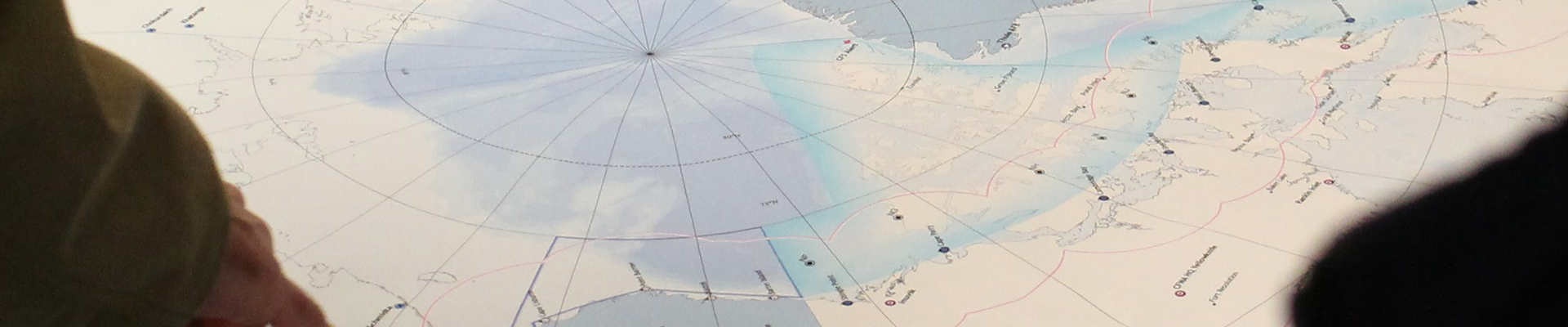
Ottawa – Canada’s North is militarily exposed, economically underdeveloped and threatened by climate change — while world powers covet its rich resources and Arctic waterways, the Senate Committee on National Security, Defence and Veterans Affairs said in a report released Wednesday, June 28, 2023.
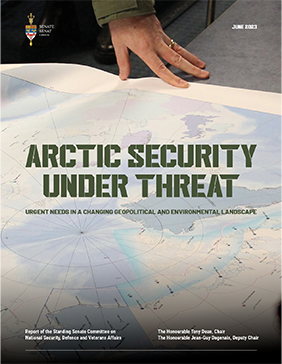
The committee’s report, Arctic Security Under Threat: Urgent needs in a changing geopolitical and environmental landscape, looks at issues relating to security and defence in Canada’s Arctic. It is the culmination of more than a year of work that took the committee north of the Arctic Circle and south to NORAD headquarters.
Russia remains an Arctic threat. Some Cold War-era military bases in the Russian Arctic have been reopened or rebuilt in the past decade; more than 10 bases are operational. Russian military capabilities in the Arctic remain formidable.
China increasingly has designs on the North, declaring itself a “Near Arctic State” in a 2018 policy document. As climate change makes the Arctic Ocean increasingly navigable, China’s desire to exploit Arctic resources will put it on a collision course with Canadian sovereignty and interests.
In contrast, Canada’s Arctic defence infrastructure is severely lacking. For example, senators went to a NORAD forward operating location in Inuvik, Northwest Territories that can barely accommodate CF-18 jets and is unusable for parts of the year. Canadian Forces members — who serve in the Arctic with commendable dedication, professionalism and resourcefulness — deserve more. All Canadians deserve more.
Canada’s Arctic civilian and industrial infrastructure is also stretched. The North still suffers from inadequate housing, poor internet connectivity and food insecurity while its resources — including abundant natural gas and rare earth elements essential for cell phones and clean technology — remain largely inaccessible, preventing economic development that could reinvigorate northern communities.
The committee was struck by the resilience, determination and ingenuity of northern residents in spite of the well-documented challenges they face and decades of federal inaction. Inuit in particular have suffered from cruel Cold War-era policies that scattered them over the Arctic in the name of Canadian sovereignty. While the scars from forced relocation and other abuses remain, their contributions to Canada have only increased, whether as vigilant members of the Canadian Rangers or through the technical expertise of the Inuit-led Nasittuq Corporation, which operates and maintains the North Warning System.
The Arctic is at a turning point. The world needs northern resources. Its residents are determined to thrive. The North needs the federal government to hear and support them, failing which a profoundly important and strategic part of Canada will remain in jeopardy.
Quick Facts
- The Canadian Arctic is 40% of Canada’s land mass and 75% of its coastline but is home to less than 1% of its population. Most of the Arctic’s population is Inuit; more than half of the inhabitants in the three territories are Indigenous.
- The committee undertook two fact-finding missions during its study: to Nunavut and the Northwest Territories, and to NORAD headquarters in Colorado Springs, Colorado.
- When a Chinese surveillance balloon entered Yukon through the Arctic in February 2023, the closest Canadian jets were caught in freezing rain in Cold Lake, Alberta. An American jet shot it down.
Quotes
“The Arctic faces many imminent threats: from climate change, ageing defence infrastructure and rapidly growing geopolitical competition, but it is also home to strong and innovative people — Indigenous peoples, our defence forces and Canadian Rangers — all doing remarkable things with very little. They are on the front line of a battle for the future — with the right resources, I am confident that the grave challenges facing Canada’s North can be overcome.”
- Senator Tony Dean, Chair of the committee
“The Canadian Arctic has vast untapped economic potential but without the infrastructure to access and transport its resources, we are leaving enormous wealth in the ground. If we do not start to make use of resources that the world needs, it will not be long before other countries seek to exploit them.”
- Senator Jean-Guy Dagenais, Deputy Chair of the committee
“We can no longer ignore the threats to our sovereignty. Foreign powers are already testing our resolve, whether in the air through spy balloons or on the water through monitoring buoys. We are too dependent on the United States for Arctic defence — we must live up to our responsibilities as a northern country.”
- Senator Pierre-Hugues Boisvenu, member of the Subcommittee on Agenda and Procedure
“The Arctic is my home. When the committee travelled to Tuktoyaktuk, I showed them where houses once stood that had to be moved because our Arctic coastline is eroding. The situation is beyond urgent — it is desperate. Canada has taken so much from us in the name of Arctic sovereignty. Without concrete action now, I fear what may come.”
- Senator Dawn Anderson, member of the Subcommittee on Agenda and Procedure
Associated Links
- Read the report: Arctic Security Under Threat: Urgent needs in a changing geopolitical and environmental landscape.
- Read past Senate reports on the Arctic:
- Northern Lights: A wake-up call for the future of Canada (2019)
- We Can Do Better: Housing in Inuit Nunangat (2017)
- Powering Canada’s Territories (2015)
- Follow the committee on social media using the hashtag #SECD.
- Subscribe to email alerts for Senate committees.
- Sign up for the Senate eNewsletter.
For more information:
Amely Coulombe
Communications Officer | Senate of Canada
343-575-7553| amely.coulombe@sen.parl.gc.ca
Multimedia
Transcript
Our report emphasizes the importance of the Government of Canada working with territorial and Indigenous governments in order to tackle infrastructure deficits in Arctic communities. Upgrades in critical military infrastructure in the Arctic should include dual use benefits such as broadband technology, clean water and clean energy.
However, it was also clear that defence spending alone is not going to address the myriad social and economic needs of communities in the Arctic. These gaps must be jointly identified and addressed by dedicated funding arrangements.
Transcript
Our study was carried out in an ever-changing geopolitical environment. Shortly after we began our study, Russia invaded Ukraine, triggering upheavals in Europe unprecedented since the Second World War. We have learned that this invasion, despite the high human and material cost, has not weakened Russia’s capabilities in the Arctic.
Transcript
We find ourselves in a volatile and turbulent period. The importance of the Arctic in military defense and security cannot be overstated. However, it is equally important to note that while the Arctic is viewed as a strategic location, it is also my home and the home of the Inuit people. We live there. Thus, it is crucial to ensure that moving forward decisions include the voices of those most affected from the Arctic strategic location and natural resources to the accessibility of the Northwest Passage and the Northern Sea route, sovereignty and territorial claims, environmental security and military presence and deterrence. These factors contribute to the region’s increasing significance in the global security landscape.
Transcript
We need to recognize that the Arctic is a border that requires our attention, our investment and our protection. The Arctic is no longer an isolated landmass. It is increasingly visited and we have to be increasingly present. If we don’t occupy it, others will. The Canadian Armed Forces are excellent, but they have huge challenges. They have insufficient equipment. In order to continue to serve, we need to improve equipment and pay and recruit and retain staff.
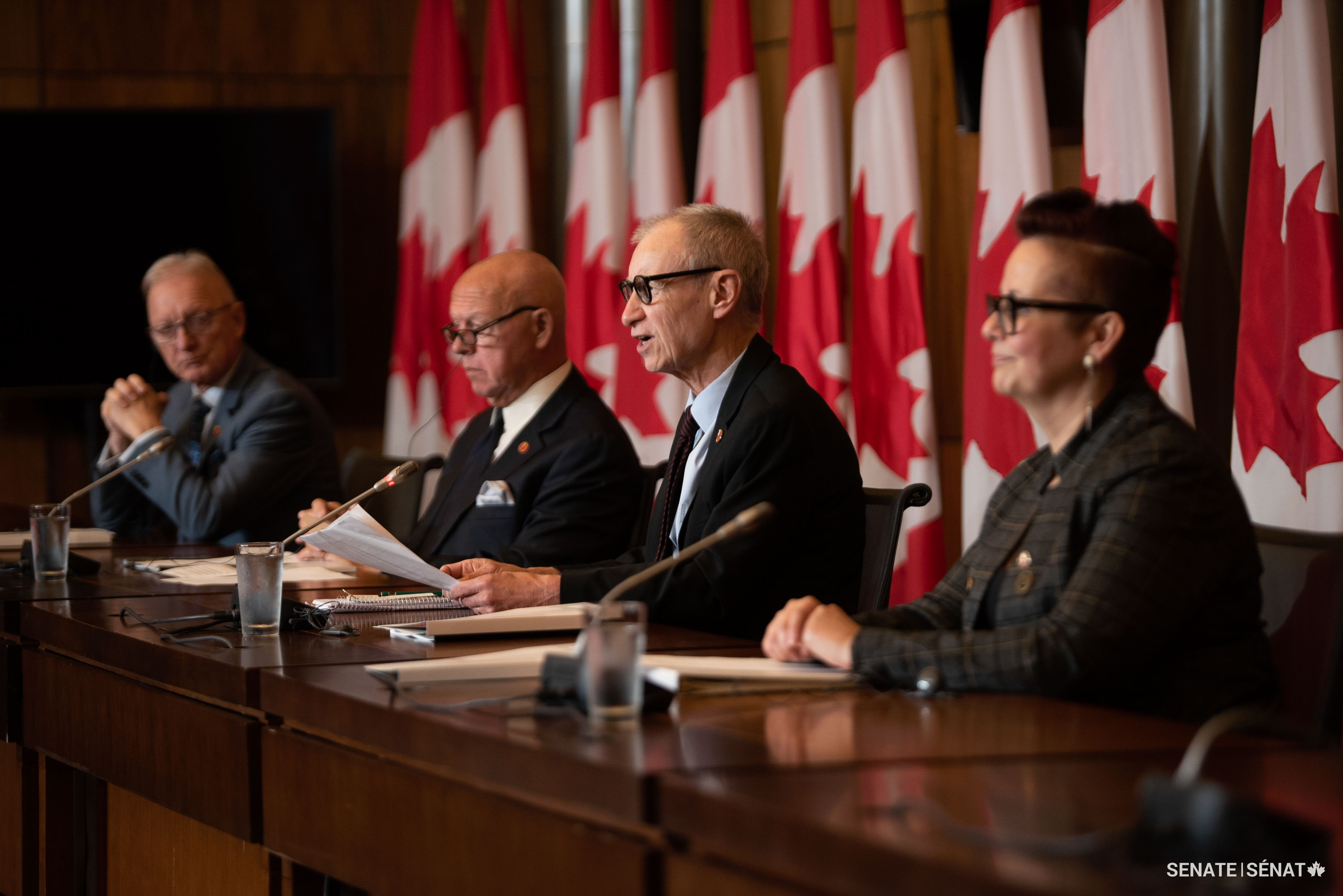 From left to right, senators Pierre-Hugues Boisvenu, Jean-Guy Dagenais, Tony Dean and Margaret Dawn Anderson, members of the Senate Committee on National Security, Defence and Veterans Affairs, present the report on Arctic security and defence during a press conference.
 Senator Pierre-Hugues Boisvenu discusses the Senate Committee on National Security, Defence and Veterans Affairs’ report on security and defence in the Arctic during a press conference.
 Senator Tony Dean, Chair of the committee, talks about the Senate Committee on National Security, Defence and Veterans Affairs’ report on security and defence in the Arctic during a press conference.
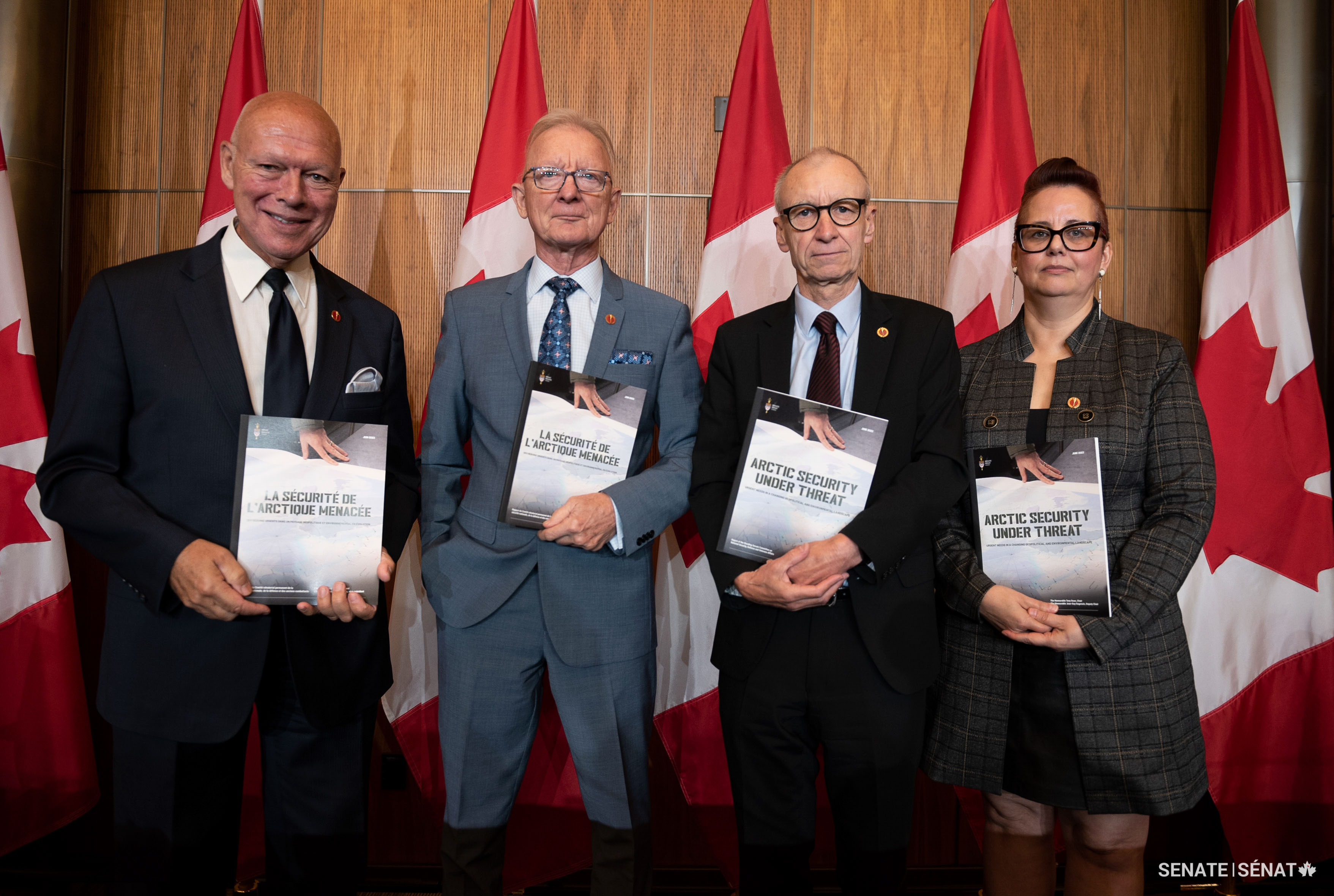 From left to right, senators Jean-Guy Dagenais, Pierre-Hugues Boisvenu, Tony Dean and Margaret Dawn Anderson show copies of the Senate Committee on National Security, Defence and Veterans Affairs’ report, “Arctic Security Under Threat: Urgent needs in a changing geopolitical and environmental landscape”, made public today.
Senators who participated in the study

Tony Dean
ISG - Ontario

Jean-Guy Dagenais
CSG - Quebec (Victoria)

Dawn Anderson
C - Northwest Territories

Peter M. Boehm
ISG - Ontario

Pierre-Hugues Boisvenu
C - Quebec (La Salle)

Donna Dasko
ISG - Ontario

Marty Deacon
ISG - Ontario (Waterloo Region)

Clément Gignac
CSG - Quebec (Kennebec)

Victor Oh
C - Ontario (Mississauga)

David Richards
C - New Brunswick

Hassan Yussuff
ISG - Ontario
Ex-officio members of the committee: The Honourable Senator Marc Gold, P.C., or, The Honourable Senator Patti LaBoucane Benson; The Honourable Senator Donald Neil Plett, or The Honourable Senator Yonah Martin
Other Senators who have participated in the study: The Honourable Senator Mobina Jaffer, The Honourable Senator Marty Klyne, The Honourable Senator Mohamed-Iqbal Ravalia, The Honourable Senator Pat Duncan, The Honourable Senator Andrew Cardozo, The Honourable Senator Larry Smith, The Honourable Senator Michèle Audette, The Honourable Senator Karen Sorensen