
Executive Summary
Ten years have passed since the idea of a federal framework for suicide prevention was realized through the adoption of the Federal Framework for Suicide Prevention Act. This Act required the Government of Canada to develop such a framework—an obligation that was fulfilled in 2016 with the release of the Federal Framework for Suicide Prevention (the Framework). The Framework’s stated mission is to “prevent suicide in Canada” however, there has been no significant change to the suicide rate in Canada since the Framework has been in place. In fact, for the Canadian population as a whole, the suicide rate has remained largely stable over the past 20 years. This seemingly stable rate obscures the overrepresentation of some populations—Indigenous peoples, and more specifically Inuit; and boys and men.
It is evident that the success of the Framework remains limited. The Standing Senate Committee on Social Affairs, Science and Technology (the committee), therefore, undertook a study to evaluate the effectiveness of the Federal Framework for Suicide Prevention, hearing from the Minister of Mental Health and Addictions, medical experts and clinicians, advocates and persons with lived and living experience with suicide. The Minister of Mental Health and Addictions informed the committee that work is being done to update the Framework and therefore, a major theme throughout the study was identifying how an updated Framework could be strengthened.
While this study aimed to evaluate the Framework, the committee acknowledges that in many ways, the Framework is intertwined with the broader topic of suicide prevention in Canada, and thanks witnesses who shared information on that topic as well. Given that the committee has not yet had the opportunity to study such an important subject at the level of detail it requires, this report is divided into two parts. The first part evaluates the Federal Framework for Suicide Prevention and provides recommendations for its improvement. The second part provides a summary of the testimony shared with the committee about suicide prevention more generally.
Recommendations
RECOMMENDATION 1
That the Government of Canada commit to updating the Federal Framework for Suicide Prevention to produce an approach that effectively works at preventing suicide in Canada, and prioritize:
– identifying and promoting evidence-based public health and clinical interventions that are known to have a meaningful impact on suicide in Canada (measured through decreased suicide rates and/or decreased hospital visits due to suicide attempts), such as means restriction;
– moving away from supporting interventions and programs that are not evidence-based;
– replacing concepts of “hope and resilience” in the Framework with “meaning and connectedness;” and
– providing programming based on data that measures the impact of suicide prevention interventions, specifically: suicide rate, number of emergency room visits associated with a suicide attempt and number of hospitalizations associated with a suicide attempt.
RECOMMENDATION 2
That the Government of Canada establish specific priorities in the updated Framework, namely:
– identifying local public health and clinical health interventions that are demonstrated to be effective, and scaling them nationwide;
– targeting populations that are currently overrepresented in Canada’s suicide rates: First Nations, Métis and Inuit; boys and men; racialized communities; and persons with mental illnesses; and
– funding research into promising initiatives for suicide prevention.
RECOMMENDATION 3
That the Government of Canada establish an independent critical review of revenue-generating suicide prevention and intervention programs operating in Canada; and that the results of this review be appended to the Framework.
RECOMMENDATION 4
That the updated Framework require that comprehensive Gender-based Analysis Plus training be added to the existing body of clinical and professional suicide prevention and treatment training, resources and development instruction provided to healthcare providers, so as to ensure that public health and clinical intervention treatments respond to the particular cultural, historical, socio-economic contexts and related contributing gendered factors that are distinct, given the diversity of individuals and groups in need of care.
RECOMMENDATION 5
That the Government of Canada collaborate with provinces, territories and civil society organizations to improve national suicide and suicide prevention data collection and analysis by:
– creating a national database on a) suicide, including indicators such as suicide rate, number of emergency room visits associated with a suicide attempt and number of hospitalizations associated with a suicide attempt; b) effective suicide prevention programs and research; and c) contributing and causal factors for suicide identified through GBA Plus;
– standardizing coroners’ reports;
– collecting sufficient demographic and geographic data for disaggregated analysis; and
– collaborating with provincial and territorial authorities on making suicide and suicide attempts incidents reportable to a specific authority.
RECOMMENDATION 6
That the Public Health Agency of Canada improve its reports on progress related to the Framework by establishing meaningful measurable outcomes and by evaluating suicide prevention programming against these benchmarks.
RECOMMENDATION 7
That the updated Framework explicitly acknowledge the additional challenges faced by certain populations in Canada—rural, remote and Northern communities; English- and French-second-language speakers; refugees and immigrants; persons with disabilities; racialized communities—in accessing mental healthcare, and provide resources and programming to mitigate these challenges; and, that the updated Framework acknowledge the high level of stigma attached to suicide, and respond by supporting mental healthcare access in all communities.
RECOMMENDATION 8
That the Government of Canada return to the Standing Senate Committee on Social Affairs, Science and Technology to share the updated Federal Framework for Suicide Prevention.
RECOMMENDATION 9
That the updated Framework acknowledge the crisis of Indigenous overrepresentation in Canada’s suicide rate, and:
– recognize the expertise and knowledge of community members by engaging directly with Indigenous experts with lived and living experience in suicide prevention;
– integrate life promotion into suicide prevention models;
– provide flexible financial support for programming that can be devised and managed by community members autonomously;
– create programming designed to train Indigenous community members in mental healthcare and intervention; and
– ensure a trauma-informed, culturally-appropriate approach when providing care to Indigenous peoples.
RECOMMENDATION 10
That the updated Framework acknowledge the overrepresentation of boys and men in Canada’s suicide rate, and:
– recognize that men and women may require different forms of therapeutic interventions;
– target research towards treatment innovations for boys and men; and
– recognize the additional stigma that boys and men may face in discussing mental health and suicide and seeking mental healthcare.
RECOMMENDATION 11
That the updated Framework recognize the impact of substance use and addiction on suicide prevention in Canada, and that funding and programming associated with suicide prevention include research and interventions into substance abuse and addiction.

Ottawa – The Federal Framework for Suicide Prevention has had no effect on the suicide rate in Canada since it was put in place in 2016, the Senate Committee on Social Affairs, Science and Technology said in a report released Thursday, June 8, 2023.
The framework’s mission is to “prevent suicide in Canada.” However, the committee found that the framework is centred around ideas of what feels good instead of seeking out what works.
The federal Minister for Mental Health and Addictions acknowledged the framework’s weaknesses at the outset of the committee’s hearings and committed to publishing an updated version in the fall. The committee has made 11 recommendations to help it perform better in the future.
For example, the seemingly stable rate of suicide in Canada obscures the fact that some populations — Indigenous peoples, especially Inuit, and men and boys — are overrepresented. Men and boys account for more than 75% of suicides, while the rate among Inuit is six to 25 times higher than the overall Canadian population. The government should establish specific priorities in the updated framework, including targeting populations that are overrepresented.
In general, the committee recommends identifying and promoting evidence-based public health and clinical interventions that are known to have a meaningful effect on suicide, and improving data collection.
Quick Facts
- The suicide rate in Canada has been either 11/100,000 or 12/100,000 in every year since 2000. There was a slight decrease to a rate 10/100,000 in 2020, which witnesses attributed to pandemic-related social supports. The Federal Framework for Suicide Prevention was published in 2016.
- The number of adults who have seriously contemplated suicide has risen significantly since the pandemic. According to Statistics Canada, the prevalence of suicidal ideation among adults rose to 4.2% after the pandemic began in 2019, up from 2.7%.
- Making the most common and lethal methods of suicide more difficult to access is the only public health intervention that has an evidence-based impact on suicide, the committee heard. This is known as means restriction.
Quotes
“Many witnesses opened their hearts to us about some of the most difficult and painful times of their lives. We are indebted to them for their candour and for their courage in speaking to us so we can work toward establishing effective methods of suicide prevention.”
- Senator Ratna Omidvar, Chair of the committee
“It is distressing to consider how many lives could have been saved had an evidence-based suicide prevention framework been in place. This report shows the urgency of the situation; the government must keep its promise to strengthen the framework without delay.”
- Senator Jane Cordy, Deputy Chair of the committee
“Data on suicide and suicide attempts are inconsistent at best and unavailable at worst. This makes it difficult to determine the most effective methods of suicide prevention. The new framework should prioritize approaches that we know will work and build from there.”
- Senator Judith G. Seidman, member of the Subcommittee on Agenda and Procedure
“We need to better understand how to reach groups most affected by suicide. We know that men, particularly Indigenous men, veterans and men with mental illnesses, are at significantly higher risk. The revised framework must acknowledge this reality and target support to these groups.”
- Senator F. Gigi Osler, member of the Subcommittee on Agenda and Procedure
Associated Links
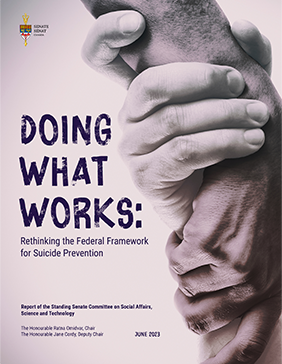
- Read the report: Doing What Works: Rethinking the Federal Framework for Suicide Prevention.
- Follow the committee on social media using the hashtag #SOCI.
- Subscribe to email alerts for Senate committees.
- Sign up for the Senate eNewsletter.
For more information:
Amely Coulombe
Communications Officer | Senate of Canada
343-575-7553 | amely.coulombe@sen.parl.gc.ca
Senators who participated in this study

Ratna Omidvar
ISG - Ontario

Judith G. Seidman
C - Quebec (De la Durantaye)

Flordeliz (Gigi) Osler
CSG - Manitoba

Jane Cordy
PSG - Nova Scotia

Wanda Thomas Bernard
PSG - Nova Scotia (East Preston)

Sharon Burey
CSG - Ontario

Donna Dasko
ISG - Ontario

Stan Kutcher
ISG - Nova Scotia

Frances Lankin, P.C.
ISG - Ontario

Marilou McPhedran
Non-affiliated - Manitoba

Rosemary Moodie
ISG - Ontario

Chantal Petitclerc
ISG - Quebec (Grandville)
Ex-officio members of the committee: The Honourable Marc Gold, P.C. or Patti Laboucane-Benson, The Honourable Donald Plett or Yonah Martin
Other Senators who have participated in the study: The Honourable Patricia Bovey (retired), The Honourable Patrick Brazeau, The Honourable Andrew Cardozo, The Honourable Margo Greenwood, The Honourable Yonah Martin, The Honourable Mary Jane McCallum, The Honourable Marie-Françoise Mégie, The Honourable Percy Mockler, The Honourable Dennis Glen Patterson, The Honourable Rose-May Poirier, The Honourable Mohamed-Iqbal Ravalia, The Honourable Josée Verner, P.C.