
Report
Executive Summary
An examination of the implementation of the United Nations Declaration on the Rights of Indigenous Peoples Act reflected an opportunity to hear from Indigenous leaders, experts and others from across Canada on their priorities and aspirations for a future where Indigenous rights are protected and respected.
The present report, based on testimony gathered by the Committee in 2024, makes nine recommendations.
Critically, the Committee recommends that Justice Canada involve the Treasury Board of Canada to support federal efforts to monitor the implementation of the United Nations Declaration on the Rights of Indigenous Peoples Act.
The Committee additionally recommends establishing reporting tools on the use of the Interim guide for officials on how to assess consistency with the United Nations Declaration on the Rights of Indigenous Peoples along with information on the United Nations Action Plan Advisory Committee’s work.
Most recommendations reflect the desire to obtain further information on a range of federal policy and legislative initiatives that have a profound effect on the lives of Indigenous Peoples. Greater information and statistics will help us understand what steps must be taken to fulfill Indigenous human rights. Greater information also contributes to transparency and supports self-determination of Indigenous governments. Additional recommendations include progress reports on:
- Indigenous health legislation and the transfer of federal health service delivery to Indigenous jurisdictions and the elimination of systemic discrimination in health service delivery;
- the implementation of the Indigenous Justice Strategy;
- socio-economic and Indigenous indicators related to equality, Indigenous child and family services and Indigenous shelters and transition houses;
- Indigenous language instruction in First Nations schools; among others.
These recommendations are intended to strengthen support and provide focus to federal officials as they move forward with the implementation of the Act. The report also serves as a source of future study topics.
Recommendations
Recommendation 1
That the Government of Canada issue progress reports by January 2027 with respect to the implementation of the United Nations Declaration on the Rights of Indigenous Peoples Act, the Truth and Reconciliation Commission of Canada’s Calls to Action and National Inquiry for Missing and Murdered Indigenous Women and Girls’ Calls for Justice. The progress report must include detailed outcomes of the Government of Canada’s initiatives to increase equality for Indigenous Peoples with respect to health, income, education, employment, drinking water, housing, language, culture and criminalization. In keeping with Canada’s ratification of the United Nations Convention on the Rights of the Child, the progress reports must also include details about Indigenous children’s involvement with child welfare systems and include steps taken towards the full exercise of Indigenous jurisdiction over their children.
Recommendation 2
That Indigenous Services Canada issue publicly available progress reports by January 2027 related to:
- the development of Indigenous health legislation, including a list of parties involved in its development and their objectives;
- the transfer of federal health service delivery to Indigenous governments and organizations, including progress on funding to support the meaningful exercise of Indigenous jurisdiction over health service delivery;
- the implementation of Joyce’s Principle related to the elimination of systemic discrimination and racism in health and social services; and,
- on initiatives on anti-disability discrimination.
Recommendation 3
That the Canadian Mortgage and Housing Corporation and Indigenous Services Canada issue a progress report by January 2027 on the number of shelters and transitional homes which received funding under the Indigenous Shelter and Transitional Housing Initiative; the status of construction and operation, including any facilities built or investments made in the Arctic; the annual operating costs allocated to these facilities; the numbers of families expected to be served or are served by such facilities; and the impact of prevention of violence against Indigenous women and children; and
That Canada Mortgage and Housing Corporation provide the Committee with detailed information by January 2027 about how many houses will be built and in what regions, as well as any impacts on the prevention of violence against Indigenous women and children under the Urban, Rural and Northern Indigenous Housing Strategy.
Recommendation 4
That Health Canada and Indigenous Services Canada provide a progress report by January 2027 on funding for Indigenous youth mental health programs; and
That Crown-Indigenous Relations and Northern Affairs Canada provide information by January 2027 on Indigenous youth programs, including how many Indigenous youth have been reached; the number of youth organizations or initiatives that have been established; funding amounts for these initiatives; related outcomes; and whether the program will receive continued funding.
Recommendation 5
That Indigenous Services Canada provide information by January 2027 pertaining to the number of schools on First Nations reserves that offer courses in Indigenous languages and the associated funding for Indigenous languages in education; and
That Crown-Indigenous Relations and Northern Affairs Canada and Heritage Canada provide the Committee by January 2027 with information pertaining to the inclusion of Indigenous languages under the Collaborative Self-Government Fiscal Policy along with details of any funding methodology for Indigenous languages either contemplated or being implemented with self-governing Indigenous governments.
Recommendation 6
That Justice Canada and Public Safey Canada provide a progress report by January 2027 on reporting mechanisms and that they report annually on the implementation of priorities raised in its Indigenous Justice Strategy, as well as the implementation of the related Calls for Action of the Truth and Reconciliation Commission of Canada and Calls for Justice from the National Inquiry into Missing and Murdered Indigenous Women and Girls. The progress report should specifically address any initiatives related to Canada’s commitment to eliminate the over-representation of Indigenous Peoples in prisons by 2025 and to return Indigenous Peoples from prisons to their communities with adequate resources for their support and integration, including via sections 81 and 84 of the Corrections and Conditional Release Act.
Recommendation 7
That Indigenous Services Canada provide the Committee with a progress report by January 2027 on its progress to advance self-determination and the exercise of First Nations jurisdictions in areas such as membership, citizenship, status, lands management, fiscal management, taxation, matrimonial real property and other contemplated initiatives under negotiation or consideration for First Nations to operate outside of the constraints of the Indian Act.
Recommendation 8
That Justice Canada, in coordination with the Privy Council Office and Treasury Board Secretariat, provide the Committee with a report by January 2027 detailing how it is monitoring the implementation of the Interim guide for officials on how to assess consistency with the United Nations Declaration on the Rights of Indigenous Peoples across federal departments; the process developed to assess the effectiveness of the Interim guide; any related mandatory assessment tools developed; and how these processes have informed federal decisions; and
That Justice Canada provide the Committee with a progress report by January 2027 on the UN Action Plan Advisory Committee’s work.
Recommendation 9
That the Government of Canada develop a mandatory training plan on the United Nations Declaration on the Rights of Indigenous Peoples Act, Aboriginal and treaty rights, treaty implementation and Indigenous history and experiences to measure progress on training a greater number of civil servants and to ensure training meets the differing departmental responsibilities.
That the federal UN Declaration Act Secretariat at Justice Canada involve the Treasury Board of Canada: to measure progress on public service education; to monitor the implementation of the United Nations Declaration on the Rights of Indigenous Peoples Act; and to support future planning and policy development.
Ottawa – The federal government must develop tools to monitor progress on the implementation of the United Nations Declaration on the Rights of Indigenous Peoples Act in Canada, and develop a mandatory and customized training plan on treaty rights and Indigenous history and experiences for public servants across the departments responsible for the act’s implementation, the Senate Committee on Indigenous Peoples said in a new report.
The committee’s report, released Thursday, contains testimony from Indigenous leaders and experts on the progress made and the challenges faced so far in the government’s efforts to align federal laws and policies with the United Nations Declaration on the Right of Indigenous Peoples (UNDRIP). Consistently, the committee heard that self-determination, Indigenous governance, law-making authority and meaningful participation in decision making are essential to implementing UNDRIP in Canada.
The report makes nine recommendations to the Government of Canada, most of which reflect the committee’s desire to obtain more detailed information and progress reports on a range of federal policy and legislative initiatives that have profound effects on the lives of Indigenous Peoples — including the transfer of federal health service delivery to Indigenous jurisdictions, the elimination of systemic discrimination in health services, shelters and transitional housing for Indigenous families in the Arctic, access to justice and support for Indigenous language instruction, among others.
The implementation of UNDRIP has the potential to transform the relationship between Indigenous Peoples and Canada, and the committee recognizes that this process will take time. The committee will carefully monitor the government’s progress on this file and undertake further studies on some of the priorities raised by witnesses, including the duty to consult and accommodate Indigenous Peoples.
Quick Facts
- The United Nations Declaration on the Rights of Indigenous Peoples (UNDRIP) contains 46 articles that recognize “the minimum standards for the survival, dignity and well-being of the Indigenous Peoples of the world.” The United Nations General Assembly adopted UNDRIP on September 13, 2007.
- Legislation to implement UNDRIP in Canada, known as the United Nations Declaration on the Rights of Indigenous Peoples Act, received Royal Assent in 2021. The act requires the Crown to align federal laws and policies with the principles of UNDRIP and, starting in 2023, to report on its progress annually to Parliament.
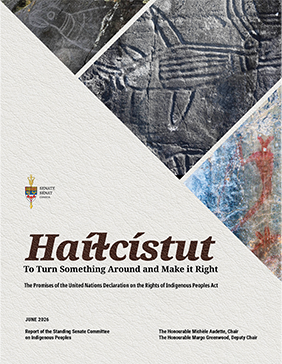
- The title of the committee’s report is derived from the concept of Haíɫcístut, which in Haíɫzaqvḷa language means “to turn something around and make it right again.” The committee was granted permission to use this term in its report by Chief Marilyn Slett of Heiltsuk Nation, who testified about the Nation’s pursuit of a self-determination agreement based on that concept.
Quotes
“This report is intended to strengthen support and provide focus to federal officials as they work to ensure Canada’s laws and policies are consistent with UNDRIP. The committee looks forward to receiving the requested progress reports from the federal government so we can maintain momentum in achieving a future where Indigenous rights are protected and respected across the country.”
- Senator Michèle Audette, chair of the committee
“The successful implementation of UNDRIP is critical to asserting Indigenous rights and to meaningful reconciliation with First Nations, Inuit and Métis peoples from coast to coast to coast. This is a complex and ambitious undertaking, and to fulfill UNDRIP’s promises, we need a coordinated and comprehensive response across all federal departments.”
- Senator Margo Greenwood, deputy chair of the committee
Associated Links
- Read the report: "Haíɫcístut: To Turn Something Around and Make it Right" The Promises of the United Nations Declaration on the Rights of Indigenous Peoples Act
- Follow the committee on social media using the hashtag #APPA
- Subscribe to email alerts for Senate committees.
- Sign up for the Senate eNewsletter.
For more information:
Chelsea DeFazio
Communications Officer | Senate of Canada
343-576-1481 | chelsea.defazio@sen.parl.gc.ca
Senators who participated in this study

Michèle Audette
PSG - Quebec (De Salaberry)

Margo Greenwood
ISG - British Columbia

Bernadette Clement
ISG - Ontario

Brian Francis
PSG - Prince Edward Island

Nancy Karetak-Lindell
ISG - Nunavut

Mary Jane McCallum
C - Manitoba

Marilou McPhedran
Non-affiliated - Manitoba

Kim Pate
ISG - Ontario

Paul (PJ) Prosper
CSG - Nova Scotia

Karen Sorensen
PSG - Alberta

Scott Tannas
CSG - Alberta
Ex officio members of the committee: the Honourable Pierre Moreau, P.C., or the Honourable Patti LaBoucane-Benson, the Honourable Leo Housakos or the Honourable Yonah Martin, the Honourable Lucie Moncion or the Honourable Joan Kingston, the Honourable Flordeliz (Gigi) Osler or the Honourable Robert Black, the Honourable Brian Francis or the Honourable Judy A. White
Other senators who have participated in the study: the Honourable David M. Arnot, the Honourable Gwen Boniface (retired since November 2025), the Honourable Mary Coyle, the Honourable Nancy Hartling (retired since February 2025), the Honourable John M. McNair