
Report
Executive Summary
The Standing Senate Committee on Banking, Commerce and the Economy began its study on housing in October 2023 at a time when Canada was experiencing a deepening housing affordability crisis marked by rapidly rising home prices, limited supply, and increasing demand. Public concern intensified as homeownership became increasingly out of reach for many Canadians. Governments at all levels turned their attention to potential solutions and, in December 2023, the committee released an interim report containing ten recommendations aimed at improving housing affordability in Canada.
The committee resumed its study on 1 October 2025, focusing on the challenges currently facing Canadian homebuyers—particularly, the effects of government taxes, fees, and levies. Over nine meetings, the committee heard that many housing markets in Canada face a troubling paradox: homes are priced beyond buyers’ reach while construction and land costs have receded. Young Canadians, in particular, are coping with significant financial strain, with many feeling that home ownership is unattainable. The committee believes that the urgency of the situation calls for coordinated and coherent action among all stakeholders and levels of government.
This report provides a summary of witness testimony, committee observations and makes 12 recommendations for key policy changes necessary for reducing housing prices and increasing supply, supporting a robust housing sector and improving access to housing for all Canadians.
Recommendations
Lowering Prices and Increasing Supply
Recommendation 1
The federal government could consider providing a 100% Goods and Services Tax/Harmonized Sales Tax rebate on all new housing valued below $1 million, with the rebate phased out for houses between $1 million and $1.5 million. Furthermore, the $1 million price threshold should be indexed annually to inflation.
Recommendation 2
Where permitted by provincial/territorial legislation, the federal government require as a condition for providing infrastructure funding:
- equivalent reductions in municipal fees where appropriate; and
- provisions to ensure compliance and oversight such as performance metrics for municipal approval processes as well as assurances that services built by developers are not included in development charges.
Recommendation 3
The federal government work with provinces/territories and municipalities to ensure that all taxes, levies and charges are directly levied on purchasers and fully itemized to promote transparency and eliminate any “tax-on-tax.”
Recommendation 4
The federal government play a leadership role and work with provinces/territories and municipalities in developing best practices with respect to municipal approval processes and that financial incentives be used to ensure provinces/territories and municipalities adopt these best practices.
Cultivating a Robust Housing Sector
Recommendation 5
The federal government work with provinces/territories and municipalities to reduce reliance on development charges and explore alternative municipal funding models, such as allowing for:
- the removal from development charges any capital works installed by the builder that could be substituted by fees;
- the charging of fees by municipalities over time for repayment of infrastructure expenditures on revenue earning services such as water, wastewater, and electrical;
- the use of tax-free municipal bonds; and
- a more equitable distribution of costs among the different levels of government.
Recommendation 6
The federal government provide more regular, reliable, detailed and advanced population and immigration forecasts to provinces/territories and municipalities.
Recommendation 7
The federal government invest in a national housing data and accountability framework to track approvals, development charges, construction timelines, number of housing completions, fees, renovation outcomes, and affordability targets.
Recommendation 8
The federal government provide support to small and medium-sized enterprises in their efforts to modernize Canada’s construction sector, with particular focus on their participation in modular and factory-built housing. It should also consider offering subsidies to create a demand for modular and factory-built housing in Canada.
Improving Access to Housing for All Canadians
Recommendation 9
The federal government explore whether renters should benefit from similar tax benefits as homeowners.
Recommendation 10
The federal government should consider a national home renovation tax credit to help update older homes, improve energy efficiency and accessibility, and support the creation of secondary or multi-unit suites to expand rental supply.
Recommendation 11
The federal government study whether regulation should be introduced to restrict the acquisition of residential rental housing by institutional investors.
Recommendation 12
In order to support the growth of the non-market housing sector, the federal government:
- expand federal investment in the sector through direct funding, low-cost financing and partnerships with non-profits organizations, cooperatives and Indigenous housing providers;
- implement a federal liquidity guarantee for non-profit and cooperative housing developers for deeply affordable units; and
- facilitate the transfer of for-profit rental buildings to non-profit ownership through tax incentives, such as capital gains exemptions.

Ottawa – Expanding the GST/HST rebate on housing and helping municipalities reduce development charges and regulatory burdens will help ease Canada’s housing crisis, the Senate Committee on Banking, Commerce and the Economy said in a report released Tuesday.
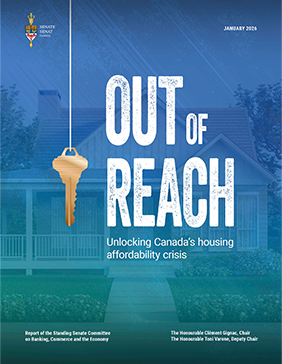
The report, Out of Reach: Unlocking Canada’s housing affordability crisis, makes 12 recommendations to achieve key housing goals: lowering prices and increasing supply, cultivating a robust housing sector and improving access to housing for all Canadians.
Although population growth has receded and construction and land costs have tempered since the committee released its interim report on housing in December 2023, many markets across the country continue to face significant supply shortages and home prices remain out of reach for buyers.
Among the committee’s key findings were shocking disparities between Canadian municipalities in the average fees and development charges on single-family homes. Additionally, depending on the city, it can take anywhere between five and 31 months for a municipality to render a decision on a development application. In the Greater Toronto Area (GTA), however, the full process — from a builder’s first meeting with municipal officials to homes being ready for occupancy — can take up to 11 years.
The committee believes the severity and urgency of Canada’s housing crisis require swift and co-ordinated action from all stakeholders and levels of government.
Quick Facts
- The GST/HST New Housing Rebate allows an individual to recover 36% of the GST — or the federal part of the HST — that was paid on a new, substantially renovated or owner-built house that will be owner-occupied. The rebate applies to new housing valued at up to $350,000 and is phased out for homes valued between $350,000 and $450,000.
- The GST/HST New Housing Rebate was established in 1991; at the time, 95% of newly built homes met the rebate’s criteria. The rebate has not been updated since its introduction 35 years ago.
- The average level of municipal fees embedded in a single-family home in Toronto is $200,000, while in Moncton and Charlottetown, it is less than $10,000.
Quotes
“All Canadians should be able to access housing without taking on high levels of debt. Municipal, provincial and federal governments all contributed to housing unaffordability; each must now do its part to de-escalate what’s become a national crisis.”
- Senator Clément Gignac, Chair of the committee
“Canada’s housing system is broken. To fix it, governments can start by removing the hidden costs of development charges from homebuyers, while exploring alternative municipal funding models and expanding the GST/HST rebate on all new housing. Improved housing affordability for all Canadians requires more transparency and less regulatory burden.”
- Senator Toni Varone, Deputy Chair of the committee
Associated Links
- Read the report: Out of Reach: Unlocking Canada’s housing affordability crisis.
- Read the committee’s interim report: Study on Housing Affordability — Interim Findings.
- Follow the committee on social media using the hashtag #BANC.
- Subscribe to email alerts for Senate committees.
- Sign up for the Senate eNewsletter.
For more information:
Chelsea DeFazio
Communications Officer | Senate of Canada
343-576-1481 | chelsea.defazio@sen.parl.gc.ca
Senators who participated in this study

Clément Gignac
CSG - Quebec (Kennebec)

Toni Varone
ISG - Ontario

Pierre J. Dalphond
ISG - Quebec (De Lorimier)

Colin Deacon
CSG - Nova Scotia

Daryl S. Fridhandler
PSG - Alberta

Danièle Henkel
PSG - Quebec (Alma)

Tony Loffreda
ISG - Quebec (Shawinegan)

Elizabeth Marshall
C - Newfoundland and Labrador

Yonah Martin
C - British Columbia

Marnie McBean
ISG - Ontario

Pierrette Ringuette
ISG - New Brunswick

Pamela Wallin
CSG - Saskatchewan

Hassan Yussuff
ISG - Ontario
Ex officio members of the committee: The Honourable Pierre Moreau, P.C., or the Honourable Patti LaBoucane-Benson, the Honourable Leo Housakos or the Honourable Yonah Martin, the Honourable Raymonde Saint-Germain or the Honourable Bernadette Clement (until December 31, 2025), the Honourable Lucie Moncion or the Honourable Joan Kingston (since January 1, 2026), the Honourable Scott Tannas or the Honourable Rebecca Patterson (until January 4, 2026), the Honourable Flordeliz (Gigi) Osler or the Honourable Robert Black (since Jan. 5, 2026), the Honourable Francis Brian or the Honourable Judy A. White
Other senators who have participated in the study: The Honourable Éric Forest, the Honourable Rosa Galvez, the Honourable Farah Mohamed and the Honourable Sandra Pupatello