
Report
Executive summary
In recent years, housing affordability in Canada has deteriorated significantly. Rapid increases in home prices and rents, combined with higher interest rates, construction costs and the cost of living, have increased financial pressure on a growing number of households. This situation now affects both low- and middle-income households, particularly in large urban centres, where the supply of affordable housing has not kept pace with population growth, thereby increasing barriers to accessing housing and the risk of homelessness.
It was in this context that, in September 2025, the government announced the creation of Build Canada Homes, a new organization tasked with implementing a renewed approach to increasing the supply of non-market housing. In October 2025, the Standing Senate Committee on National Finance (the Committee) undertook a study to examine the role and implementation of this new organization.
During its study, the Committee heard testimony on the growing need for non-market housing, particularly for Indigenous people, newcomers and students, as well as the constraints facing the community housing sector in increasing its supply. Witnesses also raised various issues related to the mandate, governance and funding of Build Canada Homes, its coordination with the Canada Mortgage and Housing Corporation, and its role in federal housing policy.
Lastly, the Committee examined how Build Canada Homes could achieve its objectives of increasing the construction of affordable housing, strengthening the capacity and viability of the non-market housing sector and supporting the development of industrialized construction methods to reduce construction costs and timeframes. This report summarizes the testimony heard and sets out 10 recommendations aimed at maximizing Build Canada Homes’ contribution to increasing the supply of non-market housing in Canada.
Recommendations
Recommendation 1
That the federal government ensure the availability of comprehensive and publicly accessible housing data to adequately assess housing needs in Canada and the actual effectiveness of federal programs designed to address these needs.
Recommendation 2
That, as a special operating agency, Build Canada Homes establish clear objectives and annual performance indicators, and ensure a high level of transparency to Canadians and to Parliament by regularly publishing detailed information on its activities, tenders, expenditures and results. Furthermore, when reviewing Bill C-20, which would transform Build Canada Homes into a Crown corporation, parliamentarians should ensure that it is bound by strict governance and accountability rules.
Recommendation 3
That Build Canada Homes ensure it attracts and retains highly qualified personnel from across the public service and from outside government in order to maintain and enhance the federal government’s expertise in affordable housing.
Recommendation 4
That the federal government promptly announce its intentions regarding the future of the National Housing Strategy and the level of funding to be allocated in the medium and long term to federal programs related to access to homeownership, and the construction and financing of affordable and non-market housing.
Recommendation 5
That Build Canada Homes ensure environmental considerations are incorporated into project selection, including by assessing environmental impacts, prioritizing construction in areas at lower risk of natural disasters, and taking into account the environmental performance and disaster resilience of construction materials.
Recommendation 6
That Build Canada Homes and the Canada Lands Company begin exploring the acquisition of additional land for the construction of non-market housing, particularly in areas where the federal government holds limited land and where non-market housing needs are significant; and that they explore the feasibility of transferring federal lands to Indigenous housing providers.
Recommendation 7
That the federal government give Build Canada Homes the mandate and tools to serve as a single window for organizations seeking to create, acquire or preserve non-market housing. In that capacity, Build Canada Homes should:
- support early project planning in order to reduce the costs and risks associated with pre-development;
- facilitate coordination and partnerships among different levels of government, municipalities and community stakeholders; and
- offer flexible financing tools tailored to project needs.
The Committee also believes that Build Canada Homes should take into account the distinct needs of diverse populations, including Indigenous people, newcomers and students, particularly with respect to housing affordability, size and accessibility, as well as the importance of preserving the existing supply of affordable housing.
Recommendation 8
That the federal government work with the provinces and territories to ensure that transitional housing supported by Build Canada Homes systematically includes a full range of support services. These services should include mental health, addiction and social services support, as well as tailored support based on needs, including those of Indigenous people.
Recommendation 9
That, to foster wider adoption of modern construction methods, the federal government:
- provide Building Canada Homes with enough funding to carry out affordable housing projects using modern construction methods and thereby enhance predictability and reduce the risks associated with the major initial investments in these methods; and
- work with the provinces, territories and municipalities to reduce regulatory and administrative barriers that could impede broader adoption of these methods, including by improving coordination between municipal approval processes and regulatory frameworks, in order to encourage their large-scale adoption.
Recommendation 10
That the federal government:
- pursue its efforts to encourage other levels of government to reduce or review development charges when they act as a barrier to new housing construction;
- continue supporting municipal infrastructure projects that underpin housing, and work closely with other levels of government to explore alternative and predictable funding mechanisms for municipal infrastructure related to residential development; and
- ensure that effective collaboration and communication mechanisms are in place with other levels of government and municipal associations to ensure that measures taken in the area of housing are consistent and coordinated.

Ottawa – Having given Build Canada Homes the enormous task of boosting Canada’s housing options for low- and middle-income households, the federal government must provide it with the resources, tools and powers necessary to maximize its impact on housing affordability, the Senate Committee on National Finance said in a report released March 26, 2026.
In response to the national housing crisis, the government launched Build Canada Homes in September 2025 with an initial budget of $13 billion over five years. The new organization’s mandate is to scale the production and financing of non-market and affordable housing across the country, and to promote faster and more cost-effective construction methods, like factory-built housing.
After examining Build Canada Homes’ implementation, funding, governance and role in federal housing policy, as well as how its activities will operate alongside those of the Canada Mortgage and Housing Corporation and other federal programs, the committee is making 10 recommendations to the government to strengthen the organization’s operations and its accountability to Parliament and taxpayers.
The recommendations, among other things, relate to the acquisition of land for housing development, the prioritization of housing that’s more resilient to natural disasters, and the distinct housing needs of diverse populations — including Indigenous peoples, newcomers and students. Additionally, the report urges the government to fill gaps in publicly available housing data and to encourage provinces and municipalities to reduce or review development charges that hinder new housing construction.
Quick Facts
- An order of reference adopted by the Senate on October 21, 2025, authorized the national finance committee to examine federal programs and initiatives to support housing, including the launch of the Build Canada Homes agency.
- Build Canada Homes is a special operating agency within Housing, Infrastructure and Communities Canada. The Build Canada Homes Act, introduced in the House of Commons in February 2026, seeks to establish the agency as a Crown corporation.
- Non-market housing refers to residential units owned or operated by community or government organizations that do not set rents or manage their housing to maximize financial returns. Examples of non-market housing in Canada include affordable housing, community housing, supportive housing and transitional housing.
Quotes
“Build Canada Homes has a massive budget and even bigger goals. The federal government must lay a robust foundation for this organization to ensure its operations and results tangibly strengthen the non-market housing sector, reduce homelessness and improve housing affordability for Canadian residents.”
- Senator Claude Carignan, P.C., Chair of the committee
“The committee believes Build Canada Homes, a new organization with billions in funding, must demonstrate a high degree of transparency and accountability to Canadians and to Parliament. The agency should regularly publish details about its objectives, activities, tenders, expenses and results.”
- Senator Éric Forest, Deputy Chair of the committee
Associated Links
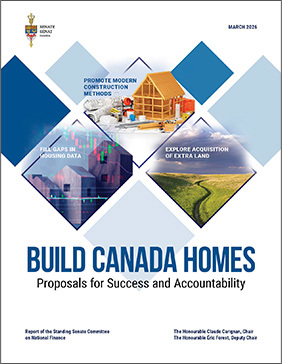
- Read the report: Build Canada Homes: Proposals for Success and Accountability
- Follow the committee on social media using the hashtag #NFFN.
- Subscribe to email alerts for Senate committees.
- Sign up for the Senate eNewsletter.
For more information:
Sabryna Lemieux
Communications Officer | Senate of Canada
Media@sen.parl.gc.ca
Senators who participated in this study

Claude Carignan, P.C.
C - Quebec (Mille Isles)

Éric Forest
ISG - Quebec (Gulf)

Andrew Cardozo
PSG - Ontario

Pierre J. Dalphond
ISG - Quebec (De Lorimier)

Rosa Galvez
ISG - Quebec (Bedford)

Clément Gignac
CSG - Quebec (Kennebec)

Martine Hébert
ISG - Quebec (Victoria)

Joan Kingston
ISG - New Brunswick

Jane MacAdam
ISG - Prince Edward Island

Elizabeth Marshall
C - Newfoundland and Labrador

Krista Ross
CSG - New Brunswick
Ex officio members of the committee: The Honourable Pierre Moreau (or Patti LaBoucane-Benson), the Honourable Leo Housakos (or Yonah Martin), the Honourable Lucie Moncion (or Joan Kingston), the Honourable Flordeliz (Gigi) Osler (or Robert Black), the Honourable Brian Francis (or Judy A. White)
Other senators who have participated in the study: The Honourable Victor Boudreau, the Honourable Marty Deacon, the Honourable Julie Miville-Dechêne, the Honourable Manuelle Oudar, the Honourable Sandra Pupatello, the Honourable Paulette Senior