
Report
Highlights
Part VII was included in the Official Languages Act (the Act) in 1988 to give effect to the principle of advancement of the equality of status and use of English and French, set out in section 16(3) of the Canadian Charter of Rights and Freedoms. Since then, this part has generated both hope and disappointment. Its vagueness and compliance issues have been the subject of complaints, investigations, court remedies and numerous studies.
In 2005, at the Senate’s initiative, a regulatory power was included in Part VII. No regulations were adopted from that time until the comprehensive review of the Act in 2023. Contrary to expectations, the draft regulations tabled in the Senate in December 2025 fall short of the ambitions of the modernized Act.
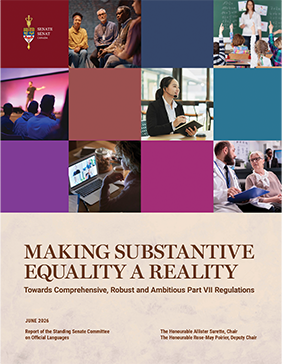
In this report, the Standing Senate Committee on Official Languages (the Senate Committee) presents the findings of its public hearings on the regulatory framework of Part VII of the Act. A total of 48 witnesses and 19 briefs or follow-ups informed its 17 recommendations. These recommendations are intended to encourage the federal government to adopt comprehensive, robust and ambitious regulations that make substantive equality a reality.
This report is addressed primarily to the President of the Treasury Board, who is responsible for enacting the regulations. The lack of clarity in the regulatory proposal raises concerns about the prospect of further disputes. By defining processes without providing for the achievement of concrete results, the proposal fails to make substantive equality a reality and does not respect Parliament’s ambitious vision. The risk of perpetuating existing gaps, by producing inadequate and difficult-to-measure outcomes across federal institutions, remains.
In its work leading up to the modernization of the Act, the Senate Committee had called for the adoption of regulations under Part VII based on a broad interpretation of its obligations. Those regulations were supposed to ensure that positive measures would be taken in accordance with common principles. With the modernized Act, strengthening the proposed regulations is essential.
First, the Senate Committee calls for a purpose clause to be included in the regulations. This clause would promote a broad interpretation of the obligations and clarify, through contextual information drawn from the Constitution, the Act and case law, the intended effects of the regulations. The Senate Committee also calls for clear definitions that would limit varying interpretations of certain concepts and improve compliance with the Act.
The Senate Committee makes a number of recommendations to ensure the ongoing implementation of the obligations under Part VII, in light of the principles established by the Federal Court of Appeal. To that end, the regulations will be required to specify the obligations of federal institutions to conduct an impact analysis prior to each decision. They will also set out the duty of those institutions to develop an action plan for implementing their obligations. In addition, the regulations will establish the process for including language clauses in agreements with provincial and territorial governments that relate to the implementation of Part VII. In Quebec, the measures to be taken by federal institutions will reflect all the provisions of the Act, which are complementary. In the area of education, they will focus on quality learning in non-formal and informal settings.
The Senate Committee shares the concerns raised, namely that the measures taken must not only have a positive effect, but must also be measurable. It recommends clarifying the obligation to ground both analyses and dialogue and consultation activities in research and evidence-based findings. It also calls for a more systematic collection of disaggregated data and the integration of language variables into federal institutions’ internal databases. In this way, the regulations could result in more effective actions and more concrete positive measures.
In addition, the Senate Committee sets out a series of criteria to be included in the regulatory framework to allow for effective consultations with official language minority communities and other stakeholders. This is an essential prerequisite for taking concrete positive measures and developing strategies to mitigate negative impacts.
Accountability mechanisms are required at every stage of the implementation of the commitments under Part VII. All information related to this part of the Act, including action plans, collected data and existing language clauses, should be made public in a common repository.
The Senate Committee still firmly believes that the obligation to apply an official language lens will enable meaningful progress toward substantive equality. Furthermore, the development of a governance framework that clearly establishes responsibilities, both at the head of the federal administration and within federal institutions themselves, will facilitate the implementation, evaluation and oversight of Part VII.
Lastly, the Senate Committee considers that the next statutory review of the Act, scheduled for 2033, will need to ensure continuity in the desired cultural change following the coming into force of the regulatory framework. With a view to advancing substantive equality, the federal government could include provisions in the legislative framework to improve intergovernmental collaboration, establish results-based accountability, and ensure better alignment of the commitments under Part VII. Furthermore, it is worth looking into the merits of harmonizing the statutory amendments to the Act and related regulations, with a view to ensuring consistent application of all provisions.
Recommendations
Recommendation 1
Amend the draft official languages (advancement of equality of status and use of English and French) regulations to include a purpose clause that provides contextual information to guide its implementation. In the circumstances, ensure that the obligations of federal institutions:
- are consistent with section 16(3) of the Canadian Charter of Rights and Freedoms and the unwritten constitutional principle of the protection of minorities;
- are consistent with the principles of interpretation of language rights set out in section 3.1 of the Official Languages Act;
- uphold the principles established by case law, including those of the Federal Court of Appeal in Canada (Office of the Commissioner of Official Languages) v. Canada (Employment and Social Development); and
- meet the criteria set out in sections 41(6) to 41(10) of the Official Languages Act, with a view to fostering a consistent understanding of positive measures.
Recommendation 2
Amend the draft official languages (advancement of equality of status and use of English and French) regulations to clearly define the terms that are open to varying interpretations, such as “positive measures”, “initiative”, “quality learning in formal, non-formal or informal settings”, “other stakeholders”, “devolution”, “strong institutions” and “vitality”. In the circumstances, ensure:
- that these terms are given a large and liberal interpretation, in accordance with section 3.1 of the Official Languages Act; and
- that the official language minority communities and the other stakeholders affected by these definitions are consulted.
If these clarifications cannot be incorporated into the regulatory framework itself, then incorporate them into the existing guide on Part VII, reflecting the ambitious vision of the modernized Official Languages Act and making them accessible to all subject federal institutions. Then, amend sections 41(10.4) and 41(11) of the Official Languages Act during its next ten-year review so that these definitions can be formalized in the regulations.
Recommendation 3
Amend the draft official languages (advancement of equality of status and use of English and French) regulations to require federal institutions to conduct an analysis prior to each decision that may have an impact on the commitments set out in sections 41(1) to 41(3) of the Official Languages Act. In the circumstances, ensure:
- that the analyses are conducted on an ongoing basis, whether it be for taking positive measures, evaluating the negative impacts, or including language clauses in intergovernmental agreements; and
- that the results of the analyses are made public or at least shared with the official language minority communities and other stakeholders participating in the dialogue and consultation activities.
Recommendation 4
Amend the draft official languages (advancement of equality of status and use of English and French) regulations to include the duty of federal institutions subject to Part VII of the Official Languages Act to develop an action plan for implementing their obligations. In the circumstances, ensure:
- that this action plan includes the concrete measures taken for the purpose of having a positive impact on the commitments set out in sections 41(1) to 41(3) of the Official Languages Act;
- that it includes performance indicators developed in consultation with the official language minority communities and other stakeholders, desired outcomes, implementation time frames and evaluation and monitoring mechanisms; and
- that it is made public, in a common repository managed by the Treasury Board of Canada Secretariat.
Recommendation 5
Amend the draft official languages (advancement of equality of status and use of English and French) regulations to include in the list of factors to be taken into account direct references to the specific characteristics of Quebec’s language regime. In the circumstances, ensure:
- that the obligations applicable in Quebec are interpreted within the context of the following provisions of the Official Languages Act, which are complementary:
- the interpretive principle that specifies support for the development of English and French linguistic minority communities in order to protect them while taking into account the fact that they have different needs, in section 2(b);
- the interpretive principle that sets out the objective of advancing the existence of a majority-French society in Quebec where the future of French is assured, in section 2(b.2);
- the commitment to enhancing the vitality of Quebec’s anglophone communities, in section 41(1); and
- the recognition of Quebec’s Charter of the French Language and respect for this province’s jurisdiction, in sections 45.1(1)(b) and 45.1(2).
Recommendation 6
Amend the draft official languages (advancement of equality of status and use of English and French) regulations to include in the list of factors to be taken into account direct references to lifelong learning in the minority language. In the circumstances, ensure:
- that special attention is paid to taking into account quality learning in non-formal and informal settings.
Recommendation 7
Amend the draft official languages (advancement of equality of status and use of English and French) regulations to specify the steps for including language clauses in intergovernmental agreements. In the circumstances, ensure:
- that consultation with the official language minority communities and other stakeholders is required at each stage of negotiating and implementing these agreements;
- that federal institutions must put measures in place in cases of non-compliance with the clauses by provincial and territorial governments;
- that these clauses must be continuously evaluated and monitored; and
- that they are made public in a common repository managed by the Treasury Board of Canada Secretariat.
Recommendation 8
Amend the draft official languages (advancement of equality of status and use of English and French) regulations to specify that federal institutions have an obligation to base their analyses and support their dialogue and consultation activities on research and evidence-based findings. In the circumstances, ensure:
- that data is continuously collected and produced in consultation with the official language minority communities and other stakeholders;
- that they inform the evaluation and monitoring of the measures taken to implement the commitments set out in sections 41(1) to 41(3) of the Official Languages Act;
- that they are based on the expertise of post-secondary institutions serving minority populations, provided that these institutions are supplied with the tools and resources necessary to produce and evaluate them; and
- that they are made public in a common repository managed by the Treasury Board of Canada Secretariat.
Recommendation 9
Amend the draft official languages (advancement of equality of status and use of English and French) regulations to encourage federal institutions to incorporate linguistic variables into their internal databases. In the circumstances, ensure:
- the systematic collection of data to measure and evaluate the advancement of substantive equality of both official languages while taking into account:
- the different needs of anglophone and francophone minority communities; and
- the particular situation of French.
Recommendation 10
Amend the draft official languages (advancement of equality of status and use of English and French) regulations to allow for meaningful consultations with the official language minority communities and other stakeholders. In the circumstances, ensure:
- that dialogue and consultation activities are ongoing, in keeping with all the principles set out in sections 41(9) and 41(9.1) of the Official Languages Act;
- that they take place prior to decisions being made, whether they be for taking positive measures, evaluating the negative impacts, or including language clauses in intergovernmental agreements;
- that they set out a clear process and encourage the active participation of beneficiary organizations:
- by allowing sufficient time to ensure this participation;
- by giving due regard to the organizations’ capacity to participate and providing them with support, as needed;
- by allowing for continuous feedback; and
- by tailoring the processes to the needs of each official language minority community and each stakeholder;
- that they promote the advancement of substantive equality of both official languages; and
- that they include evaluation and monitoring mechanisms.
Recommendation 11
Amend the draft official languages (advancement of equality of status and use of English and French) regulations to establish accountability mechanisms at each stage of implementing the commitments set out in sections 41(1) to 41(3) of the Official Languages Act. In the circumstances, ensure:
- that this accountability mechanism is continuously applied, whether it be for taking positive measures, evaluating the negative impacts, or including language clauses in intergovernmental agreements;
- that it applies both for impact analyses, dialogue and consultation activities, and for research and the collection of evidence-based findings; and
- that the Treasury Board of Canada Secretariat establishes and manages a common repository compiling all information related to Part VII of the Official Languages Act, including:
- the action plans of federal institutions and their annual reports;
- the evidence-based findings produced to inform impact analyses and dialogue and consultation activities; and
- language clauses currently in force.
Recommendation 12
Amend the draft official languages (advancement of equality of status and use of English and French) regulations to ensure that an official languages lens is systematically applied to the policies, programs and initiatives of federal institutions. In the circumstances, ensure:
- that the analyses that federal institutions must conduct take into account the principles and objectives of the Official Languages Act, including:
- the advancement of equality of status and use of both official languages;
- the different needs of the anglophone and francophone minorities; and
- the particular situation of French and the commitments to protect and promote it.
Recommendation 13
That the President of the Treasury Board develop a governance framework that clearly sets out the responsibilities for implementing, evaluating and monitoring Part VII of the Official Languages Act which rest with:
- the President of the Treasury Board and their department;
- the Minister responsible for Official Languages and their department;
- the ministers designated under Part VII and their departments, including the Minister of Foreign Affairs, the Minister of Canadian Heritage and the Minister of Citizenship and Immigration; and
- the deputy heads of the federal institutions subject to Part VII and the individuals responsible for Part VII in these institutions.
Recommendation 14
That the Minister responsible for Official Languages, in consultation with the President of the Treasury Board, re-examine the provisions pertaining to intergovernmental collaboration during the next ten-year review of the Official Languages Act. That the ministers provide alternative mechanisms to allow the federal government to work in tandem with the provincial and territorial governments to ensure the implementation of the commitments set out in sections 41(1) to 41(3) of the Act.
Recommendation 15
That the Minister responsible for Official Languages, in consultation with the President of the Treasury Board, introduce results-based accountability requirements during the next ten-year review of the Official Languages Act. That the ministers set out the courses of action, the decision-making process to be followed, and the expected outcomes to foster the advancement toward substantive equality of both official languages.
Recommendation 16
That the Minister responsible for Official Languages, in consultation with the President of the Treasury Board, set out the courses of action and the decision-making process to be followed to ensure balance and complementarity in the implementation of the commitments set out in sections 41(1) to 41(3) of the Official Languages Act.
Recommendation 17
That the President of the Treasury Board, in consultation with the Minister responsible for Official Languages, consider the merits of harmonizing the statutory reviews of the Official Languages Act and its various regulations, in order to ensure the effective and consistent implementation of all the provisions while fostering the advancement toward substantive equality of both official languages. In the interim, that the ministers provide for a midterm review to be conducted within five years of the coming into force of the official languages (advancement of equality of status and use of English and French) regulations.

Ottawa – Draft regulations meant to advance the equality of status and use of French and English lack clarity and do not fully reflect the objectives set out during the modernization of the Official Languages Act, the Senate Committee on Official Languages said in a report released June 16.
Part VII of the Official Languages Act commits the federal government to enhancing the vitality of English and French linguistic minority communities in Canada and to supporting their development, among other things. The act allows cabinet to make regulations as to how the duties set out in Part VII are to be carried out by certain federal institutions, including with regard to “positive measures” meant to have a favourable effect on the implementation of commitments set out in the act.
During a previous committee study in the House of Commons, a former official languages minister said the federal government intended to “make regulations [under Part VII] to clarify what those positive measures will be.” However, the draft regulations do not clearly define this concept nor others central to the implementation of the regulations.
The committee notes a clear consensus from the testimony it heard: while long awaited, the draft regulations are incomplete as they stand and require substantial improvements to fully meet the objectives of Part VII. As such, the committee believes that the draft regulations must be reviewed and rewritten in order to attain these objectives.
The committee makes 17 recommendations to better meet these objectives and invites the federal government to consider them carefully. In particular, the regulatory framework must clarify terms that remain ambiguous. In addition, the regulations should include measures such as requiring federal institutions to develop an action plan with performance indicators to more effectively implement their obligations.
More broadly, an official languages lens should be used to systematically examine all policies, programs and initiatives of federal institutions. Regulations should lead to concrete results, based on mechanisms that ensure effective consultation.
Quick Facts
- Part VII of the Official Languages Act says that every federal institution has a duty to take “positive measures” to enhance the vitality of official language minority communities in Canada, to foster the full recognition and use of English and French in Canadian society, to protect and promote the French language given its minority status in Canada and North America, and to advance opportunities for English and French linguistic minority communities to pursue quality learning in their own language throughout their lives.
- The making of regulations under Part VII of the act falls under the responsibility of the President of the Treasury Board, in consultation with the minister responsible for official languages.
- The report focused on draft regulations published by the federal government to implement obligations set out in Part VII of the Official Languages Act. The committee studied this draft before its implementation.
- It is important to improve the draft regulations now; once they are adopted, a review of the regulations is required only every 10 years.
Quotes
“Following the testimony heard, including that of the Commissioner of Official Languages, there is a clear consensus that the draft regulations should provide federal institutions with greater clarity and guidance on how to implement Part VII of the Act. In the view of our committee, it is imperative that the proposed regulations be revised.”
- Senator Allister Surette, chair of the committee
“The inability of the federal minister responsible for this file to make himself available to our committee over the course of this study raises serious questions and concerns. It is essential that all relevant departments work together to promote the French language and the vitality of official language minority communities.”
- Senator Rose-May Poirier, deputy chair of the committee
Associated Links
- Read the report: Making Substantive Equality a Reality: Toward Comprehensive, Robust and Ambitious Part VII Regulations.
- Follow the committee on social media using #OLLO.
- Subscribe to email alerts for Senate committees.
- Sign up for the Senate eNewsletter.
For more information:
Jérémie Spadafora
Communications Advisor | Senate of Canada
343-550-6111 | jeremie.spadafora@sen.parl.gc.ca
Senators who participated in this study

Allister Surette
ISG - Nova Scotia

Rose-May Poirier
C - New Brunswick (Saint-Louis-de-Kent)

René Cormier
ISG - New Brunswick

Amina Gerba
PSG - Quebec (Rigaud)

Martine Hébert
ISG - Quebec (Victoria)

Danièle Henkel
PSG - Quebec (Alma)

Lucie Moncion
ISG - Ontario

Rebecca Patterson
CSG - Ontario
Ex officio members of the committee: the Honourable Senator Pierre Moreau, P.C., or the Honourable Senator Patti LaBoucane-Benson, the Honourable Senator Leo Housakos or the Honourable Senator Yonah Martin, the Honourable Senator Lucie Moncion or the Honourable Senator Joan Kingston, the Honourable Senator Flordeliz (Gigi) Osler or the Honourable Senator Robert Black, the Honourable Senator Brian Francis or the Honourable Senator Judy A. White
Other senators who have participated in the study: the Honourable Senator Réjean Aucoin, the Honourable Senator Tony Loffreda, the Honourable Manuelle Oudar, the Honourable Senator Mary Robinson, the Honourable Krista Ross and the Honourable Senator David M. Wells