
Report
Executive Summary
The Standing Senate Committee on Agriculture and Forestry (the committee) completed a new study on the status of soil health in Canada. The committee learned that soil delivers ecosystem services that enable all—plant, animal, human—life on Earth, such as water purification and storage; climate and flood regulation; nutrient cycling; carbon sequestration; the provision of food, fibre, fuel, and construction materials; habitat for organisms; and the foundation for human infrastructure and cultural heritage.
Soil is as critical as the air we breathe and the water we drink. Soil health is human health is One Health.[1] Yet, soil is still at risk in Canada and around the world. Since the 1984 Senate report, the committee heard that while soil management has improved and crop yield has increased with enhanced plant genetics and cultural practices, these gains have also masked the effect of continued soil degradation and loss of agricultural land in every region of Canada.[2] This is the result of climate change and more frequent extreme weather events (drought, fires, floods), urbanization, and misread outcomes of soil management practices. We do not have another 40 years to protect and conserve soil. We must act now.
The report explores many themes and presents recommendations to understand soil health, build soil-based incentives and initiatives, and promote soil health and agricultural and forestry land preservation for a better future. Through witness testimony and fact-finding missions, the committee learned about the valuable work that farmers, ranchers, growers, foresters, agronomists, researchers, and government officials are doing in every province and territory in Canada to improve soil degradation. We thank them for their time and the knowledge they shared about beneficial soil management practices, as well as the barriers to implementing them.
Soil is a valuable natural resource. The Government of Canada should designate soil as a strategic national asset. Other countries such as Australia have appointed a national soils advocate; the committee believes that the Government of Canada should do the same.
The committee heard that while organizations such as the Soil Conservation Council of Canada have been developing a national soil strategy, there is no overarching federal strategy currently in place to protect and conserve agricultural and forestry soils in this country. Another issue facing the sector, and all Canadians, is the lack of available data on soil health. The Government of Canada must take a lead and collaborate with the provinces, territories, Indigenous governments, academia, and agricultural and forestry producers to collect, analyze, and share data on soil productivity, so that we can better understand and improve strategies to enhance our soils’ capabilities.
Given the range of soil types and climates throughout Canada, the committee was repeatedly told that a ‘one-size-fits-all-approach’ to soil health does not work and that policymakers must consider regional differences. In Canada’s North, melting permafrost—and the unknown amount of carbon it stores and releases—poses risks for agriculture and forestry in all three territories. The creation of a national permafrost assessment centre would enhance coordination and representation of these issues. The committee also heard that soil contamination is widespread in Canada. A national strategy for remediating contaminated soils throughout the country is imperative.
To protect and conserve farmland soil throughout Canada, the committee heard that all levels of government—federal, provincial, territorial, municipal—should work together to plan agriculture into, and not out of, communities. Witnesses also said that building soil-based incentives (tax credits for farmers, enhanced crop insurance, a viable carbon market), as well as sustained funding for soil research initiatives is imperative for producers’ prosperity. Finally, witnesses suggested that the Government of Canada provide funding for peer-to-peer soil networks, extension services, soil science programs, and encourage the development of programming in elementary and high schools to enhance awareness and understanding of the economic, environmental, and social contributions that agriculture brings to this country.
The committee believes that a new path forward is needed; one that is based on collaboration between federal, provincial, territorial, municipal, and Indigenous governments, to ensure that the economic prosperity of agricultural and forestry producers is at the forefront of soil-related policymaking.
[1] According to the World Health Organization, One Health is an integrated approach that aims to balance and optimize the health of people, animals, and the environment in a sustainable manner by recognizing that they are closely linked and interdependent.
[2] AGFO, Evidence, 22 September 2022 (Don Lobb, Farmer, As an individual).
Recommendations
To Better Understand the State of Soil Health and Its Evolution, the Committee Recommends That:
RECOMMENDATION 1
The Government of Canada designate soil as a strategic national asset.
RECOMMENDATION 2
The Government of Canada appoint a national soils advocate.
RECOMMENDATION 3
The Government of Canada support the development of a long-term overarching strategy to protect and conserve soil throughout Canada and that this strategy include targets, timetables, and provisions for review.
RECOMMENDATION 4
That the Government of Canada collaborate with the provinces and territories to support the development of a consensus on how to measure, report, and verify soil health.
RECOMMENDATION 5
The Government of Canada collaborate with provinces, territories, Indigenous governments, academia, and agricultural and forestry producers to create a national soils institute and database; that this data be shared with provinces, territories, Indigenous governments, academia, and agricultural and forestry producers; and, that this data be collected at different points in time to adequately measure change over time.
RECOMMENDATION 6
The Government of Canada create a national permafrost assessment program.
To Build Soil-Related Incentives and Initiatives, the Committee Recommends That:
RECOMMENDATION 7
The Government of Canada encourage provinces, territories, and municipalities to develop measures—as a form of land use planning—that best preserve and protect agricultural land in their jurisdictions.
RECOMMENDATION 8
The Government of Canada collaborate with the provinces and territories to create and deliver a crop insurance model that incentivizes the ecological goods and services carried out by farmers, growers, and ranchers.
RECOMMENDATION 9
The Government of Canada help to facilitate and encourage the creation of viable and valuable carbon markets for farmers, ranchers, and growers.
RECOMMENDATION 10
The Government of Canada implement tax credits for farmers, ranchers, and growers who have adopted, or are adopting, innovation and technology that support soil health, and that the Government of Canada does not leave the early adopters behind.
RECOMMENDATION 11
The Government of Canada collaborate with the provinces and territories to expand and deliver higher quality broadband internet access in rural areas to promote a wider adoption of precision agriculture techniques to enhance soil health.
RECOMMENDATION 12
The Government of Canada enhance funding for public/private partnerships for research and development with respect to agricultural and forestry soils.
RECOMMENDATION 13
The Government of Canada collaborate with the provinces and territories to provide long-term funding for:
- agricultural and forest soil mapping throughout the country, as well as for data aggregation;
- a national topsoil sampling program; and,
- flood mapping near agricultural lands.
RECOMMENDATION 14
The Government of Canada collaborate with the provinces and territories to:
- extend the Living Laboratories Initiative to all parts of the agriculture sector;
- update the agri-environmental indicators annually; and,
- invest further in the AgriScience Program clusters.
RECOMMENDATION 15
The Government of Canada reinstate the Prairie Farm Rehabilitation Administration.
To Promote Soil Health, Human Health, and a Better Future, the Committee Recommends That:
RECOMMENDATION 16
The Government of Canada enhance funding for peer-to-peer soil networks that extends to all provinces and territories.
RECOMMENDATION 17
The Government of Canada collaborate with the provinces and territories to enhance long-term funding for soil extension services.
RECOMMENDATION 18
The Government of Canada collaborate with provinces, territories, and Indigenous governments to develop a national strategy for remediating contaminated soils throughout the country.
RECOMMENDATION 19
The Government of Canada collaborate with provinces, territories, and Indigenous governments to conduct more research on soil pollution to examine its impacts on human health.
RECOMMENDATION 20
The Government of Canada address policy gaps that fail to create opportunities for Indigenous communities that will be effective in supporting soil health.
RECOMMENDATION 21
The Government of Canada collaborate with the provinces and territories to enhance long-term funding for soils programming at post-secondary institutions and that this funding be sustained.
RECOMMENDATION 22
The Government of Canada provide financial support for and encourage the development of programming in elementary and high schools to enhance awareness and understanding of the environmental, social, and economic contributions that agriculture brings to our country.
RECOMMENDATION 23
The federal, provincial, and territorial governments, the national soils advocate, and relevant interested parties should commit to holding an annual national summit on soil health, and that the issue of soil health be the subject of each agriculture minister’s agenda, leading to an annual report on soil health for the country.
RECOMMENDATION 24
The federal, provincial, and territorial governments give special consideration to the economic viability of agricultural and forestry producers in the development and implementation of all its future policies and programs related to soil health to ensure that producers are able to invest in soil health.
RECOMMENDATION 25
The Government of Canada recognize a sense of urgency and act accordingly. We do not have another 40 years to protect and conserve soil.
Ottawa – Climate change, extreme weather events, pollution and urbanization are damaging Canadian soil, and are threatening food security, the environment and millions of livelihoods, according to a new report by the Senate Committee on Agriculture and Forestry.
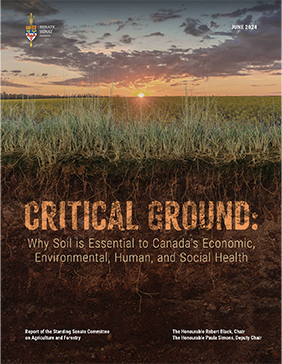
Critical Ground: Why Soil is Essential to Canada’s Economic, Environmental, Human, and Social Health digs deep into the critical role of soil in mitigating climate change, contributing to biodiversity and putting food on tables. The committee is urging the federal government to lead the way in protecting this vital national resource.
Soil is the foundation of Canada’s agriculture system and a key economic driver. In 2022, agricultural and food product exports totalled nearly $93 billion. However, the committee heard that there is a lack of awareness of the value of soil, and that education is crucial to changing perceptions of farming in Canada.
The report highlights concerns from farmers, ranchers, producers and soil health experts about the unprecedented challenges to growing food. Floods, droughts, wildfires and the loss of farmland are among the many causes of soil degradation across the country.
The committee learned of many soil management practices that can help maintain soil health, but there is no “one-size-fits-all approach,” as soil and climate vary across the country. It is also difficult to analyze soil health data because governments, academic institutions, organizations and industry groups do not have a common means of gathering and sharing this information. The committee is recommending long-term funding for soil mapping and data aggregation across the country.
The report makes 25 recommendations to the federal government to work with the Canadian agricultural and forestry sectors, as well as municipal, provincial, territorial and Indigenous governments, to tackle soil degradation and preservation aggressively. The committee strongly believes that soil must be a national policy priority to help fight climate change and feed future generations.
Quick Facts
- The Senate Committee on Agriculture and Forestry heard from 153 witnesses and received over 60 written briefs and supporting documents from soil science researchers, agronomists, farmers, ranchers, foresters, environmental organizations, agri-businesses, industry groups and federal, provincial and territorial governments.
- In 2022, primary agriculture farms covered 62.2 million hectares, or 6.2% of Canada’s total land and generated $36.3 billion of GDP.
- Soil can absorb and store carbon, provide protection from flooding and drought, purify water and provide habitat for hundreds of organisms. Healthy soils produce food for Canadians and the world, and will help support Canada’s net-zero emissions targets by 2030 and 2050.
- Soil health is a global concern. The Food and Agriculture Organization of the United Nations estimates that 33% of the world’s soil is already degraded and over 90% could become degraded by 2050.
Quotes
“Soil is often overlooked, yet it’s essential to all life. It grows our food and purifies our air and water. We must act now to preserve this valuable national resource, which is increasingly susceptible to climate change, floods, droughts, wildfires and the loss of farmlands. Canadian soil was at risk 40 years ago when the Senate released its first report on soil health. We don’t have another 40 years.”
- Senator Rob Black, Chair of the committee
“Healthy soil doesn’t just grow better crops and trees. Regenerative ranching and farming practices can moderate climate change, by sequestering more carbon in the soil itself. And carbon-rich soil is better able to withstand drought and flood. Today, we need ranchers, farmers and environmentalists to see themselves as partners in the fight against global warming, soil loss and soil pollution.”
- Senator Paula Simons, Deputy Chair of the committee
“Soil degradation threatens our food security and endangers the livelihoods of millions of people, including the agriculture producers and foresters who are on the frontlines. The federal government must act now to cultivate healthy soil for future generations.”
- Senator Victor Oh, Member of the Subcommittee on Agenda and Procedure
“During our study we learned that Indigenous peoples have been left out of soil science and agricultural education, and that Indigenous farmers still face barriers when trying to access funding programs. It’s crucial that we close these gaps and incorporate Indigenous knowledge into our soil health practices.”
- Senator Marty Klyne, Member of the Subcommittee on Agenda and Procedure
Associated Links
- Read the report: Critical Ground: Why Soil is Essential to Canada’s Economic, Environmental, Human, and Social Health.
- Follow the committee on social media using the hashtag #AGFO.
- Subscribe to email alerts for Senate committees.
- Sign up for the Senate eNewsletter.
For more information:
Ben Silverman
Communications Officer | Senate of Canada
343-574-4950 | Ben.Silverman@sen.parl.gc.ca
Multimedia

Members of the Senate Committee on Agriculture and Forestry present their latest report on Canadian soil health.
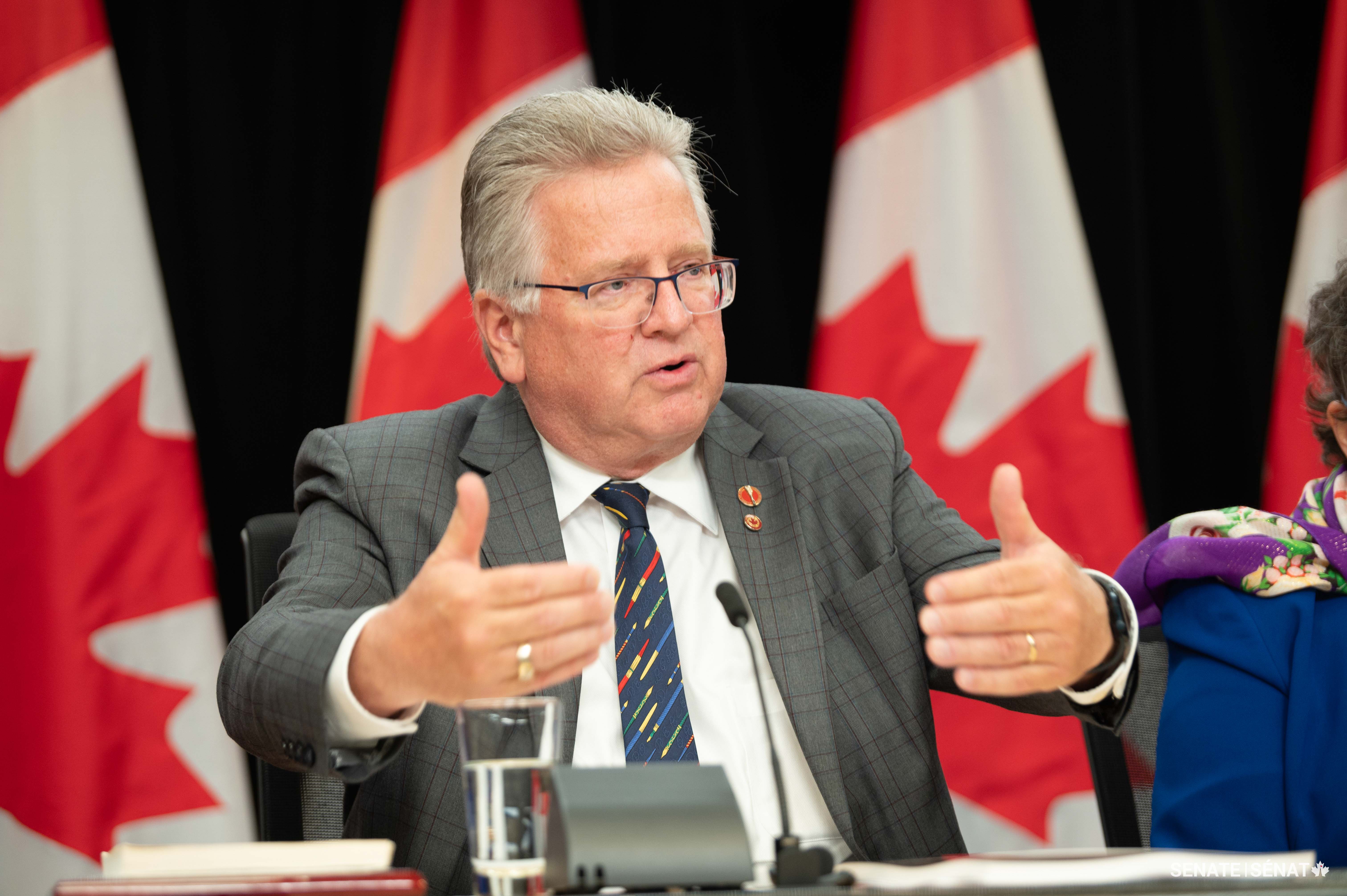
At a press conference unveiling a new report by the Senate Committee on Agriculture and Forestry, committee chair Senator Robert Black discusses soil health in Canada.
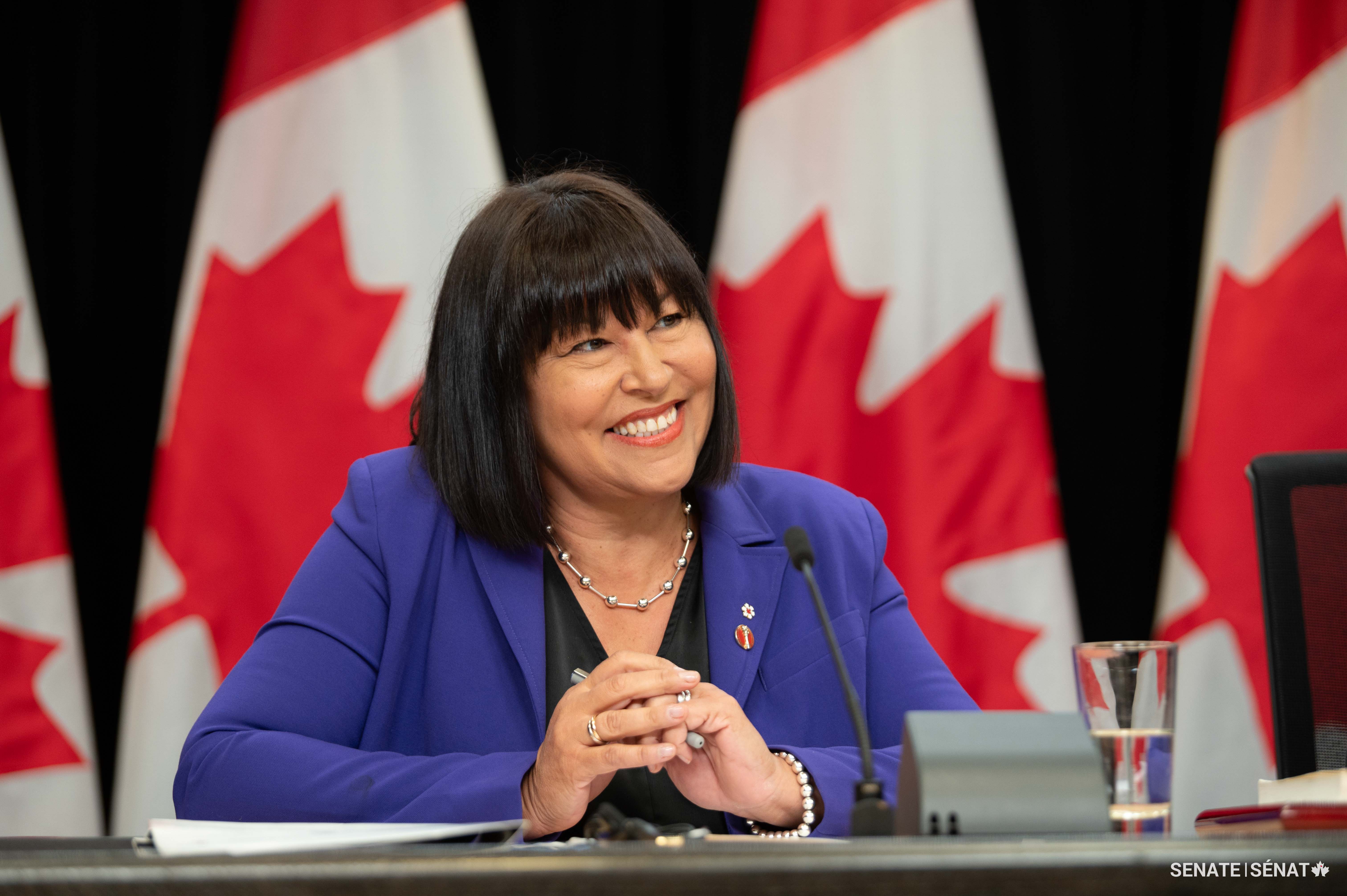
Senator Chantal Petitclerc, member of the Senate Committee on Agriculture and Forestry, answers journalists’ questions during a press conference to present its latest report on Canadian soil health.

Senator Paula Simons, Deputy Chair of the Senate committee on Agriculture and Forestry, discusses the committee’s report on Canadian soil health during a press conference.
Senators who participated in this study

Robert Black
CSG - Ontario

Paula Simons
ISG - Alberta

Sharon Burey
CSG - Ontario

Brent Cotter
ISG - Saskatchewan

Pierre J. Dalphond
ISG - Quebec (De Lorimier)

Mobina S. B. Jaffer
ISG - British Columbia

Marty Klyne
PSG - Saskatchewan

John M. McNair
ISG - New Brunswick

Victor Oh
C - Ontario (Mississauga)

Chantal Petitclerc
ISG - Quebec (Grandville)

Donald Neil Plett
C - Manitoba (Landmark)
Ex-officio members of the committee: The Honourable Senator Gold and/or the Honourable Senator LaBoucane-Benson, The Honourable Senator Plett and/or the Honourable Senator Martin, The Honourable Senator Saint-Germain and/or the Honourable Senator Clement, The Honourable Senator Tannas and/or the Honourable Senator Patterson, The Honourable Senator Dalphond and/or the Honourable Senator White
Other Senators who have participated in the study: The Honourable David M. Arnot, The Honourable Michèle Audette, The Honourable Diane Bellemare, The Honourable Andrew Cardozo, The Honourable Jean-Guy Dagenais, The Honourable Colin Deacon (Nova Scotia), The Honourable Marty Deacon (Ontario), The Honourable Pat Duncan, The Honourable Renée Dupuis (retired), The Honourable Margo Greenwood, The Honourable Sabi Marwah (retired), The Honourable Marnie McBean, The Honourable Percy Mockler (retired), The Honourable Mary Robinson, The Honourable Larry W. Smith, The Honourable Karen Sorenson, The Honourable Pamela Wallin, The Honourable David M. Wells, The Honourable Howard Wetston (retired), The Honourable Yuen Pau Woo