
Report
Recommendations
RECOMMENDATION 1
That the Clerk of the Privy Council and federal public servants at all levels act as leaders in confronting anti-Black racism, as outlined in the Clerk of the Privy Council’s Call to Action on Anti-Racism, Equity, and Inclusion in the Federal Public Service, that measures to promote diversity, equity and inclusion be included as a performance measurement across all federal departments and agencies, and that federal public servants analyze available data to make evidence-based improvements.
RECOMMENDATION 2
That all federal departments and agencies increase mandatory anti-racism training for their employees, with the content of such training tailored to employees’ specific roles and responsibilities.
RECOMMENDATION 3
That the Department of Canadian Heritage urgently complete its promised National Action Plan on Combatting Hate and updated Anti-Racism Strategy.
RECOMMENDATION 4
That the Department of Canadian Heritage develop educational items on Anti-Black racism and other forms of systemic discrimination that can be incorporated into classroom and professional development activities for various age groups and
stakeholders.
RECOMMENDATION 5
That a parliamentary committee undertake a study about anti-Black racism in the public service as soon as possible.
RECOMMENDATION 6
That the Canadian Human Rights Commission consider providing immediate legal and psychological support for complainants and their families.
RECOMMENDATION 7
That the Government of Canada take steps to ensure that victims of discrimination have access to a human rights system that is fair, effective and timely.
RECOMMENDATION 8
That the Government of Canada appoint a Black Equity Commissioner as an independent officer of Parliament.
RECOMMENDATION 9
That the Government of Canada commission an independent review of the conditions of CHRC employees from diverse backgrounds past and present, with particular focus on the experience of Black, racialized and Indigenous employees, and that the report be published by a specified date.
RECOMMENDATION 10
That the Government of Canada introduce legislation to modernize the Employment Equity Act, including by amending the designated groups under the Act to better reflect intersectionality and to specifically include Black and other equity deserving groups.
RECOMMENDATION 11
That the Department of Justice undertake a comprehensive review of the Canadian Human Rights Act that includes a comparative study of human rights systems in various Canadian and international jurisdictions, and propose amendments to improve access to justice for marginalized groups, including by considering changes to:
- shift to a direct access model;
- increase the compensation ceiling for the pain and suffering of victims from the current cap of $20,000;
- strengthen protections against retaliation by employers;
- remove the requirement for legal presence in Canada as a prerequisite for filing a complaint; and
- ensure that commissioners include individuals from equity deserving groups.

Ottawa – The federal government should appoint a Black equity commissioner, modernize human rights and employment equity laws, and hire an independent expert to review workplace conditions of Black, Indigenous and racialized employees at Canada’s human rights watchdog, a Senate committee said in a report released Monday.
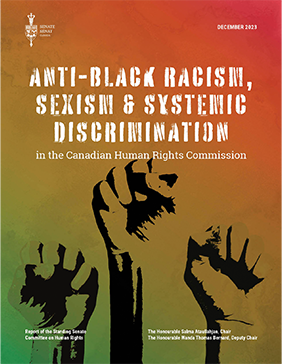
The report reveals the findings of the Senate Committee on Human Rights’ study on anti-Black racism, sexism and systemic discrimination in the Canadian Human Rights Commission (CHRC). The committee’s study was prompted by a set of grievances filed against the independent commission about its treatment of Black and racialized employees, which raised serious concerns about its decision-making processes when dealing with human rights complaints.
Witnesses described a toxic culture at the commission and provided specific evidence of systemic discrimination. Their testimony, as well as written submissions to the committee, demonstrated a crisis of confidence in the federal human rights system and underscored that no institution is immune from systemic racism.
The report makes 11 recommendations to immediately address the problems at CHRC and to meaningfully confront the broader issue of systemic racism across the federal public service. The committee welcomes CHRC’s recent efforts to address its discriminatory internal culture and practices but heard the commission must do more to regain the trust of its Black and racialized employees — and the communities that rely upon it for justice.
The committee wishes to thank all the witnesses who appeared for its study and the many individuals who submitted written materials. Their courage in sharing their stories publicly is deeply appreciated and an important step toward critical change.
Quick Facts
- The Canadian Human Rights Commission (CHRC) is the first point of contact for registering a human rights complaint at the federal level. It also has a broader mandate to promote human rights through research, policy development and employment equity audits of employers under federal jurisdiction.
- The Public Service Alliance of Canada, the Association of Justice Counsel and the Canadian Association of Professional Employees filed grievances against the CHRC. In March 2023, the Treasury Board of Canada Secretariat confirmed the CHRC breached the “No Discrimination” clauses of three collective agreements.
- The committee began its study in May 2023. It heard from 24 witnesses and received many written briefs.
Quotes
“Everyone who has experienced discrimination deserves a reliable path to justice. Anti-Black racism and other forms of systemic discrimination are unacceptable in any institution. To prevent further harm, the federal government must act quickly to ensure victims of discrimination have access to a human rights system that is fair, effective and timely. The Canadian Human Rights Commission fell short of that standard.”
- Senator Salma Ataullahjan, Chair of the committee
“Canada’s human rights watchdog discriminated against populations that it’s responsible for protecting. Workplace discrimination can have catastrophic, profound and lasting effects on employees and their families. The appointment of a Black equity commissioner, among other crucial steps, would go a long way toward confronting and eradicating institutional and systemic racism in federal workplaces.”
- Senator Wanda Thomas Bernard, Deputy Chair of the committee
“The committee heard that designated equity groups in the Employment Equity Act are outdated and overbroad, which makes it more difficult to address discrimination against equity deserving groups that aren’t explicitly set out in the act. The federal government must address this by amending the act to explicitly include Black and other equity deserving groups.”
- Senator Nancy J. Hartling, member of the Subcommittee on Agenda and Procedure
Associated Links
- Read the report: Anti-Black Racism, Sexism and Systemic Discrimination in the Canada Human Rights Commission.
- Follow the committee on social media using the hashtag #RIDR.
- Subscribe to email alerts for Senate committees.
- Sign up for the Senate eNewsletter.
For more information:
Amely Coulombe
Communications Officer | Senate of Canada
343-575-7553 | amely.coulombe@sen.parl.gc.ca
Senators who participated in this study

Salma Ataullahjan
C - Ontario (Toronto)

Wanda Thomas Bernard
PSG - Nova Scotia (East Preston)

Nancy J. Hartling
ISG - New Brunswick

David M. Arnot
ISG - Saskatchewan

Amina Gerba
PSG - Quebec (Rigaud)

Mobina S. B. Jaffer
ISG - British Columbia

Fabian Manning
C - Newfoundland and Labrador

Ratna Omidvar
ISG - Ontario
Ex-officio members of the committee: The Honourable Senator Marc Gold, P.C., or Patti LaBoucane-Benson; The Honourable Senator Donald Plett or Yonah Martin
Other Senators who have participated in the study: The Honourable Senator Kim Pate