
Report
Executive Summary
In recent years, telecommunications and electricity companies have experienced an increase in copper theft and vandalism. These crimes cause critical infrastructure service outages and can have serious consequences for public safety. Businesses, municipalities and various organizations experience financial losses due to copper theft.
In light of the evidence heard, the Standing Senate Committee on Transport and Communications (the committee) recommends amending the Criminal Code to impose harsher penalties for crimes involving critical infrastructure, such as copper theft. The committee believes that the federal government could encourage provincial and territorial governments to review their regulations. Furthermore, the committee believes that better sharing of information on metal theft among law enforcement agencies would ensure better coordination of investigations into these offences.
Recommendations
Recommendation 1
That the Government of Canada amend the Criminal Code to impose more serious penalties for metal theft that causes damage to critical or essential infrastructure.[1]
Recommendation 2
That the Government of Canada encourage the provincial and territorial governments to regulate the sale of scrap metal, including by keeping a record of transactions and the origin of the metal.
Recommendation 3
That the Government of Canada create a task force on metal theft to promote information sharing among law enforcement agencies.
[1] Since this study was conducted, the Government of Canada introduced in October 2025 Bill C-14, An Act to amend the Criminal Code, the Youth Criminal Justice Act and the National Defence Act (bail and sentencing) (Bill C-14). Clause 10 adds subsection 334.1(2) to the Criminal Code, creating an “aggravating circumstance” when an offence interferes with the access or functioning of an essential infrastructure or causes it to be unsafe. A Justice Canada backgrounder states that copper theft is an offence interfering with essential infrastructure.
Ottawa – Concerned by the troubling surge in copper thefts in Canada’s telecommunications and electricity industries, the Senate Committee on Transport and Communications is calling on the federal government to immediately address this threat to critical infrastructure and public safety.
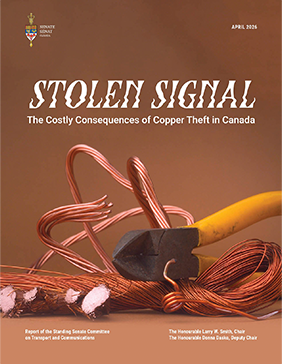
The committee’s report, Stolen Signal: The Costly Consequences of Copper Theft in Canada, released April 14, 2026, describes how copper thefts cause major service outages, sometimes leaving communities without telephone, internet or wireless services for extended periods. These crimes can disrupt emergency services, hospitals and airports, and create financial burdens for businesses, municipalities and organizations.
The report recommends amending the Criminal Code to impose harsher penalties for metal theft crimes that damage critical infrastructure. It also calls on the federal government to encourage provincial and territorial governments to regulate the sale of scrap metal and promote information sharing about metal theft between law enforcement agencies.
The Senate is currently examining Bill C-14, the Bail and Sentencing Reform Act. The bill could lead to higher sentences for people committing certain crimes that also involve interfering with the functioning of essential infrastructure. Should the bill be adopted, the fact that the offender had interfered with essential infrastructure while committing theft, robbery or mischief would be considered an aggravating circumstance for the purpose of sentencing. While the committee acknowledges that this is an important step, the federal government can do more to address copper theft.
Quick Facts
- Copper is malleable, conductive and resistant to corrosion. For these reasons, it is widely used across various industrial sectors, such as electronics, construction, transportation and telecommunications.
- In February 2026, the price of copper was approximately US$13,000 a tonne.
- The Canadian Telecommunications Association estimated a 200% increase in theft and vandalism incidents between 2022 and 2024.
- More than 1,300 incidents of copper theft have been recorded by Canadian carriers since January 2022, according to Innovation, Science and Economic Development Canada.
- Under section 334 of the Criminal Code, an offender could serve up to 10 years in prison for stealing more than $5,000 worth of copper wire, or up to two years if the total amount stolen is worth less.
Quotes
“Copper thefts are not petty crimes that only affect telecommunications and electricity companies. They are dangerous criminal acts that pose serious public safety threats to those who rely on the critical services that these companies provide.”
- Senator Larry W. Smith, Chair of the Committee
“Entire communities have been left isolated and cut off from emergency services — all because of copper thefts. The federal government must urgently act to curb this alarming problem before it gets worse.”
- Senator Donna Dasko, Deputy Chair of the Committee
Associated Links
- Read the report: Stolen Signal: The Costly Consequences of Copper Theft in Canada.
- Follow the committee on social media using the hashtag #TRCM.
- Subscribe to email alerts for Senate committees.
- Sign up for the Senate eNewsletter.
For more information:
Sabryna Lemieux
Communications Officer | Senate of Canada
343-598-3547 | Sabryna.Lemieux@sen.parl.gc.ca
Senators who participated in this study

Larry W. Smith
C - Quebec (Saurel)

Donna Dasko
ISG - Ontario

Dawn Arnold
ISG - New Brunswick

Réjean Aucoin
CSG - Nova Scotia

René Cormier
ISG - New Brunswick

Todd Lewis
CSG - Saskatchewan

Fabian Manning
C - Newfoundland and Labrador

Julie Miville-Dechêne
PSG - Quebec (Inkerman)

Farah Mohamed
ISG - Ontario

Jim Quinn
C - New Brunswick

Paula Simons
ISG - Alberta

Duncan Wilson
PSG - British Columbia
Ex officio members of the committee: the Honourable Pierre Moreau, P.C., or the Honourable Patti LaBoucane-Benson, the Honourable Leo Housakos or the Honourable Yonah Martin, the Honourable Raymonde Saint-Germain or the Honourable Bernadette Clement (until December 31, 2025), the Honourable Lucie Moncion or the Honourable Joan Kingston (since January 1, 2026), the Honourable Scott Tannas or the Honourable Rebecca Patterson (until January 4, 2026), the Honourable Flordeliz (Gigi) Osler or the Honourable Robert Black (since January 5, 2026), the Honourable Brian Francis or the Honourable Judy A. White
Other senators who have participated in the study: The Honourable Andrew Cardozo, the Honourable Bernadette Clement, the Honourable Rodger Cuzner, the Honourable Clément Gignac, the Honourable Katherine Hay, the Honourable Leo Housakos and the Honourable Suze Youance