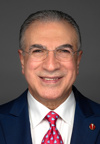
SENATORS’ STATEMENTS — The Honourable Mohammad Al Zaibak
Expression of Thanks
June 11, 2026
Honourable senators, thank you all for the kindness of your tributes this afternoon. I will carry your generous words with me always. To tell you the truth, I’m quite overwhelmed by your warmth, kindness and generosity. Thank you all.
[Editor’s Note: Senator Al Zaibak spoke in Arabic.]
Honourable senators and dear friends, I have risen in this chamber many times in the past two years. I confess that none of those interventions were as difficult to write as this one because none of them asked me to say goodbye.
Let me begin, as I began my maiden speech in this place, with the only emotion adequate to the moment: a deep and profound humility, and with it, a gratitude too large for any one sentence to hold.
When I was sworn in, on February 6, 2024, I held the Canadian Charter of Rights and Freedoms in my hand as I made my solemn oath.
Within weeks, this chamber was deep in debate on Bill C-62 on medical assistance in dying, one of the most soul-searching debates a parliament can hold.
The intensity of the arguments for and against by admired, skilful debaters in this chamber, especially senators with remarkable medical credentials — among them Doctors Mohamed Ravalia, Rosemary Moodie, Stan Kutcher, Gigi Osler and Sharon Burey — made me feel as if I were sitting in a class at the finest case method university. It was a living case study in intellect, independence and genuine sober second thought.
Now, in my final days here, this chamber has been seized with Bill C-9, the combatting hate act, and Bill C-11 on modernizing military justice — debates that are every bit as profound. Those two sets of debates are the bookends of my service, and between them, throughout that entire time, I felt that I was attending the best school of my life. So the word I reach for today is not “retirement.” It is “graduation.”
Before I go further, let me turn to the gallery — to the people without whom I would have nothing to be grateful for. Najla is my wife and life partner of more than 45 years and my closest friend. Every success ever credited to me belongs in equal measure to you.
You stood beside me when we left our homeland. You stood beside me as we built a life in this country. You stood beside me, at least in spirit, through every long day and late night of these past two years.
Here you are, still cheering for me, as another chapter comes to a close. I hope you know that whatever good I have done in my life, I had you and our family — and my late mother and father — in mind all the time. Thank you, my love.
To our son, Omar, and our daughters, Leen and Jana, watching the three of you become the people you are has been the greatest privilege of my life.
To our sons-in-law, Michael and Khaled, thank you for the love you bring to our family. To my sister, Mona, and my niece, Lara, thank you for being here on behalf of our extended family, and thank you for your continued love.
To our grandsons, Dean and Jude, you are both far too young to have any interest in a Senate speech, and I do not blame you one bit. However, one day, you might read these words, and when you do, I hope you remember that your grandfather believed in service, humanity, community and country and that public life is not about titles but about responsibility and giving back. And I hope you remember that of all the titles your grandfather was ever given, the one he treasured the most was “Grandpa,” or Jeddo in Arabic.
I love you.
Honourable colleagues, I was born and raised in the heart of Damascus, the oldest continuously inhabited city on Earth, in the neighbourhood of the ancient street the Bible calls Straight. There, as a child and young man, I was inspired and taught by my parents to love and respect others. They taught me a principle that has guided my entire life. They said, “E’mel khair wa irmi bil bahr,” which literally translates into “Make good deeds and cast them into the sea.” In other words: Give without condition or expectation of return, and the universe takes care of the rest. The rewards come in unexpected ways.
I carried that wisdom with me to Canada, and here is what happened: I fell in love with this country, and to my great delight and joy, Canada loved me back. It let a young immigrant entrepreneur build a business, raise a family and, in time, take a seat in this chamber as the first senator of Syrian-Arab heritage since Confederation in 1867.
It is a responsibility that I hope I have carried for the Canadian Arab community, for the Canadian Muslim community and for my province. It is one that I hope I am the first of many to hold — for that community has a great deal more to offer this place and this country.
For I have learned here that being Canadian is defined not by where we were born but by what we are willing to build together.
The wider Arab world — 22 states and some 500 million people, from the Arabian Gulf through North Africa to the shores of the Atlantic — is a natural strategic partner for the Canada I love in terms of trade, investment and friendship.
Honourable colleagues, I will never forget the day I took office. Senator Peter Boehm sponsored me into this chamber; former senator Marc Gold welcomed me; the Usher of the Black Rod, Greg Peters, guided me with grace; the then-interim Clerk, Gerry Lafrenière, administered my oath; and the Speaker, Senator Raymonde Gagné, received me.
It was quite a memorable day.
I was sworn in that same day alongside Senator Paulette Senior, Senator Marnie McBean, my old friend Senator Toni Varone and my seatmate-to-be Senator Mary Robinson, with Senator Manuelle Oudar joining us two days later.
I was honoured by the presence of the Right Honourable Joe Clark and the Honourable Charles Sousa, who is also here today. Thank you, Charles, for being here.
I was also honoured by the presence of members of the Canadian Arab community.
And I was welcomed warmly by the leaders of every group in this chamber. I remember Senators Jane Cordy, Marc Gold, Scott Tannas, Yonah Martin and Raymonde Saint-Germain. Everything you said made me feel so welcome. You made me feel at home, actually.
Small kindnesses stay with me: There was Senator Michèle Audette with a herbal-scented candle I will not forget. And Senators Rob Black, Colin Deacon, Salma Ataullahjan, Amina Gerba, Mohamed Ravalia, Rebecca Patterson and others were the first ones to shake my hand and give me big hugs. Thank you. I remember well the familiar faces of my old friends Senators Ratna Omidvar and Mary Coyle, as well as the helpful offers from Senators Woo and McPhedran. Thank you all. It helped me a lot, easing me into this amazing place.
A few weeks later, Senator Andrew Cardozo looked out for me during an unpleasant incident, but that is a story for another day.
Senator Pierre Dalphond gave me a five-hour crash course on the constitutional essence of this place, and Senator Raymonde Saint-Germain befriended me.
These are friendships I count among this chamber’s true gifts.
Dear colleagues, I had considered myself knowledgeable about the Senate before I arrived here, only to discover that whatever I knew then was merely the tip of the iceberg. The orientation sessions cured me of that vanity within a week.
My one complaint about my time here is that there was so little of it. My one wish is that I were a few years younger so that I might give you and this great chamber more. If my brief chapter has a single theme, it is this: I am a builder of bridges, physically, culturally and metaphorically.
I spent my working life laying spans between things that stood apart. I structured an international joint venture that built the Bahrain-Saudi Arabia King Fahd Causeway before coming to Canada. I co-founded the public-private partnership that my colleagues referred to earlier, which carried Ontario’s land registry into the digital age. I co-founded non-profits that built cultural bridges among our communities through art, music and creativity. I came here to do the same.
On the Foreign Affairs Committee, and as deputy chair of the National Security and Defence Committee, I worked with my honourable colleagues to strengthen the bridges between Canada and a turbulent world.
Through our parliamentary friendship groups, I held to a simple faith: that parliamentary diplomacy and dialogue between people are never wasted. The security of our country — I came to see — is never a partisan question; it is a national responsibility and a bridge we build together or not at all.
What a time it has been. In two short years, I watched this Parliament prorogued and then dissolved, an election fought and a new government formed under Prime Minister Mark Carney. I sat in this chamber with you when His Majesty King Charles III came in person to open Parliament and deliver the Speech from the Throne, the first reigning monarch to do so on Canadian soil since 1977, nearly half a century ago.
Only this week, in this very chamber, we welcomed our new Governor General, Her Excellency the Right Honourable Louise Arbour, who once prosecuted the gravest crimes on earth in the name of human rights.
Beyond our borders, the return of an administration in Washington tested this country’s sovereignty, its economy and its resolve, and reminded Canadians who we are.
The wider world also paused to remember important milestones. This past year marked 80 years since the founding of the United Nations, born from the ashes of the Second World War. I have always believed Canada belongs inside such institutions, not on the sidelines, a middle power that leads through diplomacy, partnerships and principles.
That brings me to the work I hold dearest and to the land of my birth. This past April, Syria marked 80 years of independence. This chamber will appreciate the coincidence that my mother and father were married that very year. I came along five years later, the first of nine children. I will let you do the arithmetic.
I am told some of you, with great kindness, drew up a petition — supported by a sworn affidavit, no less — alleging the registrar had erred and that I am not yet 75. I was moved by the conspiracy, and I appreciated the creative thinking, but the Constitution, like my late mother, is not easily argued with.
Honourable colleagues, in 2024, the oppressive regime that had darkened Syria for half a century fell at last, and from the safety of this chamber, I have watched the land of my birth begin to turn a page I had feared it never would. Years before, when war drove millions of Syrians from their homes, a group of us in Toronto helped create Lifeline Syria. I say “we,” and I mean it, for I was, at most, a catalyst and a participant.
The heavy lifting was done by remarkable people: former senator Ratna Omidvar, Lifeline Syria’s co-founder and first chair; John Sewell, former Toronto mayor; Sheldon Levy, former president of Toronto Metropolitan University; my friend Frank Palmay, a corporate lawyer who had himself come to Canada with his parents as a Hungarian refugee; and many others, with the support of former Toronto mayor John Tory, the Government of Ontario under Premier Kathleen Wynne and the Honourable Charles Sousa, who is sitting with us today as the Minister of Finance. A former mayor, a university president and a lawyer who had once been a refugee himself: Canadians from every walk of life. That was rather the point.
However, the truest work of all was done by thousands of ordinary Canadians whose names will never be known. They opened their homes to strangers arriving with nothing but hope.
Lifeline Syria has long since completed its mandate, and it is quiet now, as it should be. It was made for a season, and it met that season. It was made for a reason, and it met that reason. Then it stepped aside. But the families it helped welcome are Canadians now, raising children and building this country.
My parents taught me to do good, cast it into the sea and expect nothing back. Lifeline Syria was that lesson made real. We cast what good we could upon the water, and the sea has returned it a hundredfold, as reflected in the faces of new Canadians who now call this place home. If I have any proof that the things I am telling you today are true, it is them.
Dear colleagues, not every milestone was an affair of state. Some were the quiet joys of a family. Just six weeks after I was sworn in, we welcomed our second grandson, Jude, who could not be with us today. This past summer, our youngest daughter, Jana, was married.
There were other proud moments in this chamber too. On April 3, 2025, in a formal ceremony administered by the Usher of the Black Rod and his office, I had the honour of presenting King Charles III’s Coronation Medal to 20 deserving fellow Canadians, Arab and non-Arab, Muslim, Christian, Jewish and of no faith at all. The ceremony opened with our national anthem sung in English, French and Arabic for the first time beneath this roof. If you want to know what I believe Canada is, it is this chamber on that morning. It was the bridge made visible.
One year ago today, on June 11, 2025, I rose in this place to reintroduce the Arab Heritage Month Bill.
My colleagues, more history than many see in a decade.
To the bill’s sponsor in the other place, my friend the Honourable Ahmed Hussen, thank you for everything that you are doing to take the bill to the finish line, and thank you for your incredible public service. I thank my colleagues in the Senate for helping to push this bill through.
Dear colleagues, let me say plainly what every one of you knows: I came late and I leave soon. The Constitution sends me home at 75, but a short chapter can still be a full one.
Let me be transparent with you, as this chamber expects us all to be. I arrived a builder, impatient by nature and temperament, with an agenda full of bills and initiatives I meant to carry through. Much of it remains undone — files I could not close and good work I am out of time to finish. I will not pretend it does not sting. It does.
To labour as hard as you know how and still leave the table half cleared is the quiet grief of a short tenure, and I feel it keenly today.
So I will do the one thing still in my capacity. I will set my unfinished work — the policy briefs and studies I commissioned — in your hands, trusting that more patient and longer-serving hands than mine will carry it across.
Dear colleagues, if I may leave one conviction behind, let it be this: Guard the independence of this place. I arrived a believer in the reformed, non-partisan Senate, and I leave more convinced than ever.
I have seen with my own eyes how the move to a non-partisan, merit-based chamber has lifted the quality of our debate and the trust of the public we serve. This is not only my opinion. This spring, as we learned two days ago from our colleague Senator Dasko, a Nanos poll commissioned by her found that, for the first time in a decade, Canadians’ positive impression of this chamber outweighs the negative.
I will permit myself one immodest thought. Perhaps our cohort and those of us who arrived in 2024 and after have been good for the brand and helped tip the scale.
Independence is not a possession; it is a practice renewed in every debate and every vote. It is the most important bridge of all, the one between the people of this country and the sober second thought they are owed. I trust you will tend it well.
My thanks will not fit in a list, so forgive me for the names I must leave out.
First, thank you to those who entrusted me with this seat: the Independent Advisory Board for Senate Appointments, the Right Honourable Justin Trudeau and former Governor General Mary Simon.
Thank you to our Speaker, the Honourable Senator Gagné, for her fairness and patience; my colleagues in the Canadian Senators Group and our leaders, Senators Gigi Osler and Scott Tannas, who made me feel at home from my earliest days; and the chairs of committees I served under — Senators Peter Boehm, Marty Deacon, Hassan Yussuff and Tony Dean — and their clerks, Ericka Paajanen and Chantal Lalonde. Thank you for your support and help.
To my seatmate, and now our group chair, Mary Robinson, thank you for your friendship and support.
Thank you to friends in every corner of this chamber and to the former senators whose friendship outlasted their tenure: Jane Cordy, Ratna Omidvar, Stan Kutcher and Brent Cotter.
And thank you to those who truly keep this place running: the Speaker pro tempore, Senator René Cormier; the table clerks and our pages; the teams in administration, finance, protective services, communications, human resources, audiovisual, interpretation, legislative and legal services; and the researchers at the Library of Parliament. You turn the invisible machinery of our democracy, and you have my lasting gratitude.
Now to my Director of Parliamentary Affairs, Shiraz Keushgerian, I told you I did not want a “yes man.” You took that to heart, to my benefit, and you were the better adviser for it. Thank you.
To my office team, past and present — Tina Emiri, Sofiia, Garance, Sara Alby and Venus Ramos — thank you for your care, devotion and support.
And, Sofiia, happy birthday today.
Finally, in absentia, to the steady anchor of my Toronto office for more than a decade, my executive assistant, Anne Drakes, who, quietly and faithfully, has kept everything moving for over 10 years, thank you for being the silent engine of my office. I truly could not have done this without you. I’m sorry that you are not able to be with us today.
Honourable senators, I’m leaving the Senate but I’m not leaving the work, for I have never been much good at sitting still. I plan to go on building bridges in my community, in my country, wherever a span is needed.
Honourable colleagues, when I gave my first speech in this space, I said that we are better when we build one another up, that welcoming the newcomer is wiser than walling them out, that a life of service is richer than a life of self. I believed it then. I believe it more deeply now.
And at a moment when others beyond our borders are busy building walls, I can wish you nothing better than this: Build bridges, my friends, not walls. It is the conviction I leave in your keeping, and it has never once failed me.
Honourable colleagues, that someone born and raised in Damascus, once a beacon of science, literature and civilization and, for thousands of years, a great trading and cultural centre of the ancient world, can become the first Syrian-born Arab Canadian senator in the Parliament of one of the most advanced democracies in the modern world is an incredible privilege and is a testament to the diversity, inclusion and civility of our beloved Canada.
Honourable colleagues, it has been the honour of my life to sit among you. I will miss you. But this is not “goodbye”; it is “see you around,” my friends.
Thank you. Meegwetch, Shukran.