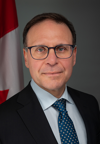
Vital Role of Physical Activity and Sport
Inquiry--Debate
March 10, 2026
Honourable senators, I am very pleased to speak to this inquiry on the vital role of sport and physical activity.
I would first like to say thank you to the colleagues who have already spoken on this inquiry. I want to take this opportunity to invite colleagues to join in sharing their experience through sport and physical activity.
This is not a marginal issue. This is not a niche issue. It is a question that touches on health, inclusion, dignity and the kind of country we want to build.
Sport is a simple word, but it encompasses a huge reality. It means sport for everyone, sport for young people, sport for health and high-performance sport. In all its forms, sport is a catalyst for change in people’s lives. That is true for everyone.
Physical activity and organized sports are not exactly the same thing, but they do share the same foundation. They allow people to inhabit their bodies differently. They improve endurance and strength. They have the power to improve physical health, of course, but also to support mental well-being, social inclusion and personal development. They can reduce isolation and build confidence. They create not only movement, but meaning.
The preliminary report of the Future of Sport in Canada Commission explicitly recognizes sport as an avenue for health and well-being and as a tool that can provide life-changing opportunities for personal growth and social inclusion.
I sincerely believe that this truth is compounded for people with disabilities.
When we compare the journeys of several Olympic and Paralympic athletes, it quickly becomes apparent that their entry into sport is not always the same. Olympic athletes often discover their sport at a very early age. They grow up in a club, a team or an organization. The path is demanding, but it is already laid out. It exists, it is structured and it is well marked.
For many Paralympic athletes, sport comes into their lives in a different way. Sometimes it comes along after an accident, a tragedy, an illness or a breakdown. It is not always the fulfillment of a childhood dream. Sometimes it becomes a way to reconnect with themselves, with their body and with their future.
Allow me to take some time to share my own journey through sport because this is certainly how it happened for me and how it was life-changing. Some of you know this, but I come from a very small town, Saint-Marc-des-Carrières, and this is where I had my accident at the age of 13. It was one of those very plain accidents that still happen too often in rural communities. We were visiting some friends of the family. They had a farm which was abandoned, so the message from the parents was quite clear: We, the kids, were not allowed to go play on that farm. But we were 13, and we had no screens, so we went to play on that farm, which was not the brightest idea of my life.
The big idea was to lift a barn door that was broken and to put some sort of a crate underneath it and turn it into a jumping ramp for a bicycle. Again, not the best idea. But we did that at 13, and with not as much muscle as I had as an athlete, I could not hold the door. The door fell on me, and that is how I became a paraplegic.
You know, it goes fast. Even when you’re very young, there are some things in life that you just sense. I have this memory of being on the ground and unable to move, unable to get up, unable to feel my legs and just sensing that life would never be exactly quite the same and that I would need to adapt very quickly to that new reality.
Then it goes fast. You have the hospital and the rehab centre, and you go back home. I went back home to Saint-Marc-des-Carrières. I left in the spring in an ambulance and came back in a wheelchair to a very small town. One person changed the direction of my life, really, and it was my physical education teacher, Gaston Jacques, who came to me and said, “I’m not too sure what to do with you.”
It wasn’t a time of big conversations on inclusion, equity and diversity. It was more like, “What can I do and how can we figure this out?” He was there and said, “We don’t know what to do, but let’s do something. This is too important not to. Let’s try swimming.”
That’s how sport came into my life — and how it changed my life — because I was not an athlete before my accident. I am not from an athletic family. I had no idea I had that potential, but I trusted someone through sport. I said yes, and for five years we did a lot of swimming.
After five years, I was in the best shape of my life. For someone in a wheelchair, being fit means being self-sufficient and independent. It means being free. It means having the ability to move around, to transfer yourself, as I do when I move from my wheelchair to my chair.
That changed everything.
It gave me independence.
But the deepest effect was not simply physical. It really sent a message to everyone — especially to me — that, even with this accident, even with my living in a wheelchair, my life had not stopped. It was clearly taking a new direction, but somehow, because of sport, I was confident that while I still faced a lot of obstacles, most importantly, there were still a lot of possibilities and opportunities. That is the power of sport. That is the moment when I understood something that has stayed with me ever since: that everyone — every athlete and every person with a disability — always has more potential than limits. For me, sport was part of that potential.
This is so true because, for many children with a disability, sport is not only about movement, but also identity, friendship and being part of something. It is about not always feeling like or being the one kid with a disability, but being there as a teammate, a competitor and just a kid.
I’m thinking about a boy called Milan. I’ve talked to you about him before. He’s my cousin’s son, and he was born with cerebral palsy. Milan is now an awesome teen. He’s from Saint-Marc-des-Carrières too. When he was younger, he had a great community and amazing parents, but opportunities to participate in an adapted sport were obviously few and far between in Saint-Marc-des-Carrières. But then he discovered sledge hockey thanks to Défi sportif AlterGo in Montreal. This organization operates across Quebec. That sport gave him much more than just an activity.
It gave him passion, goals and certainty and took him to the provincial level, but what struck me most was that it gave him a sense of belonging. In his school, in his community, in the village, he is now not known only as the one kid with a difference and a disability: He is known as an athlete. Sport has helped to strengthen his sense of inclusion because it gave others a new way to see him, and it gave him a new way to see himself.
The last time I saw Milan was amazing. I was visiting Saint-Marc with my son, and Milan asked my son to try sledge hockey. They played sledge hockey together, and it was such an amazing image.
It was a very simple moment, but it clearly showed that sport also gives us a way to come together, to unite, to share our passions and to develop a sense of belonging to something greater than yourself.
This is also why athletes matter as role models. My first great role model was Rick Hansen. I was in high school when his tour came to my school, and I was the only one in a wheelchair. They said, “Just go meet him. You are the only one in a wheelchair.” The first thing he told me was, “My God, you need a better wheelchair.” That changed my life. We’re still friends, and I always remind him of that story.
As Senator Clement said, representation and visibility matter. This is not only in a symbolic way but in a very practical one, because role models expand imagination, and imagination changes what young people dare to hope for.
Despite all the progress made in recent decades, equal access to sports and physical activity is still a long way off. Often, the first obstacle is the environment itself. Even if you’re right next to a swimming pool, you may not actually be able to access the water if the facility doesn’t have a ramp, wheelchair, or adapted changing rooms. Even outdoors, a trail that is classified as accessible isn’t necessarily accessible if the surface is unstable, the slope is too steep, or the entry points are less accessible.
Sometimes, I find myself asking a very simple question: If my own child were using a wheelchair, what exactly would I do? Where would I take him after school for sports and practice? We all know that his options would be much more limited than is acceptable. If that question is already difficult to answer in a large city, we can only imagine how much more difficult it becomes in smaller and rural communities, where accessible options may be rare and inconsistent.
Even here, through my work in Ottawa, I see many of my early bird colleagues at the gym in the morning. The gym is in my hotel, but it does not have a hand bike. It has a pool, but there are seven steps I must traverse to get to it. This kind of experience may seem minor from the outside, but when you live it and repeat it time after time, again and again, those small barriers add up. They are frustrating and become, in fact, a system of exclusion.
A major barrier to sport for persons with disabilities is cost. I won’t go into detail, but we are watching our athletes at the games right now. Every time you see a sit ski, think $20,000 to $30,000. Every time you see a wheelchair racer, think $10,000. The costs are more and the funding is less, so you do the math.
When we see difficulty around participation — and representation, as you said, Senator Clement — we must be careful not to confuse exclusion with lack of interest. Very often, people are not on the sidelines because they don’t want to be active; they are on the sidelines because participating has been made too expensive, too complicated and too challenging.
I would like to talk about things that have gotten better. The Canadian Paralympic Committee now has a performance recognition program that awards Paralympic medallists — the ones we’re watching right now — the same amounts of money that Olympic medallists get: $20,000 for a gold medal, $15,000 for a silver medal and $10,000 for a bronze medal. This performance bonus has been in place since 2008 for our Olympic medallists, but only since 2024 for Paralympic medallists. This week’s Paralympic medallists will be the first winter Paralympians to receive this well-deserved recognition. This is a concrete measure. It is also important symbolically because it acknowledges that an athlete is an athlete.
Money alone will not solve everything because there is a deeper barrier, one that is harder to identify because, somehow, it has become a bit normalized. That is ableism. Research highlighted by the University of British Columbia through the work of Andrea Bundon shows that ableism continues to shape Canadian sport at every level, from participation to leadership. When sport is designed around assumptions about what a normal or valid body is, disabled people are too often treated as exceptions to be accommodated later rather than as participants who should be included right from the beginning.
I’d like to conclude quickly, so I will ask my colleagues now if they would allow me to extend my remarks by five minutes.
Is leave granted?
Thank you, senators.
I would like to conclude by sharing an unforgettable experience that came to mind as I was writing this speech.
In 1990, at the Commonwealth Games in Auckland, wheelchair athletics was there for the very first time as a demo event, and that was historic. We were proud and excited to be there. We felt like doors were opening, and yet it became one of the most difficult experiences of my life, really.
We arrived at Auckland. The village was not accessible, so we were housed in a location away from the rest of Team Canada. We did not have the Team Canada jackets and kit. When we arrived at the track, it became clear that the organizers had not even considered the fact that, like any other athletes, we would need access so that we could train before competing. We were told to get physically off the track. It was suggested that the tires would damage the track — that was the excuse — but my coach was stubborn. We stayed there and we came back.
The next morning, there was a sign depicting a wheelchair with a “no entry” cross on it. We had to insist and keep going, but I can tell you that I was in shock, and this was the most difficult exclusionary experience of my life.
I am telling this story today not to dwell on the past, but to show that progress is being made. It is not coming quickly enough, nor is it happening everywhere or for everyone, but there is real progress nonetheless.
So right now let’s watch our athletes at the Paralympic Games. Let’s celebrate what they’re doing — excellence. Let’s cheer for medals. Let’s be proud of them. But let us also aim higher than mere applause. Let us build a Canada where more children, adults and seniors living with disabilities can access the simple, powerful, life-changing experience of movement. That’s because when barriers come down, potential rises, and when inclusion is real, sport becomes more than activity and more than performance. It becomes freedom, it becomes belonging and it becomes dignity in motion. Thank you. Meegwetch.
Honourable senators, I rise briefly on debate regarding this inquiry as well. There is no doubt that this inquiry encompasses some of the most important elements in building a society, of course. Physical activity, sports and athleticism not only build a healthy society and healthy young people but they also teach them how to communicate, how to strive, how to be the best and how to persevere. At the end of the day, the most important things that come out of athleticism and sport are perseverance and challenging young people to be the best they can possibly be. There are no limitations on what people can achieve.
First and foremost, thank you, Senator Petitclerc, for being an inspiration to so many Quebecers and so many Canadians.
Your story is not only inspiring but — as I said — gives hope to every single one of us that we can be the best as long as we persevere. I would like to end on that positive note.