

Here’s what we need from Canada’s next fighter jet: Senator Patterson
Tags
“Not to have an adequate air force in the present state of the world is to compromise the foundations of national freedom and independence.” – Winston Churchill, 1934
Like the changes to the global world order in the 1930s, there have been profound challenges to maintaining the rules-based international order in recent years. Canada needs to be able to assert our security and sovereignty in the increasingly contested air and space domains. As the government undertakes a review of the future fighter jet force for the Royal Canadian Air Force (RCAF), it is essential that we look to the future and not just present needs.
The RCAF needs a new fighter jet that possesses the advanced capabilities essential to detect, deter and — if needed — to defend against adversaries. Canada needs a fighter jet that propels our ability to defend North America, that contributes to our international alliances like NATO and that is commensurate with our allies around the world.
Regardless of the fighter jet selected, the focus should be interoperability within current and future generations of air and space warfare ecosystems. That requires a fighter jet force that has the advanced technology necessary to link and share data, that has sensor fusion across platforms and that possesses the exquisite capabilities necessary for the fifth-generation battle space. The government needs to see the next fighter jet as a stepping stone to future capabilities that have yet to be imagined if Canada is to remain sovereign and secure in this dynamic.
This country is making major investments in new capabilities for the Canadian Armed Forces writ large. It is also looking to build upon and grow a domestic defence industrial base. We cannot afford to invest in ‘good enough.’ Long term, we need to focus on positioning ourselves for the future.
We have an opportunity to upskill the future of our aerospace industry in choosing the next fighter jet. To do this we need to think beyond present needs, examine lessons learned since 1997 and mobilize the experience we have already gained as a reliable international partner. This forward thinking will not only create return on investment in our aerospace industry, but it will also position us to be on the leading edge of future technological advances and investments.
Concepts of a mixed fighter-jet fleet offer an impractical solution in search of a problem. A mixed fighter-jet fleet would burden the RCAF by creating increasingly complex logistical supply chains, infrastructure issues, and maintenance and personnel training challenges. Ultimately, it jeopardizes the planned fighter-jet transition with unnecessary delays. And it endangers interoperability with our key allies, which is required for our security and sovereignty now and into the future.
The current fleet of CF-18 fighter jets must be retired in 2032. Therefore, we need to act fast. Planning is already underway to ensure a smooth transition from old fighter jets to new. The risk of disrupting this plan, either by delayed or changed procurement, will add additional strains on an increasingly weakened Canadian fighter jet capability.
Our allies are already moving forward. Recently the Royal Danish Air Force — a key Nordic ally along NATO’s Northern Flank — committed itself to its future fighter jet force. Any prevarication on our way ahead now runs the risk of increased reliance on our allies to ensure our sovereignty and security. And that includes, through NORAD, the potential that the Americans will provide the majority of air surveillance in our Arctic until we catch up.
Wherever Canada’s future fighter jets take to the skies, we need to be part of the fifth-generation defence and security ecosystem alongside our allies. While investments in defence industry and the procurement of the right fighter jet are essential components of military programming and expenditures, the focus must also be on the serving members of the RCAF. We must remember that those who serve are Canadians. Parliamentarians and government owe it to those Canadians who have decided to put service to this country before themselves. It is our obligation to guarantee that the decisions we make will ensure that they have the right capabilities to do the job and keep them as safe as possible now and into the future.
Senator Rebecca Patterson is a retired rear-admiral and a veteran of the Canadian Armed Forces with 34 years of service. She represents Ontario in the Senate and is a member of the Senate Committee on National Security, Defence and Veterans Affairs.
This article was published in The Hill Times on May 25, 2026.
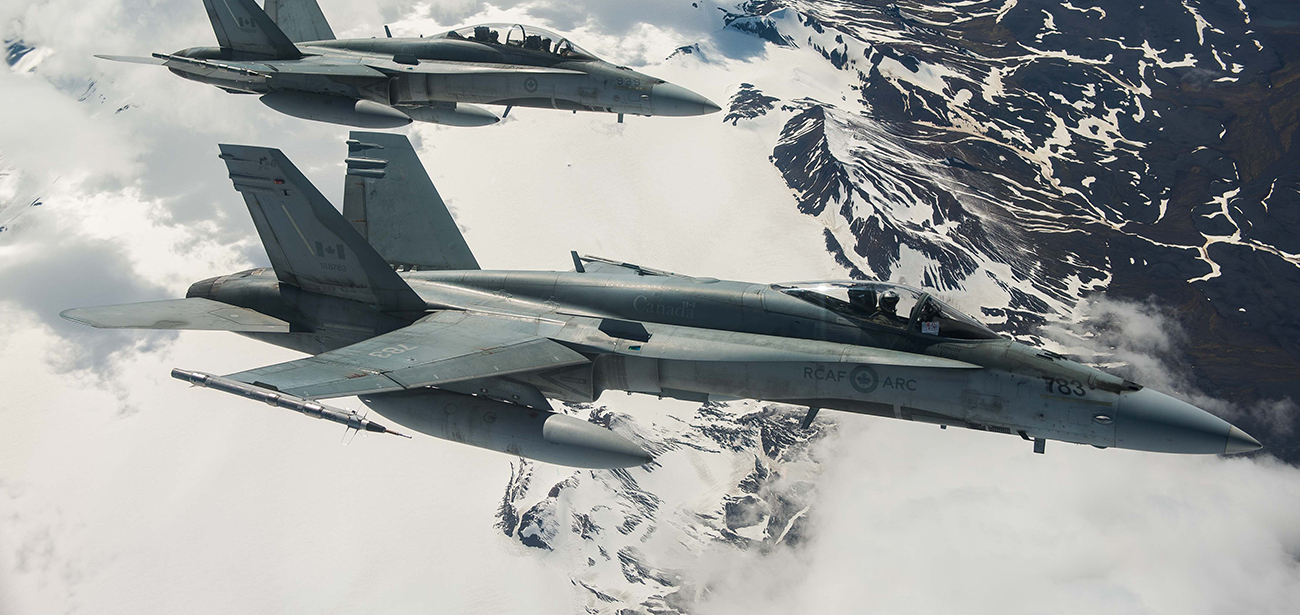
Photo caption: Two Royal Canadian Air Force CF-188 Hornet fighters from the 433 Tactical Fighter Squadron fly over Iceland on May 31, 2017, during an Operation REASSURANCE surveillance mission.
“Not to have an adequate air force in the present state of the world is to compromise the foundations of national freedom and independence.” – Winston Churchill, 1934
Like the changes to the global world order in the 1930s, there have been profound challenges to maintaining the rules-based international order in recent years. Canada needs to be able to assert our security and sovereignty in the increasingly contested air and space domains. As the government undertakes a review of the future fighter jet force for the Royal Canadian Air Force (RCAF), it is essential that we look to the future and not just present needs.
The RCAF needs a new fighter jet that possesses the advanced capabilities essential to detect, deter and — if needed — to defend against adversaries. Canada needs a fighter jet that propels our ability to defend North America, that contributes to our international alliances like NATO and that is commensurate with our allies around the world.
Regardless of the fighter jet selected, the focus should be interoperability within current and future generations of air and space warfare ecosystems. That requires a fighter jet force that has the advanced technology necessary to link and share data, that has sensor fusion across platforms and that possesses the exquisite capabilities necessary for the fifth-generation battle space. The government needs to see the next fighter jet as a stepping stone to future capabilities that have yet to be imagined if Canada is to remain sovereign and secure in this dynamic.
This country is making major investments in new capabilities for the Canadian Armed Forces writ large. It is also looking to build upon and grow a domestic defence industrial base. We cannot afford to invest in ‘good enough.’ Long term, we need to focus on positioning ourselves for the future.
We have an opportunity to upskill the future of our aerospace industry in choosing the next fighter jet. To do this we need to think beyond present needs, examine lessons learned since 1997 and mobilize the experience we have already gained as a reliable international partner. This forward thinking will not only create return on investment in our aerospace industry, but it will also position us to be on the leading edge of future technological advances and investments.
Concepts of a mixed fighter-jet fleet offer an impractical solution in search of a problem. A mixed fighter-jet fleet would burden the RCAF by creating increasingly complex logistical supply chains, infrastructure issues, and maintenance and personnel training challenges. Ultimately, it jeopardizes the planned fighter-jet transition with unnecessary delays. And it endangers interoperability with our key allies, which is required for our security and sovereignty now and into the future.
The current fleet of CF-18 fighter jets must be retired in 2032. Therefore, we need to act fast. Planning is already underway to ensure a smooth transition from old fighter jets to new. The risk of disrupting this plan, either by delayed or changed procurement, will add additional strains on an increasingly weakened Canadian fighter jet capability.
Our allies are already moving forward. Recently the Royal Danish Air Force — a key Nordic ally along NATO’s Northern Flank — committed itself to its future fighter jet force. Any prevarication on our way ahead now runs the risk of increased reliance on our allies to ensure our sovereignty and security. And that includes, through NORAD, the potential that the Americans will provide the majority of air surveillance in our Arctic until we catch up.
Wherever Canada’s future fighter jets take to the skies, we need to be part of the fifth-generation defence and security ecosystem alongside our allies. While investments in defence industry and the procurement of the right fighter jet are essential components of military programming and expenditures, the focus must also be on the serving members of the RCAF. We must remember that those who serve are Canadians. Parliamentarians and government owe it to those Canadians who have decided to put service to this country before themselves. It is our obligation to guarantee that the decisions we make will ensure that they have the right capabilities to do the job and keep them as safe as possible now and into the future.
Senator Rebecca Patterson is a retired rear-admiral and a veteran of the Canadian Armed Forces with 34 years of service. She represents Ontario in the Senate and is a member of the Senate Committee on National Security, Defence and Veterans Affairs.
This article was published in The Hill Times on May 25, 2026.
Photo caption: Two Royal Canadian Air Force CF-188 Hornet fighters from the 433 Tactical Fighter Squadron fly over Iceland on May 31, 2017, during an Operation REASSURANCE surveillance mission.