

Visual Voices 2026: Art exhibit journeys through Canada’s transportation infrastructure
An art exhibit installed in the Senate of Canada Building is calling attention to the evolution and complexities of Canada’s transportation infrastructure — a topic that has been studied over time by the Senate Committee on Transport and Communications.
The exhibit’s six works, by four Canadian artists, capture different transportation methods across land, air and sea — and in a range of mediums, from oil and acrylic paints to watercolour, coloured pencil and mixed media.
“Together, these striking artworks showcase a variety of ways in which people and cargo move across Canada’s diverse geographies, landscapes and climates,” said Senator Andrew Cardozo, chair of the Senate’s Artwork and Heritage Advisory Working Group.
“The exhibit’s prominent placement in one of the Senate’s main committee rooms serves as an important reminder of the breadth of the studies and investigations that senators undertake, as well as the distinct regions that we represent here in the Red Chamber.”
The transportation-themed exhibit represents the fourth display in the Senate’s Visual Voices program, a rotating exhibit launched in 2022 that features artworks with themes highlighting the work of Canada’s senators. The Artwork and Heritage Advisory Working Group oversees the program.
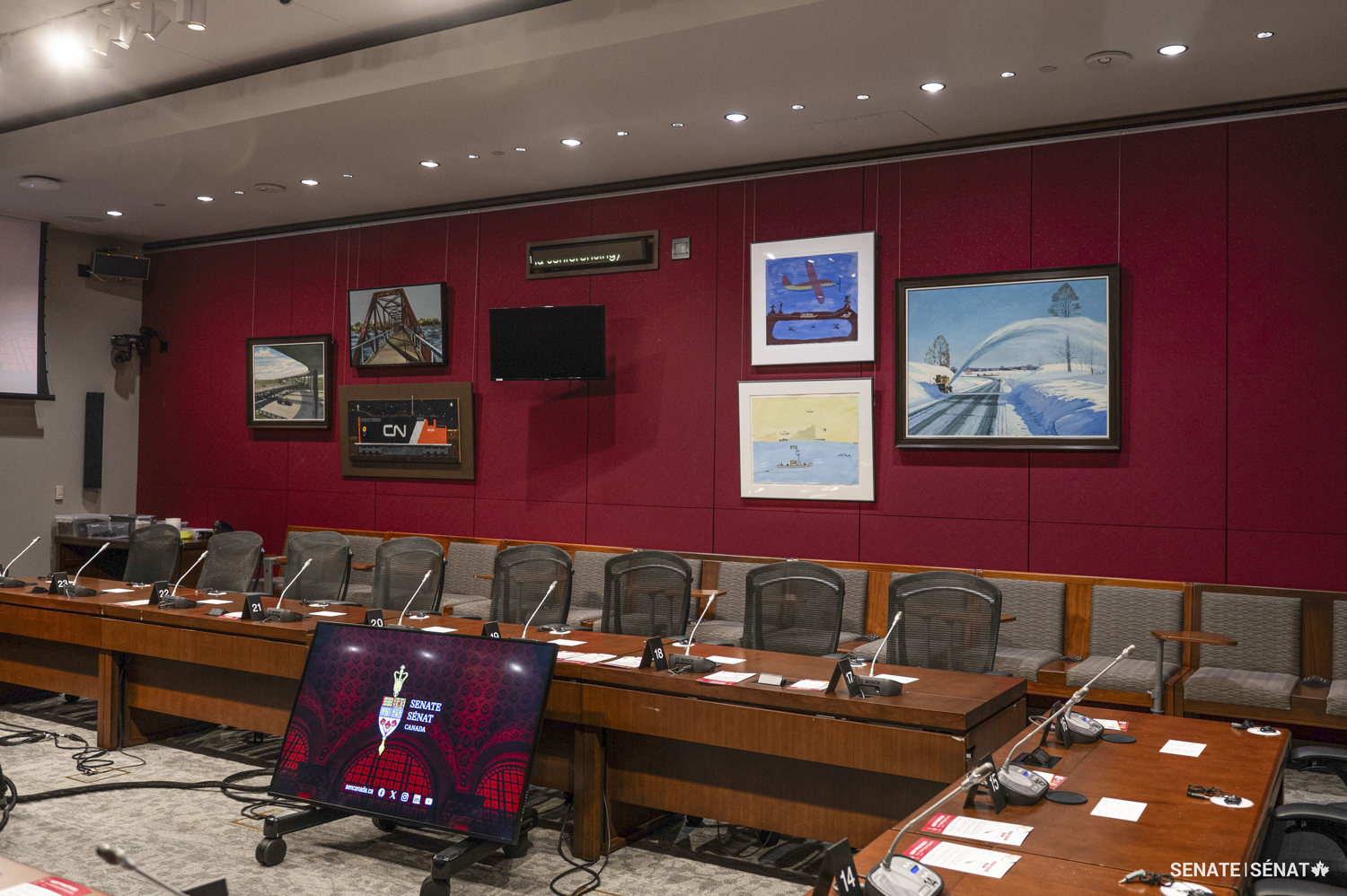 The fourth display in the Visual Voices program includes artworks highlighting Canada’s transportation infrastructure. The works are exhibited in a committee room in the Senate of Canada Building.
In this installation, two oil-on-canvas paintings by Serbian-Canadian painter Moma Markovich feature rural and urban road infrastructure in Ontario. Modern Intersection depicts the dense layering of a major highway interchange, while Snow Removal shows a snow blower clearing a quiet road after a winter storm.
Born in Belgrade, Serbia in 1902, Markovich enjoyed an active career as an artist, illustrator and freelance cartoonist in the Balkans. After escaping a Nazi labour camp in Austria during the Second World War, he immigrated to Canada in 1951, where he found employment with Ontario’s Ministry of Transportation — first as a draftsman and then as an artist, painting renderings of transportation infrastructure across the province. He created almost 200 artworks during his 15-year tenure at the department, and died in 1977.
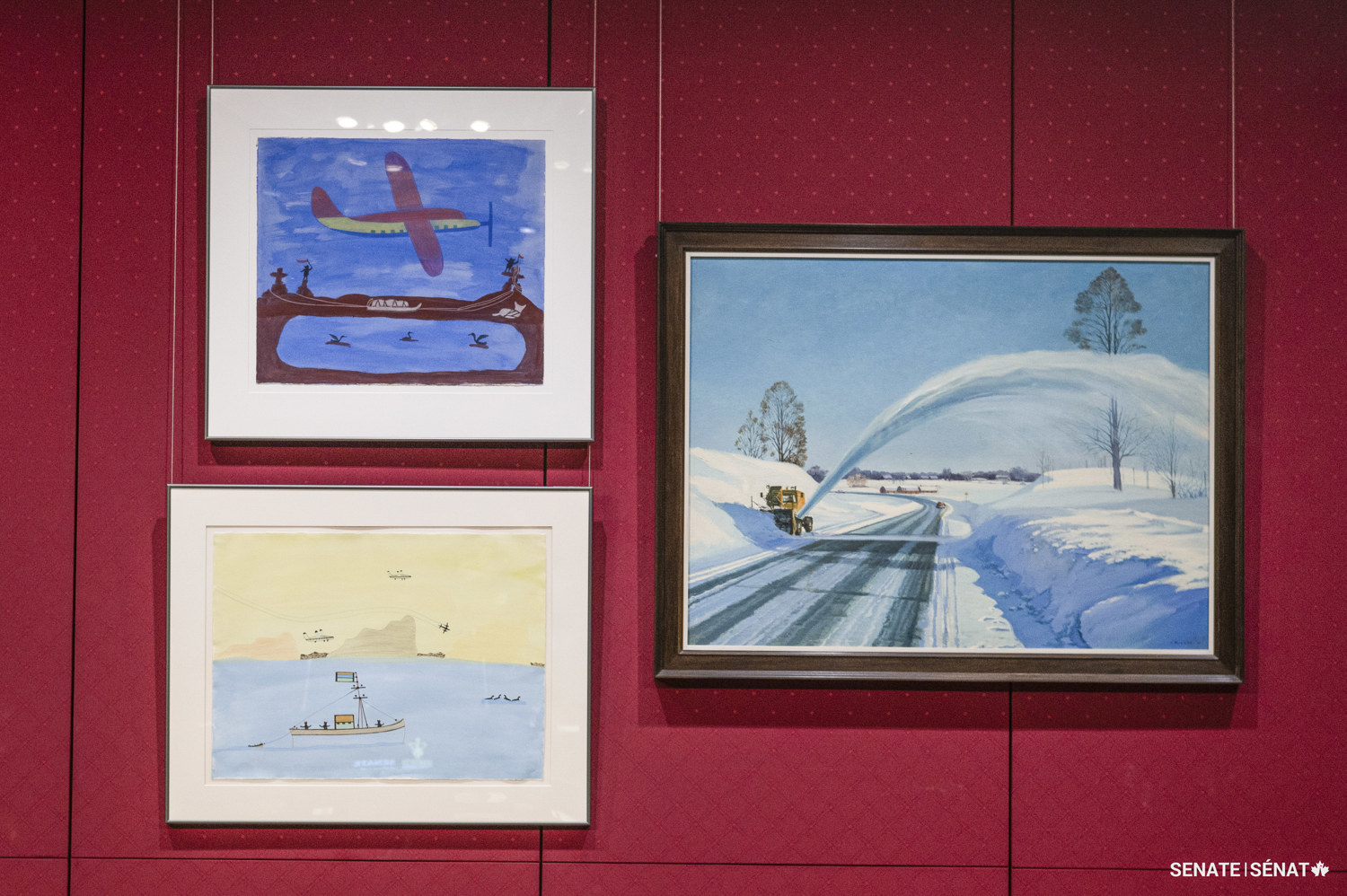 On the left, two untitled drawings by Inuk artist Pudlo Pudlat depict transportation by plane, sled and boat in the North. On the right, a painting titled Snow Removal (1960), by Serbian-Canadian painter Moma Markovich, features a snow blower clearing a quiet road after a winter storm.
Two drawings by Pudlo Pudlat, an Inuk artist from Nunavut, depict transportation by land, air and sea in the North. The untitled works from the 1970s — created using acrylic, watercolour and coloured pencil on paper — underscore issues of access, distance and seasonal constraints in he country’s remote regions.
The artist was born in Ilupirlik, a small camp near Amadjuak, Nunavut, and was later based out of Kinngait (Cape Dorset). A sculptor-turned-painter, Pudlat gained recognition for depicting how Inuit leading traditional, nomadic lifestyles transitioned to using modern technologies. Pudlat passed away in 1992; he created about 4,500 drawings and close to 200 prints during his lifetime.
Point Saint-Charles Interactive, a mixed-media collage by Métis-Acadian artist Eric Walker, highlights the railway’s central role in shaping Canada and its national identity. The piece, which shows a Canadian National locomotive passing through Montréal, also emphasizes the railway’s importance as a main artery for shipping goods across the country.
“Alongside the other artworks, Eric Walker’s collage offers a specific perspective on movement, connection and infrastructure that shapes Canadians’ daily lives,” said Senator Robert Black, who sits on the Artwork and Heritage Advisory Working Group.
“The national railway links Canada’s different regions — from Nova Scotia to British Columbia to the Northwest Territories — and remains crucial to the transport of our food and other essentials.”
Walker, born in 1957, is a Sang-Mêlés Acadien from the Chebake (Western Nova Scotia). A graduate of the Nova Scotia College of Art and Design, he works in experimental video and mixed-media constructions that “blur the boundaries of painting, collage and sculpture.” In these works, Walker often uses commonplace subjects — like trains, ships and government buildings — to evoke the collective history and culture of the Maritimes.
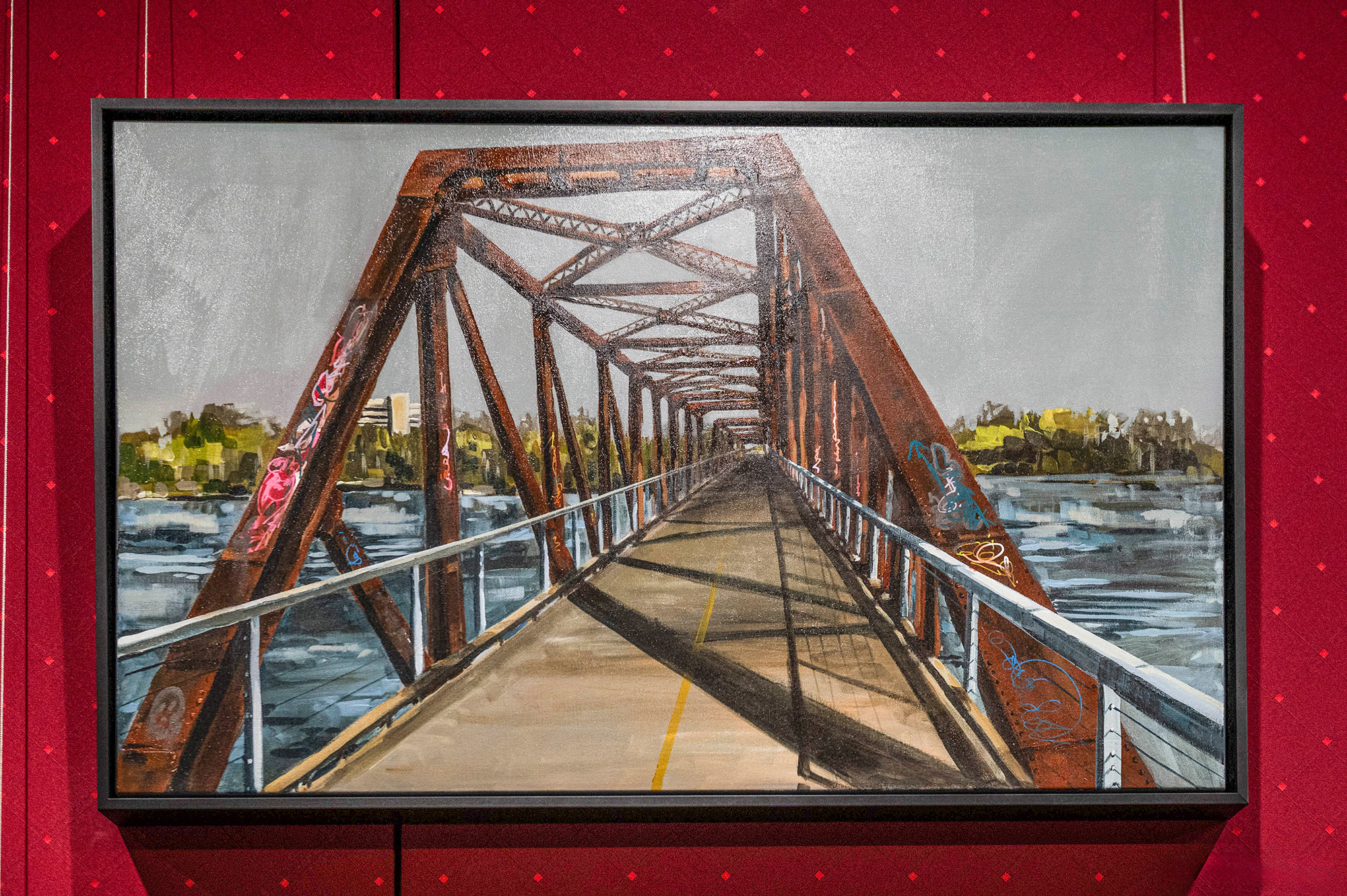
Finally, Eryn O’Neill’s painting captures the transformation of the Chief William Commanda Bridge, an interprovincial crossing that connects Ottawa, Ontario and Gatineau, Quebec. The former rail bridge reopened in 2023 as a pedestrian and cycling path, signalling a shift in values and urban priorities. Commanda Pedestrian Bridge is part of the Senate Artwork and Heritage Collection.
Born in 1985 and based in Ottawa, O’Neill is currently pursuing a PhD in cultural mediations at Carleton University. She describes her work as examining urban transformation and focusing on “construction landscapes, temporary infrastructure and the shifting experience of pedestrian movement within cities undergoing large-scale change.”
“Art plays a fundamental role in the documentation of Canadian history and our understanding of who we are and of the environments that shape us,” said Senator René Cormier, member of the Artwork and Heritage Advisory Working Group.
“The Visual Voices program not only allows us to showcase the work of talented artists from across this country at the Senate, but it also brings additional awareness and meaning to the issues that directly affect Canadians, which senators investigate on their behalf.”
The six artworks were installed in February 2026 and will be on display until early 2027. This exhibit was made possible through the generous loans of works of art from the Global Affairs Canada Diplomatic Art Collection, the Government of Ontario Art Collection and the Canada Council Art Bank.
Visual Voices in retrospect
In 2025, the Visual Voices exhibit marked the 60th anniversary of the National Flag of Canada and the role senators played in its adoption.
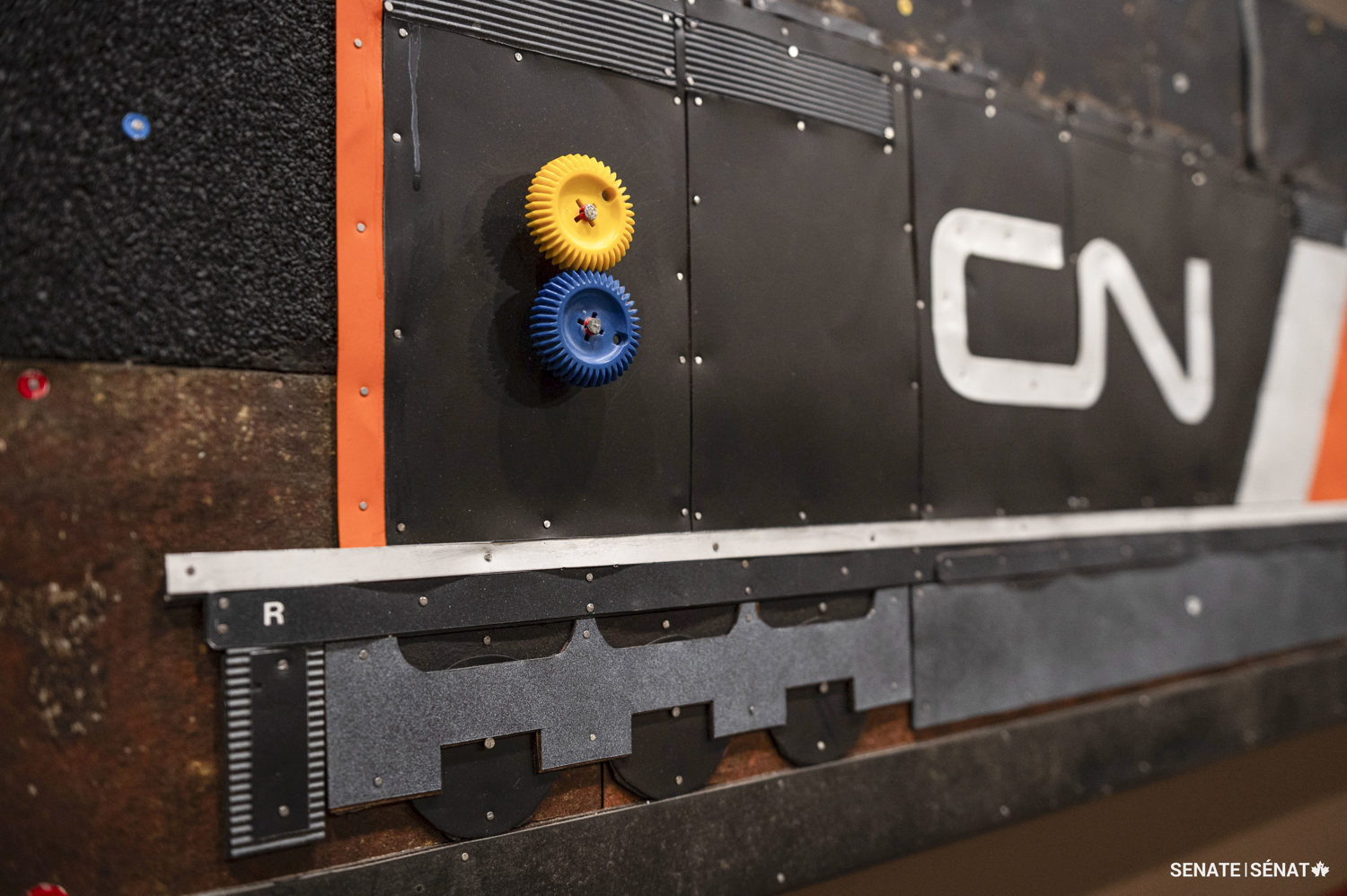 Detail of Point Saint-Charles Interactive (2002), a mixed-media collage by Métis-Acadian artist Eric Walker. The work highlights the CN railway’s central role in shaping Canada and its national identity.
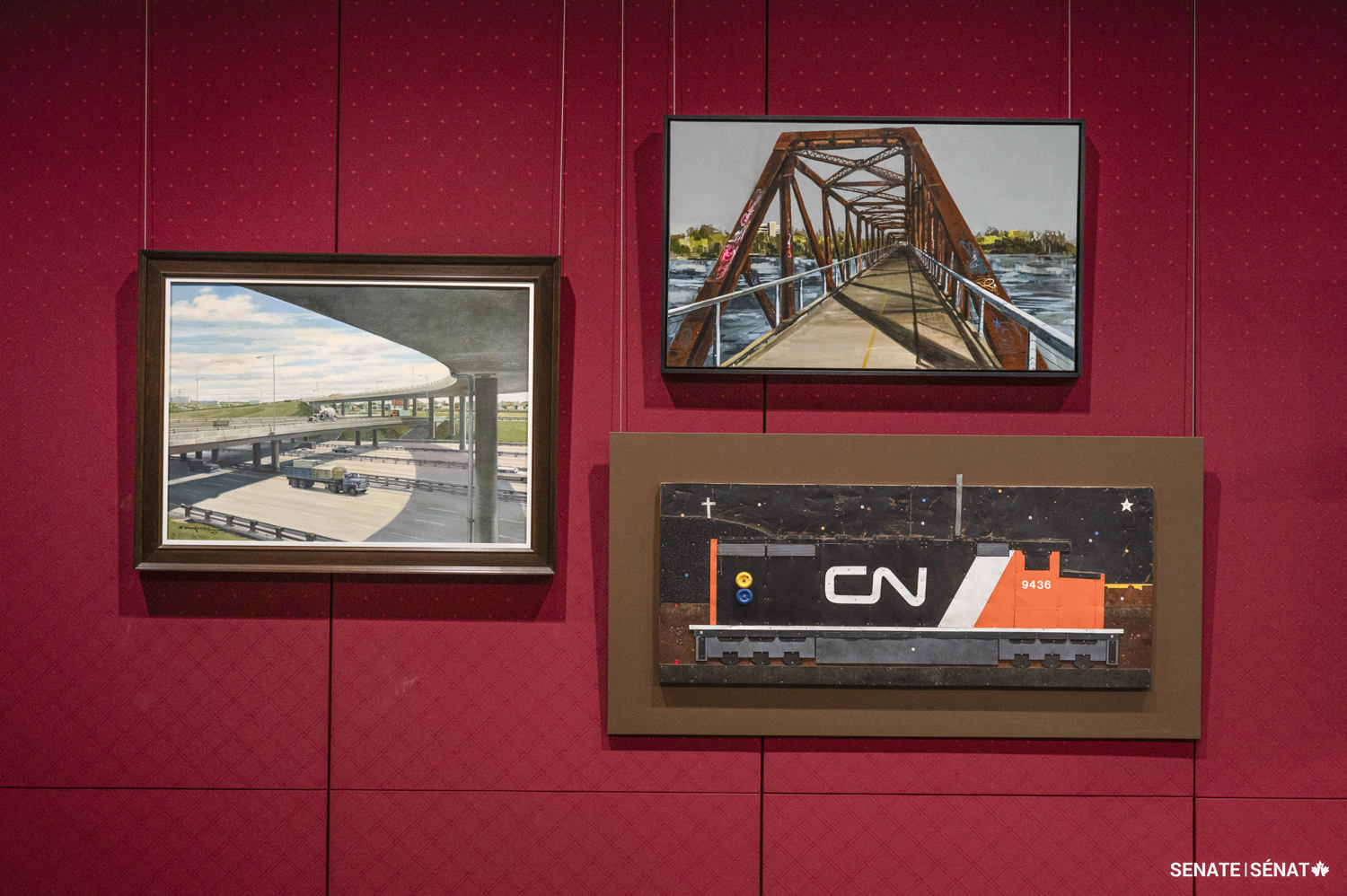 On the left, Markovich’s Modern Intersection (1967) depicts a major highway interchange. On the top right, Commanda Pedestrian Bridge (2024), by Canadian artist Eryn O’Neill, captures a repurposed rail bridge in Ottawa. On the bottom right, Walker’s Point Saint-Charles Interactive shows a Canadian National locomotive passing through Montréal.
The year prior, the program spotlighted the importance of soil health and the completion of a landmark, two-year study on the topic by the Senate Committee on Agriculture and Forestry.
The first Visual Voices exhibit, which took place in 2022, showcased two large-scale photographs that captured the effects of climate change on Canada’s landscapes and endangered species.
Related articles
Tags
Committee news
Visual Voices 2026: Art exhibit journeys through Canada’s transportation infrastructure
An art exhibit installed in the Senate of Canada Building is calling attention to the evolution and complexities of Canada’s transportation infrastructure — a topic that has been studied over time by the Senate Committee on Transport and Communications.
The exhibit’s six works, by four Canadian artists, capture different transportation methods across land, air and sea — and in a range of mediums, from oil and acrylic paints to watercolour, coloured pencil and mixed media.
“Together, these striking artworks showcase a variety of ways in which people and cargo move across Canada’s diverse geographies, landscapes and climates,” said Senator Andrew Cardozo, chair of the Senate’s Artwork and Heritage Advisory Working Group.
“The exhibit’s prominent placement in one of the Senate’s main committee rooms serves as an important reminder of the breadth of the studies and investigations that senators undertake, as well as the distinct regions that we represent here in the Red Chamber.”
The transportation-themed exhibit represents the fourth display in the Senate’s Visual Voices program, a rotating exhibit launched in 2022 that features artworks with themes highlighting the work of Canada’s senators. The Artwork and Heritage Advisory Working Group oversees the program.
The fourth display in the Visual Voices program includes artworks highlighting Canada’s transportation infrastructure. The works are exhibited in a committee room in the Senate of Canada Building.
In this installation, two oil-on-canvas paintings by Serbian-Canadian painter Moma Markovich feature rural and urban road infrastructure in Ontario. Modern Intersection depicts the dense layering of a major highway interchange, while Snow Removal shows a snow blower clearing a quiet road after a winter storm.
Born in Belgrade, Serbia in 1902, Markovich enjoyed an active career as an artist, illustrator and freelance cartoonist in the Balkans. After escaping a Nazi labour camp in Austria during the Second World War, he immigrated to Canada in 1951, where he found employment with Ontario’s Ministry of Transportation — first as a draftsman and then as an artist, painting renderings of transportation infrastructure across the province. He created almost 200 artworks during his 15-year tenure at the department, and died in 1977.
On the left, two untitled drawings by Inuk artist Pudlo Pudlat depict transportation by plane, sled and boat in the North. On the right, a painting titled Snow Removal (1960), by Serbian-Canadian painter Moma Markovich, features a snow blower clearing a quiet road after a winter storm.
Two drawings by Pudlo Pudlat, an Inuk artist from Nunavut, depict transportation by land, air and sea in the North. The untitled works from the 1970s — created using acrylic, watercolour and coloured pencil on paper — underscore issues of access, distance and seasonal constraints in he country’s remote regions.
The artist was born in Ilupirlik, a small camp near Amadjuak, Nunavut, and was later based out of Kinngait (Cape Dorset). A sculptor-turned-painter, Pudlat gained recognition for depicting how Inuit leading traditional, nomadic lifestyles transitioned to using modern technologies. Pudlat passed away in 1992; he created about 4,500 drawings and close to 200 prints during his lifetime.
Point Saint-Charles Interactive, a mixed-media collage by Métis-Acadian artist Eric Walker, highlights the railway’s central role in shaping Canada and its national identity. The piece, which shows a Canadian National locomotive passing through Montréal, also emphasizes the railway’s importance as a main artery for shipping goods across the country.
“Alongside the other artworks, Eric Walker’s collage offers a specific perspective on movement, connection and infrastructure that shapes Canadians’ daily lives,” said Senator Robert Black, who sits on the Artwork and Heritage Advisory Working Group.
“The national railway links Canada’s different regions — from Nova Scotia to British Columbia to the Northwest Territories — and remains crucial to the transport of our food and other essentials.”
Walker, born in 1957, is a Sang-Mêlés Acadien from the Chebake (Western Nova Scotia). A graduate of the Nova Scotia College of Art and Design, he works in experimental video and mixed-media constructions that “blur the boundaries of painting, collage and sculpture.” In these works, Walker often uses commonplace subjects — like trains, ships and government buildings — to evoke the collective history and culture of the Maritimes.
Finally, Eryn O’Neill’s painting captures the transformation of the Chief William Commanda Bridge, an interprovincial crossing that connects Ottawa, Ontario and Gatineau, Quebec. The former rail bridge reopened in 2023 as a pedestrian and cycling path, signalling a shift in values and urban priorities. Commanda Pedestrian Bridge is part of the Senate Artwork and Heritage Collection.
Born in 1985 and based in Ottawa, O’Neill is currently pursuing a PhD in cultural mediations at Carleton University. She describes her work as examining urban transformation and focusing on “construction landscapes, temporary infrastructure and the shifting experience of pedestrian movement within cities undergoing large-scale change.”
“Art plays a fundamental role in the documentation of Canadian history and our understanding of who we are and of the environments that shape us,” said Senator René Cormier, member of the Artwork and Heritage Advisory Working Group.
“The Visual Voices program not only allows us to showcase the work of talented artists from across this country at the Senate, but it also brings additional awareness and meaning to the issues that directly affect Canadians, which senators investigate on their behalf.”
The six artworks were installed in February 2026 and will be on display until early 2027. This exhibit was made possible through the generous loans of works of art from the Global Affairs Canada Diplomatic Art Collection, the Government of Ontario Art Collection and the Canada Council Art Bank.
Visual Voices in retrospect
In 2025, the Visual Voices exhibit marked the 60th anniversary of the National Flag of Canada and the role senators played in its adoption.
Detail of Point Saint-Charles Interactive (2002), a mixed-media collage by Métis-Acadian artist Eric Walker. The work highlights the CN railway’s central role in shaping Canada and its national identity.
On the left, Markovich’s Modern Intersection (1967) depicts a major highway interchange. On the top right, Commanda Pedestrian Bridge (2024), by Canadian artist Eryn O’Neill, captures a repurposed rail bridge in Ottawa. On the bottom right, Walker’s Point Saint-Charles Interactive shows a Canadian National locomotive passing through Montréal.
The year prior, the program spotlighted the importance of soil health and the completion of a landmark, two-year study on the topic by the Senate Committee on Agriculture and Forestry.
The first Visual Voices exhibit, which took place in 2022, showcased two large-scale photographs that captured the effects of climate change on Canada’s landscapes and endangered species.