

Visual Voices 2026: Senate art exhibit captures glimpses of northern life
An art display in the Senate of Canada Building brings together six distinct, but complementary glimpses of life in the North — a region with its own social, cultural, economic, environment and security issues that have been studied by committees in the Upper Chamber, including the Senate Committee on Indigenous Peoples and the former Special Senate Committee on the Arctic.
The exhibit, installed in a large room where Senate committees meet, marks the fifth display in the Senate’s Visual Voices program — a rotating exhibit launched in 2022 that features artworks with themes highlighting the work of Canada’s senators.
“I’m thrilled to mark this milestone in the Visual Voices program with this selection of stunning and profound works by Inuit, Tlingit and Quebecois artists — each of which offers a unique slice of life in the territories and northern Quebec,” said Senator Andrew Cardozo, chair of the Artwork and Heritage Advisory Working Group, which oversees the Visual Voices program.
“It is one way of bringing the North into the work of the Senate — a reminder of who we serve.”
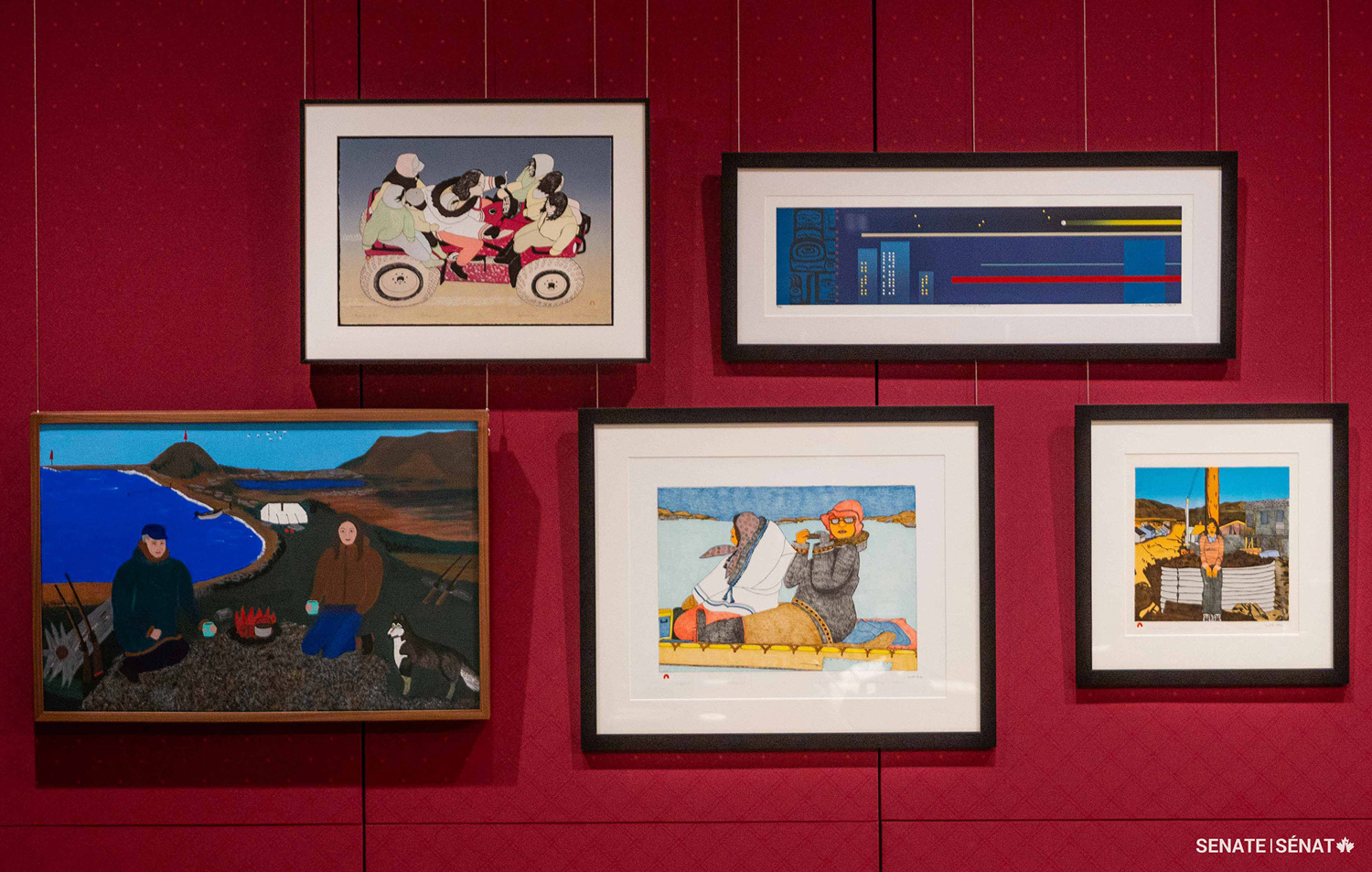 Among the artworks exhibited in 2026 as part of the Visual Voices program are five pieces that capture glimpses of life in the North.
Together, the six artworks offer insight into the richness of different northern experiences: moments of quiet reflection, the vibrancy of community, and scenes of nature and activity.
Tim Pitsiulak’s dynamic lithograph, Family of Eight, depicts a family riding a quad on the land. The piece captures an everyday moment of contemporary life in Kinngait (Cape Dorset), Nunavut — the community where the renowned artist was based and for which he held a deep affection.
Known primarily for his drawing and printmaking, Pitsiulak’s work reflected his daily experiences and interests, and also communicated his deep respect for and connection to the land. He passed away in Iqaluit in 2016. This work is on loan from the Indigenous Art Centre, Crown-Indigenous Relations and Northern Affairs Canada.
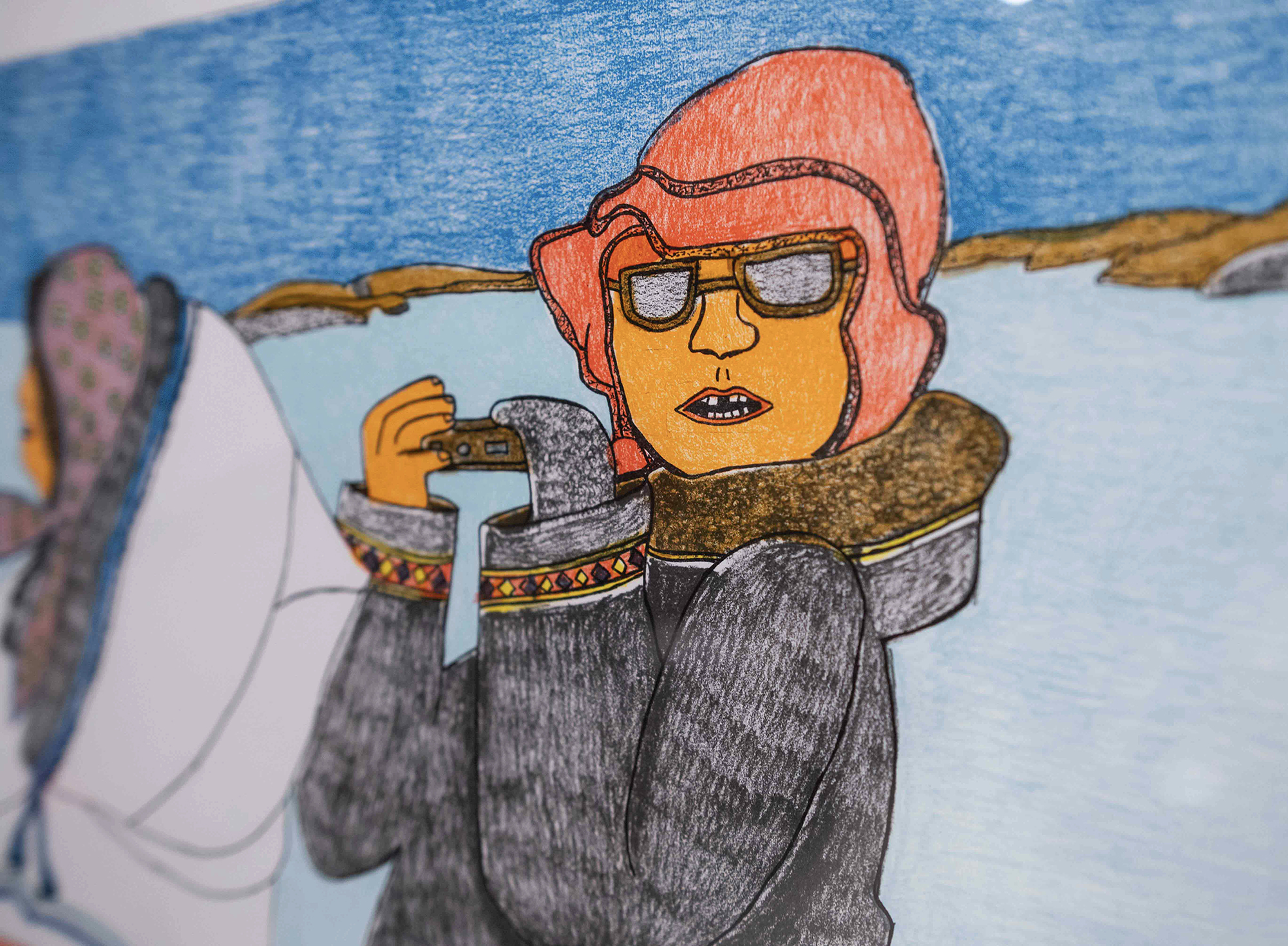
A pair of character-driven lithographs by Kudluajuk Ashoona, another Cape Dorset artist, captures further examples of community life in and around the coastal hamlet — specifically, family outings and leisure activities.
Born to well-known carvers in Kinngait, Ashoona was adopted by the family of a notable graphic artist. Her works are known for depicting scenes of contemporary family life in a very literal and narrative fashion. She died in 2019.
For Senator Nancy Karetak-Lindell, born in what is now called Arviat in Nunavut, the display provides a sense of belonging.
“To be able to see art from the North and by Indigenous artists in our committee rooms is a real comfort to me,” she said.
“It makes me feel we rightfully belong in the beautiful parliamentary buildings as other Canadians. That we, too, are recognized for our contributions to this country.”
Fall Hunting with Father is a self-portrait of artist Agnes “Aggi” Ettagiak hunting with her father on Tapqaq Beach near Tuktoyaktuk, an Inuvialuit hamlet on the Arctic coast of the Northwest Territories.
The artist began painting later in life, at age 65, as a way of honouring and expressing cherished and sacred memories. Many of Ettagiak’s works depict her upbringing and her education in traditional practices — including hunting, drumming, dancing, sewing and storytelling.
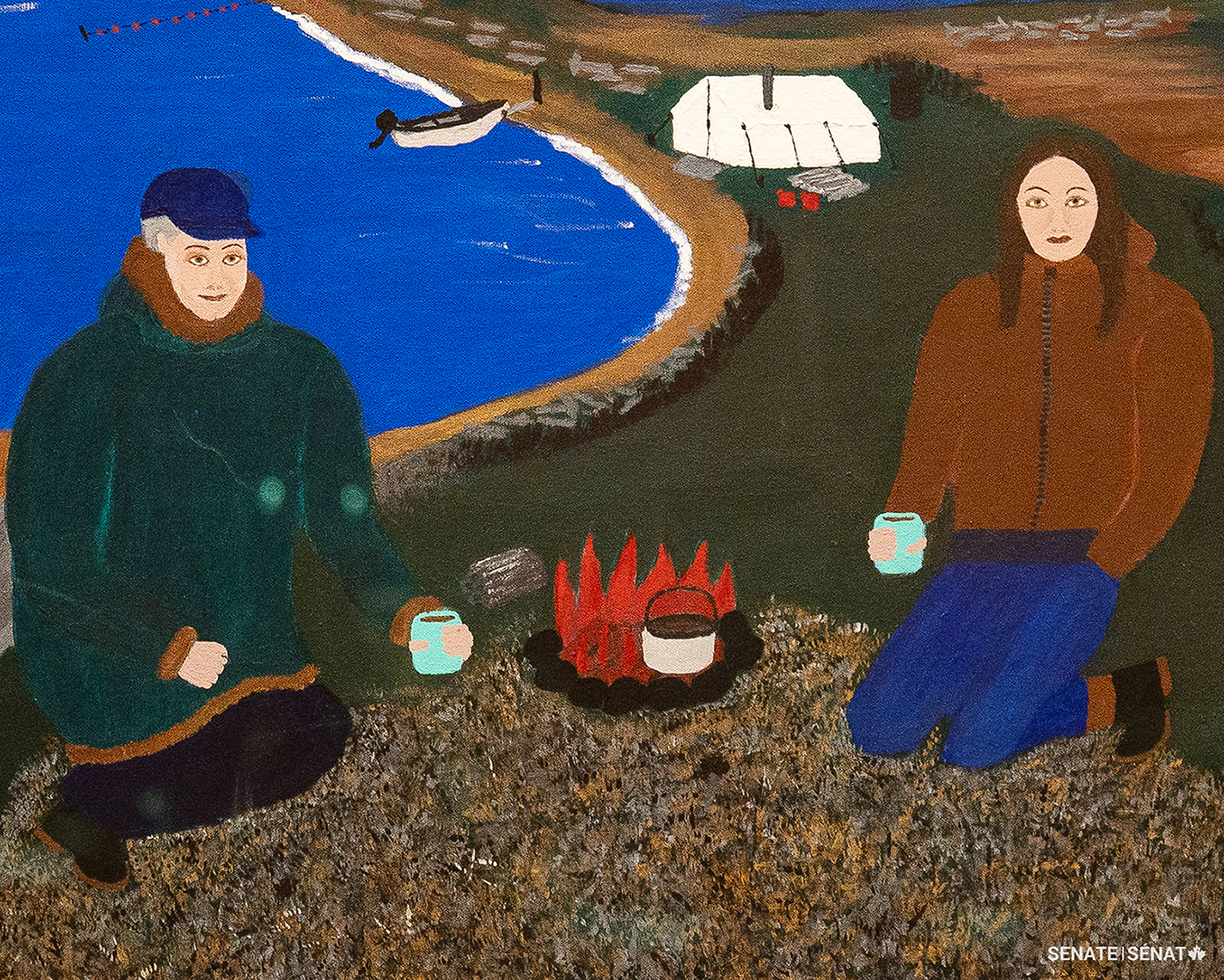 Fall Hunting with Father(2019) is a self-portrait of artist Agnes “Aggi” Ettagiak hunting with her father on Tapqaq Beach near Tuktoyaktuk, an Inuvialuit hamlet on the Arctic coast of the Northwest Territories.
Starry, Starry Night by Yukon artist Mark Preston is a printed expression of the button blanket, a wool blanket of great significance to First Nations on the northwest coast. The blankets, often embroidered with mother-of-pearl buttons, tell stories of the wearers’ families and feature their clan symbols.
Born in Dawson City, Preston was an artist of Irish and Tlingit ancestry, the latter of which he learned about through family and school study. Working across mediums — including prints, jewelry, furniture and architecture — he blended contemporary art with traditional practices. The artist passed away in Whitehorse in 2022.
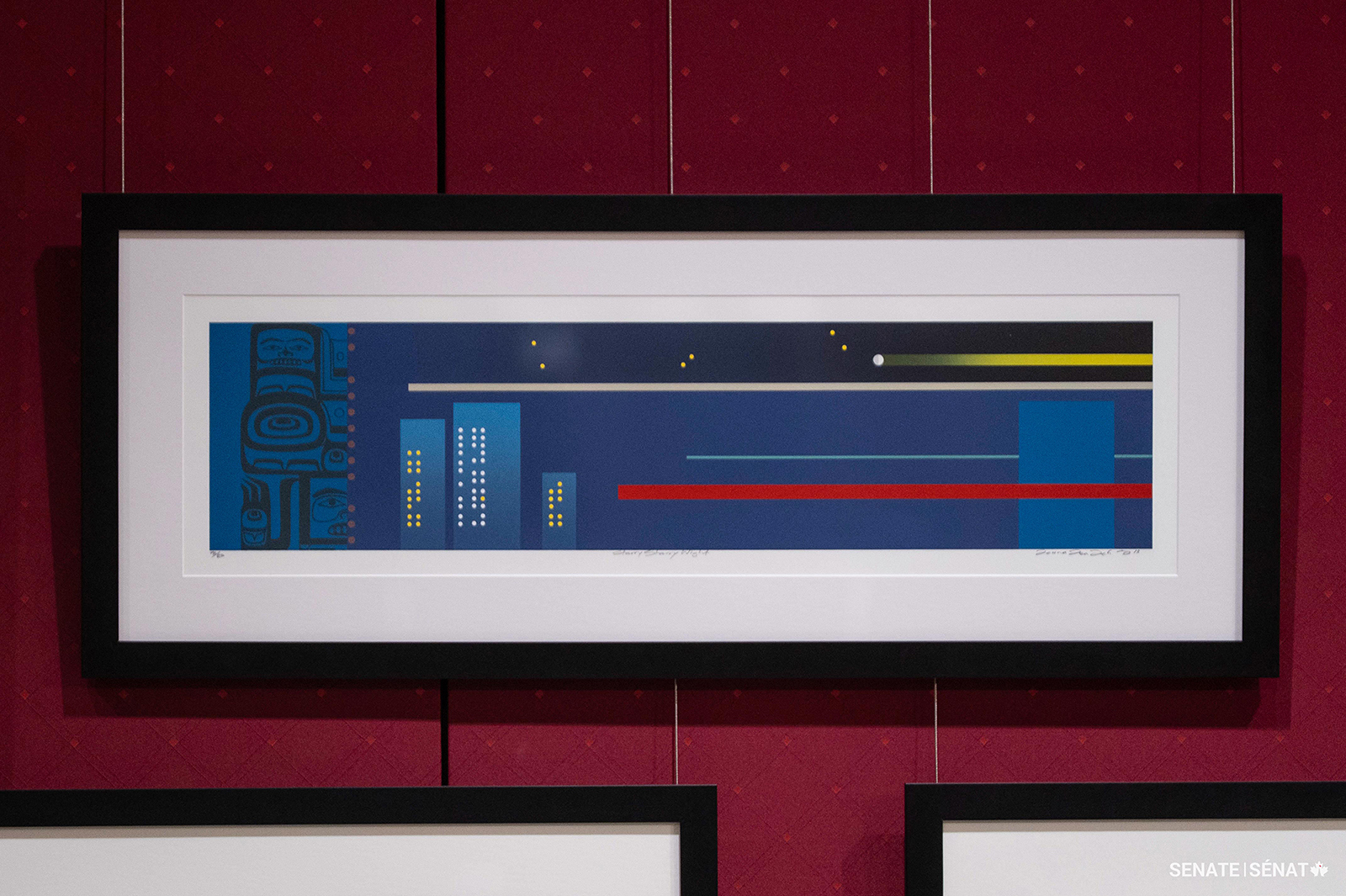 Starry, Starry Night (2013) by Yukon artist Mark Preston is a printed expression of the button blanket, a wool blanket of great significance to First Nations on the northwest coast.
Rounding out the Visual Voices exhibit is a large, cool-toned drawing by Lyne Bastien of a blue canoe disappearing under freshly fallen snow. The coloured-pencil work is part of the Montréal-based artist’s Dormance / Dormancy series, in which she explores the stillness and beauty of winter in Nunavik, the northernmost region of Quebec, where she lived and worked for six years.
Born in Abitibi, in western Quebec, the artist grew up camping, hunting and fishing in nature close to home. Her affinity and appreciate for the wilderness was rekindled when she moved to the Arctic community of Puvirnituq in 2014.
“As an artist myself, I’ve been delighted and inspired to witness the evolution of the Senate’s Visual Voices program and how it adds greater depth and meaning to the studies senators undertake,” said Senator Salma Ataullahjan, a longtime member of the Artwork and Heritage Advisory Working Group.
“This latest exhibit is another moving example of how much we can learn from the talented Indigenous and Canadian artists who record and interpret our country’s contemporary history and diverse communities.”
The six artworks were installed in March 2026 and will be on display until early 2027.
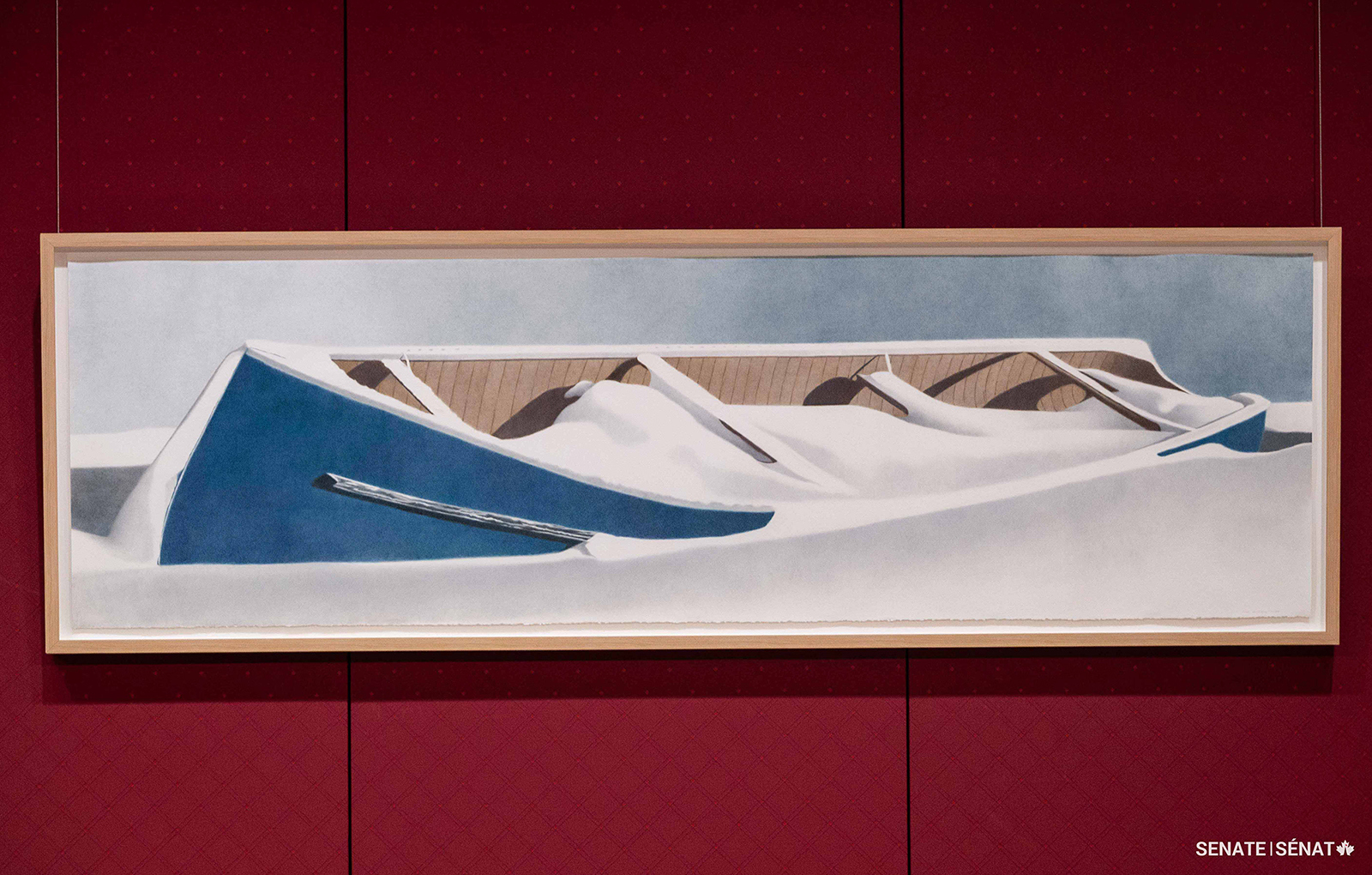 Dormance I (2022)by Lyne Bastien depicts a blue canoe disappearing under freshly fallen snow. The work is part of the Montréal-based artist’s Dormance / Dormancy series, in which she explores the stillness and beauty of winter in the Nunavik region of Quebec.
Visual Voices in retrospect
A concurrent Visual Voices display installed in 2026 calls attention to the evolution and complexities of Canada’s transportation infrastructure.
In 2025, the Visual Voices exhibit marked the 60th anniversary of the National Flag of Canada and the role senators played in its adoption.
The year prior, the program spotlighted the importance of soil health and the completion of a landmark, two-year study on the topic by the Senate Committee on Agriculture and Forestry.
The first Visual Voices exhibit, which took place in 2022, showcased two large-scale photographs that captured the effects of climate change on Canada’s landscapes and endangered species.
Related articles
Tags
Committee news
Visual Voices 2026: Senate art exhibit captures glimpses of northern life
An art display in the Senate of Canada Building brings together six distinct, but complementary glimpses of life in the North — a region with its own social, cultural, economic, environment and security issues that have been studied by committees in the Upper Chamber, including the Senate Committee on Indigenous Peoples and the former Special Senate Committee on the Arctic.
The exhibit, installed in a large room where Senate committees meet, marks the fifth display in the Senate’s Visual Voices program — a rotating exhibit launched in 2022 that features artworks with themes highlighting the work of Canada’s senators.
“I’m thrilled to mark this milestone in the Visual Voices program with this selection of stunning and profound works by Inuit, Tlingit and Quebecois artists — each of which offers a unique slice of life in the territories and northern Quebec,” said Senator Andrew Cardozo, chair of the Artwork and Heritage Advisory Working Group, which oversees the Visual Voices program.
“It is one way of bringing the North into the work of the Senate — a reminder of who we serve.”
Among the artworks exhibited in 2026 as part of the Visual Voices program are five pieces that capture glimpses of life in the North.
Together, the six artworks offer insight into the richness of different northern experiences: moments of quiet reflection, the vibrancy of community, and scenes of nature and activity.
Tim Pitsiulak’s dynamic lithograph, Family of Eight, depicts a family riding a quad on the land. The piece captures an everyday moment of contemporary life in Kinngait (Cape Dorset), Nunavut — the community where the renowned artist was based and for which he held a deep affection.
Known primarily for his drawing and printmaking, Pitsiulak’s work reflected his daily experiences and interests, and also communicated his deep respect for and connection to the land. He passed away in Iqaluit in 2016. This work is on loan from the Indigenous Art Centre, Crown-Indigenous Relations and Northern Affairs Canada.
A pair of character-driven lithographs by Kudluajuk Ashoona, another Cape Dorset artist, captures further examples of community life in and around the coastal hamlet — specifically, family outings and leisure activities.
Born to well-known carvers in Kinngait, Ashoona was adopted by the family of a notable graphic artist. Her works are known for depicting scenes of contemporary family life in a very literal and narrative fashion. She died in 2019.
For Senator Nancy Karetak-Lindell, born in what is now called Arviat in Nunavut, the display provides a sense of belonging.
“To be able to see art from the North and by Indigenous artists in our committee rooms is a real comfort to me,” she said.
“It makes me feel we rightfully belong in the beautiful parliamentary buildings as other Canadians. That we, too, are recognized for our contributions to this country.”
Fall Hunting with Father is a self-portrait of artist Agnes “Aggi” Ettagiak hunting with her father on Tapqaq Beach near Tuktoyaktuk, an Inuvialuit hamlet on the Arctic coast of the Northwest Territories.
The artist began painting later in life, at age 65, as a way of honouring and expressing cherished and sacred memories. Many of Ettagiak’s works depict her upbringing and her education in traditional practices — including hunting, drumming, dancing, sewing and storytelling.
Fall Hunting with Father(2019) is a self-portrait of artist Agnes “Aggi” Ettagiak hunting with her father on Tapqaq Beach near Tuktoyaktuk, an Inuvialuit hamlet on the Arctic coast of the Northwest Territories.
Starry, Starry Night by Yukon artist Mark Preston is a printed expression of the button blanket, a wool blanket of great significance to First Nations on the northwest coast. The blankets, often embroidered with mother-of-pearl buttons, tell stories of the wearers’ families and feature their clan symbols.
Born in Dawson City, Preston was an artist of Irish and Tlingit ancestry, the latter of which he learned about through family and school study. Working across mediums — including prints, jewelry, furniture and architecture — he blended contemporary art with traditional practices. The artist passed away in Whitehorse in 2022.
Starry, Starry Night (2013) by Yukon artist Mark Preston is a printed expression of the button blanket, a wool blanket of great significance to First Nations on the northwest coast.
Rounding out the Visual Voices exhibit is a large, cool-toned drawing by Lyne Bastien of a blue canoe disappearing under freshly fallen snow. The coloured-pencil work is part of the Montréal-based artist’s Dormance / Dormancy series, in which she explores the stillness and beauty of winter in Nunavik, the northernmost region of Quebec, where she lived and worked for six years.
Born in Abitibi, in western Quebec, the artist grew up camping, hunting and fishing in nature close to home. Her affinity and appreciate for the wilderness was rekindled when she moved to the Arctic community of Puvirnituq in 2014.
“As an artist myself, I’ve been delighted and inspired to witness the evolution of the Senate’s Visual Voices program and how it adds greater depth and meaning to the studies senators undertake,” said Senator Salma Ataullahjan, a longtime member of the Artwork and Heritage Advisory Working Group.
“This latest exhibit is another moving example of how much we can learn from the talented Indigenous and Canadian artists who record and interpret our country’s contemporary history and diverse communities.”
The six artworks were installed in March 2026 and will be on display until early 2027.
Dormance I (2022)by Lyne Bastien depicts a blue canoe disappearing under freshly fallen snow. The work is part of the Montréal-based artist’s Dormance / Dormancy series, in which she explores the stillness and beauty of winter in the Nunavik region of Quebec.
Visual Voices in retrospect
A concurrent Visual Voices display installed in 2026 calls attention to the evolution and complexities of Canada’s transportation infrastructure.
In 2025, the Visual Voices exhibit marked the 60th anniversary of the National Flag of Canada and the role senators played in its adoption.
The year prior, the program spotlighted the importance of soil health and the completion of a landmark, two-year study on the topic by the Senate Committee on Agriculture and Forestry.
The first Visual Voices exhibit, which took place in 2022, showcased two large-scale photographs that captured the effects of climate change on Canada’s landscapes and endangered species.